
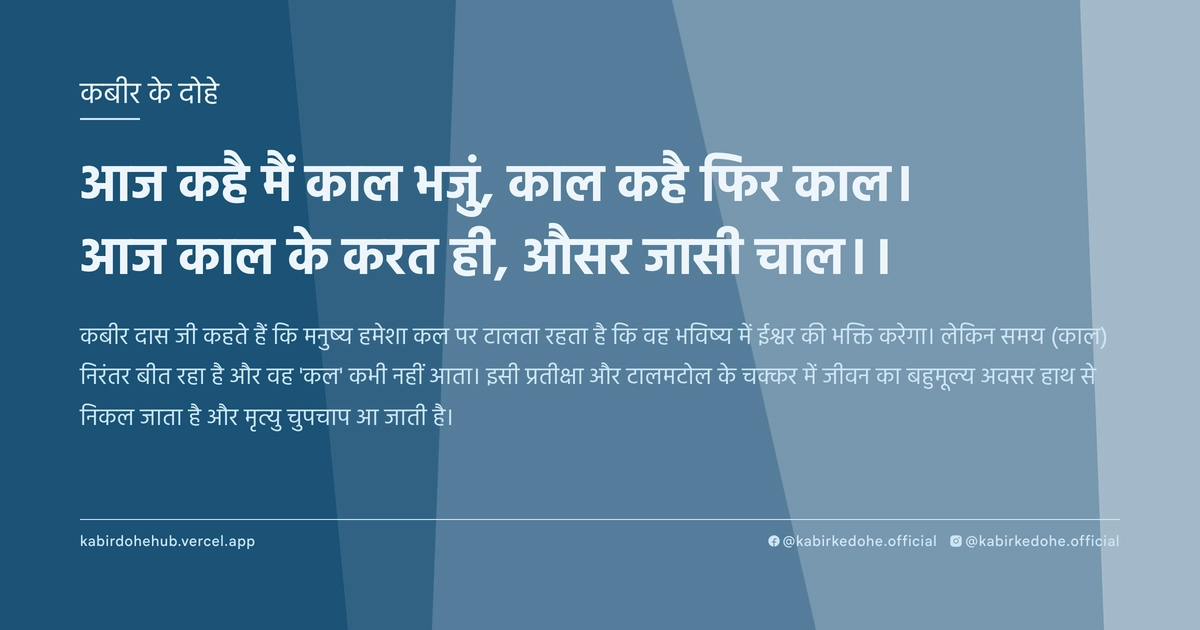
आज कहै मैं काल भजुं, काल कहै फिर काल।
आज काल के करत ही, औसर जासी चाल।।
Aaj kahai main kaal bhajun, kaal kahai phir kaal. Aaj kaal ke karat hi, ausar jaasi chaal.
इस पृष्ठ पर इस कबीर दोहे का अर्थ (meaning), हिंदी व्याख्या और अंग्रेज़ी अनुवाद, दार्शनिक विश्लेषण और व्यावहारिक जीवन सीख दी गई है। यह दोहा समय का महत्व (The Value of Time) विषय से जुड़ा है — Kabir doha meaning and explanation in Hindi and English.
अर्थ (Meaning):
कबीर दास जी कहते हैं कि मनुष्य हमेशा कल पर टालता रहता है कि वह भविष्य में ईश्वर की भक्ति करेगा। लेकिन समय (काल) निरंतर बीत रहा है और वह 'कल' कभी नहीं आता। इसी प्रतीक्षा और टालमटोल के चक्कर में जीवन का बहुमूल्य अवसर हाथ से निकल जाता है और मृत्यु चुपचाप आ जाती है।
Kabir warns against the fallacy of procrastination in spiritual pursuit. The human mind constantly claims it will seek the Divine 'tomorrow,' but Time (Kaal) relentlessly pushes that tomorrow further away. In this endless cycle of delaying the awakening, the precious opportunity of life slips away, and death arrives unexpectedly.
व्याख्या (Interpretation):
इस दोहे में 'काल' शब्द के दो अर्थ हैं: समय और मृत्यु। शाब्दिक अर्थ यह है कि हम अपनी आध्यात्मिक यात्रा को भविष्य के लिए सुरक्षित रख रहे हैं। रूपकात्मक रूप से, यह 'माया' के प्रभाव को दर्शाता है, जहाँ अहंकार हमें विश्वास दिलाता है कि हमारे पास अनंत समय है। निर्गुण भक्ति के अनुसार, परमात्मा अभी और इसी क्षण में उपलब्ध है; उसे भविष्य की किसी तिथि पर नहीं पाया जा सकता। यह अद्वैत वेदांत के उस सत्य को उजागर करता है जहाँ 'अहं' (ego) समय के भ्रम का उपयोग करके सत्य के साक्षात्कार को रोकता है। जब तक साधक यह नहीं समझता कि वर्तमान ही एकमात्र वास्तविकता है, वह जन्म-मृत्यु के चक्र में फंसा रहता है।
In this couplet, 'Kaal' serves a dual purpose, meaning both 'Time' and 'Death.' Literally, it addresses the habit of delaying spiritual practice. Metaphorically, it exposes the veil of Maya, where the ego creates a false sense of permanence to avoid the immediate surrender required for enlightenment. In Nirgun Bhakti, the Formless Divine is not a destination to be reached in the future but a presence to be realized now. This aligns with Advaita Vedanta's non-duality, suggesting that the separation between the seeker and the sought is an illusion sustained by the concept of 'tomorrow.' The paradox is that while we wait for a 'perfect time' to seek Truth, the very act of waiting reinforces the ego that prevents the Truth from emerging.
दार्शनिक विश्लेषण (Philosophical Analysis):
कबीर का यह प्रहार उस सामाजिक और धार्मिक ढर्रे पर है जहाँ लोग कर्मकांडों को भविष्य की मुक्ति के लिए संचित करते हैं। उनके युग में, लोग सोचते थे कि जीवन भर सांसारिक सुख भोगने के बाद बुढ़ापे में भक्ति की जा सकती है। कबीर इस विचार को सिरे से खारिज करते हैं। वे बताते हैं कि आध्यात्मिक जागृति कोई सेवानिवृत्ति योजना नहीं है, बल्कि एक तात्कालिक आवश्यकता है।
दार्शनिक स्तर पर, यह सूफीवाद के 'ज़िह्र' और 'मौत' के विचार से मिलता है, जहाँ 'मरने से पहले मरना' (fana) महत्वपूर्ण है। यदि हम आज अपने अहंकार को नहीं मारते, तो हम केवल समय व्यर्थ कर रहे हैं। यह अद्वैत के उस सिद्धांत का समर्थन करता है कि ब्रह्म अभी है, और जो इसे कल के लिए टालता है, वह वास्तव में द्वैत (duality) के भ्रम में जी रहा है।
कबीर का विरोध केवल समय के प्रबंधन से नहीं, बल्कि उस मानसिक जड़ता से है जो हमें वर्तमान क्षण की पवित्रता से दूर रखती है। वे तर्क देते हैं कि जाति, धर्म और बाहरी आडंबर केवल समय बिताने के बहाने हैं। वास्तविक धर्म वह है जो इस क्षण में अहंकार का विसर्जन करे।
मनोवैज्ञानिक रूप से, यह 'प्रोक्रैस्टिनेशन' (टालमटोल) का आध्यात्मिक विश्लेषण है। मनुष्य भय और मोह के कारण सत्य का सामना करने से डरता है और 'कल' का सहारा लेता है। यह एक रक्षा तंत्र है जो हमें यह महसूस कराता है कि हम नियंत्रण में हैं, जबकि वास्तव में समय हमें नियंत्रित कर रहा है।
अंततः, कबीर यह संदेश देते हैं कि मुक्ति कोई भविष्य की घटना नहीं है, बल्कि एक वर्तमान स्थिति है। जब 'मैं' (अहंकार) समाप्त होता है, तब समय का अस्तित्व भी समाप्त हो जाता है, और केवल शाश्वत वर्तमान शेष रहता है।
Kabir’s critique targets the systemic religious complacency of his era, where spiritual pursuit was often viewed as a task for old age, following a lifetime of worldly indulgence. He dismantles the notion that enlightenment is a destination reached after completing a checklist of earthly desires. For Kabir, spiritual awakening is an urgent necessity, not a retirement plan.
Philosophically, this resonates with the Sufi concept of 'Fana'—the annihilation of the self. To 'die before you die' means to dissolve the ego in the present moment. If one waits for a future date to surrender, they are merely feeding the very ego that separates them from the Divine. This mirrors Advaita Vedanta’s core tenet: Brahman is the only reality, and any perception of a 'future' realization is a product of Avidya (ignorance).
Kabir’s rejection of ritualism is central here. He views the obsession with external rites as a sophisticated form of procrastination. By focusing on the 'how' and 'when' of ritual, the seeker avoids the 'now' of internal transformation. The rituals become a shield against the terrifying immediacy of self-realization.
Psychologically, this doha analyzes the mechanism of avoidance. The human mind uses the concept of 'tomorrow' as a psychological buffer to avoid the discomfort of confronting its own mortality and the emptiness of its social masks. This creates a false sense of security, while the clock of existence relentlessly ticks toward an inevitable end.
Ultimately, Kabir asserts that liberation (Mukti) is not a chronological event but a state of consciousness. When the 'I' (the ego) is extinguished, the linear perception of time collapses, leaving only the Eternal Now. The tragedy of the human condition, according to Kabir, is the belief that there is a time other than this moment to be one with the Truth.
मूल संदेश (Core Message):
- भविष्य की प्रतीक्षा करना वास्तव में सत्य से भागना है।
- अहंकार 'कल' का वादा करता है ताकि आप 'आज' न जागें।
- परमात्मा कोई गंतव्य नहीं, बल्कि वर्तमान की एक अनुभूति है।
- समय का प्रबंधन नहीं, बल्कि समय के पार जाना ही लक्ष्य है।
- मृत्यु किसी समय की प्रतीक्षा नहीं करती, इसलिए जागृति को भी नहीं करनी चाहिए।
- Waiting for the future is a sophisticated form of escaping the Truth.
- The ego promises a 'tomorrow' to ensure you never wake up 'today.'
- The Divine is not a destination to reach, but a presence to realize now.
- The goal is not to manage time, but to transcend the illusion of time.
- Death waits for no one; therefore, awakening must wait for nothing.
व्यावहारिक उदाहरण (Practical Example):
वाराणसी के एक पुराने घाट पर रहने वाली एक वृद्ध विधवा, जानकी, का जीवन एक अंतहीन प्रतीक्षा था। वह हर दिन गंगा किनारे बैठती और सोचती कि जब उसके परिवार के सभी सदस्य अपनी जिम्मेदारियां पूरी कर लेंगे और वह पूरी तरह अकेली हो जाएगी, तब वह अपना पूरा समय ईश्वर की भक्ति में लगाएगी। वह मानती थी कि अभी उसके ऊपर 'कर्तव्यों' का बोझ है, और भक्ति के लिए एक 'सही समय' आएगा जब मन पूरी तरह शांत होगा।
वर्ष बीतते गए। जानकी ने अपने बेटों की शादियाँ करवाईं, पोते-पोतियों को पाला और घर के हर छोटे-बड़े विवाद को सुलझाया। वह हमेशा कहती, 'अभी तो यह काम है, फिर वह काम है, उसके बाद मैं शांति से माला जपूँगी।' उसका जीवन एक ऐसी सूची बन गया था जिसे वह कभी पूरा नहीं कर पाई।
एक दिन, घाट पर एक घुमक्कड़ फकीर आया जिसने कबीर का यह दोहा सुनाया। जानकी ने अपनी वही पुरानी कहानी दोहराई कि वह कल से अपनी साधना शुरू करेगी। फकीर ने मुस्कुराते हुए पूछा, 'माँ, क्या गंगा का पानी कल बहना शुरू करेगा या वह अभी बह रहा है?'
जानकी ने जवाब दिया, 'वह तो अभी बह रहा है।' फकीर ने कहा, 'तो फिर तुम्हारी आत्मा क्यों इंतज़ार कर रही है? क्या तुम नदी के किनारे खड़े होकर कल नहाने का इंतज़ार करोगी, जबकि पानी तुम्हारे पैरों को छू रहा है?'
यह बात जानकी के हृदय में गहरे तक उतर गई। उसे अहसास हुआ कि उसने 'सही समय' के इंतजार में अपना पूरा जीवन एक मानसिक तैयारी में बिता दिया, जबकि वास्तविक जीवन उस तैयारी के बीच ही बीत गया।
उसने उसी क्षण अपनी माला उठाई और अपनी वर्तमान स्थिति—अपने अकेलेपन, अपने दर्द और अपनी सांसों—को ही ईश्वर की प्रार्थना बना लिया। उसने यह नहीं सोचा कि वह 'कल' क्या बनेगी, बल्कि उसने 'आज' में जीना शुरू किया।
उसने पाया कि जब वह घर के काम कर रही होती, तब भी वह ईश्वर से जुड़ी रह सकती थी। उसे अब किसी विशेष समय या एकांत की आवश्यकता नहीं थी।
जानकी का व्यवहार बदल गया। वह अब भविष्य की चिंता नहीं करती थी। उसने सीखा कि भक्ति कोई कार्य नहीं है जिसे समय सारणी में फिट किया जाए, बल्कि यह हर सांस के साथ जीने का एक तरीका है।
उसकी शांति अब बाहरी परिस्थितियों पर निर्भर नहीं थी। वह जान गई थी कि 'कल' एक माया है और केवल 'अभी' ही सत्य है।
Janaki, an elderly widow living on the ancient ghats of Varanasi, spent her life in a state of perpetual waiting. Every day, sitting by the Ganges, she told herself that once her children were settled and her domestic obligations were fully discharged, she would dedicate her entire existence to the Divine. She believed there was a 'perfect time' for devotion—a future moment when her mind would be completely devoid of distraction.
Years passed. Janaki managed her sons' weddings, raised her grandchildren, and mediated countless family disputes. Her internal dialogue was always the same: 'First this task, then that responsibility, and after that, I shall meditate in peace.' Her life became a checklist that could never be completed.
One afternoon, a wandering fakir arrived at the ghat and recited Kabir’s doha about the illusion of 'tomorrow.' Janaki shared her plan to start her spiritual journey 'soon.' The fakir smiled and asked, 'Mother, does the Ganges wait until tomorrow to flow, or is it flowing right now?'
Janaki replied, 'It is flowing right now.' The fakir countered, 'Then why does your soul wait? Would you stand on the bank and wait for tomorrow to bathe, while the water is already touching your feet?'
This simple analogy pierced through Janaki's long-standing delusion. She realized she had spent her entire life in a state of 'preparation,' treating spirituality as a destination to be reached after a series of prerequisites, while the actual journey of life was slipping away.
In that moment, Janaki picked up her prayer beads, not as a chore for the future, but as an anchor for the present. She stopped waiting for a state of perfect peace and instead embraced her current reality—her loneliness, her aging body, and her breath—as the very altar of her worship.
She discovered that she didn't need a specific hour or a silent room to be with the Divine. She could be in a state of prayer while sweeping the floor or feeding a stray dog.
Her behavior shifted fundamentally. The anxiety of 'not having done enough' vanished, replaced by the joy of 'being here.' She stopped treating her life as a rehearsal for a future spiritual performance.
Janaki finally understood that 'tomorrow' is a ghost created by the ego to avoid the vulnerability of the present. She lived her remaining days not in anticipation of a reward, but in the celebration of the Now.
अभ्यास मार्गदर्शन (Practice Guidance):
- प्रतिदिन 15 मिनट 'साक्षी भाव' का अभ्यास करें: अपने विचारों को देखें और यह पहचानें कि आप 'कल' की कितनी योजनाएं बना रहे हैं।
- स्व-पूछताछ जर्नल: हर रात लिखें कि आज आपने किस कार्य को 'कल' पर टाला और वह डर या आलस्य क्या था जिसने आपको रोका।
- व्यवहार परिवर्तन: किसी भी ऐसे कार्य को जो आपके आध्यात्मिक या नैतिक विकास के लिए आवश्यक है, उसे 'अभी' करने का संकल्प लें, चाहे वह कितना भी छोटा क्यों न हो।
- निदान चेकलिस्ट: क्या आप अक्सर 'जब मैं सेवानिवृत्त हो जाऊंगा' या 'जब बच्चे बड़े हो जाएंगे' जैसे वाक्यों का उपयोग करते हैं? यदि हाँ, तो आप 'काल' के भ्रम में हैं।
- Practice 15 minutes of 'Witness Consciousness' daily: Observe your thoughts and note how often you project your happiness or spiritual growth into a hypothetical 'tomorrow.'
- Self-Inquiry Journaling: Every night, record one thing you postponed to 'tomorrow' and analyze the specific fear or ego-driven resistance that caused the delay.
- Behavioral Shift: Commit to the 'Immediate Action' rule for any ethical or spiritual impulse. If you feel the urge to be kind or meditative, do it instantly without calculating the 'right time.'
- Diagnostic Checklist: Do you frequently use phrases like 'Once I retire' or 'When things settle down'? If so, you are currently operating under the illusion of Kaal (Time).
चिंतन प्रश्न (Reflection Questions):
- मेरे जीवन का वह कौन सा 'कल' है जिसका मैं वर्षों से इंतज़ार कर रहा हूँ, और वह वास्तव में क्या छिपा रहा है?
- क्या मेरी आध्यात्मिक आकांक्षाएं वास्तव में सत्य की खोज हैं, या केवल एक भविष्य की सुरक्षा योजना?
- यदि मुझे पता चले कि यह मेरा अंतिम दिन है, तो मेरी 'कल' की सभी योजनाएं कितनी निरर्थक लगेंगी?
- मैं किन सामाजिक मुखौटों का उपयोग यह दिखाने के लिए करता हूँ कि मैं 'तैयार' हो रहा हूँ, जबकि मैं वास्तव में डर रहा हूँ?
- मेरे भीतर का वह कौन सा हिस्सा है जो वर्तमान क्षण की पूर्णता को स्वीकार करने से इनकार करता है?
- What is the specific 'tomorrow' I have been waiting for for years, and what fear is it masking?
- Are my spiritual aspirations a genuine search for Truth, or merely a psychological insurance policy for the future?
- If I were told this is my final day, how absurd would my 'tomorrow' plans appear to me?
- Which social masks do I wear to signal that I am 'preparing' for growth, while I am actually avoiding it?
- What part of my identity refuses to accept the absolute completeness of the present moment?