
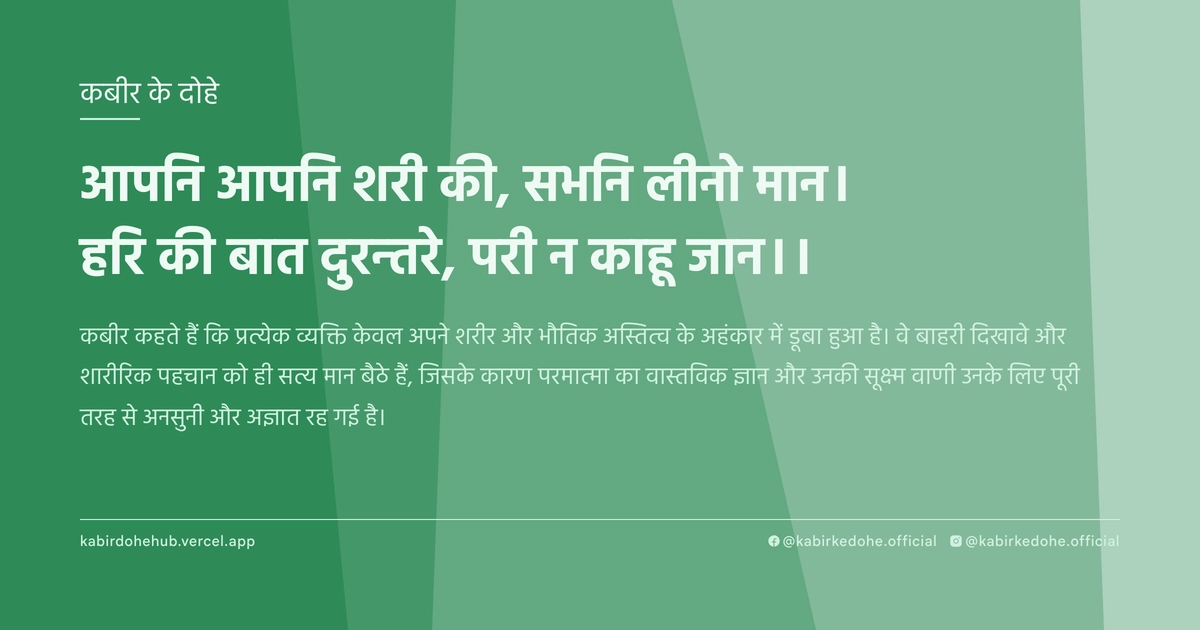
आपनि आपनि शरी की, सभनि लीनो मान।
हरि की बात दुरन्तरे, परी न काहू जान।।
Aapni aapni sharee ki, sabhani leeno maan. Hari ki baat durantare, pari na kaahu jaan.
इस पृष्ठ पर इस कबीर दोहे का अर्थ (meaning), हिंदी व्याख्या और अंग्रेज़ी अनुवाद, दार्शनिक विश्लेषण और व्यावहारिक जीवन सीख दी गई है। यह दोहा अहंकार (The Ego) विषय से जुड़ा है — Kabir doha meaning and explanation in Hindi and English.
अर्थ (Meaning):
कबीर कहते हैं कि प्रत्येक व्यक्ति केवल अपने शरीर और भौतिक अस्तित्व के अहंकार में डूबा हुआ है। वे बाहरी दिखावे और शारीरिक पहचान को ही सत्य मान बैठे हैं, जिसके कारण परमात्मा का वास्तविक ज्ञान और उनकी सूक्ष्म वाणी उनके लिए पूरी तरह से अनसुनी और अज्ञात रह गई है।
Kabir observes that every individual is consumed by the pride and attachment to their own physical body and material identity. By prioritizing the transient shell over the eternal spirit, the profound truth of the Divine remains distant and unheard, leaving the essence of spiritual liberation completely unknown to them.
व्याख्या (Interpretation):
इस दोहे का शाब्दिक अर्थ है कि लोग अपने शरीर का मान कर रहे हैं, लेकिन हरि की बात नहीं समझ रहे। रूपक के स्तर पर, 'शरीर' यहाँ केवल मांस और हड्डी नहीं, बल्कि 'अहंकार' (Ego) और 'माया' का प्रतीक है। निर्गुण भक्ति के अनुसार, जब तक साधक स्वयं को इस नश्वर शरीर के साथ जोड़कर देखता है, वह द्वैत में रहता है। अद्वैत वेदांत के परिप्रेक्ष्य में, यह शरीर एक पर्दा है जो आत्मा और ब्रह्म की एकता को छुपाता है। कबीर यहाँ उस विरोधाभास को उजागर कर रहे हैं जहाँ मनुष्य स्वयं को खोजने का प्रयास करता है, लेकिन गलत जगह—बाहरी रूप में—खोजता है। जब तक 'मैं' (शरीर का बोध) जीवित है, तब तक 'वह' (परमात्मा) अदृश्य रहता है।
Literally, the verse suggests people are preoccupied with their physical forms while ignoring the Divine. Metaphorically, the 'body' represents the 'Ahamkara' (ego) and the veil of 'Maya' (illusion). In the context of Nirgun Bhakti, as long as the seeker identifies with the perishable shell, they remain trapped in duality. From the lens of Advaita Vedanta, the body acts as a screen obscuring the non-duality of Atman and Brahman. Kabir highlights the central paradox: humanity seeks the Truth but looks in the wrong direction—the external form. Until the 'I' (bodily identification) is dissolved, the 'Divine' remains an unreachable distance away.
दार्शनिक विश्लेषण (Philosophical Analysis):
कबीर का यह दोहा उस युग की प्रतिक्रिया है जहाँ धर्म केवल कर्मकांडों, जातिगत श्रेष्ठता और शारीरिक शुद्धता तक सीमित था। कबीर ने इस 'शारीरिक मान' पर प्रहार किया क्योंकि यह सामाजिक विभाजन का मूल कारण है। जब मनुष्य स्वयं को शरीर से पहचानता है, तो वह ऊंच-नीच, सुंदर-कुरूप और शुद्ध-अशुद्ध के भ्रम में फंस जाता है।
दार्शनिक रूप से, यह सूफी मत के 'फना' (अहंकार का विनाश) और वेदांत के 'नेति नेति' (यह नहीं, वह नहीं) के करीब है। कबीर तर्क देते हैं कि शरीर एक वस्त्र है, जबकि चेतना शाश्वत है। जो व्यक्ति शरीर को ही अपनी अंतिम पहचान मान लेता है, वह आध्यात्मिक रूप से अंधा हो जाता है।
यहाँ 'हरि की बात' का अर्थ किसी धार्मिक ग्रंथ का पाठ नहीं, बल्कि उस आंतरिक मौन और सत्य का अनुभव है जो केवल अहंकार के विसर्जन के बाद सुनाई देता है। यह एक मनोवैज्ञानिक रूपांतरण की मांग करता है जहाँ व्यक्ति 'कर्ता' होने के भ्रम को त्याग कर 'साक्षी' बन जाए।
कबीर की अस्वीकृति केवल बाहरी आडंबरों की नहीं, बल्कि उस आंतरिक सूक्ष्म अहंकार की है जो हमें यह विश्वास दिलाता है कि हम शरीर हैं। यह बोध ही बंधन का कारण है।
अंततः, यह विश्लेषण स्पष्ट करता है कि मुक्ति शरीर को छोड़ने में नहीं, बल्कि शरीर के साथ अपने तादात्म्य (Identification) को छोड़ने में है। जब शरीर का 'मान' समाप्त होता है, तब परमात्मा का 'ज्ञान' स्वतः प्रकट होता है।
This couplet is a direct reaction to an era where religion was reduced to ritualism, caste superiority, and physical purity. Kabir attacks this 'bodily pride' because it is the root of all social fragmentation. When a human identifies solely with the body, they fall into the illusion of high and low, beautiful and ugly, pure and impure.
Philosophically, this aligns with the Sufi concept of 'Fana' (annihilation of the self) and the Vedantic practice of 'Neti Neti' (not this, not that). Kabir argues that the body is merely a garment, while consciousness is eternal. One who mistakes the shell for the essence becomes spiritually blind.
'Hari's word' here does not refer to the recitation of scriptures, but to the experience of that inner silence and truth that becomes audible only after the ego is dissolved. It demands a psychological shift from being the 'doer' to becoming the 'witness'.
Kabir's rejection is not just of external pomposity, but of the subtle internal ego that convinces us we are this physical form. This identification is the very cause of bondage.
Ultimately, the analysis reveals that liberation is not found in leaving the body, but in relinquishing the identification with it. When the pride of the body vanishes, the knowledge of the Divine manifests spontaneously.
मूल संदेश (Core Message):
- शरीर एक अस्थायी आवरण है, इसे अपनी पहचान न बनाएं।
- अहंकार का विसर्जन ही परमात्मा के मिलन की पहली शर्त है।
- बाहरी रूप की पूजा वास्तव में स्वयं को भ्रमित करना है।
- सत्य शरीर के पार, चेतना के अनंत विस्तार में स्थित है।
- जब 'मैं' मिटता है, तभी 'वह' प्रकट होता है।
- The body is a transient veil; do not mistake it for your identity.
- Dissolving the ego is the primary prerequisite for Divine union.
- Worshipping the external form is merely a self-imposed delusion.
- Truth resides beyond the flesh, in the infinite expanse of consciousness.
- Only when the 'I' vanishes does the 'Divine' manifest.
व्यावहारिक उदाहरण (Practical Example):
वाराणसी के एक पुराने घाट पर रहने वाली एक वृद्ध विधवा, जानकी, का जीवन केवल अपनी शारीरिक पीड़ाओं और अपनी सामाजिक स्थिति के इर्द-गिर्द घूमता था। वह दिन भर अपनी कमजोर हड्डियों और बीमारियों का विलाप करती, और मानती कि उसकी यह दुखी देह ही उसकी नियति है।
वह अक्सर मंदिर जाती, लेकिन वहां भी वह केवल अपनी शारीरिक अक्षमताओं के कारण मिलने वाली सहानुभूति और विशेष स्थान की तलाश करती। उसका पूरा अस्तित्व 'मैं बीमार हूँ', 'मैं वृद्ध हूँ' और 'मैं असहाय हूँ' के इर्द-गिर्द सिमटा हुआ था।
एक दिन, घाट पर एक फकीर बैठा था जो बिना किसी माला या तिलक के केवल मौन में लीन था। जानकी ने उसके पास जाकर अपनी शारीरिक पीड़ाओं का लंबा वर्णन किया और पूछा कि क्या उसकी इस जर्जर देह के साथ उसे शांति मिल सकती है।
फकीर ने उसकी ओर देखा भी नहीं और बस इतना कहा, 'माँ, तुम उस टूटे हुए घड़े की बात कर रही हो जिसमें पानी गिर चुका है, लेकिन तुम यह भूल गई कि तुम वह आकाश हो जिसमें यह घड़ा तैर रहा है।'
जानकी को पहले तो यह बात समझ नहीं आई। उसने सोचा कि फकीर उसकी बीमारी का मजाक उड़ा रहा है। लेकिन वह वाक्य उसके मन में घर कर गया—'तुम वह आकाश हो'।
अगले कुछ दिनों तक, जानकी ने एक प्रयोग किया। जब भी उसे दर्द होता, वह यह नहीं कहती कि 'मुझे दर्द हो रहा है', बल्कि वह कहती, 'शरीर में दर्द महसूस हो रहा है, लेकिन मैं वह हूँ जो इस दर्द को देख रहा है'।
धीरे-धीरे, उसका अपनी देह के साथ जो गहरा तादात्म्य था, वह टूटने लगा। उसने महसूस किया कि उसकी पीड़ा उसकी पहचान नहीं है। वह केवल एक अनुभव था जो आ रहा था और जा रहा था।
एक सुबह, जब वह गंगा की लहरों को देख रही थी, उसे अचानक अनुभव हुआ कि वह न तो एक विधवा है, न ही एक बीमार वृद्ध महिला, और न ही वह शरीर जो झुक गया है। वह केवल एक शुद्ध चेतना है।
उसका 'शारीरिक मान' (चाहे वह दुख का मान हो या सुख का) समाप्त हो गया। अब वह दूसरों की सेवा बिना किसी अहंकार या दया के करने लगी, क्योंकि उसने हर किसी में उसी 'आकाश' को देखना शुरू कर दिया था।
उसकी जीवन की दिशा बदल गई। वह अब अपनी बीमारियों का विलाप नहीं करती थी, बल्कि एक शांत मुस्कान के साथ अपनी अंतिम यात्रा की प्रतीक्षा करने लगी, क्योंकि उसने 'हरि की बात' को अपने भीतर सुन लिया था।
In the ancient ghats of Varanasi lived Janaki, an elderly widow whose entire existence revolved around her physical ailments and social status. She spent her days lamenting her brittle bones and failing health, believing her suffering body was her ultimate destiny.
She visited the temple daily, but even there, she sought only the sympathy and special attention accorded to her physical fragility. Her identity was tightly wound around the phrases 'I am sick,' 'I am old,' and 'I am helpless.'
One day, she encountered a fakir sitting in profound silence on the ghat, devoid of any religious beads or markings. Janaki approached him, detailing her physical agonies and asking if peace was possible for a body as decayed as hers.
The fakir didn't even look at her; he simply said, 'Mother, you speak of the broken pot from which the water has leaked, but you forget that you are the vast sky in which this pot floats.'
Initially, Janaki was confused and felt the fakir was mocking her illness. However, the phrase 'You are the sky' took root in her subconscious.
Over the next few days, Janaki began an experiment. Whenever pain flared, instead of saying 'I am in pain,' she would tell herself, 'Pain is being felt in the body, but I am the one observing this pain.'
Slowly, her deep identification with the physical shell began to crack. She realized that her suffering was not her identity; it was merely an experience passing through her.
One morning, watching the ripples of the Ganges, she suddenly felt that she was neither a widow, nor a sick old woman, nor the body that had stooped with age. She was pure consciousness.
Her 'bodily pride'—even the pride of being a victim—evaporated. She began serving others without ego or pity, for she now saw the same 'sky' in everyone she encountered.
Her life's trajectory shifted. She ceased lamenting her illness and began awaiting her final journey with a serene smile, having finally heard the 'word of Hari' within herself.
अभ्यास मार्गदर्शन (Practice Guidance):
- साक्षी भाव का अभ्यास: दिन में तीन बार 10 मिनट के लिए बैठें और स्वयं को एक तीसरे व्यक्ति की तरह देखें। विचार करें: 'यह शरीर मेरा वाहन है, मैं स्वयं नहीं'।
- अहंकार की पहचान: एक डायरी लिखें जिसमें उन क्षणों को दर्ज करें जब आपने अपनी शारीरिक उपस्थिति, सुंदरता, या बीमारी के आधार पर दूसरों से श्रेष्ठता या सहानुभूति महसूस की।
- मौन चिंतन: प्रतिदिन 15 मिनट पूर्ण मौन में रहें, जहाँ आप न तो कुछ बोलें और न ही मानसिक रूप से अपनी शारीरिक पहचान (नाम, पद, रूप) को दोहराएं।
- निदान चेकलिस्ट: क्या मैं अपनी शारीरिक कमियों पर अत्यधिक विलाप करता हूँ? क्या मैं अपनी बाहरी दिखावट को अपनी योग्यता मानता हूँ? क्या मैं दूसरों को उनके शरीर या जाति से आंकता हूँ? यदि हाँ, तो आप अभी भी 'शरीर के मान' में हैं।
- Practice of the Witness: Three times a day, sit for 10 minutes and observe yourself from a third-person perspective. Contemplate: 'This body is my vehicle, not my identity.'
- Ego Mapping: Keep a journal recording moments where you felt superior or sought sympathy based on your physical appearance, status, or illness.
- Silent Contemplation: Spend 15 minutes daily in absolute silence, consciously dropping all physical identifiers (name, title, appearance) from your mental narrative.
- Diagnostic Checklist: Do I obsess over my physical flaws? Do I equate my external appearance with my worth? Do I judge others by their physical form or caste? If yes, you are still trapped in 'bodily pride'.
चिंतन प्रश्न (Reflection Questions):
- यदि आज आपका शरीर पूरी तरह बदल जाए, तो आपके व्यक्तित्व का कौन सा हिस्सा बचेगा?
- आप अपनी डिजिटल पहचान (सोशल मीडिया) को कितना वास्तविक मानते हैं और यह आपके 'शारीरिक मान' को कैसे बढ़ाता है?
- क्या आपकी करुणा वास्तव में दूसरों के लिए है, या यह आपके स्वयं के 'परोपकारी' होने के अहंकार को संतुष्ट करती है?
- आप किन शारीरिक लक्षणों के आधार पर लोगों को चुपचाप श्रेणियों में बांटते हैं?
- वह कौन सा डर है जो आपको यह स्वीकार करने से रोकता है कि आप इस शरीर से अलग हैं?
- If your body were completely transformed today, what part of your personality would actually remain?
- How much of your digital identity do you perceive as real, and how does it amplify your 'bodily pride'?
- Is your compassion truly for others, or does it merely satisfy the ego of being a 'benevolent person'?
- Based on which physical traits do you silently categorize people in your mind?
- What is the underlying fear that prevents you from accepting that you are distinct from this body?