
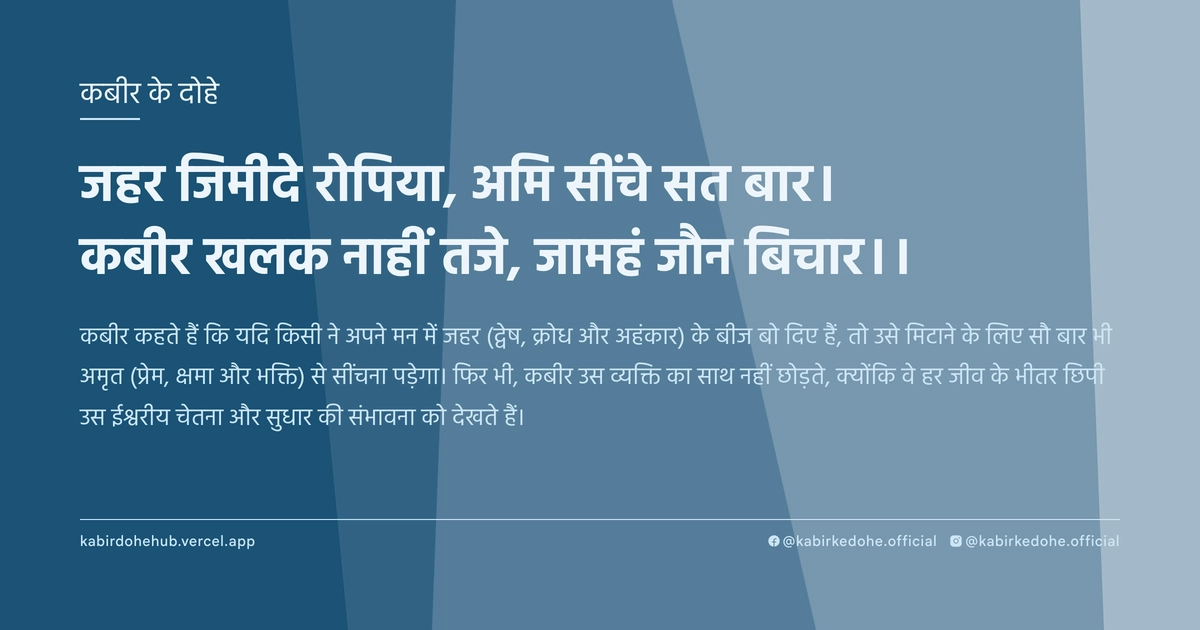
जहर जिमीदे रोपिया, अमि सींचे सत बार।
कबीर खलक नाहीं तजे, जामहं जौन बिचार।।
Zahar jimide ropiya, ami sinche sat baar. Kabir khalak nahin taje, jamhan jaun bichaar.
इस पृष्ठ पर इस कबीर दोहे का अर्थ (meaning), हिंदी व्याख्या और अंग्रेज़ी अनुवाद, दार्शनिक विश्लेषण और व्यावहारिक जीवन सीख दी गई है। यह दोहा करुणा (Compassion) विषय से जुड़ा है — Kabir doha meaning and explanation in Hindi and English.
अर्थ (Meaning):
कबीर कहते हैं कि यदि किसी ने अपने मन में जहर (द्वेष, क्रोध और अहंकार) के बीज बो दिए हैं, तो उसे मिटाने के लिए सौ बार भी अमृत (प्रेम, क्षमा और भक्ति) से सींचना पड़ेगा। फिर भी, कबीर उस व्यक्ति का साथ नहीं छोड़ते, क्योंकि वे हर जीव के भीतर छिपी उस ईश्वरीय चेतना और सुधार की संभावना को देखते हैं।
Kabir asserts that if a person has sown seeds of poison—hatred, anger, and ego—within their heart, it requires a hundred fold watering with the nectar of love, forgiveness, and devotion to cleanse it. Despite the toxicity of the individual, Kabir refuses to abandon them, recognizing the inherent divine spark and the eternal possibility of transformation within every soul.
व्याख्या (Interpretation):
इस दोहे का शाब्दिक अर्थ है कि बुराई की जड़ें बहुत गहरी होती हैं। रूपक के तौर पर, 'जहर' यहाँ अविद्या और अहंकार का प्रतीक है, जबकि 'अमृत' आत्म-ज्ञान और करुणा का। यह निरगुण भक्ति के उस सिद्धांत को दर्शाता है जहाँ ईश्वर किसी व्यक्ति के बाहरी आचरण से नहीं, बल्कि उसकी आत्मा से प्रेम करता है। माया ने मनुष्य को इस कदर ढका है कि वह स्वयं को जहर समझ बैठा है, जबकि वह वास्तव में ब्रह्म का अंश है। यह विरोधाभास है कि जिसे दुनिया 'पापी' कहती है, संत उसे केवल एक 'बीमार आत्मा' मानता है जिसे उपचार की आवश्यकता है। अद्वैत वेदांत के अनुसार, जब द्वैत समाप्त होता है, तब केवल प्रेम शेष रहता है, जो जहर को भी अमृत में बदलने की क्षमता रखता है।
Literally, the couplet speaks of the difficulty of erasing deep-seated negativity. Metaphorically, 'poison' represents Avidya (ignorance) and the ego, while 'nectar' symbolizes Atma-Jnana (self-knowledge) and compassion. This aligns with Nirgun Bhakti, where the Divine is not judged by external conduct but is loved as the essence of the soul. Maya has so thoroughly veiled the human that they perceive themselves as the poison, forgetting they are an extension of Brahman. The central paradox lies in the world labeling someone as 'sinful,' while the Saint views them merely as a 'wounded soul' in need of healing. According to Advaita Vedanta, when the illusion of duality vanishes, only universal love remains—a force capable of transmuted toxicity into transcendence.
दार्शनिक विश्लेषण (Philosophical Analysis):
कबीर का यह कथन उनके युग के कट्टरपंथी सामाजिक और धार्मिक वातावरण पर एक प्रहार है। उस समय धर्म को बाहरी कर्मकांडों और जातिगत शुद्धता से जोड़ा जाता था। कबीर ने इस धारणा को चुनौती देते हुए यह स्थापित किया कि आध्यात्मिक शुद्धि किसी मंदिर या मस्जिद जाने से नहीं, बल्कि हृदय के रूपांतरण से आती है। वे ritualism का विरोध करते हैं क्योंकि वह केवल अहंकार को पुष्ट करता है, उसे मिटाता नहीं।
दार्शनिक स्तर पर, यह दोहा सूफी मत के 'इश्क-ए-हकीकी' (ईश्वरीय प्रेम) और अद्वैत वेदांत के 'अहं ब्रह्मास्मि' का संगम है। सूफी संत मानते हैं कि प्रेम वह अग्नि है जो अहंकार को जलाकर राख कर देती है। कबीर यहाँ 'खलक' (सृष्टि/लोग) का साथ न छोड़ने की बात कर रहे हैं, जो यह दर्शाता है कि कोई भी व्यक्ति 'असाध्य' नहीं है। यह मनोवैज्ञानिक रूप से इस सत्य को उजागर करता है कि घृणा का उत्तर घृणा से देने पर जहर बढ़ता है, जबकि करुणा उसे neutralise करती है।
कबीर यहाँ 'अहं' के विलीनीकरण की बात कर रहे हैं। जब साधक यह समझ जाता है कि सामने वाले का क्रोध वास्तव में उसकी अपनी पीड़ा का प्रकटीकरण है, तब वह व्यक्ति से घृणा करना बंद कर देता है। यह 'साक्षी भाव' (Witness Consciousness) की स्थिति है। यहाँ जहर बोना एक मानसिक संस्कार (Samskara) है, और अमृत सींचना उस संस्कार का शोधन है।
अक्सर लोग इस दोहे को केवल 'क्षमा' के रूप में देखते हैं, लेकिन यह उससे कहीं गहरा है। यह 'करुणा' (Compassion) का उच्चतम स्तर है जहाँ आप सामने वाले की बुराई को उसकी पहचान नहीं मानते। आप उसे उस 'अंधेरे' के रूप में देखते हैं जो केवल 'प्रकाश' की अनुपस्थिति है।
अंततः, कबीर यह संदेश देते हैं कि आध्यात्मिक मार्ग पर चलने वाले का धर्म केवल अपनी मुक्ति नहीं, बल्कि दूसरों को उस अंधकार से बाहर निकालना है। यह 'लोक-कल्याण' की भावना है जो व्यक्तिगत मोक्ष से ऊपर उठकर सामूहिक चेतना के उत्थान की बात करती है।
Kabir’s statement is a direct critique of the dogmatic social and religious atmosphere of his era. During his time, spirituality was tethered to external rituals and caste-based purity. Kabir challenged this, establishing that spiritual purification occurs not through temple or mosque visits, but through the transmutation of the heart. He rejects ritualism because it often reinforces the ego rather than dissolving it.
Philosophically, this couplet is a confluence of the Sufi concept of 'Ishq-e-Haqiqi' (Divine Love) and the Advaita Vedanta principle of 'Aham Brahmasmi.' Sufi saints believe that love is the fire that incinerates the ego. By stating he will not abandon the 'khalak' (creation/people), Kabir asserts that no soul is beyond redemption. Psychologically, this highlights that responding to hatred with hatred only amplifies the poison, whereas compassion neutralizes it.
Kabir focuses on the annihilation of the 'I.' When a seeker realizes that another's anger is merely a manifestation of their own inner suffering, the hatred for the individual ceases. This is the state of 'Sakshi Bhava' or Witness Consciousness. Sowing poison is a mental 'Samskara' (impression), and watering it with nectar is the process of purifying that impression.
Common literalist interpretations view this merely as an act of 'forgiveness,' but it is far deeper. It is the highest form of 'Karuna' (Compassion), where you cease to identify a person by their toxicity. You perceive the evil not as an identity, but as 'darkness'—which is simply the absence of light.
Ultimately, Kabir suggests that the duty of a spiritual practitioner is not merely personal liberation, but to assist others in emerging from the darkness. This is the spirit of 'Lok-Kalyan' (universal welfare), prioritizing the elevation of collective consciousness over individual salvation.
मूल संदेश (Core Message):
- घृणा एक मानसिक रोग है, जिसे केवल करुणा से ठीक किया जा सकता है।
- अहंकार का अंत तब होता है जब हम दूसरों में स्वयं का प्रतिबिंब देखते हैं।
- कोई भी आत्मा पूरी तरह दूषित नहीं होती; बीज हमेशा शुद्ध होता है।
- सच्ची भक्ति वह है जो शत्रु को भी मित्र बनाने का साहस रखे।
- बाहरी शुद्धता भ्रम है; वास्तविक शुद्धि हृदय के रूपांतरण में है।
- प्रेम वह एकमात्र औषधि है जो गहरे से गहरे जहर को भी अमृत बनाती है।
- Hatred is a mental affliction that can only be cured by compassion.
- The ego dissolves when we see our own reflection in others.
- No soul is entirely corrupted; the seed of divinity is always pure.
- True devotion is the courage to transform an enemy into a friend.
- External purity is an illusion; real purification lies in the heart's transmutation.
- Love is the only medicine capable of turning the deepest poison into nectar.
व्यावहारिक उदाहरण (Practical Example):
वाराणसी के एक पुराने मोहल्ले में माधव नाम का एक बुनकर रहता था। माधव स्वभाव से अत्यंत क्रोधी और कड़वा था। वह अपने पड़ोसियों को कोसता, राहगीरों को अपशब्द कहता और अपनी छोटी सी दुकान पर आने वाले ग्राहकों से भी झगड़ता था। पूरे मोहल्ले ने उसे 'जहरीला' मानकर उससे नाता तोड़ लिया था। लोग उसे देखते ही रास्ता बदल लेते थे।
उसी मोहल्ले में एक वृद्ध महिला रहती थी, जिन्हें सब 'माई' कहते थे। माई ने देखा कि माधव का क्रोध वास्तव में उसके अकेलेपन और पुराने दुखों की उपज है। जहाँ सब उसे कोसते थे, माई उसके पास जातीं और बिना कुछ पूछे उसके लिए ताज़ा भोजन ले आतीं। माधव उन पर चिल्लाता, उन्हें बुरा-भला कहता, लेकिन माई बस मुस्कुरातीं और कहतीं, 'बेटा, आज सब्जी बहुत स्वाद बनी है, चख कर देख।'
महीनों तक यह सिलसिला चला। माधव ने कई बार माई का अपमान किया, उनके हाथों से थाली गिरा दी, लेकिन माई ने कभी पलटकर क्रोध नहीं किया। वह हर बार अमृत जैसी करुणा के साथ वापस आतीं। माधव के भीतर का जहर धीरे-धीरे उसे कचोटने लगा। वह सोचने लगा कि दुनिया में सबने मुझे नकारा, फिर यह औरत मुझे क्यों चाहती है?
एक दिन माधव बहुत बीमार पड़ गया। उसके पास कोई नहीं था, यहाँ तक कि दवा देने वाला भी नहीं। तब माई ने दिन-रात उसकी सेवा की, उसे अपने हाथों से दवा पिलाई और उसके सिरहाने बैठकर भजन गाती रहीं। माधव की आँखों से आँसू बहने लगे। उसे महसूस हुआ कि उसकी कड़वाहट की दीवार माई के निस्वार्थ प्रेम के सामने ढह गई है।
माधव का रूपांतरण अचानक नहीं हुआ, बल्कि वह उन 'सौ बार' सींचे गए अमृत का परिणाम था। उसने महसूस किया कि जिसे वह अपनी ताकत समझता था (उसका क्रोध), वह वास्तव में उसकी सबसे बड़ी कमजोरी थी। उसने माई के चरणों में गिरकर क्षमा मांगी।
इसके बाद माधव बदल गया। उसने अपनी दुकान को केवल कपड़े बेचने की जगह नहीं, बल्कि लोगों की मदद करने का केंद्र बना लिया। वह अब उन लोगों की मदद करता था जिन्हें समाज ने ठुकरा दिया था।
उसने सीखा कि जब कोई आपको बिना शर्त स्वीकार करता है, तो आपके भीतर का जहर अपने आप अमृत में बदलने लगता है। यह 'कबीर ट्विस्ट' था—जहाँ घृणा का उत्तर घृणा से नहीं, बल्कि अगाध प्रेम से दिया गया।
आज माधव वाराणसी का सबसे प्रिय व्यक्ति है, न कि इसलिए कि वह महान था, बल्कि इसलिए क्योंकि उसे एक ऐसी आत्मा मिली जिसने उसे उसकी बुराई के बावजूद नहीं छोड़ा।
In an ancient lane of Varanasi lived a weaver named Madhav. Madhav was notoriously irritable and caustic. He cursed his neighbors, insulted passersby, and fought with every customer who entered his small shop. The entire neighborhood labeled him 'poisonous' and severed ties with him. People would change their path just to avoid his sight.
In the same neighborhood lived an elderly woman known to all as 'Mai.' Mai observed that Madhav's anger was actually a byproduct of profound loneliness and old wounds. While everyone else shunned him, Mai would visit him, bringing fresh food without asking for anything in return. Madhav would scream at her and insult her, but Mai would simply smile and say, 'Son, the vegetables are very tasty today, do try some.'
This continued for months. Madhav humiliated her repeatedly and even knocked the plate of food from her hands, yet Mai never responded with anger. She returned every time with a nectar-like compassion. Slowly, the poison within Madhav began to gnaw at him. He wondered, 'Everyone in the world has rejected me, then why does this woman still care?'
One day, Madhav fell severely ill. He had no one, not even someone to bring him medicine. Mai stepped in, nursing him day and night, feeding him medicine, and singing bhajans by his bedside. Tears streamed down Madhav's face. He realized that the wall of bitterness he had built had crumbled before Mai's selfless love.
Madhav's transformation was not instantaneous; it was the result of being 'watered a hundred times' with nectar. He realized that what he perceived as his strength—his anger—was actually his greatest weakness.
Following this, Madhav changed. He turned his shop not just into a place of business, but into a center for helping others. He began supporting those whom society had cast aside.
He learned that when someone accepts you unconditionally, the poison within you naturally begins to transmute into nectar. This was the 'Kabir Twist'—where hatred was not met with hatred, but with boundless love.
Today, Madhav is the most beloved person in that part of Varanasi, not because he was inherently great, but because he found a soul who refused to abandon him despite his flaws.
अभ्यास मार्गदर्शन (Practice Guidance):
- दैनिक अभ्यास: प्रतिदिन 15 मिनट मौन रहकर उन लोगों का स्मरण करें जिनसे आप घृणा करते हैं। उनके प्रति क्रोध के बजाय यह सोचें कि वे भी किसी आंतरिक पीड़ा से जूझ रहे हैं।
- आत्म-पूछताछ जर्नल: लिखें कि आपके जीवन में वह कौन सा 'जहर' (क्रोध, ईर्ष्या) है जो बार-बार उभरता है? विश्लेषण करें कि यह किस पुराने घाव से जुड़ा है।
- व्यवहारिक परिवर्तन: अगले 30 दिनों तक, यदि कोई आपके साथ बुरा व्यवहार करे, तो प्रतिक्रिया देने के बजाय एक बार मुस्कुराएं या शांत रहें। इसे 'अमृत सींचने' का प्रयोग मानें।
- डायग्नोस्टिक चेकलिस्ट: (1) क्या मैं दूसरों की गलतियों को उनकी पहचान मान लेता हूँ? (2) क्या मैं केवल उन्हीं से प्रेम करता हूँ जो मुझसे प्रेम करते हैं? (3) क्या मैं किसी व्यक्ति को 'असाध्य' मानकर त्याग देता हूँ? (यदि उत्तर 'हाँ' है, तो आप अभी भी द्वैत और अहंकार में हैं)।
- Daily Practice: Spend 15 minutes in silence visualizing those you harbor hatred toward. Instead of anger, contemplate the inner pain they might be enduring.
- Self-Inquiry Journal: Document the specific 'poison' (anger, jealousy) that repeatedly surfaces in your life. Analyze which old wound or trauma fuels this reaction.
- Behavioral Shift: For the next 30 days, when someone treats you poorly, respond with a smile or silence instead of a reaction. Treat this as an experiment in 'watering with nectar.'
- Diagnostic Checklist: (1) Do I identify people by their mistakes? (2) Do I only love those who love me back? (3) Do I label anyone as 'beyond redemption' and discard them? (If 'Yes,' you are still operating within the illusion of duality and ego).
चिंतन प्रश्न (Reflection Questions):
- क्या मेरा 'नैतिक श्रेष्ठता' का भाव वास्तव में करुणा है, या यह मेरे अहंकार को संतुष्ट करने का एक तरीका है?
- मैं किन लोगों को अपने जीवन से 'जहर' मानकर बाहर कर चुका हूँ, और क्या मैंने उन्हें बदलने का एक भी अवसर दिया?
- मेरे डिजिटल व्यक्तित्व (Social Media) में मैं कितना 'अमृत' बाँटता हूँ और निजी जीवन में कितना 'जहर' संजोता हूँ?
- यदि मैं स्वयं को एक 'जहरीले' व्यक्ति के रूप में देखूँ, तो मैं अपने आप से किस तरह की करुणा की अपेक्षा करूँगा?
- क्या मैं वास्तव में दूसरों को क्षमा करता हूँ, या मैं केवल यह दिखावा करता हूँ ताकि मैं स्वयं को 'बड़ा' महसूस कर सकूँ?
- मेरे भीतर का वह कौन सा हिस्सा है जो अभी भी मानता है कि कुछ लोग 'बुरे' पैदा होते हैं?
- Is my sense of 'moral superiority' truly compassion, or is it just a way to feed my ego?
- Whom have I discarded from my life as 'poison,' and did I ever give them a single chance to transform?
- How much 'nectar' do I distribute through my digital persona, and how much 'poison' do I harbor in my private life?
- If I viewed myself as a 'poisonous' person, what kind of compassion would I hope to receive?
- Do I truly forgive others, or do I merely perform forgiveness to feel 'superior'?
- Which part of me still believes that some people are born 'evil'?