
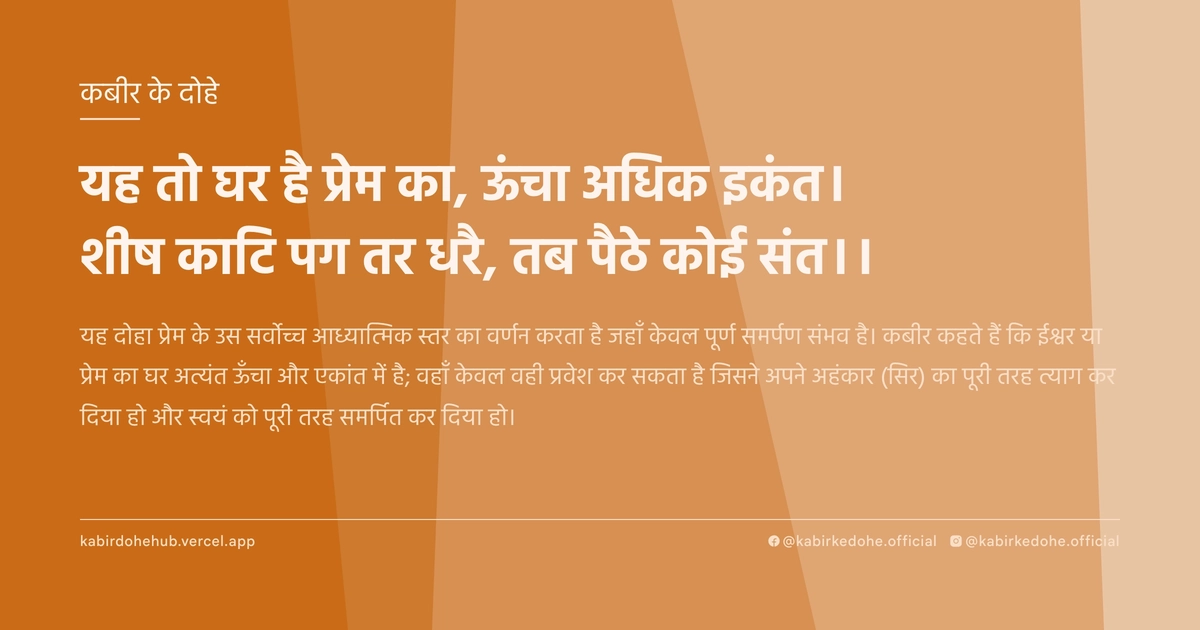
यह तो घर है प्रेम का, ऊंचा अधिक इकंत।
शीष काटि पग तर धरै, तब पैठे कोई संत।।
Yeh to ghar hai prem ka, ooncha adhik ikant. Sheesh kaati pag tar dharai, tab paithay koi sant.
इस पृष्ठ पर इस कबीर दोहे का अर्थ (meaning), हिंदी व्याख्या और अंग्रेज़ी अनुवाद, दार्शनिक विश्लेषण और व्यावहारिक जीवन सीख दी गई है। यह दोहा भक्ति (Bhakti) विषय से जुड़ा है — Kabir doha meaning and explanation in Hindi and English.
अर्थ (Meaning):
यह दोहा प्रेम के उस सर्वोच्च आध्यात्मिक स्तर का वर्णन करता है जहाँ केवल पूर्ण समर्पण संभव है। कबीर कहते हैं कि ईश्वर या प्रेम का घर अत्यंत ऊँचा और एकांत में है; वहाँ केवल वही प्रवेश कर सकता है जिसने अपने अहंकार (सिर) का पूरी तरह त्याग कर दिया हो और स्वयं को पूरी तरह समर्पित कर दिया हो।
This couplet describes the supreme spiritual plane of Divine Love, which is accessible only through absolute surrender. Kabir asserts that the abode of Love is lofty and secluded; only those who have severed their ego (symbolized by the head) and placed it at the feet of the Divine can truly enter this sacred space.
व्याख्या (Interpretation):
शाब्दिक रूप से, कबीर एक ऐसे घर की बात कर रहे हैं जहाँ प्रवेश की शर्त आत्म-बलिदान है। रूपकात्मक स्तर पर, 'सिर काटना' शारीरिक मृत्यु नहीं, बल्कि 'अहंकार' की मृत्यु है। Nirgun Bhakti में, ईश्वर किसी मूर्ति में नहीं बल्कि शुद्ध चेतना में है। माया का पर्दा तभी हटता है जब 'मैं' का भाव समाप्त हो जाता है। यह Advaita Vedanta के उस सिद्धांत को दर्शाता है जहाँ जीव और ब्रह्म के बीच का एकमात्र अवरोध अहंकार है। जब साधक अपनी पहचान को शून्य करता है, तब वह उस 'इकंत' या शून्य में प्रवेश करता है जहाँ केवल परमात्मा का वास है। यह विरोधाभास है कि स्वयं को पूरी तरह खोकर ही स्वयं को वास्तव में पाया जा सकता है।
Literally, Kabir speaks of a dwelling where the price of entry is self-sacrifice. Metaphorically, 'cutting off the head' does not signify physical death, but the annihilation of the ego (Ahamkara). In Nirgun Bhakti, the Divine resides not in idols but in pure consciousness. The veil of Maya only lifts when the sense of 'I' is extinguished. This aligns with Advaita Vedanta, where the sole barrier between the Atman and Brahman is the ego. When the seeker reduces their identity to zero, they enter that 'seclusion' or void where the Divine dwells. It is the central paradox of spirituality: only by completely losing oneself can one truly be found.
दार्शनिक विश्लेषण (Philosophical Analysis):
कबीर का यह दोहा मध्यकालीन भारत के धार्मिक पाखंड और कर्मकांडीय कठोरता के विरुद्ध एक सशक्त प्रहार है। उस समय धर्म बाहरी दिखावे, तीर्थयात्रा और कठोर उपवासों तक सीमित था। कबीर ने स्पष्ट किया कि मोक्ष किसी बाहरी क्रिया से नहीं, बल्कि आंतरिक रूपांतरण से मिलता है। उन्होंने 'प्रेम' को सर्वोच्च ज्ञान माना, जो किसी शास्त्र या मंदिर का मोहताज नहीं है।
यह दर्शन Sufism के 'Fana' (अहंकार का विलीनीकरण) के अत्यंत निकट है, जहाँ प्रेमी अपने अस्तित्व को मिटाकर परमात्मा में समा जाता है। कबीर का 'प्रेम' कामुक या सांसारिक नहीं, बल्कि एक आध्यात्मिक अग्नि है जो अशुद्धियों को जला देती है। यहाँ 'ऊँचा' और 'इकंत' शब्द उस मानसिक अवस्था को दर्शाते हैं जो सांसारिक शोर और सामाजिक प्रतिष्ठा से परे है।
Advaita Vedanta के परिप्रेक्ष्य में, यह दोहा अद्वैत की प्राप्ति का मार्ग बताता है। जब तक 'कर्ता' का भाव रहता है, तब तक द्वैत बना रहता है। 'शीष काटि' का अर्थ है उस सूक्ष्म अहंकार का अंत करना जो हमें यह विश्वास दिलाता है कि हम ईश्वर से अलग हैं। यह मनोवैज्ञानिक रूपांतरण है जहाँ व्यक्ति अपनी सामाजिक पहचान (जाति, पद, प्रतिष्ठा) को त्याग कर शुद्ध आत्मा बन जाता है।
कबीर यहाँ यह चेतावनी देते हैं कि जो लोग केवल बौद्धिक चर्चा या धार्मिक अनुष्ठानों के माध्यम से ईश्वर को पाना चाहते हैं, वे इस 'घर' की दहलीज तक भी नहीं पहुँच सकते। प्रेम की मांग पूर्णता है; आधा-अधूरा समर्पण यहाँ स्वीकार्य नहीं है। यह एक क्रांतिकारी विचार था जिसने तत्कालीन समाज को यह सोचने पर मजबूर किया कि सच्ची भक्ति हृदय की गहराई में है, न कि बाहरी आडंबरों में।
अंततः, यह दोहा मनुष्य की उस आंतरिक यात्रा का मानचित्र है जहाँ वह अपनी सीमाओं को तोड़कर अनंत में विलीन होता है। यह सिखाता है कि आध्यात्मिक प्रगति का पैमाना ज्ञान की मात्रा नहीं, बल्कि अहंकार के विसर्जन की गहराई है। जब तक 'मैं' जीवित है, तब तक 'वह' अनुपस्थित है।
Kabir's couplet is a powerful critique of the religious hypocrisy and ritualistic rigidity of medieval India. During his era, religion was often confined to external displays, pilgrimages, and austere fasting. Kabir clarifies that liberation is not achieved through external acts, but through internal transformation. He posits 'Love' as the supreme knowledge, independent of scriptures or temples.
This philosophy closely mirrors the Sufi concept of 'Fana' (annihilation of the self), where the lover dissolves their existence to merge with the Beloved. Kabir's 'Love' is not erotic or mundane, but a spiritual fire that incinerates all impurities. The terms 'lofty' and 'secluded' describe a state of consciousness far removed from worldly noise and social prestige.
From the perspective of Advaita Vedanta, this verse outlines the path to non-duality. As long as the sense of 'doership' exists, duality persists. 'Cutting off the head' signifies the end of that subtle ego which convinces us that we are separate from the Divine. This is a psychological metamorphosis where the individual sheds their social identity—caste, rank, and reputation—to become the pure Atman.
Kabir warns that those seeking the Divine through mere intellectual discourse or religious rituals cannot even reach the threshold of this 'house.' Love demands totality; partial surrender is unacceptable. This was a revolutionary idea, forcing the society of his time to realize that true devotion lies in the depths of the heart, not in outward pomposity.
Ultimately, this couplet maps the internal journey where a human transcends their limitations to merge into the Infinite. It teaches that the metric of spiritual progress is not the volume of one's knowledge, but the depth of one's ego-dissolution. As long as the 'I' survives, the 'He' remains absent.
मूल संदेश (Core Message):
- अहंकार वह अंतिम पर्दा है जो आत्मा को परमात्मा से अलग करता है।
- सच्चा प्रेम समर्पण की मांग करता है, सौदेबाजी की नहीं।
- ज्ञान जब तक अहंकार को नहीं मिटाता, वह केवल एक मानसिक बोझ है।
- शून्यता ही वह एकमात्र द्वार है जिससे अनंत में प्रवेश संभव है।
- ईश्वर मंदिर या मस्जिद में नहीं, बल्कि पूर्ण आत्म-समर्पण में मिलता है।
- Ego is the final veil separating the individual soul from the Universal Consciousness.
- True Love demands absolute surrender, not a transactional bargain.
- Knowledge is merely a mental burden unless it annihilates the ego.
- Emptiness is the only gateway through which the Infinite can be accessed.
- The Divine is found not in temples or mosques, but in total self-surrender.
व्यावहारिक उदाहरण (Practical Example):
एक समय की बात है, बनारस के घाटों पर माधव नाम का एक अत्यंत अहंकारी विद्वान रहता था। माधव ने चारों वेद पढ़ लिए थे और वह अपनी विद्वत्ता के कारण पूरे शहर में प्रसिद्ध था। वह हर चर्चा में दूसरों को नीचा दिखाता और स्वयं को आध्यात्मिक रूप से श्रेष्ठ मानता था। वह घंटों मंदिर में पूजा करता, लेकिन उसके मन में यह गर्व था कि उसकी भक्ति सबसे शुद्ध है।
उसी शहर में एक वृद्ध विधवा, जानकी, रहती थी जो दूसरों के घरों में सफाई का काम करती थी। जानकी अनपढ़ थी, लेकिन उसका हृदय करुणा से भरा था। वह चुपचाप अपनी सेवा करती और हर जीव में ईश्वर को देखती थी। माधव अक्सर जानकी का उपहास करता कि वह बिना मंत्रों के कैसे मोक्ष की आशा कर सकती है।
एक दिन शहर में एक रहस्यमयी फकीर आए। माधव उनके पास गया और अपनी विद्वत्ता का प्रदर्शन करने लगा। उसने फकीर से पूछा, 'ईश्वर के घर का रास्ता क्या है?' फकीर ने मुस्कुराते हुए माधव की ओर देखा और कहा, 'उस घर का द्वार बहुत छोटा है, वहाँ केवल वही जा सकता है जिसने अपना सिर बाहर छोड़ दिया हो।'
माधव उलझन में पड़ गया। उसने सोचा कि शायद फकीर किसी गुप्त तंत्र की बात कर रहे हैं। उसने कई दिनों तक कठिन तपस्या की, उपवास रखे और और भी अधिक शास्त्र पढ़े, लेकिन उसे वह 'द्वार' नहीं मिला। वह जितना अधिक प्रयास करता, उसका अहंकार उतना ही बढ़ता जाता कि वह दुनिया का सबसे बड़ा तपस्वी है।
एक शाम, माधव ने देखा कि जानकी एक बीमार कुत्ते की सेवा कर रही थी। वह कुत्ता उसे काट रहा था और उसके कपड़े गंदे कर रहा था, लेकिन जानकी की आँखों में केवल प्रेम और आंसू थे। वह पूरी तरह से उस कुत्ते के दुख में लीन थी, उसे अपनी सामाजिक स्थिति या गंदगी की कोई परवाह नहीं थी। उस क्षण, जानकी के चेहरे पर एक ऐसा दिव्य तेज था जो माधव ने कभी किसी शास्त्र में नहीं पढ़ा था।
माधव को अचानक अहसास हुआ कि वह जिसे 'ज्ञान' समझ रहा था, वह वास्तव में उसके अहंकार की एक दीवार थी। उसने महसूस किया कि जानकी ने अपना 'सिर' (अहंकार) बहुत पहले ही काट दिया था, जबकि वह अभी भी अपने ज्ञान के मुकुट को ढो रहा था। वह समझ गया कि प्रेम का घर ऊँचा इसलिए है क्योंकि वहाँ तक पहुँचने के लिए अहंकार की सीढ़ियों को तोड़ना पड़ता है।
माधव का गर्व चूर-चूर हो गया। वह जानकी के पैरों में गिर पड़ा और फूट-फूट कर रोने लगा। उसने पहली बार महसूस किया कि जब 'मैं' मरता है, तभी 'प्रेम' जन्म लेता है। उसने अपनी सारी पुस्तकें एक तरफ रख दीं और सेवा के मार्ग पर चल पड़ा।
अब माधव विद्वान नहीं, बल्कि एक विनम्र सेवक बन गया था। उसने सीखा कि ईश्वर को पाने के लिए शास्त्रों के बोझ की नहीं, बल्कि हृदय के खालीपन की आवश्यकता होती है। उसका जीवन अब प्रदर्शन नहीं, बल्कि समर्पण बन गया था।
Once, on the ghats of Varanasi, lived a profoundly arrogant scholar named Madhav. Madhav had mastered the four Vedas and was renowned throughout the city for his erudition. In every debate, he belittled others and considered himself spiritually superior. He spent hours in temple worship, yet his heart harbored the pride that his devotion was the purest of all.
In the same city lived an elderly widow named Janaki, who earned her living cleaning other people's homes. Janaki was illiterate, but her heart overflowed with compassion. She served others silently and saw the Divine in every living being. Madhav often mocked Janaki, questioning how she could hope for liberation without knowing the sacred mantras.
One day, a mysterious fakir arrived in the city. Madhav approached him and began showcasing his scholarship. He asked the fakir, 'What is the path to the house of God?' The fakir smiled and replied, 'The door to that house is very small; only he who has left his head outside can enter.'
Madhav was bewildered. He thought the fakir was referring to some secret occult practice. For days, he performed rigorous penance, fasted, and read even more scriptures, but he could not find this 'door.' The more he strove, the more his ego grew, believing himself to be the greatest ascetic in the world.
One evening, Madhav saw Janaki tending to a sick dog. The dog was biting her and staining her clothes, but Janaki's eyes held only love and tears. She was completely absorbed in the dog's suffering, oblivious to her social status or the filth. In that moment, a divine radiance shone from Janaki's face—a light Madhav had never read about in any scripture.
Madhav suddenly realized that what he had mistaken for 'knowledge' was actually a wall of ego. He saw that Janaki had 'cut off her head' (her ego) long ago, while he was still lugging around the heavy crown of his scholarship. He understood that the house of Love is 'lofty' because one must demolish the stairs of pride to reach it.
Madhav's pride shattered. He fell at Janaki's feet and wept uncontrollably. He realized for the first time that only when the 'I' dies, 'Love' is born. He set aside his books and embarked on the path of selfless service.
Madhav was no longer a scholar, but a humble servant. He learned that reaching God requires not the burden of scriptures, but the emptiness of the heart. His life ceased to be a performance and became a surrender.
अभ्यास मार्गदर्शन (Practice Guidance):
- प्रतिदिन 20 मिनट मौन ध्यान करें, जहाँ आप अपने भीतर उठने वाले 'मैं' (अहंकार) के विचारों को केवल एक साक्षी की तरह देखें, बिना उन्हें सही या गलत ठहराए।
- एक 'अहंकार डायरी' लिखें: दिन भर में ऐसी कौन सी स्थितियाँ थीं जब आपको लगा कि आप दूसरों से श्रेष्ठ हैं या जब आपकी प्रशंसा की इच्छा जागी? इन क्षणों का विश्लेषण करें।
- सचेत सेवा (Conscious Service): सप्ताह में एक बार किसी ऐसे व्यक्ति की निस्वार्थ सेवा करें जिससे आप घृणा करते हैं या जिसे आप तुच्छ समझते हैं, ताकि आपके भीतर का निर्णयकर्ता समाप्त हो सके।
- निदान चेकलिस्ट: क्या आप अभी भी अपनी उपलब्धियों का श्रेय स्वयं लेते हैं? क्या आप दूसरों की आलोचना करते समय श्रेष्ठता महसूस करते हैं? यदि हाँ, तो आप अभी भी 'सिर' (अहंकार) के साथ घर में प्रवेश करने की कोशिश कर रहे हैं।
- Practice 20 minutes of silent meditation daily, observing the thoughts of 'I' (ego) as a witness, without judging them as right or wrong.
- Maintain an 'Ego Journal': Record moments during the day when you felt superior to others or craved validation. Analyze the root of these impulses.
- Conscious Service: Once a week, perform a selfless act for someone you dislike or perceive as inferior, specifically to dismantle your internal judge.
- Diagnostic Checklist: Do you still claim sole credit for your achievements? Do you feel a sense of superiority while criticizing others? If yes, you are still attempting to enter the house while carrying your 'head' (ego).
चिंतन प्रश्न (Reflection Questions):
- मेरी वह कौन सी 'पहचान' है जिसे खोने के विचार मात्र से मुझे डर लगता है?
- क्या मेरा अध्यात्म वास्तव में मुझे विनम्र बना रहा है, या यह मेरे अहंकार को एक 'आध्यात्मिक श्रेष्ठता' का नया मुखौटा दे रहा है?
- यदि आज मेरी सारी सामाजिक प्रतिष्ठा और उपलब्धियाँ छीन ली जाएँ, तो मेरे भीतर क्या बचेगा?
- मैं किन लोगों को अपने से 'नीचा' समझता हूँ, और यह धारणा मेरे भीतर किस डर से उपजी है?
- क्या मैं प्रेम करता हूँ, या मैं केवल उस प्रेम की प्रशंसा और उससे मिलने वाले सुख से प्रेम करता हूँ?
- Which part of my 'identity' am I most terrified of losing?
- Is my spirituality actually making me humble, or is it providing my ego with a new mask of 'spiritual superiority'?
- If all my social prestige and achievements were stripped away today, what would remain within me?
- Whom do I perceive as 'inferior,' and from what internal fear does this perception arise?
- Do I truly love, or do I merely love the admiration and pleasure that come from being loved?