
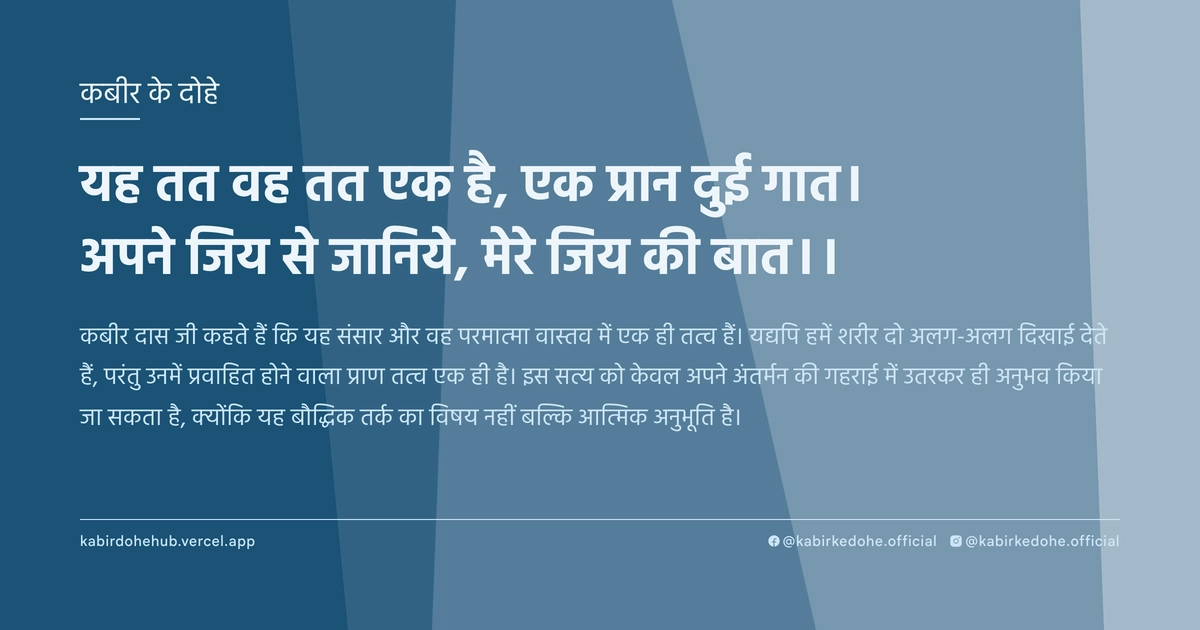
यह तत वह तत एक है, एक प्रान दुई गात।
अपने जिय से जानिये, मेरे जिय की बात।।
Yeh tat vah tat ek hai, ek praan dui gaat. Apne jiy se jaaniye, mere jiy ki baat.
इस पृष्ठ पर इस कबीर दोहे का अर्थ (meaning), हिंदी व्याख्या और अंग्रेज़ी अनुवाद, दार्शनिक विश्लेषण और व्यावहारिक जीवन सीख दी गई है। यह दोहा निर्गुण ब्रह्म (Nirguna Brahman) विषय से जुड़ा है — Kabir doha meaning and explanation in Hindi and English.
अर्थ (Meaning):
कबीर दास जी कहते हैं कि यह संसार और वह परमात्मा वास्तव में एक ही तत्व हैं। यद्यपि हमें शरीर दो अलग-अलग दिखाई देते हैं, परंतु उनमें प्रवाहित होने वाला प्राण तत्व एक ही है। इस सत्य को केवल अपने अंतर्मन की गहराई में उतरकर ही अनुभव किया जा सकता है, क्योंकि यह बौद्धिक तर्क का विषय नहीं बल्कि आत्मिक अनुभूति है।
Kabir asserts that the manifest world and the divine essence are fundamentally one and the same. Although we perceive two distinct bodies or forms, the vital life-force animating them is a single, undivided entity. This truth cannot be grasped through intellectual reasoning but must be realized through the depths of one's own inner consciousness and intuitive experience.
व्याख्या (Interpretation):
इस दोहे का शाब्दिक अर्थ है कि 'यह' (दृश्य जगत) और 'वह' (अदृश्य ईश्वर) एक ही तत्व हैं। कबीर यहाँ 'एक प्रान दुई गात' के माध्यम से द्वैत के भ्रम को तोड़ते हैं, जहाँ शरीर अलग दिखते हैं पर चेतना एक है। यह निर्गुण भक्ति का सार है, जहाँ ईश्वर किसी मूर्ति में नहीं बल्कि कण-कण में व्याप्त है। माया हमें यह विश्वास दिलाती है कि हम अलग हैं, जबकि अद्वैत वेदांत के अनुसार आत्मा और ब्रह्म एक ही हैं। यहाँ 'जिय' का अर्थ केवल हृदय नहीं, बल्कि वह साक्षी चेतना है जो अहंकार से परे है। इस विरोधाभास को समझना ही आध्यात्मिक जागृति है कि जो बाहर खोज रहे हो, वह भीतर ही स्थित है।
Literally, the verse claims that 'this' (the manifest universe) and 'that' (the unmanifest Divine) are the same essence. Through the phrase 'one breath, two bodies,' Kabir dismantles the illusion of duality, suggesting that while physical forms appear separate, the animating consciousness is singular. This is the core of Nirgun Bhakti, where the Divine is not a distant deity but an immanent presence in every atom. Maya creates the veil of separation, whereas Advaita Vedanta posits the non-duality of Atman and Brahman. The term 'jiy' refers not merely to the heart, but to the witness-consciousness that transcends the ego. The central paradox is that the seeker and the sought are identical; the perceived distance is a cognitive error.
दार्शनिक विश्लेषण (Philosophical Analysis):
कबीर का यह दर्शन उस समय के कट्टरपंथी धार्मिक वातावरण के विरुद्ध एक क्रांतिकारी प्रहार था, जहाँ हिंदू और मुस्लिम अपनी अलग-अलग पहचान और कर्मकांडों में उलझे थे। कबीर ने यह स्थापित किया कि ईश्वर किसी विशेष धर्म, मंदिर या मस्जिद का नहीं है, बल्कि वह एक सार्वभौमिक तत्व है। यह विचार सूफीवाद के 'वहदत-अल-वुजूद' (अस्तित्व की एकता) के अत्यंत निकट है, जो मानता है कि संपूर्ण सृष्टि ईश्वर का ही प्रतिबिंब है।
अद्वैत वेदांत के परिप्रेक्ष्य में, कबीर 'तत् त्वम् असि' (वह तू ही है) के सूत्र को सरल भाषा में समझा रहे हैं। वे तर्क देते हैं कि यदि प्राण एक है, तो जाति, धर्म और वर्ग के आधार पर भेदभाव करना पूरी तरह निरर्थक है। यह केवल एक सामाजिक विसंगति नहीं, बल्कि एक आध्यात्मिक अज्ञानता है।
कबीर ritualism (कर्मकांड) का विरोध करते हैं क्योंकि बाहरी आडंबर केवल अहंकार को पुष्ट करते हैं। जब व्यक्ति यह मान लेता है कि वह दूसरों से अलग है, तो वह 'मैं' और 'तू' के द्वंद्व में फंस जाता है। इस द्वंद्व का अंत ही मोक्ष है।
मनोवैज्ञानिक स्तर पर, यह दोहा व्यक्ति को अपनी पहचान के संकुचित दायरे (नाम, पद, शरीर) से निकालकर एक व्यापक वैश्विक पहचान से जोड़ता है। यह अहंकार के विलीनीकरण की प्रक्रिया है, जहाँ 'स्व' का विस्तार होकर 'सर्व' हो जाता है।
अंततः, कबीर यह स्पष्ट करते हैं कि सत्य को शब्दों में नहीं बांधा जा सकता। 'मेरे जिय की बात' का अर्थ है कि यह ज्ञान केवल अनुभवजन्य (experiential) है। जब तक साधक अपने भीतर के शोर को शांत नहीं करता, वह इस एकता के संगीत को नहीं सुन सकता।
Kabir's philosophy served as a revolutionary strike against the rigid religious atmosphere of his era, where Hindus and Muslims were entrenched in separate identities and rituals. He established that the Divine does not belong to a specific religion, temple, or mosque, but is a universal essence. This perspective closely aligns with the Sufi concept of 'Wahdat-al-Wujud' (Unity of Existence), which posits that the entire creation is a reflection of the One.
From the lens of Advaita Vedanta, Kabir simplifies the mahavakya 'Tat Tvam Asi' (Thou Art That). He argues that if the vital breath is one, then discrimination based on caste, creed, or class is entirely futile. Such division is not merely a social anomaly but a profound spiritual ignorance.
Kabir rejects ritualism because external pomposity only reinforces the ego. When an individual believes they are separate from others, they become trapped in the duality of 'I' and 'Thou.' The dissolution of this duality is the essence of liberation (Mukti).
Psychologically, this verse urges the individual to expand their identity beyond the narrow confines of name, status, and body, merging into a broader cosmic identity. It is a process of ego-annihilation, where the 'self' expands to become the 'all.'
Ultimately, Kabir clarifies that Truth cannot be encapsulated in words. 'The talk of my heart' implies that this knowledge is purely experiential. Until the seeker silences the internal noise of the mind, the symphony of this primordial unity remains unheard.
मूल संदेश (Core Message):
- बाहरी भिन्नता केवल एक भ्रम है, आंतरिक सत्य एक है।
- अहंकार वह पर्दा है जो हमें हमारी एकता देखने नहीं देता।
- सत्य बौद्धिक चर्चा में नहीं, बल्कि आत्म-अनुभूति में है।
- प्राण की एकता को पहचानना ही वास्तविक करुणा है।
- जब 'मैं' मिटता है, तभी 'वह' प्रकट होता है।
- External differences are mere illusions; the internal truth is one.
- The ego is the veil that obscures our fundamental unity.
- Truth resides not in intellectual debate, but in self-realization.
- Recognizing the unity of breath is the birth of true compassion.
- Only when the 'I' dissolves does the 'Universal' manifest.
व्यावहारिक उदाहरण (Practical Example):
वाराणसी के एक पुराने घाट पर रहने वाले रामू नाम के एक वृद्ध नाविक थे। रामू का जीवन केवल नाव चलाने और यात्रियों को पार उतारने तक सीमित था। वे स्वभाव से बहुत शांत थे, लेकिन उनके मन में एक गहरी टीस थी—वे देखते थे कि लोग धर्म और जाति के नाम पर एक-दूसरे से घृणा करते थे, जबकि वे सब एक ही गंगा के जल में स्नान करते थे।
एक दिन, एक अत्यंत अहंकारी विद्वान उनकी नाव पर सवार हुआ। वह विद्वान बार-बार रामू को नीची जाति का कहकर अपमानित कर रहा था और उसे ज्ञान की बातें समझा रहा था कि कैसे एक 'अछूत' कभी सत्य को नहीं जान सकता। रामू चुपचाप मुस्कुराते रहे और नाव चलाते रहे।
तभी अचानक नदी में एक भंवर आया और नाव डगमगाने लगी। विद्वान घबरा गया और चिल्लाने लगा। उसकी सारी किताबी विद्या और अहंकार उस समय गायब हो गए। वह डर के मारे रामू का हाथ पकड़कर गिड़गिड़ाने लगा, 'मुझे बचा लो, मैं मरना नहीं चाहता!'
उस क्षण रामू ने देखा कि विद्वान के चेहरे पर वही डर था जो किसी भी साधारण मनुष्य के चेहरे पर होता है। उस डर में न कोई जाति थी, न कोई ज्ञान, न कोई श्रेष्ठता। केवल एक छटपटाता हुआ प्राण था जो जीवित रहना चाहता था।
रामू ने बड़ी कुशलता से उसे बचा लिया। जब वे किनारे पहुंचे, तो विद्वान चुप था। रामू ने धीरे से कहा, 'साहब, जब मौत सामने आई, तो आपकी जाति और मेरी जाति का अंतर मिट गया। तब केवल एक ही प्राण था जो डर रहा था। क्या हम जीवन भर इसी एकता को नहीं देख सकते?'
विद्वान को एक गहरा झटका लगा। उसे एहसास हुआ कि उसने जीवन भर जिस 'तत्व' को किताबों में खोजा, वह तो उसके सामने खड़ा एक साधारण नाविक के शब्दों में था। उसने महसूस किया कि उसकी श्रेष्ठता का भ्रम केवल एक पर्दा था।
उस दिन के बाद, वह विद्वान बदल गया। उसने अपनी पोथियों को किनारे रखा और लोगों की सेवा में लग गया। उसने समझा कि मानवता ही एकमात्र धर्म है और हर इंसान में वही एक प्राण धड़कता है।
यह 'कबीर ट्विस्ट' था—जहाँ मृत्यु के भय ने अहंकार की दीवार को ढहा दिया और उसे उस सत्य से मिला दिया जिसे वह तर्क से कभी नहीं समझ पाया था। रामू की सादगी ने उसे वह ज्ञान दिया जो हज़ारों ग्रंथों में नहीं मिला था।
In the ancient ghats of Varanasi lived an elderly boatman named Ramu. Ramu's life was limited to rowing his boat and ferrying passengers across the river. He was naturally serene, but a deep ache resided in his heart—he observed people hating one another in the name of religion and caste, even while they all bathed in the same waters of the Ganges.
One day, a highly arrogant scholar boarded his boat. The scholar repeatedly insulted Ramu, calling him low-born and lecturing him on how an 'untouchable' could never grasp the Truth. Ramu remained silent, smiling gently as he continued to row.
Suddenly, a powerful whirlpool emerged in the river, and the boat began to tilt violently. The scholar panicked and started screaming. All his bookish knowledge and ego vanished in an instant. Terrified, he grabbed Ramu's hand and pleaded, 'Save me! I do not want to die!'
In that moment, Ramu saw that the expression of fear on the scholar's face was identical to that of any ordinary human being. In that terror, there was no caste, no scholarship, and no superiority. There was only a struggling life-force desperate to survive.
With great skill, Ramu managed to save him. Once they reached the shore, the scholar remained silent. Ramu softly remarked, 'Sir, when death stood before you, the difference between your caste and mine vanished. There was only one breath, trembling in fear. Why can we not see this unity throughout our lives?'
The scholar was profoundly shaken. He realized that the 'essence' he had spent his life searching for in texts was present in the words of a simple boatman. He understood that his illusion of superiority was merely a veil.
From that day forward, the scholar changed. He set aside his scriptures and dedicated himself to the service of humanity. He understood that humanity is the only true religion and that the same single life-force beats in every heart.
This was the 'Kabir Twist'—where the fear of death demolished the walls of ego and connected him to the truth that logic could never reveal. Ramu's simplicity provided the wisdom that thousands of volumes had failed to deliver.
अभ्यास मार्गदर्शन (Practice Guidance):
- प्रतिदिन 20 मिनट मौन ध्यान करें, जहाँ आप अपने शरीर की पहचान छोड़कर केवल अपनी सांसों (प्राण) पर ध्यान केंद्रित करें और महसूस करें कि यह सांस पूरे ब्रह्मांड से जुड़ी है।
- एक 'एकता जर्नल' बनाएँ: दिन भर में उन लोगों की सूची लिखें जिनसे आप असहमत हैं, और फिर उनके भीतर मौजूद उसी 'प्राण तत्व' को देखने का प्रयास करें जो आपके भीतर है।
- व्यवहार परिवर्तन: जब भी किसी के प्रति क्रोध या निर्णय (judgment) आए, तो स्वयं से पूछें, 'क्या मैं इस व्यक्ति को देख रहा हूँ या उस एक तत्व को जो हम दोनों में समान है?'
- डायग्नोस्टिक चेकलिस्ट: यदि आप अभी भी लोगों को उनकी सामाजिक स्थिति या धर्म से पहचान रहे हैं, तो आप द्वैत में हैं। यदि आप दूसरों के दुख को अपना दुख महसूस करने लगे हैं, तो आप इस ज्ञान को जी रहे हैं।
- Practice 20 minutes of silent meditation daily, stripping away your bodily identity and focusing solely on the breath (Prana), feeling its connection to the universal rhythm.
- Maintain a 'Unity Journal': List people you disagree with during the day, then consciously attempt to perceive the same 'essential element' in them that exists within you.
- Behavioral Shift: Whenever anger or judgment arises toward another, ask yourself, 'Am I seeing this person's mask, or am I seeing the single essence we both share?'
- Diagnostic Checklist: If you still identify people primarily by their social status or religion, you are living in duality. If you begin to feel the suffering of others as your own, you are embodying this wisdom.
चिंतन प्रश्न (Reflection Questions):
- मेरे व्यक्तित्व का वह कौन सा हिस्सा है जो मुझे दूसरों से श्रेष्ठ या निम्न महसूस कराता है?
- यदि मेरा नाम, धर्म और सामाजिक पद छीन लिया जाए, तो मेरे भीतर क्या बचेगा?
- मैं अपनी डिजिटल पहचान (social media ego) के माध्यम से कितनी कृत्रिम दीवारें खड़ी कर रहा हूँ?
- क्या मैं वास्तव में दूसरों की मदद करता हूँ, या केवल अपनी श्रेष्ठता की पुष्टि करने के लिए दान देता हूँ?
- मेरे भीतर का वह कौन सा डर है जो मुझे यह मानने से रोकता है कि मैं और मेरा शत्रु एक ही हैं?
- Which part of my personality creates the illusion that I am superior or inferior to others?
- If my name, religion, and social status were stripped away, what would remain within me?
- How many artificial walls am I constructing through my digital identity and social media ego?
- Do I truly help others, or do I give charity merely to confirm my own sense of superiority?
- What is the fear within me that prevents me from accepting that I and my enemy are one?