
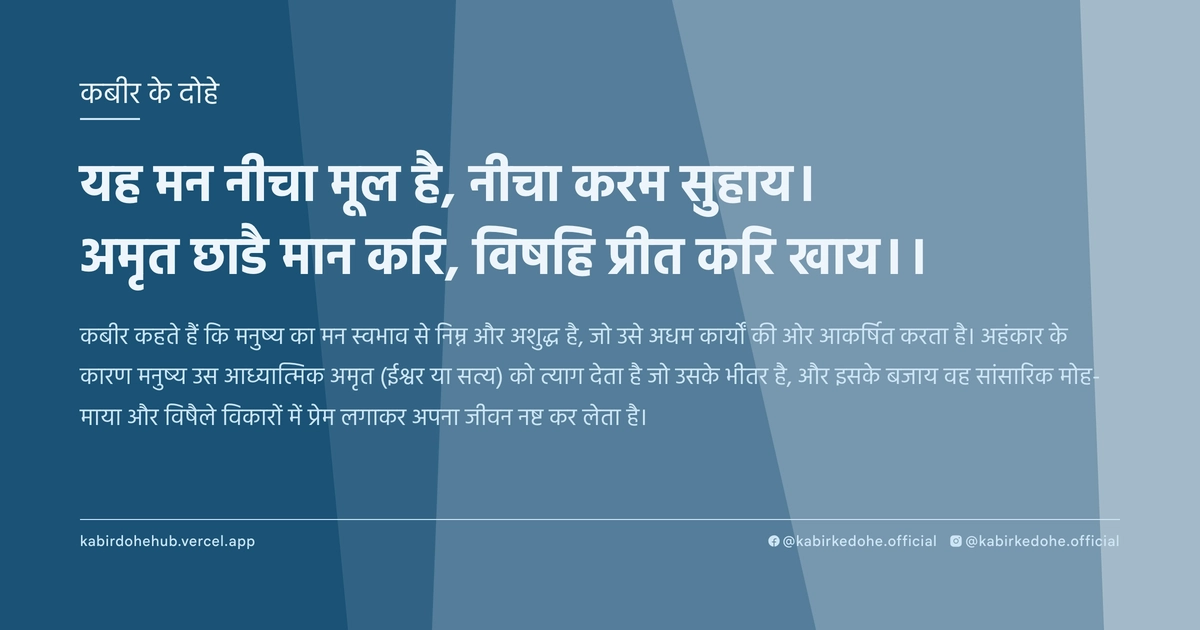
यह मन नीचा मूल है, नीचा करम सुहाय।
अमृत छाडै मान करि, विषहि प्रीत करि खाय।।
Yeh man neecha mool hai, neecha karam suhaay. Amrit chhadai maan kari, vishahi preet kari khaay.
इस पृष्ठ पर इस कबीर दोहे का अर्थ (meaning), हिंदी व्याख्या और अंग्रेज़ी अनुवाद, दार्शनिक विश्लेषण और व्यावहारिक जीवन सीख दी गई है। यह दोहा मन नियंत्रण (Mind Control) विषय से जुड़ा है — Kabir doha meaning and explanation in Hindi and English.
अर्थ (Meaning):
कबीर कहते हैं कि मनुष्य का मन स्वभाव से निम्न और अशुद्ध है, जो उसे अधम कार्यों की ओर आकर्षित करता है। अहंकार के कारण मनुष्य उस आध्यात्मिक अमृत (ईश्वर या सत्य) को त्याग देता है जो उसके भीतर है, और इसके बजाय वह सांसारिक मोह-माया और विषैले विकारों में प्रेम लगाकर अपना जीवन नष्ट कर लेता है।
Kabir asserts that the human mind is rooted in lowliness, naturally gravitating toward base desires and ignoble actions. Driven by ego and pride, the individual rejects the divine nectar of spiritual truth residing within, choosing instead to embrace and cherish the poisonous illusions of the material world and egoic attachments.
व्याख्या (Interpretation):
यह दोहा मन की द्वैतवादी प्रकृति का विश्लेषण करता है। 'नीचा मूल' का अर्थ है कि अज्ञानता के कारण मन केवल इंद्रिय सुखों को ही सत्य मानता है। यहाँ 'अमृत' निर्गुण ब्रह्म और आत्म-साक्षात्कार का प्रतीक है, जबकि 'विष' माया और अहंकार का प्रतिनिधित्व करता है। कबीर यह समझाते हैं कि जब तक 'मान' यानी अहंकार जीवित है, मनुष्य सत्य को देख नहीं पाता। यह स्थिति अद्वैत वेदांत के उस सिद्धांत को दर्शाती है जहाँ जीव अपनी वास्तविक पहचान (ब्रह्म) को भूलकर मिथ्या जगत के साथ तादात्म्य स्थापित कर लेता है। अंततः, यह एक आध्यात्मिक विरोधाभास है: हम उस अमृत की तलाश बाहर करते हैं जिसे हमने अपने अहंकार के कारण भीतर ही त्याग दिया है।
This couplet analyzes the dualistic nature of the mind. 'Neecha mool' refers to the state of ignorance where the mind perceives only sensory pleasures as reality. Here, 'Amrit' (nectar) symbolizes the Nirgun Brahman and self-realization, while 'Vish' (poison) represents Maya and the ego. Kabir explains that as long as 'Maan' or pride exists, the seeker remains blind to the Truth. This aligns with Advaita Vedanta, where the Jiva forgets its identity as Brahman and identifies with the illusory world. It presents a spiritual paradox: the human soul searches externally for the very nectar it has discarded internally due to the arrogance of the ego.
दार्शनिक विश्लेषण (Philosophical Analysis):
कबीर का यह दृष्टिकोण उनके समय के कर्मकांडीय धर्म और सामाजिक स्तरीकरण पर एक गहरा प्रहार है। वे तर्क देते हैं कि पवित्रता किसी बाहरी अनुष्ठान या जाति से नहीं, बल्कि मन की शुद्धि से आती है। उनके लिए 'नीचा' होना सामाजिक स्थिति नहीं, बल्कि चेतना की एक अवस्था है।
दार्शनिक रूप से, यह दोहा सूफी मत के 'नफ्स' (अहंकार) के विचार से मिलता-जुलता है, जहाँ आत्मा को शुद्ध करने के लिए अहंकार की मृत्यु आवश्यक है। कबीर यहाँ यह स्पष्ट करते हैं कि मनुष्य की त्रासदी यह नहीं है कि वह विष पी रहा है, बल्कि यह है कि वह विष को 'प्रेम' समझकर पी रहा है।
अद्वैत वेदांत के संदर्भ में, यह 'अविद्या' (अज्ञान) का वर्णन है। जब व्यक्ति स्वयं को शरीर और मन मानता है, तो वह माया के जाल में फंस जाता है। यह भ्रम ही उसे अमृत (मोक्ष) से दूर ले जाता है।
कबीर का विरोध उन लोगों से है जो बाहरी दिखावे को आध्यात्मिक उपलब्धि मानते हैं। वे चेतावनी देते हैं कि यदि मन का मूल आधार ही दूषित है, तो सभी बाहरी पूजा-पाठ व्यर्थ हैं।
मनोवैज्ञानिक स्तर पर, यह 'संज्ञानात्मक विसंगति' की बात करता है—जहाँ हम जानते हैं कि क्या सही है, फिर भी हम अपनी आदतों और अहंकार के कारण गलत को चुनते हैं। यह अहंकार का वह सूक्ष्म स्तर है जो हमें विश्वास दिलाता है कि हमारी अशुद्धियाँ ही हमारी पहचान हैं।
Kabir's perspective is a profound critique of the ritualistic religion and social stratification of his era. He argues that purity does not stem from external rites or caste, but from the purification of the mind. To him, being 'low' is not a social status but a state of consciousness.
Philosophically, this aligns with the Sufi concept of 'Nafs' (the lower self/ego), where the death of the ego is essential for the soul's ascent. Kabir emphasizes that the human tragedy is not merely the consumption of poison, but the act of loving the poison, mistaking it for sustenance.
In the context of Advaita Vedanta, this describes 'Avidya' (ignorance). When an individual identifies solely with the body and mind, they become entangled in Maya. This illusion diverts them from the Amrit, or liberation (Moksha).
Kabir opposes those who mistake external piety for spiritual achievement. He warns that if the root of the mind remains corrupted, all external rituals are futile and meaningless.
Psychologically, this addresses a form of cognitive dissonance—where one knows the truth but continues to choose the detrimental path due to ingrained habits and ego. It highlights the subtle layer of pride that convinces us that our flaws are our identity.
मूल संदेश (Core Message):
- अहंकार वह विष है जो अमृत का स्वाद भुला देता है।
- बाहरी पवित्रता व्यर्थ है यदि मन का मूल दूषित है।
- सत्य की प्राप्ति के लिए 'मैं' का विसर्जन अनिवार्य है।
- प्रेम ही वह औषधि है जो मन के विष को नष्ट करती है।
- आत्मा का वास्तविक स्वरूप निर्गुण और अहंकार-मुक्त है।
- Ego is the poison that erases the taste of divine nectar.
- External purity is futile if the root of the mind is corrupted.
- The dissolution of 'I' is mandatory for the realization of Truth.
- Love is the only medicine capable of neutralizing the mind's poison.
- The true nature of the soul is formless and free from ego.
व्यावहारिक उदाहरण (Practical Example):
वाराणसी के घाटों पर रहने वाले एक वृद्ध विधवा, जानकी की कहानी है। जानकी ने अपना पूरा जीवन कठोर तपस्या और बाहरी नियमों के पालन में बिताया। वह मानती थी कि उसकी कठोरता ही उसे ईश्वर के करीब ले जाएगी।
वह अन्य महिलाओं को उनकी छोटी गलतियों पर टोकती और खुद को उनसे श्रेष्ठ मानती। उसका 'मान' (अहंकार) उसकी भक्ति का आवरण बन गया था।
एक दिन उसने एक छोटे बच्चे को देखा जो बिना किसी नियम के, केवल प्रेम से एक फटे हुए कपड़े के टुकड़े पर बैठकर भजन गा रहा था। बच्चे की आँखों में वह शांति थी जो जानकी ने दशकों की तपस्या के बाद भी नहीं पाई थी।
जानकी ने बच्चे से पूछा, 'तुमने कौन से शास्त्र पढ़े?' बच्चे ने हँसकर कहा, 'माँ, मैंने केवल प्रेम पढ़ा है, शास्त्र तो बोझ होते हैं।'
यह बात जानकी के हृदय में चुभी। उसे एहसास हुआ कि वह जिस 'पवित्रता' का ढोंग कर रही थी, वह वास्तव में उसके अहंकार का विष था।
उसने महसूस किया कि वह अमृत (ईश्वर के प्रेम) को त्याग कर अपनी श्रेष्ठता के विष को पी रही थी।
उस रात जानकी ने अपनी सारी कठोरता त्याग दी। उसने उन महिलाओं से क्षमा मांगी जिन्हें उसने नीचा दिखाया था।
उसका व्यवहार बदल गया; अब वह नियमों की रक्षक नहीं, बल्कि करुणा की मूरत बन गई।
उसने पाया कि जब उसने अपना 'मान' छोड़ा, तो उसके भीतर का अमृत स्वतः प्रवाहित होने लगा।
उसका जीवन अब बाहरी प्रदर्शन से मुक्त होकर आंतरिक शांति में विलीन हो गया।
This is the story of Janaki, an elderly widow living on the ghats of Varanasi. Janaki had spent her entire life adhering to rigorous penance and external religious codes. She believed her austerity was the only path to the Divine.
She would constantly correct other women for their minor lapses, viewing herself as spiritually superior. Her 'Maan' (pride) had become the very veil covering her devotion.
One day, she noticed a small child sitting on a torn piece of cloth, singing hymns with an effortless, pure joy. The child possessed a serenity that Janaki had failed to achieve despite decades of discipline.
Janaki asked the child, 'Which scriptures have you studied to attain such peace?' The child laughed and replied, 'Mother, I have only studied love; scriptures can sometimes be a burden.'
These words pierced Janaki's heart. She realized that the 'purity' she was projecting was actually the poison of her own ego.
She understood that she had discarded the Amrit (the nectar of divine love) to feast upon the poison of her own perceived superiority.
That night, Janaki let go of her rigidity. She sought forgiveness from the women she had looked down upon.
Her behavior transformed; she was no longer the guardian of rules, but an embodiment of compassion.
She discovered that once she relinquished her pride, the internal nectar began to flow spontaneously.
Her life shifted from a performance of piety to a state of genuine internal peace.
अभ्यास मार्गदर्शन (Practice Guidance):
- दैनिक आत्म-निरीक्षण: प्रतिदिन 15 मिनट मौन बैठें और उन क्षणों को पहचानें जब आपने अपनी श्रेष्ठता सिद्ध करने के लिए दूसरों को नीचा दिखाया।
- अहंकार का विसर्जन: जब भी मन में 'मैं सही हूँ और दूसरा गलत' का भाव आए, तो रुकें और पूछें—'क्या यह सत्य है या मेरा अहंकार?'
- सेवा का अभ्यास: बिना किसी प्रशंसा की इच्छा के किसी ऐसे व्यक्ति की मदद करें जिसे समाज 'नीचा' समझता है।
- निदान चेकलिस्ट: क्या मैं दूसरों की आलोचना करके खुद को बेहतर महसूस करता हूँ? क्या मेरी भक्ति में दूसरों के प्रति निर्णय (judgment) शामिल है? यदि हाँ, तो आप विष का सेवन कर रहे हैं।
- Daily Self-Inquiry: Sit in silence for 15 minutes daily and identify moments where you belittled others to establish your own superiority.
- Ego Dissolution: Whenever the thought 'I am right and the other is wrong' arises, pause and ask—'Is this the Truth, or is this my ego?'
- Practice of Service: Help someone whom society deems 'low' or 'inferior,' doing so without any desire for recognition or praise.
- Diagnostic Checklist: Do I feel better about myself after criticizing others? Does my spirituality involve judging others? If yes, you are consuming the poison of the ego.
चिंतन प्रश्न (Reflection Questions):
- मेरे जीवन का वह कौन सा 'अमृत' है जिसे मैंने अपनी सामाजिक छवि (image) को बचाने के लिए त्याग दिया?
- मैं अपनी डिजिटल पहचान (social media ego) के माध्यम से किस प्रकार के 'विष' का सेवन कर रहा हूँ?
- क्या मेरी नैतिकता वास्तव में करुणा से प्रेरित है, या यह दूसरों को नियंत्रित करने का एक साधन है?
- यदि मेरी सभी उपलब्धियाँ और पद छीन लिए जाएँ, तो मेरे भीतर क्या बचेगा?
- मैं किन लोगों को 'नीचा' मानता हूँ, और यह धारणा मेरे अपने किस डर या असुरक्षा को छिपा रही है?
- What 'nectar' in my life have I discarded simply to protect my social image?
- In what ways am I consuming 'poison' through the maintenance of my digital ego on social media?
- Is my morality truly driven by compassion, or is it a tool to control and judge others?
- If all my achievements and titles were stripped away, what would remain of me?
- Whom do I perceive as 'inferior,' and what fear or insecurity within myself does this judgment hide?