
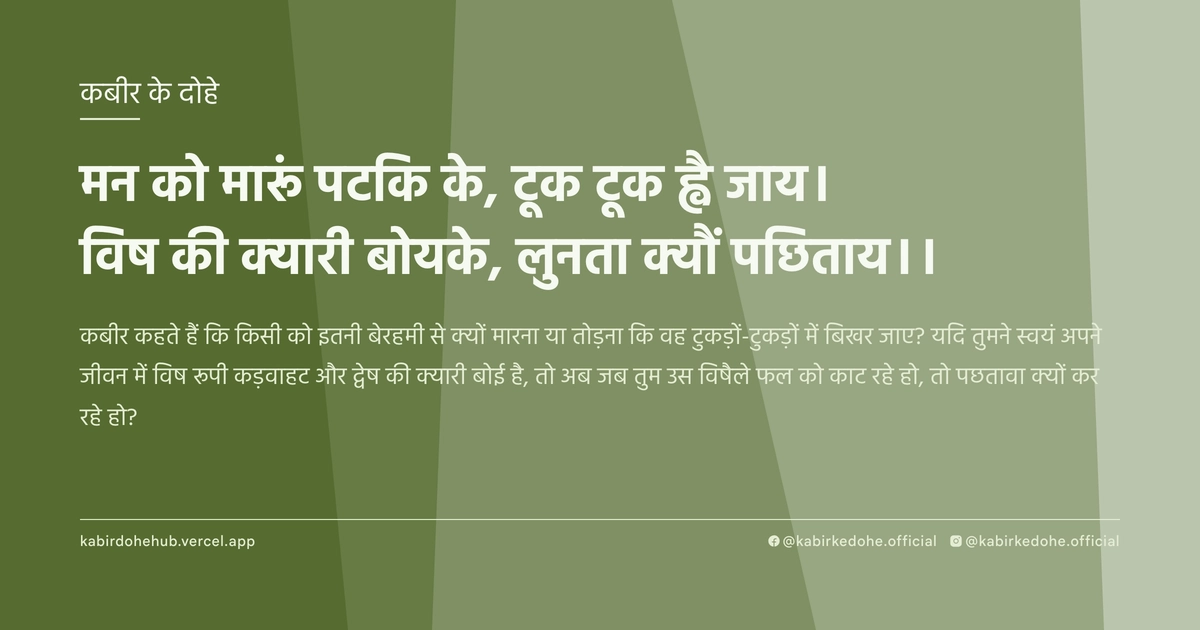
मन को मारूं पटकि के, टूक टूक ह्वै जाय।
विष की क्यारी बोयके, लुनता क्यौं पछिताय।।
Man ko maroon patki ke, took took hvai jaaye. Vish ki kyaari boyke, lunta kyun pachitay.
इस पृष्ठ पर इस कबीर दोहे का अर्थ (meaning), हिंदी व्याख्या और अंग्रेज़ी अनुवाद, दार्शनिक विश्लेषण और व्यावहारिक जीवन सीख दी गई है। यह दोहा कर्म (Karma) विषय से जुड़ा है — Kabir doha meaning and explanation in Hindi and English.
अर्थ (Meaning):
कबीर कहते हैं कि किसी को इतनी बेरहमी से क्यों मारना या तोड़ना कि वह टुकड़ों-टुकड़ों में बिखर जाए? यदि तुमने स्वयं अपने जीवन में विष रूपी कड़वाहट और द्वेष की क्यारी बोई है, तो अब जब तुम उस विषैले फल को काट रहे हो, तो पछतावा क्यों कर रहे हो?
Kabir asks why one resorts to such extreme violence or cruelty that it shatters another human being into pieces. He posits a spiritual law of causality: if you have spent your life planting a garden of poison—filled with hatred, malice, and ego—why do you now lament and grieve when you are forced to harvest the bitter fruits of those very seeds?
व्याख्या (Interpretation):
यह दोहा कर्म के सिद्धांत और मानवीय करुणा के अंतर्संबंधों की व्याख्या करता है। 'पटकि के मारना' केवल शारीरिक हिंसा नहीं, बल्कि अहंकार द्वारा दूसरे के आत्म-सम्मान को कुचलने का प्रतीक है। 'विष की क्यारी' मन की उन प्रवृत्तियों को दर्शाती है जहाँ ईर्ष्या और क्रोध पनपते हैं। निर्गुण भक्ति के परिप्रेक्ष्य में, जब साधक दूसरे में उसी परमात्मा को नहीं देखता, तो वह वास्तव में स्वयं को ही खंडित कर रहा होता है। यह माया के उस भ्रम को उजागर करता है जहाँ व्यक्ति मानता है कि वह दूसरे को नुकसान पहुँचाकर स्वयं सुरक्षित रह सकता है। अंततः, यह अद्वैत वेदांत की उस स्थिति की ओर संकेत करता है जहाँ 'स्व' और 'पर' का भेद मिट जाता है, और हिंसा केवल आत्म-विनाश बन जाती है। यह विरोधाभास है कि मनुष्य शांति की खोज तो करता है, परंतु उसके बीज घृणा के बोता है।
This couplet elucidates the profound interconnection between the law of Karma and human compassion. 'Shattering someone into pieces' is not merely physical violence but a metaphor for the ego crushing another's spiritual essence. The 'garden of poison' represents the mental landscape where jealousy, hatred, and arrogance are cultivated. In the context of Nirgun Bhakti, when a seeker fails to recognize the Divine in the other, they are essentially fracturing their own soul. It exposes the illusion of Maya, where the individual falsely believes they can harm another while remaining unscathed. Ultimately, it aligns with Advaita Vedanta's non-duality, suggesting that since there is no 'other,' all violence is self-inflicted. The central paradox lies in the human tendency to crave peace while diligently planting the seeds of discord.
दार्शनिक विश्लेषण (Philosophical Analysis):
कबीर का यह प्रहार उनके समय के सामाजिक और धार्मिक पाखंडों पर एक गहरा कटाक्ष है। उन्होंने देखा कि कैसे धर्म के नाम पर लोग एक-दूसरे को नीचा दिखाते थे और जातिगत श्रेष्ठता के अहंकार में दूसरों के अस्तित्व को 'टुकड़ों' में तोड़ देते थे। कबीर यहाँ कर्म के सिद्धांत को एक मनोवैज्ञानिक दर्पण के रूप में प्रस्तुत करते हैं। वे बताते हैं कि बाहरी दुनिया में हम जो भी बोते हैं, वह वास्तव में हमारे आंतरिक अवचेतन का प्रतिबिंब होता है।
अद्वैत वेदांत के अनुसार, ब्रह्म ही एकमात्र सत्य है और जगत मिथ्या है। यदि हम इस सत्य को स्वीकार करें, तो किसी दूसरे के प्रति हिंसा करना असंभव हो जाता है क्योंकि 'दूसरा' कोई है ही नहीं। कबीर इस दार्शनिक सत्य को एक सरल ग्रामीण रूपक (क्यारी और विष) के माध्यम से समझाते हैं। वे सूफी मत के 'इश्क-ए-हकीकी' (ईश्वरीय प्रेम) से प्रभावित हैं, जहाँ प्रेम ही एकमात्र मार्ग है और घृणा आत्मा की सबसे बड़ी बाधा है।
यहाँ 'विष' का अर्थ केवल क्रोध नहीं, बल्कि 'अहंकार' (Ego) है। जब अहंकार हावी होता है, तो व्यक्ति स्वयं को कर्ता मानता है और दूसरों को केवल वस्तु। यह 'कर्ता भाव' ही दुख का मूल कारण है। कबीर सुझाव देते हैं कि जब तक हम अपने भीतर के विष को नहीं पहचानते, हम बाहरी दुनिया में केवल संघर्ष ही पाएंगे।
अनुष्ठानों और कर्मकांडों के प्रति कबीर की अस्वीकृति यहाँ स्पष्ट है। वे कहते हैं कि मंदिर या मस्जिद जाने से अधिक महत्वपूर्ण यह है कि आप अपने व्यवहार में करुणा लाएं। यदि आपका हृदय विषैला है, तो आपकी पूजा केवल एक ढोंग है। वास्तविक शुद्धि बाहरी स्नान से नहीं, बल्कि आंतरिक क्षमा और प्रेम से आती है।
मनोवैज्ञानिक स्तर पर, यह दोहा 'प्रोजेक्शन' (Projection) की प्रक्रिया को समझाता है। हम अक्सर अपनी आंतरिक कुंठाओं को दूसरों पर थोकते हैं और फिर उसके परिणामों से दुखी होते हैं। कबीर इस चक्र को तोड़ने के लिए आत्म-जागरूकता और 'साक्षी भाव' की वकालत करते हैं, जिससे व्यक्ति अपने कर्मों के प्रति उत्तरदायी बन सके।
Kabir’s critique serves as a profound commentary on the social and religious hypocrisies of his era. He witnessed how people, in the name of faith, belittled others and shattered human dignity under the weight of caste superiority. Here, Kabir presents the law of Karma not as a divine punishment, but as a psychological mirror. He asserts that whatever we sow in the external world is a direct reflection of our internal subconscious landscape.
According to Advaita Vedanta, Brahman is the only reality, and the perceived separation is an illusion. If this truth is realized, violence against another becomes an impossibility because there is no 'other.' Kabir translates this complex metaphysical truth into a simple agrarian metaphor—the garden and the poison—making the highest philosophy accessible to the common man.
Influenced by the Sufi concept of 'Ishq-e-Haqiqi' (Divine Love), Kabir posits that love is the only viable path to liberation, while hatred is the primary obstacle to the soul's evolution. In this context, 'poison' is a synonym for the 'Ahamkara' or the ego. When the ego dominates, the individual views themselves as the sole actor and others as mere objects. This 'sense of doership' is the root of all suffering.
Kabir’s rejection of ritualism is stark here. He suggests that the act of visiting a temple or mosque is meaningless if the heart remains toxic. True purification does not come from ritual bathing but from the internal alchemy of forgiveness and compassion. He challenges the notion that spiritual merit can be earned through rites while maintaining a cruel disposition toward fellow beings.
Psychologically, this couplet addresses the mechanism of projection. We often project our internal frustrations onto others and then lament the resulting conflict. Kabir advocates for 'Sakshi Bhav' (the witness consciousness) and radical self-awareness, urging the individual to take absolute responsibility for the seeds they plant in their mind and life.
मूल संदेश (Core Message):
- क्रोध और अहंकार आत्मा के लिए विष के समान हैं।
- हिंसा केवल शारीरिक नहीं, बल्कि मानसिक और वाचिक भी होती है।
- हम जो दूसरों को देते हैं, वही लौटकर हमारे पास आता है।
- सच्ची आध्यात्मिक प्रगति दूसरों के प्रति करुणा में निहित है।
- अहंकार का विसर्जन ही शांति का एकमात्र मार्ग है।
- Anger and ego act as spiritual toxins within the soul.
- Violence is not merely physical; it is also mental and verbal.
- The energy we project onto others inevitably returns to us.
- True spiritual evolution is found in radical compassion.
- The dissolution of the ego is the only gateway to peace.
व्यावहारिक उदाहरण (Practical Example):
वाराणसी के एक पुराने मोहल्ले में रामदीन नाम का एक वृद्ध बुनकर रहता था। वह अपने काम में निपुण था, लेकिन स्वभाव से अत्यंत कठोर और क्रोधी था। वह अपने परिवार, पड़ोसियों और यहाँ तक कि अपने शिष्यों को भी छोटी-छोटी गलतियों पर ऐसे शब्दों से प्रहार करता था कि उनका आत्मविश्वास पूरी तरह टूट जाता था। वह मानता था कि अनुशासन केवल कठोरता से आता है।
वर्षों तक रामदीन ने अपने आस-पास कड़वाहट की एक ऐसी क्यारी बोई कि धीरे-धीरे लोग उससे दूर होने लगे। उसके बेटे ने उसके साथ बात करना बंद कर दिया और उसके शिष्य उसे छोड़कर चले गए। एक दिन रामदीन गंभीर रूप से बीमार पड़ा। उसने देखा कि जिस घर में उसने कभी प्रेम की भाषा नहीं बोली, वहाँ अब सन्नाटा पसरा है।
वह बिस्तर पर लेटा हुआ अपनी पुरानी बातों को याद कर रहा था। उसे याद आया कि कैसे उसने अपने बेटे के सपनों को 'बेकार' कहकर कुचल दिया था और कैसे उसने अपनी पत्नी के धैर्य का मजाक उड़ाया था। उसे महसूस हुआ कि वह अब जिस अकेलेपन के विष को पी रहा है, वह उसी का बोया हुआ फल है।
तभी उसकी मुलाकात एक भ्रमणकारी साधु से हुई, जिसने उसे कबीर का यह दोहा सुनाया। साधु ने कहा, 'रामदीन, तुम इस समय जिस पीड़ा में हो, वह किसी बाहरी शत्रु ने नहीं दी, बल्कि तुम्हारे अपने शब्दों के विष ने दी है। तुमने दूसरों को टुकड़ों में तोड़ा, और अब तुम्हारा अपना जीवन टुकड़ों में बिखर गया है।'
रामदीन को पहली बार अपनी गलती का अहसास हुआ। उसने महसूस किया कि उसकी 'कठोरता' वास्तव में उसका अहंकार था, जिसे वह अनुशासन समझ बैठा था। उसने अपनी आँखों से आँसू बहाते हुए अपने बेटे को बुलाया और पहली बार उससे क्षमा मांगी।
उसने अपने व्यवहार को बदलने का संकल्प लिया। उसने उन लोगों को ढूंढना शुरू किया जिन्हें उसने मानसिक चोट पहुँचाई थी। वह उनके पास गया, न कि अपनी श्रेष्ठता दिखाने, बल्कि उनकी पीड़ा को समझने के लिए।
धीरे-धीरे उसके घर का वातावरण बदलने लगा। उसने सीखा कि प्रेम और करुणा के बिना दिया गया निर्देश केवल आदेश होता है, प्रेरणा नहीं। उसने अपने बुनकर कार्य को अब केवल जीविका नहीं, बल्कि सेवा का माध्यम बनाया।
अंततः, रामदीन ने पाया कि जब उसने दूसरों के प्रति अपनी कठोरता को त्याग दिया, तो उसके भीतर का मानसिक द्वंद्व और अशांति भी समाप्त हो गई। उसने विष की क्यारी को उखाड़ फेंका और उसकी जगह क्षमा और प्रेम के बीज बोए, जिससे उसका अंतिम समय शांति और संतोष से भर गया।
In an ancient lane of Varanasi lived an elderly weaver named Ramdeen. He was a master of his craft, but his temperament was harsh and volatile. He would lash out at his family, neighbors, and apprentices with words so cutting that they would shatter the confidence of whoever heard them. He believed that discipline could only be achieved through severity.
For years, Ramdeen cultivated a garden of bitterness around him. Gradually, people began to distance themselves. His own son stopped speaking to him, and his apprentices left in search of kinder masters. One day, Ramdeen fell gravely ill, confined to his bed, surrounded by a heavy, oppressive silence.
As he lay there, he began to recall the fragments of his life. He remembered how he had crushed his son's dreams by calling them 'worthless' and how he had mocked his wife's endless patience. He realized that the poison of loneliness he was now drinking was the very harvest of the seeds he had sown.
During his recovery, he met a wandering monk who recited this specific Doha of Kabir. The monk told him, 'Ramdeen, the agony you feel now was not inflicted by an external enemy, but by the poison of your own words. You broke others into pieces, and now your own life has shattered into fragments.'
For the first time, Ramdeen faced the mirror of his soul. He realized that his 'discipline' was merely a mask for his ego. Overwhelmed by remorse, he called his son and, for the first time in decades, asked for genuine forgiveness, not as a father demanding respect, but as a flawed human seeking grace.
He vowed to transform his behavior. He began seeking out those he had emotionally wounded, not to justify his actions, but to acknowledge their pain. He learned that a command without compassion is merely an order, whereas a word spoken with love is an inspiration.
Slowly, the atmosphere of his home shifted. He turned his weaving not just into a means of livelihood, but into a service to others, teaching his craft with patience and humility.
Ultimately, Ramdeen discovered that as he ceased the violence of his tongue, the inner turmoil and restlessness within him vanished. He uprooted the garden of poison and planted seeds of forgiveness, ensuring that his final years were filled with a peace he had never known in his pride.
अभ्यास मार्गदर्शन (Practice Guidance):
- दैनिक आत्म-निरीक्षण: प्रतिदिन सोने से पहले विचार करें कि क्या आज आपने किसी के प्रति कठोर शब्दों का प्रयोग किया? यदि हाँ, तो उस भावना के मूल कारण (अहंकार, डर या क्रोध) को पहचानें।
- करुणा का अभ्यास: दिन में कम से कम एक बार किसी ऐसे व्यक्ति के प्रति दया दिखाएं जिससे आपके संबंध तनावपूर्ण हैं। यह व्यवहारिक परिवर्तन आपके आंतरिक विष को कम करेगा।
- मौन साधना: जब भी क्रोध का आवेग उठे, तुरंत प्रतिक्रिया देने के बजाय 10 गहरी सांसें लें। यह 'प्रतिक्रिया' और 'प्रतिसाद' के बीच का वह अंतराल है जहाँ आप सचेत चुनाव कर सकते हैं।
- डायग्नोस्टिक चेकलिस्ट: क्या आप दूसरों की गलतियों पर तुरंत निर्णय लेते हैं? क्या आप अपनी सफलता का श्रेय केवल स्वयं को देते हैं? क्या आप दूसरों की पीड़ा को देखकर उदासीन महसूस करते हैं? यदि हाँ, तो आप अभी भी 'विष की क्यारी' में हैं।
- Daily Self-Inquiry: Before sleep, reflect on whether you used harsh words today. Identify the root cause—was it ego, fear, or anger?—and observe how it felt in the body.
- Compassion Practice: Once a day, consciously show kindness to someone with whom you have a strained relationship. This behavioral shift neutralizes the internal poison of resentment.
- Silence Practice: When a surge of anger arises, instead of reacting immediately, take ten deep breaths. This creates a gap between 'stimulus' and 'response,' allowing for a conscious choice.
- Diagnostic Checklist: Do you judge others' mistakes instantly? Do you attribute all success solely to yourself? Do you feel indifferent to the suffering of others? If yes, you are still cultivating a 'garden of poison.'
चिंतन प्रश्न (Reflection Questions):
- मेरे जीवन में वह कौन सा 'विष' है जिसे मैं बार-बार बोता हूँ और फिर उसके परिणामों से दुखी होता हूँ?
- क्या मेरी 'ईमानदारी' वास्तव में ईमानदारी है, या यह दूसरों को नीचा दिखाने का एक तरीका है?
- मैं अपनी डिजिटल पहचान (सोशल मीडिया) पर दूसरों के प्रति कितना कठोर हूँ और यह मेरे वास्तविक स्वभाव को कैसे दर्शाता है?
- जब मैं किसी को 'टुकड़ों में तोड़ता' हूँ, तो वास्तव में मैं अपने भीतर के किस खालीपन को भरने की कोशिश कर रहा होता हूँ?
- यदि आज मेरा जीवन एक दर्पण होता, तो मुझे अपने व्यवहार में सबसे अधिक डरावनी चीज़ क्या दिखती?
- What is the specific 'poison' I repeatedly sow in my life, only to lament its bitter harvest later?
- Is my 'brutal honesty' truly about truth, or is it a sophisticated tool to diminish others?
- How does my behavior toward others in digital spaces reflect the hidden shadows of my ego?
- When I 'shatter' someone's spirit, what internal void am I desperately trying to fill?
- If my life were a mirror today, what would be the most frightening aspect of my behavior reflected back at me?