
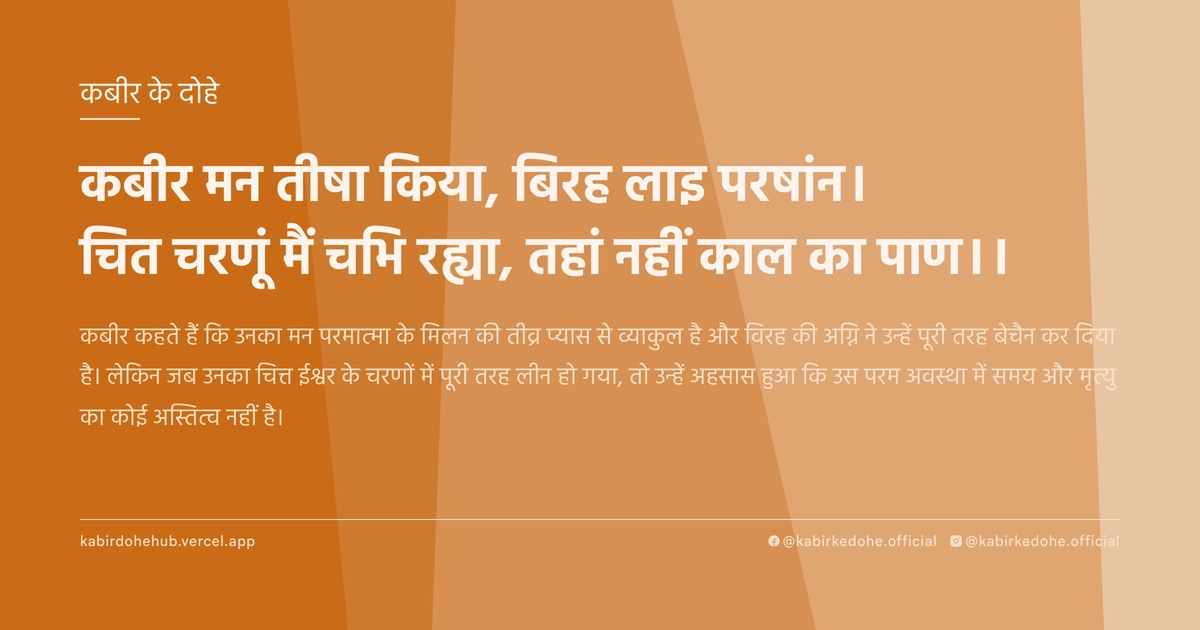
कबीर मन तीषा किया, बिरह लाइ परषांन।
चित चरणूं मैं चभि रह्या, तहां नहीं काल का पाण।।
Kabir man tisha kiya, birah lai parshan. Chit charnun main chabhi rahya, taha nahi kaal ka paan.
इस पृष्ठ पर इस कबीर दोहे का अर्थ (meaning), हिंदी व्याख्या और अंग्रेज़ी अनुवाद, दार्शनिक विश्लेषण और व्यावहारिक जीवन सीख दी गई है। यह दोहा भक्ति (Bhakti) विषय से जुड़ा है — Kabir doha meaning and explanation in Hindi and English.
अर्थ (Meaning):
कबीर कहते हैं कि उनका मन परमात्मा के मिलन की तीव्र प्यास से व्याकुल है और विरह की अग्नि ने उन्हें पूरी तरह बेचैन कर दिया है। लेकिन जब उनका चित्त ईश्वर के चरणों में पूरी तरह लीन हो गया, तो उन्हें अहसास हुआ कि उस परम अवस्था में समय और मृत्यु का कोई अस्तित्व नहीं है।
Kabir expresses a profound, aching thirst within the soul for union with the Divine, where the agony of separation has left him restless. However, once his consciousness becomes completely absorbed in the Divine feet, he discovers a timeless realm where the reach of death and the constraints of time cease to exist.
व्याख्या (Interpretation):
यह दोहा आत्मा की परमात्मा के प्रति तीव्र तड़प से शुरू होता है, जिसे 'बिरह' कहा गया है। यहाँ 'तीषा' केवल शारीरिक प्यास नहीं, बल्कि अस्तित्वगत अधूरापन है। जब साधक का चित्त (चेतना) पूरी तरह से समर्पण कर देता है, तो वह द्वैत से अद्वैत की ओर बढ़ता है। 'चरणूं में चभि रह्या' का अर्थ है अहंकार का पूर्ण विलीनीकरण। यह अवस्था निर्गुण भक्ति की पराकाष्ठा है जहाँ भक्त और भगवान एक हो जाते हैं। इस अद्वैत स्थिति में 'काल' (समय/मृत्यु) का प्रभाव समाप्त हो जाता है क्योंकि काल केवल माया और शरीर के लिए है, आत्मा के लिए नहीं। यह विरोधाभास है कि विरह की पीड़ा ही अंततः शाश्वत शांति और अमरता का द्वार खोलती है।
The couplet begins with the soul's intense longing for the Divine, termed 'Birha' or the agony of separation. Here, 'Tisha' is not mere physical thirst but an existential void. As the seeker's consciousness (Chit) surrenders completely, they transition from duality to non-duality. 'Chabhi rahyan' signifies the total dissolution of the ego into the Divine presence. This represents the pinnacle of Nirgun Bhakti, where the distinction between the devotee and the Deity vanishes. In this state of Advaita, 'Kaal' (Time/Death) loses its grip because time is a construct of Maya and the physical body, not the eternal Atman. The central paradox is that the very pain of separation serves as the catalyst for achieving timeless liberation.
दार्शनिक विश्लेषण (Philosophical Analysis):
कबीर का यह दृष्टिकोण मध्यकालीन भारत के सामाजिक और धार्मिक परिवेश में एक क्रांतिकारी मोड़ था। उन्होंने बाहरी कर्मकांडों, जैसे तीर्थयात्रा या मूर्ति पूजा, के बजाय आंतरिक विरह और प्रेम को मोक्ष का साधन माना। यह दर्शन सूफी मत के 'इश्क-ए-हकीकी' (ईश्वर के प्रति प्रेम) और अद्वैत वेदांत के 'अहं ब्रह्मास्मि' का एक अनूठा संगम है। कबीर यहाँ यह स्थापित कर रहे हैं कि ईश्वर कहीं बाहर नहीं, बल्कि चेतना के गहनतम स्तर पर स्थित है।
उनका विरह का वर्णन केवल दुख नहीं है, बल्कि एक आध्यात्मिक शोधन प्रक्रिया है। जैसे सोना आग में तपकर शुद्ध होता है, वैसे ही आत्मा विरह की अग्नि में जलकर अपने अहंकार और सांसारिक मोह का त्याग करती है। यह मनोवैज्ञानिक रूपांतरण है जहाँ 'मैं' का विलोपन होता है और केवल 'वह' शेष रहता है।
कबीर ने जाति और धर्म की सीमाओं को तोड़ते हुए यह संदेश दिया कि परमात्मा तक पहुँचने का मार्ग केवल शुद्ध प्रेम और समर्पण है। उन्होंने उन पंडितों और मुल्लाओं को चुनौती दी जो केवल शास्त्रों के ज्ञान पर गर्व करते थे, जबकि वास्तविक ज्ञान हृदय की तड़प और अनुभव से आता है।
दार्शनिक रूप से, 'काल का पाण' का अर्थ है समय की सीमा से मुक्ति। जब व्यक्ति अपनी पहचान को शरीर से हटाकर शुद्ध चेतना (ब्रह्म) से जोड़ लेता है, तो वह जन्म और मृत्यु के चक्र (संसार) से मुक्त हो जाता है। यह मोक्ष की वह स्थिति है जहाँ समय एक भ्रम बन जाता है।
अंततः, यह दोहा हमें सिखाता है कि आध्यात्मिक यात्रा में पीड़ा अनिवार्य है। वह पीड़ा हमें हमारी सीमाओं का अहसास कराती है और हमें उस अनंत की ओर धकेलती है जहाँ कोई अंत नहीं है। यह विरह ही मिलन की पहली शर्त है।
Kabir's perspective represents a revolutionary shift in the socio-religious landscape of medieval India. Instead of external rituals, such as pilgrimages or idol worship, he posits internal longing and love as the primary vehicles for liberation. This philosophy is a unique synthesis of the Sufi concept of 'Ishq-e-Haqiqi' (Divine Love) and the Advaita Vedanta realization of 'Aham Brahmasmi' (I am Brahman).
His description of 'Birha' (separation) is not merely an expression of sorrow but a process of spiritual alchemy. Just as gold is purified in fire, the soul is purged of ego and worldly attachments through the fire of longing. This is a psychological transformation where the 'I' is annihilated, leaving only the Divine presence.
By transcending caste and creed, Kabir asserted that the path to the Divine is paved solely with pure love and surrender. He challenged the scholarly pride of the Pandits and Mullas, arguing that true gnosis comes not from textual mastery but from the visceral experience of the heart's yearning.
Philosophically, 'Kaal ka paan' refers to liberation from the constraints of temporal existence. When an individual shifts their identity from the perishable body to the immutable consciousness (Brahman), they exit the cycle of birth and death (Samsara). In this state, time is revealed as a mere illusion of Maya.
Ultimately, the couplet teaches that spiritual suffering is an essential catalyst. This pain makes us aware of our limitations and propels us toward the Infinite. Separation is not the opposite of union, but the very prerequisite for it.
मूल संदेश (Core Message):
- आंतरिक तड़प ही आध्यात्मिक जागृति का वास्तविक द्वार है।
- अहंकार का विलीनीकरण ही परमात्मा से मिलन की एकमात्र शर्त है।
- समय और मृत्यु केवल शरीर के लिए हैं, आत्मा के लिए नहीं।
- बाहरी कर्मकांडों से ऊपर उठकर आंतरिक प्रेम को प्राथमिकता दें।
- अद्वैत की स्थिति में भक्त और भगवान का भेद समाप्त हो जाता है।
- Inner longing is the true gateway to spiritual awakening.
- The dissolution of ego is the sole prerequisite for Divine union.
- Time and death apply only to the body, not to the eternal soul.
- Prioritize internal love over external ritualistic performances.
- In the state of non-duality, the distinction between devotee and Divine vanishes.
व्यावहारिक उदाहरण (Practical Example):
वाराणसी के एक पुराने घाट पर माधव नाम का एक वृद्ध बुनकर रहता था। माधव का पूरा जीवन केवल धागों को जोड़ने और कपड़े बुनने में बीता था, लेकिन उसके मन में हमेशा एक अनजानी बेचैनी रहती थी। वह अक्सर सोचता था कि इस भौतिक संसार की भागदौड़ के बीच वह वास्तव में क्या खोज रहा है।
वह हर दिन मंदिर जाता, मंत्र पढ़ता और दान देता, लेकिन उसकी आंतरिक प्यास शांत नहीं होती थी। उसे लगता था कि वह ईश्वर के करीब तो है, पर उनके बीच एक अदृश्य दीवार है। यह दीवार उसके अपने अहंकार की थी, जो उसे लगता था कि वह एक 'सच्चा भक्त' है क्योंकि वह नियम मानता है।
एक दिन, माधव ने एक फकीर को सुना जो कह रहा था कि ईश्वर को पाने के लिए पहले खुद को खोना पड़ता है। माधव ने महसूस किया कि उसकी भक्ति केवल एक आदत थी, प्रेम नहीं। उसने तय किया कि वह अब बाहरी दिखावे को छोड़कर अपने भीतर की तड़प को महसूस करेगा।
शुरुआत में, यह बदलाव बहुत दर्दनाक था। उसे ऐसा लगा जैसे उसकी पूरी पहचान छिन रही है। वह रातों को जागकर रोता और उस शून्य को महसूस करता जहाँ वह खुद को पूरी तरह अकेला पाता था। यह वही 'बिरह' था जिसका जिक्र कबीर ने किया था।
धीरे-धीरे, माधव ने पाया कि जब वह अपनी इच्छाओं और अपनी 'भक्त' होने की छवि को छोड़ देता है, तो उसके भीतर एक गहरा मौन छाने लगता है। वह अब केवल कपड़े नहीं बुनता था, बल्कि हर धागे में उसे उस परमात्मा की उपस्थिति महसूस होने लगी।
एक शाम, जब वह घाट पर बैठा था, उसे अचानक अहसास हुआ कि जिस ईश्वर को वह बाहर खोज रहा था, वह वास्तव में उसके अपने अस्तित्व की गहराई में समाया हुआ है। उसकी बेचैनी अब एक असीम शांति में बदल गई थी।
अब माधव को मृत्यु का भय नहीं था। उसने देखा कि उसके आस-पास के लोग समय की चिंता में डूबे थे, लेकिन वह एक ऐसी स्थिति में था जहाँ समय ठहर गया था। वह अब केवल एक बुनकर नहीं था, बल्कि उस अनंत चेतना का हिस्सा बन चुका था।
माधव की कहानी हमें सिखाती है कि जब हम अपनी पहचान के बोझ को उतार फेंकते हैं, तभी हम उस शाश्वत सत्य का अनुभव कर सकते हैं जो समय और मृत्यु से परे है।
In the ancient ghats of Varanasi lived an elderly weaver named Madhav. Madhav's entire life had been spent intertwining threads and weaving cloth, yet an unknown restlessness always lingered in his heart. He often wondered what he was truly searching for amidst the chaos of material existence.
Every day, he visited the temple, chanted mantras, and gave alms, but his inner thirst remained unquenched. He felt that while he was close to the Divine, an invisible wall stood between them. This wall was his own ego—the belief that he was a 'true devotee' simply because he followed the rules.
One day, Madhav heard a wandering dervish say that to find God, one must first lose oneself. Madhav realized that his devotion had become a mere habit, not love. He decided to abandon external displays and instead embrace the raw longing within his soul.
Initially, this transition was agonizing. He felt as if his entire identity was being stripped away. He spent sleepless nights weeping, feeling a profound void where he found himself utterly alone. This was the 'Birha' mentioned by Kabir.
Gradually, Madhav discovered that as he let go of his desires and his image as a 'devotee,' a deep silence began to permeate his being. He no longer just wove cloth; in every thread, he began to perceive the presence of the Divine.
One evening, sitting by the river, he suddenly realized that the God he had been searching for externally was actually embedded in the deepest layers of his own existence. His restlessness transformed into an infinite peace.
Madhav no longer feared death. He observed people around him consumed by the anxiety of time, while he existed in a state where time had ceased to flow. He was no longer just a weaver, but a part of the eternal consciousness.
Madhav's story teaches us that only when we cast off the burden of our constructed identities can we experience the eternal truth that transcends time and mortality.
अभ्यास मार्गदर्शन (Practice Guidance):
- प्रतिदिन 20 मिनट मौन बैठें और अपने भीतर की उस 'प्यास' या अधूरेपन को महसूस करें, उसे दबाने के बजाय उसे स्वीकार करें।
- एक डायरी लिखें जिसमें आप अपनी उन इच्छाओं को दर्ज करें जो आपको परमात्मा या सत्य से दूर रखती हैं, और फिर उन्हें मानसिक रूप से समर्पित करें।
- व्यवहार में बदलाव: दिन भर में कम से कम तीन बार यह याद करें कि आपकी वर्तमान पहचान (नाम, पद, रिश्ता) अस्थायी है और आप केवल एक शुद्ध चेतना हैं।
- निदान चेकलिस्ट: क्या आप अभी भी बाहरी प्रशंसा खोज रहे हैं? क्या आप मृत्यु या समय के बीतने से डरते हैं? यदि हाँ, तो आप अभी भी अहंकार के दायरे में हैं।
- Sit in silence for 20 minutes daily, consciously feeling the 'thirst' or void within you; accept it rather than trying to suppress it.
- Maintain a journal to record the desires that distance you from the Truth, and then mentally surrender them to the Infinite.
- Behavioral Shift: At least three times a day, remind yourself that your current identity (name, status, role) is temporary and you are essentially pure consciousness.
- Diagnostic Checklist: Are you still seeking external validation? Do you fear death or the passage of time? If yes, you are still operating within the confines of the ego.
चिंतन प्रश्न (Reflection Questions):
- मेरी वह कौन सी 'प्यास' है जिसे मैं भौतिक सुखों से भरने की कोशिश कर रहा हूँ?
- यदि मेरी सारी सामाजिक पहचान (पद, प्रतिष्ठा) छीन ली जाए, तो वास्तव में मैं कौन हूँ?
- क्या मेरा धर्म और आध्यात्मिकता केवल एक सामाजिक मुखौटा है या इसमें वास्तविक तड़प है?
- मैं समय के बीतने से क्यों डरता हूँ, जबकि मेरी चेतना शाश्वत है?
- मेरे जीवन में 'विरह' का क्या अर्थ है—क्या यह केवल दुख है या यह मुझे किसी उच्च सत्य की ओर ले जा रहा है?
- What is the 'thirst' within me that I am trying to quench with material pleasures?
- If all my social identities (status, reputation) were stripped away, who would I truly be?
- Is my religion and spirituality merely a social mask, or is there a genuine longing within?
- Why do I fear the passage of time, while my consciousness remains eternal?
- What does 'separation' mean in my life—is it merely sorrow, or is it leading me toward a higher truth?