
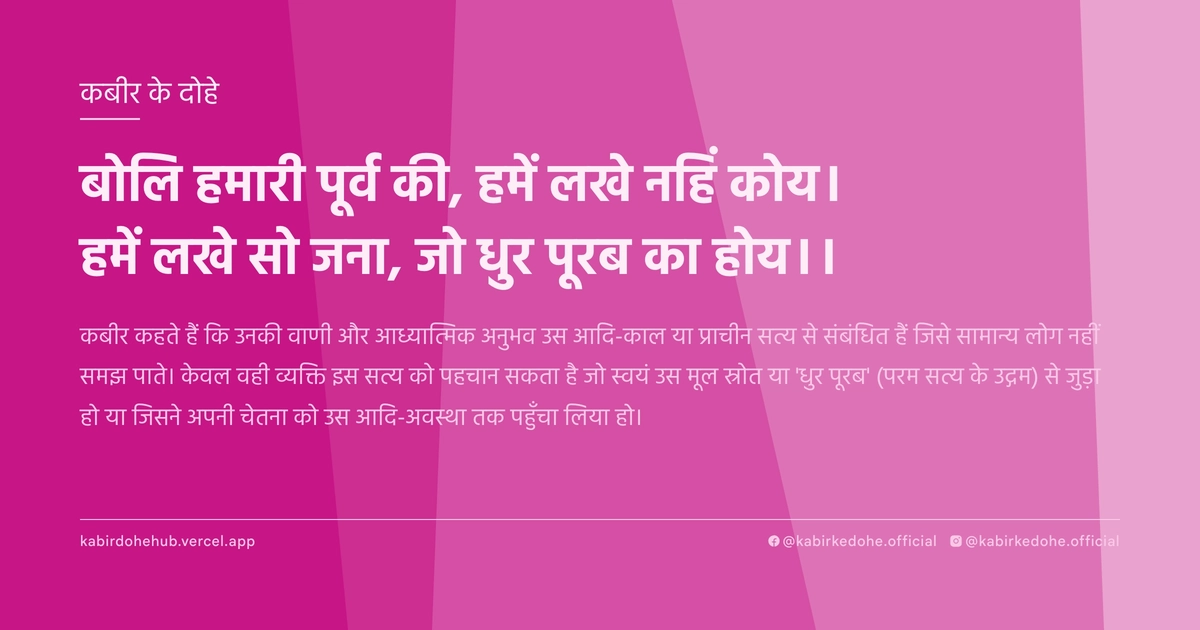
बोलि हमारी पूर्व की, हमें लखे नहिं कोय।
हमें लखे सो जना, जो धुर पूरब का होय।।
Boli hamari purv ki, hume lakhe nahin koy. Hume lakhe so jana, jo dhur purab ka hoye.
इस पृष्ठ पर इस कबीर दोहे का अर्थ (meaning), हिंदी व्याख्या और अंग्रेज़ी अनुवाद, दार्शनिक विश्लेषण और व्यावहारिक जीवन सीख दी गई है। यह दोहा विश्व-दर्शन (Universalism) विषय से जुड़ा है — Kabir doha meaning and explanation in Hindi and English.
अर्थ (Meaning):
कबीर कहते हैं कि उनकी वाणी और आध्यात्मिक अनुभव उस आदि-काल या प्राचीन सत्य से संबंधित हैं जिसे सामान्य लोग नहीं समझ पाते। केवल वही व्यक्ति इस सत्य को पहचान सकता है जो स्वयं उस मूल स्रोत या 'धुर पूरब' (परम सत्य के उद्गम) से जुड़ा हो या जिसने अपनी चेतना को उस आदि-अवस्था तक पहुँचा लिया हो।
Kabir asserts that his speech and spiritual realizations originate from a primordial time and a timeless truth that remains invisible to the ordinary eye. Only those who are attuned to the 'Dhur Purab'—the primordial East or the original source of existence—possess the spiritual vision required to recognize and comprehend the essence of his message.
व्याख्या (Interpretation):
शाब्दिक रूप से, कबीर अपनी भाषा को 'पूर्व की' कह रहे हैं, लेकिन यहाँ 'पूर्व' दिशा नहीं बल्कि सृष्टि के आरम्भिक बिंदु का प्रतीक है। यह दोहा निर्गुण भक्ति के उस गहरे रहस्य को उजागर करता है जहाँ आत्मा का मिलन परमात्मा से होता है। माया के प्रभाव में फँसा मनुष्य केवल बाहरी शब्दों को सुनता है, जबकि सत्य केवल उसी को दिखता है जिसने अहंकार का त्याग कर दिया है। यह अद्वैत वेदांत के उस सिद्धांत को दर्शाता है जहाँ ज्ञाता, ज्ञान और ज्ञेय एक हो जाते हैं। 'धुर पूरब' वह अवस्था है जहाँ द्वैत समाप्त हो जाता है और केवल शुद्ध चेतना शेष रहती है। इस प्रकार, कबीर यह स्पष्ट करते हैं कि आध्यात्मिक ज्ञान बौद्धिक नहीं, बल्कि अनुभवात्मक होता है।
Literally, Kabir refers to his language as being from the 'East,' but 'Purab' here symbolizes the primordial point of origin rather than a geographical direction. This doha unveils the profound mystery of Nirgun Bhakti, where the soul merges with the Formless Divine. A human trapped in the illusions of Maya perceives only the external words, while the truth is visible only to those who have annihilated the ego. This aligns with the Advaita Vedanta principle where the knower, the known, and the knowledge become one. 'Dhur Purab' represents that state where duality vanishes, leaving only pure consciousness. Thus, Kabir clarifies that spiritual realization is not an intellectual achievement but an experiential awakening.
दार्शनिक विश्लेषण (Philosophical Analysis):
कबीर का यह कथन उस समय की सामाजिक और धार्मिक जड़ता पर एक प्रहार है जहाँ धर्म केवल कर्मकांडों और बाहरी पहचानों तक सीमित था। वे एक ऐसे सत्य की बात कर रहे हैं जो किसी मंदिर, मस्जिद या शास्त्र की सीमाओं में नहीं बंधा है। यह दृष्टिकोण सूफी मत के 'फना' (अहंकार का विनाश) और वेदांत के 'ब्रह्म' के विचार का संगम है। कबीर का 'पूर्व' वह शून्य है जहाँ से सब उत्पन्न हुआ और जहाँ सब विलीन हो जाना है।
ऐतिहासिक रूप से, कबीर ने जाति और धर्म के कृत्रिम विभाजनों को नकार दिया क्योंकि वे जानते थे कि आत्मा की कोई जाति नहीं होती। जब वे कहते हैं कि 'हमें लखे नहिं कोय', तो वे उस आध्यात्मिक अकेलेपन की ओर इशारा करते हैं जो एक जागृत गुरु महसूस करता है। यह अकेलापन अलगाव नहीं, बल्कि उस पूर्णता का अनुभव है जिसे दुनिया की सीमित दृष्टि नहीं समझ सकती।
यहाँ 'वाणी' केवल शब्दों का समूह नहीं है, बल्कि वह 'अनहद नाद' है जो ब्रह्मांड में निरंतर गूँज रहा है। कबीर का दर्शन यह है कि सत्य को बाहर खोजने की आवश्यकता नहीं है; यह हमारे भीतर ही उस आदि-स्रोत के रूप में मौजूद है। जो व्यक्ति अपनी आंतरिक यात्रा पूरी करता है, वही कबीर की भाषा को समझ पाता है।
मनोवैज्ञानिक स्तर पर, यह दोहा चेतना के स्तरों की बात करता है। अधिकांश लोग 'सतही चेतना' में जीते हैं, जहाँ केवल भौतिक जगत सत्य है। कबीर हमें 'गहन चेतना' की ओर बुला रहे हैं, जहाँ व्यक्ति अपनी व्यक्तिगत पहचान को खोकर सार्वभौमिक पहचान प्राप्त करता है।
अंततः, यह दोहा इस बात पर जोर देता है कि सत्य का मार्ग केवल उन्हीं के लिए खुला है जो अपनी पूर्व-धारणाओं को छोड़ने के लिए तैयार हैं। यह एक आमंत्रण है उस मूल स्रोत की ओर लौटने का, जहाँ मनुष्य और ईश्वर के बीच का पर्दा गिर जाता है और केवल एक अखंड प्रकाश शेष रहता है।
Kabir's statement is a sharp critique of the social and religious rigidity of his era, where faith was confined to rituals and external identities. He speaks of a truth that transcends the boundaries of temples, mosques, or scriptures. This perspective is a confluence of the Sufi concept of 'Fana' (annihilation of the ego) and the Vedantic notion of 'Brahman.' Kabir's 'East' is the primordial void from which all existence emerges and into which all must eventually dissolve.
Historically, Kabir rejected the artificial divisions of caste and creed, recognizing that the soul possesses no caste. When he says 'none perceive me,' he points toward the spiritual solitude experienced by an awakened master. This solitude is not loneliness but the experience of a wholeness that the limited vision of the world cannot comprehend.
Here, 'speech' is not merely a collection of words, but the 'Anhad Naad'—the unstruck sound that resonates eternally throughout the cosmos. Kabir's philosophy posits that truth need not be sought externally; it exists within us as that primordial source. Only the individual who completes the inward journey can truly understand Kabir's language.
On a psychological level, this doha addresses the layers of consciousness. Most people live in 'surface consciousness,' where only the material world is real. Kabir invites us toward 'deep consciousness,' where the individual identity is shed to attain a universal identity.
Ultimately, this doha emphasizes that the path to truth is open only to those willing to abandon their preconceptions. It is an invitation to return to the original source, where the veil between the human and the divine falls away, leaving only a single, unbroken light.
मूल संदेश (Core Message):
- शब्द केवल संकेत हैं, गंतव्य नहीं।
- सत्य की भाषा केवल मौन और अनुभव है।
- अहंकार का विसर्जन ही मूल स्रोत तक पहुँचने का मार्ग है।
- बाहरी पहचानें आध्यात्मिक दृष्टि में निरर्थक हैं।
- आत्मा का उद्गम सार्वभौमिक और कालातीत है।
- Words are mere signposts, not the destination.
- The language of truth is only silence and experience.
- The dissolution of ego is the only path to the original source.
- External identities are meaningless in the eyes of spiritual vision.
- The origin of the soul is universal and timeless.
व्यावहारिक उदाहरण (Practical Example):
वाराणसी के एक पुराने घाट पर माधव नाम का एक वृद्ध बुनकर रहता था। वह अपनी कला में निपुण था, लेकिन उसका मन हमेशा अशांत रहता था। वह घंटों तक पंडितों और मौलवियों को बहस करते देखता, जहाँ हर कोई अपने धर्म को श्रेष्ठ बताने की कोशिश करता था। माधव को लगता था कि वह इन सबके बीच में होकर भी बहुत अकेला है, जैसे वह कोई ऐसी भाषा बोल रहा हो जिसे कोई समझ नहीं रहा।
एक दिन माधव की मुलाकात एक घुमक्कड़ फकीर से हुई जो घाट की सीढ़ियों पर चुपचाप बैठा था। फकीर ने माधव की आँखों में देखा और बिना कुछ कहे बस मुस्कुराया। माधव को अचानक महसूस हुआ कि यह मुस्कुराहट वही है जो वह सालों से अपने भीतर खोज रहा था। उसने फकीर से पूछा, "आप मुझे कैसे पहचान गए?"
फकीर ने उत्तर दिया, "मैंने तुम्हें नहीं, बल्कि तुम्हारे भीतर के उस मौन को देखा है जो उसी आदि-स्रोत से आता है जहाँ से मैं भी आया हूँ। हम दोनों एक ही 'पूर्व' के राही हैं।"
माधव स्तब्ध रह गया। उसने महसूस किया कि उसकी पूरी जिंदगी उसने बाहरी शोर में बिता दी थी, जबकि असली संवाद तो मौन में हो रहा था। उसे समझ आया कि उसकी बेचैनी इसलिए थी क्योंकि वह उन लोगों से अपनी पहचान खोज रहा था जो केवल शब्दों के स्तर पर बात करते थे।
उस दिन के बाद माधव ने बहस करना छोड़ दिया। उसने अपनी बुनाई को एक ध्यान बना लिया। अब जब वह धागों को जोड़ता, तो उसे लगता कि वह केवल कपड़ा नहीं बुन रहा, बल्कि अपनी आत्मा को उस सार्वभौमिक चेतना से जोड़ रहा है।
उसके आस-पास के लोग उसे 'पागल' कहने लगे क्योंकि वह अब कम बोलता था और अक्सर शून्य में ताकता रहता था। लेकिन माधव के चेहरे पर एक ऐसी शांति थी जो पहले कभी नहीं थी।
एक बार एक अहंकारी विद्वान ने उससे पूछा कि उसने क्या पाया है। माधव ने बस मुस्कुराकर कहा, "मैंने वह भाषा सीख ली है जिसमें शब्द नहीं होते, केवल अनुभव होते हैं।"
विद्वान को यह बात समझ नहीं आई, लेकिन माधव के भीतर का द्वंद्व समाप्त हो चुका था। उसने जान लिया था कि सत्य को शब्दों से नहीं, बल्कि उसी 'धुर पूरब' की अनुभूति से पहचाना जा सकता है।
माधव का जीवन अब एक जीवित उदाहरण था कि जब मनुष्य बाहरी पहचानों को त्याग कर अपने मूल स्रोत से जुड़ता है, तो वह दुनिया की भीड़ में भी अकेला नहीं रहता, बल्कि संपूर्ण ब्रह्मांड के साथ एक हो जाता है।
यह 'कबीर ट्विस्ट' था—जहाँ एक साधारण बुनकर ने शब्दों के जाल को काटकर मौन के उस आदि-सत्य को पा लिया, जिसे दुनिया की कोई भी किताबी शिक्षा नहीं दे सकती थी।
On an ancient ghat in Varanasi lived an elderly weaver named Madhav. He was a master of his craft, yet his mind was perpetually restless. He spent hours watching priests and maulvis debate, each attempting to prove their faith superior. Madhav felt an odd solitude amidst the crowd, as if he were speaking a language that no one else understood.
One day, Madhav encountered a wandering fakir sitting silently on the stone steps of the ghat. The fakir looked into Madhav's eyes and simply smiled without uttering a word. Suddenly, Madhav felt that this smile was the very thing he had been searching for within himself for years. He asked the fakir, "How did you recognize me?"
The fakir replied, "I did not see you; I saw the silence within you, which originates from the same primordial source from which I have come. We are both travelers from the same 'East.'"
Madhav was stunned. He realized he had spent his entire life immersed in external noise, while the true conversation was happening in silence. He understood that his restlessness stemmed from seeking validation from people who only communicated on the level of words.
After that day, Madhav stopped engaging in debates. He turned his weaving into a form of meditation. Now, as he interlaced the threads, he felt he wasn't just making cloth, but weaving his soul back into the universal consciousness.
The people around him began calling him 'mad' because he spoke less and often gazed into the void. However, a peace settled upon his face that had never been there before.
Once, an arrogant scholar asked him what he had discovered. Madhav simply smiled and said, "I have learned the language that has no words, only experiences."
The scholar could not comprehend this, but Madhav's inner conflict had vanished. He had realized that truth cannot be recognized through words, but only through the experience of that 'Dhur Purab.'
Madhav's life became a living testament that when a person sheds external identities and connects with their original source, they are no longer alone in the crowd, but one with the entire universe.
This was the 'Kabir Twist'—where a simple weaver cut through the web of words to find the primordial truth of silence, something no textbook education could ever provide.
अभ्यास मार्गदर्शन (Practice Guidance):
- प्रतिदिन 20 मिनट 'मौन साधना' करें, जहाँ आप शब्दों और विचारों के बिना केवल अपनी श्वास के साक्षी बनें।
- एक डायरी लिखें जिसमें आप उन क्षणों को दर्ज करें जब आपने महसूस किया कि आपकी आंतरिक सच्चाई आपकी सामाजिक पहचान से अलग है।
- व्यवहार परिवर्तन: जब कोई आपसे आपकी जाति, धर्म या पद के बारे में पूछे, तो आंतरिक रूप से मुस्कुराएं और याद करें कि ये सब 'माया' के आवरण हैं।
- निदान चेकलिस्ट: क्या आप अभी भी दूसरों की स्वीकृति के लिए अपनी बातों को बदलते हैं? क्या आप सत्य को केवल तर्कों में खोज रहे हैं? यदि हाँ, तो आप अभी भी 'धुर पूरब' से दूर हैं।
- Practice 20 minutes of 'Silent Meditation' daily, where you remain a witness to your breath without the interference of words or thoughts.
- Maintain a journal to record moments where you felt your internal truth was distinct and deeper than your social identity.
- Behavioral Shift: When someone asks about your caste, religion, or status, smile internally and remember that these are merely veils of 'Maya.'
- Diagnostic Checklist: Do you still alter your truth to seek external validation? Are you searching for truth only through logical arguments? If yes, you are still distant from the 'Dhur Purab'.
चिंतन प्रश्न (Reflection Questions):
- क्या मेरी सार्वजनिक पहचान मेरे वास्तविक स्वरूप को छिपाने का एक मुखौटा है?
- मैं किन शब्दों और धारणाओं के कारण दूसरों को समझने में विफल रहता हूँ?
- यदि मेरी सारी उपलब्धियाँ और पद छीन लिए जाएँ, तो मेरे भीतर क्या शेष बचेगा?
- क्या मैं सत्य को सुनने की क्षमता रखता हूँ, या मैं केवल वही सुनता हूँ जो मैं सुनना चाहता हूँ?
- मेरे जीवन का वह कौन सा हिस्सा है जो अभी भी 'माया' के प्रभाव में है और मुझे मूल स्रोत से दूर रख रहा है?
- Is my public identity merely a mask hiding my true essence?
- Which words and preconceptions prevent me from truly understanding others?
- If all my achievements and titles were stripped away, what would remain within me?
- Do I possess the capacity to hear the truth, or do I only hear what I want to hear?
- Which part of my life is still under the influence of 'Maya,' keeping me distant from the primordial source?