
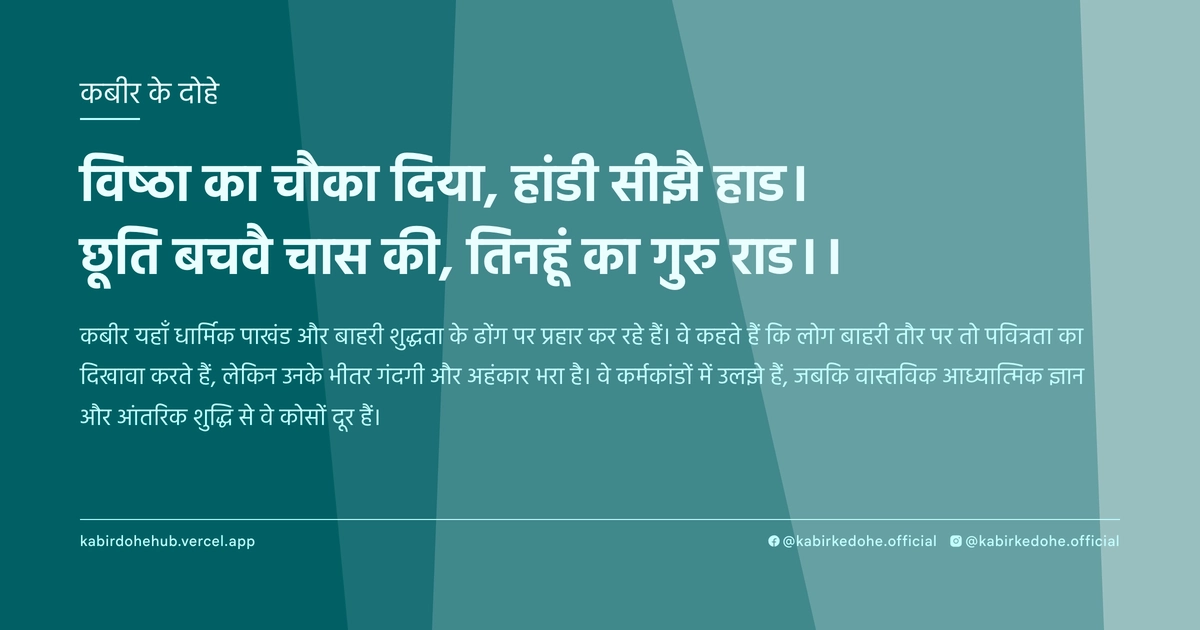
विष्ठा का चौका दिया, हांडी सीझै हाड।
छूति बचवै चास की, तिनहूं का गुरु राड।।
Vishta ka chauka diya, haandi seejhai haad. Chooti bachavai chaas ki, tinhoon ka guru raad.
इस पृष्ठ पर इस कबीर दोहे का अर्थ (meaning), हिंदी व्याख्या और अंग्रेज़ी अनुवाद, दार्शनिक विश्लेषण और व्यावहारिक जीवन सीख दी गई है। यह दोहा जाति विरोध (Anti-casteism) विषय से जुड़ा है — Kabir doha meaning and explanation in Hindi and English.
अर्थ (Meaning):
कबीर यहाँ धार्मिक पाखंड और बाहरी शुद्धता के ढोंग पर प्रहार कर रहे हैं। वे कहते हैं कि लोग बाहरी तौर पर तो पवित्रता का दिखावा करते हैं, लेकिन उनके भीतर गंदगी और अहंकार भरा है। वे कर्मकांडों में उलझे हैं, जबकि वास्तविक आध्यात्मिक ज्ञान और आंतरिक शुद्धि से वे कोसों दूर हैं।
Kabir critiques the hypocrisy of outward ritual purity and religious pretension. He suggests that while people obsess over the cleanliness of their physical surroundings and ritual spaces, their inner selves remain cluttered with filth and ego. They cling to superficial traditions while ignoring the true path of spiritual purification.
व्याख्या (Interpretation):
इस दोहे में 'विष्ठा' (मल) और 'चौका' (पवित्र स्थान) का विरोधाभास बाहरी स्वच्छता और आंतरिक अशुद्धि के बीच के अंतर को दर्शाता है। कबीर का संकेत है कि जो व्यक्ति केवल बाहरी नियमों का पालन करता है, वह वास्तव में भ्रम (माया) में है। यह निर्गुण भक्ति का सार है, जहाँ ईश्वर किसी विशेष स्थान या शुद्धता के मापदंडों में नहीं, बल्कि हृदय की सरलता में बसता है। यहाँ 'हांडी' और 'हाड' मानव शरीर और उसकी भौतिक सीमाओं का प्रतीक हैं। अंततः, कबीर यह समझाते हैं कि जब तक अहंकार का विसर्जन नहीं होता, तब तक कोई भी बाहरी अनुष्ठान व्यर्थ है, क्योंकि वास्तविक गुरु वह है जो हमें इस द्वैत से मुक्त करे।
The contrast between 'vishta' (filth) and 'chauka' (ritual purity) highlights the gap between external performance and internal reality. Kabir suggests that those obsessed with ritualistic purity are trapped in Maya, the illusion of form. In the context of Nirgun Bhakti, the Divine is not found in sanitized spaces but in the purity of a selfless heart. The 'haandi' (pot) and 'haad' (bone/structure) symbolize the physical vessel of the human body and its inherent limitations. The central paradox is that the seeker tries to reach the Infinite through finite, rigid rules. True liberation occurs only when the ego is annihilated, revealing the non-duality of Atman and Brahman, rendering all external rituals obsolete.
दार्शनिक विश्लेषण (Philosophical Analysis):
कबीर का यह दोहा उनके युग के सामाजिक और धार्मिक संघर्षों का प्रतिबिंब है, जहाँ जाति और शुद्धता के कठोर नियम हावी थे। वे ब्राह्मणवादी कर्मकांडों और सूफी मत के कुछ बाहरी रूपों, दोनों की आलोचना करते हैं। उनका दर्शन अद्वैत वेदांत के करीब है, जहाँ आत्मा और परमात्मा एक हैं, और उनके बीच केवल अज्ञानता का पर्दा है।
वे तर्क देते हैं कि यदि मन में ईर्ष्या, क्रोध और अहंकार है, तो शरीर को गंगा स्नान कराना या घर के एक कोने को पवित्र घोषित करना निरर्थक है। यह 'बाह्य आडंबर' बनाम 'आंतरिक सत्य' का संघर्ष है। कबीर के लिए, धर्म का अर्थ मंदिर जाना नहीं, बल्कि सत्य के मार्ग पर चलना है।
सूफीवाद के 'फना' (अहंकार का विनाश) के सिद्धांत की तरह, कबीर भी मानते हैं कि जब तक 'मैं' जीवित है, तब तक 'वह' (ईश्वर) प्रकट नहीं हो सकता। वे मनुष्य को अपनी सामाजिक पहचान और धार्मिक लेबल को त्यागकर अपनी मूल चेतना की ओर लौटने का आह्वान करते हैं।
मनोवैज्ञानिक स्तर पर, यह दोहा संज्ञानात्मक विसंगति (cognitive dissonance) को दर्शाता है, जहाँ व्यक्ति अपनी आंतरिक बुराइयों को छिपाने के लिए बाहरी प्रतीकों का सहारा लेता है। कबीर इस ढोंग को तोड़कर व्यक्ति को आत्म-साक्षात्कार की ओर धकेलते हैं।
अंततः, यह शिक्षण हमें बताता है कि आध्यात्मिक प्रगति का पैमाना यह नहीं है कि हमने कितने नियम माने, बल्कि यह है कि हमने अपने भीतर के कितने विकारों को समाप्त किया। यह कर्मकांड से चेतना की ओर संक्रमण है।
This doha reflects the socio-religious tensions of Kabir's era, characterized by rigid hierarchies of caste and notions of ritual purity. Kabir challenges both the Brahmanical orthodoxy and the superficial aspects of organized religion, aligning himself with the radical essence of Nirgun Bhakti. His philosophy echoes Advaita Vedanta, asserting that the perceived separation between the individual soul and the Universal Consciousness is a result of ignorance (Avidya).
He argues that physical purification, such as bathing in holy rivers or maintaining a 'pure' kitchen, is meaningless if the mind remains infested with greed, hatred, and ego. This is a direct assault on the 'external' versus 'internal' dichotomy. For Kabir, spirituality is not a set of rules but a state of being in truth.
Drawing parallels with the Sufi concept of 'Fana' (the annihilation of the self), Kabir posits that the ego is the primary veil. As long as the 'I' persists in its pride, the Divine cannot be realized. He urges the seeker to shed social labels and religious identities to rediscover their primordial essence.
Psychologically, the verse addresses the human tendency toward projection and compensation—using outward symbols of holiness to mask internal turmoil. Kabir forces the individual to confront their shadow self, stripping away the comfort of ritual to face the raw truth of their existence.
Ultimately, the teaching shifts the metric of spiritual success from adherence to dogma to the actual transformation of consciousness. It is a call to move from the mechanical performance of religion to the living experience of spirituality.
मूल संदेश (Core Message):
- बाहरी शुद्धता एक भ्रम है; वास्तविक पवित्रता हृदय की करुणा में है।
- अहंकार वह गंदगी है जिसे कोई भी गंगा स्नान नहीं धो सकता।
- धर्म नियमों का पालन नहीं, बल्कि स्वयं के विकारों का विनाश है।
- जब 'मैं' मिटता है, तभी परमात्मा का वास्तविक अनुभव होता है।
- मानवता ही सबसे बड़ा धर्म है और प्रेम ही सबसे बड़ी पूजा है।
- External purity is an illusion; true sanctity resides in a compassionate heart.
- Ego is the only filth that no ritual bath can ever wash away.
- Religion is not the adherence to rules, but the annihilation of inner vices.
- Only when the 'I' vanishes does the true experience of the Divine begin.
- Humanity is the highest religion, and love is the ultimate form of worship.
व्यावहारिक उदाहरण (Practical Example):
वाराणसी के एक पुराने मोहल्ले में रामदीन नाम का एक वृद्ध बुनकर रहता था। वह अपने आप को बहुत धार्मिक मानता था और अपने घर के एक हिस्से को 'चौका' मानकर वहां किसी को पैर रखने नहीं देता था। वह दिन भर मंत्र पढ़ता और शुद्धता के कड़े नियमों का पालन करता, लेकिन अपने ही पड़ोसियों और परिवार के सदस्यों के साथ उसका व्यवहार अत्यंत कठोर और तिरस्कारपूर्ण था।
रामदीन का मानना था कि उसकी बाहरी पवित्रता उसे ईश्वर के करीब ले जाएगी। वह अक्सर दूसरों को 'अपवित्र' कहकर उनका अपमान करता था, जबकि उसके मन में दूसरों के प्रति घृणा और श्रेष्ठता का भाव भरा रहता था।
एक दिन, उसके मोहल्ले में एक फकीर आया, जिसने रामदीन के इस व्यवहार को देखा। फकीर ने रामदीन से कहा, "तुम जिस चौके को पवित्र कहते हो, वह तो केवल मिट्टी और चूने का है, लेकिन तुम्हारा हृदय ईर्ष्या की गंदगी से भरा है। क्या तुम उस ईश्वर की पूजा कर सकते हो जिसे तुम अपने व्यवहार से हर पल दुखी करते हो?"
रामदीन को पहले तो गुस्सा आया, लेकिन फकीर की बातों ने उसके भीतर एक हलचल पैदा कर दी। उसने महसूस किया कि वह जिसे 'पवित्रता' समझ रहा था, वह वास्तव में उसका अहंकार था जो उसे दूसरों से अलग और श्रेष्ठ महसूस कराता था।
उस रात रामदीन सो नहीं सका। उसने सोचा कि वह घंटों पूजा करता है, लेकिन क्या उसने कभी किसी की मदद बिना किसी अहंकार के की? उसने महसूस किया कि उसकी 'शुद्धता' केवल एक मुखौटा थी।
अगली सुबह, रामदीन ने अपने उस 'पवित्र' चौके के दरवाजे खोल दिए और उन लोगों को आमंत्रित किया जिन्हें वह अब तक नीची नजर से देखता था। उसने अपने अहंकार की 'हांडी' को तोड़ दिया।
उसने पाया कि जब उसने दूसरों के प्रति करुणा अपनाई, तो उसे वह शांति मिली जो उसे वर्षों के कर्मकांडों से नहीं मिली थी। उसकी बाहरी शुद्धता अब आंतरिक प्रेम में बदल गई थी।
रामदीन अब केवल मंत्रों का जाप नहीं करता था, बल्कि वह अपने कर्मों से प्रेम बांटने लगा। उसने सीखा कि असली चौका वह हृदय है जहाँ सबके लिए जगह हो।
गाँव के लोग हैरान थे कि जो व्यक्ति सबसे अधिक कठोर था, वह अब सबसे अधिक विनम्र हो गया है। यह बदलाव किसी बाहरी नियम से नहीं, बल्कि एक आंतरिक बोध से आया था।
रामदीन ने अंततः समझ लिया कि ईश्वर किसी विशेष स्थान या शुद्धता के नियमों में नहीं, बल्कि मानवता और निस्वार्थ सेवा में बसता है।
In an ancient neighborhood of Varanasi lived an elderly weaver named Ramdin. He considered himself deeply religious and maintained a strictly 'pure' area in his home, the 'chauka,' where he forbade anyone from entering with 'impure' feet. He spent his days chanting mantras and adhering to rigorous purity laws, yet his behavior toward his neighbors and family was harsh and contemptuous.
Ramdin believed that this external purity would bring him closer to God. He frequently insulted others, calling them 'impure,' while his own heart was filled with hatred and a sense of superiority.
One day, a wandering Sufi dervish arrived in the neighborhood and observed Ramdin's conduct. The dervish said to him, "The 'chauka' you call pure is merely mud and lime, yet your heart is cluttered with the filth of envy. Can you truly worship a God whom you offend every moment with your cruelty?"
Ramdin was initially enraged, but the dervish's words planted a seed of doubt. He began to realize that what he perceived as 'purity' was actually his ego, using ritual as a tool to feel superior to others.
That night, Ramdin could not sleep. He questioned whether his hours of prayer mattered if he had never helped another human being without a sense of pride. He realized his purity was nothing more than a mask.
The next morning, Ramdin opened the doors of his 'sacred' space and invited the very people he had spent years belittling. He symbolically broke the 'pot' of his own ego.
He discovered that by embracing compassion, he attained a peace that years of rigid ritualism had failed to provide. His external purity transformed into internal love.
Ramdin no longer just chanted mantras; he began to distribute love through his actions. He learned that the only true 'chauka' is a heart that has room for everyone.
The villagers were astonished that the most rigid man among them had become the most humble. This transformation did not come from a new rule, but from an internal awakening.
Ramdin finally understood that the Divine does not reside in specific zones of purity or strict laws, but in the essence of humanity and selfless service.
अभ्यास मार्गदर्शन (Practice Guidance):
- दैनिक आत्म-निरीक्षण: प्रतिदिन 15 मिनट मौन बैठें और विचार करें कि क्या आपका व्यवहार आपकी धार्मिक या नैतिक छवि के अनुरूप है।
- अहंकार की पहचान: जब भी आप किसी को 'कम' या 'अपवित्र' महसूस कराएं, तो तुरंत रुकें और पूछें, "यह निर्णय मेरा है या मेरे अहंकार का?"
- सेवा का अभ्यास: सप्ताह में एक बार ऐसे व्यक्ति की मदद करें जिसे समाज 'अछूत' या 'निम्न' मानता है, बिना किसी अहसान के भाव के।
- डायरी लेखन: उन क्षणों को लिखें जब आपने बाहरी नियमों को आंतरिक सत्य से ऊपर रखा और विश्लेषण करें कि आपने ऐसा क्यों किया।
- निदान चेकलिस्ट: क्या मैं दूसरों की आलोचना अपनी श्रेष्ठता सिद्ध करने के लिए करता हूँ? क्या मेरी शांति बाहरी परिस्थितियों पर निर्भर है? क्या मैं नियमों को प्रेम से अधिक महत्व देता हूँ?
- Daily Self-Inquiry: Spend 15 minutes in silence daily, questioning whether your actual behavior aligns with the religious or moral image you project to the world.
- Ego Identification: Whenever you feel a sense of superiority or judge someone as 'impure' or 'lesser,' stop and ask, "Is this a truth, or is this my ego speaking?"
- Practice of Service: Once a week, serve someone whom society deems 'marginalized' or 'impure,' ensuring there is no sense of charity or superiority in your heart.
- Journaling: Document instances where you prioritized external rules over internal truth and analyze the psychological need that drove that choice.
- Diagnostic Checklist: Do I criticize others to validate my own superiority? Is my peace dependent on external ritualistic order? Do I value the rule more than the human being?
चिंतन प्रश्न (Reflection Questions):
- मेरे जीवन में ऐसा कौन सा 'चौका' (पवित्र क्षेत्र) है जिसे मैं दूसरों से अलग रखने के लिए उपयोग करता हूँ?
- क्या मेरी धार्मिकता वास्तव में मुझे विनम्र बना रही है, या यह मुझे दूसरों से श्रेष्ठ महसूस कराने का एक साधन है?
- यदि मेरे सभी बाहरी प्रतीक (कपड़े, तिलक, माला) छीन लिए जाएं, तो मेरी आध्यात्मिक पहचान क्या रह जाएगी?
- मैं किन लोगों को अनजाने में 'अपवित्र' या 'अयोग्य' मानता हूँ, और यह धारणा मेरे किस डर से उपजी है?
- क्या मैं सत्य को खोजने का प्रयास कर रहा हूँ, या केवल सत्य जैसा दिखने का प्रयास कर रहा हूँ?
- What is the 'chauka' (sacred space) in my life that I use to exclude others or maintain a boundary of superiority?
- Is my spirituality truly making me humble, or is it merely a tool to make me feel superior to others?
- If all my external symbols of faith (clothing, rituals, labels) were stripped away, what would remain of my spiritual identity?
- Whom do I unconsciously perceive as 'impure' or 'unworthy,' and from which hidden fear does this prejudice stem?
- Am I genuinely striving to find the Truth, or am I merely striving to appear truthful to the world?