
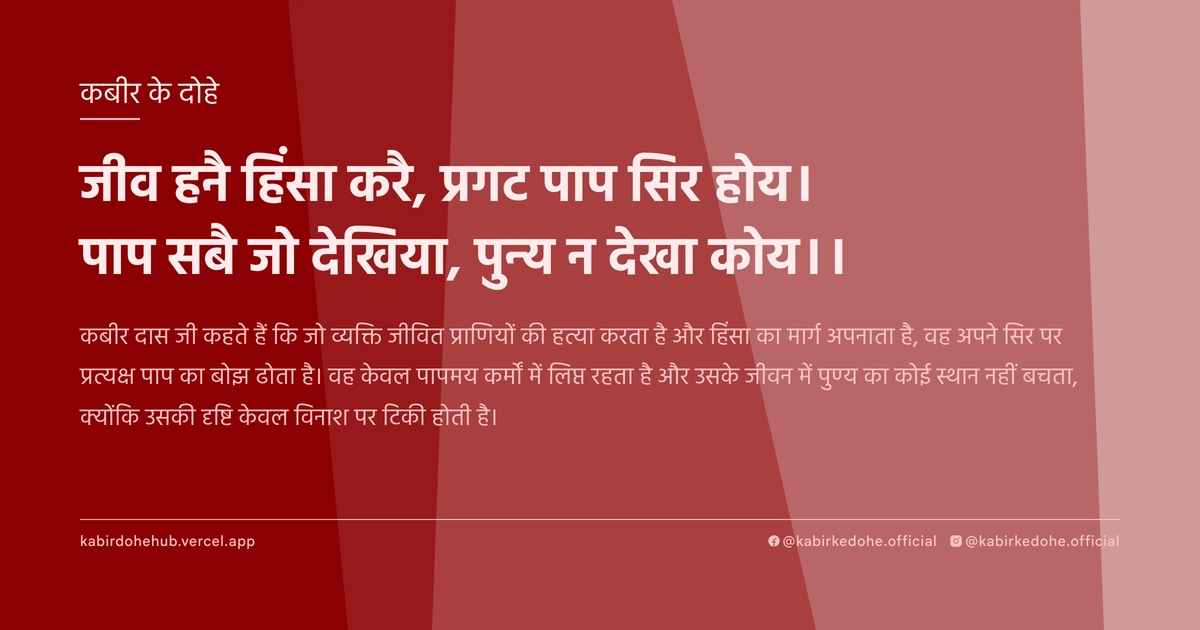
जीव हनै हिंसा करै, प्रगट पाप सिर होय।
पाप सबै जो देखिया, पुन्य न देखा कोय।।
Jeev hanai hinsa karai, pragat paap sir hoye. Paap sabai jo dekhiya, puny na dekha koy.
इस पृष्ठ पर इस कबीर दोहे का अर्थ (meaning), हिंदी व्याख्या और अंग्रेज़ी अनुवाद, दार्शनिक विश्लेषण और व्यावहारिक जीवन सीख दी गई है। यह दोहा अहिंसा (Non-violence) विषय से जुड़ा है — Kabir doha meaning and explanation in Hindi and English.
अर्थ (Meaning):
कबीर दास जी कहते हैं कि जो व्यक्ति जीवित प्राणियों की हत्या करता है और हिंसा का मार्ग अपनाता है, वह अपने सिर पर प्रत्यक्ष पाप का बोझ ढोता है। वह केवल पापमय कर्मों में लिप्त रहता है और उसके जीवन में पुण्य का कोई स्थान नहीं बचता, क्योंकि उसकी दृष्टि केवल विनाश पर टिकी होती है।
Kabir asserts that one who engages in the slaughter of living beings and embraces violence carries the manifest weight of sin upon their own head. Such a person becomes consumed by destructive actions, blinded to the path of virtue, as their consciousness is entirely occupied by the act of killing.
व्याख्या (Interpretation):
इसका शाब्दिक अर्थ है कि हिंसा करना पाप है। लेकिन आध्यात्मिक स्तर पर, 'जीव' केवल बाहरी प्राणी नहीं, बल्कि स्वयं के भीतर की करुणा और चेतना है। जब हम किसी अन्य जीव को मारते हैं, तो हम वास्तव में अपने भीतर के दैवीय अंश (Atman) की हत्या करते हैं। यह निर्गुण भक्ति का सिद्धांत है जहाँ ईश्वर हर कण में व्याप्त है; अतः हिंसा वास्तव में ईश्वर के विरुद्ध अपराध है। माया हमें यह विश्वास दिलाती है कि हम अलग-अलग हैं, जबकि अद्वैत वेदांत सिखाता है कि हम सब एक ही ब्रह्म हैं। हिंसा इस एकता के भ्रम को गहरा करती है और आत्मा को अज्ञान के अंधकार में धकेल देती है।
Literally, the verse condemns the act of killing. Metaphorically, the 'living being' represents the spark of divine consciousness present in all. By harming another, one effectively slaughters the divinity within oneself. In the realm of Nirgun Bhakti, where the Formless Divine permeates every atom, violence is an affront to the Universal Soul. Maya creates the illusion of separation, leading the ego to believe it can destroy another without destroying itself. According to Advaita Vedanta, the non-duality of Atman and Brahman implies that any act of aggression is a paradoxical assault on one's own true nature, trapping the soul in a cycle of karmic ignorance.
दार्शनिक विश्लेषण (Philosophical Analysis):
कबीर का यह दोहा उस युग की प्रतिक्रिया है जहाँ धर्म के नाम पर पशुबलि और कट्टरता चरम पर थी। उन्होंने कर्मकांडीय शुद्धता के बजाय 'जीव दया' को वास्तविक धर्म माना। यह विचार सूफी मत के 'वहदत-उल-वजूद' (अस्तित्व की एकता) से मेल खाता है, जहाँ हर रचना ईश्वर का प्रतिबिंब है।
कबीर यहाँ हिंसा को केवल शारीरिक चोट के रूप में नहीं, बल्कि चेतना के पतन के रूप में देखते हैं। जब मनुष्य हिंसा करता है, तो वह अपने अहंकार (Ego) को पुष्ट करता है, जो मोक्ष के मार्ग में सबसे बड़ी बाधा है। यह अहंकार ही उसे यह विश्वास दिलाता है कि वह दूसरों का जीवन लेने का अधिकार रखता है।
अद्वैत वेदांत के परिप्रेक्ष्य में, हिंसा 'द्वैत' (duality) का परिणाम है। जब तक हम स्वयं को दूसरों से अलग देखते हैं, तब तक घृणा और हिंसा संभव है। जैसे ही यह बोध होता है कि 'सोऽहम्' (वह मैं हूँ), हिंसा स्वतः समाप्त हो जाती है।
कबीर का प्रहार उन धार्मिक पाखंडियों पर है जो मंदिर और मस्जिद में पूजा करते हैं लेकिन बाहर निर्दोष जीवों का रक्त बहाते हैं। उनके लिए, वास्तविक इबादत या पूजा वह है जिसमें जीव मात्र के प्रति प्रेम हो।
मनोवैज्ञानिक स्तर पर, हिंसा करने वाला व्यक्ति आंतरिक शांति खो देता है। पाप का 'सिर पर होना' वास्तव में मानसिक तनाव, अपराधबोध और आध्यात्मिक शून्यता का प्रतीक है, जो व्यक्ति को सत्य के अनुभव से दूर ले जाता है।
This couplet emerges from an era rife with ritualistic animal sacrifice and religious bigotry. Kabir rejects institutionalized piety in favor of 'Jeev Daya' (compassion for all living beings), aligning his thought with the Sufi concept of 'Wahdat-al-Wujud' (the Unity of Existence), where every creation is a mirror of the Divine.
Kabir views violence not merely as a physical act, but as a regression of consciousness. The act of killing reinforces the 'Ahankar' (ego), the primary veil obscuring the path to liberation. The ego creates the delusion of superiority, granting the perpetrator a false sense of authority over the life of another.
From the lens of Advaita Vedanta, violence is the direct consequence of 'Dvaita' or duality. As long as the individual perceives a separation between the self and the other, hatred remains possible. The realization of 'So-ham' (I am That) dissolves the boundary between subject and object, rendering violence an impossibility.
Kabir specifically targets the hypocrisy of those who perform elaborate rituals in temples and mosques while shedding innocent blood outside. For him, true worship is not found in stone structures but in the heart that beats with universal love.
Psychologically, the 'sin upon the head' symbolizes the spiritual fragmentation and subconscious guilt that haunt the violent mind. This internal turbulence creates a noise that drowns out the 'Anhad Naad' (the unstruck sound of the universe), preventing the soul from achieving stillness.
मूल संदेश (Core Message):
- हिंसा केवल बाहरी कृत्य नहीं, बल्कि आंतरिक पतन है।
- हर जीवित प्राणी में वही दिव्य चेतना वास करती है जो आपमें है।
- अहंकार का विनाश ही वास्तविक अहिंसा की शुरुआत है।
- पुण्य कर्मों का संचय हिंसा के त्याग से ही संभव है।
- ब्रह्मांड की एकता को पहचानना ही हिंसा का अंतिम उपचार है।
- Violence is not merely an external act, but an internal spiritual collapse.
- The same divine consciousness resides in every living being as it does in you.
- The annihilation of the ego is the true beginning of non-violence.
- The accumulation of virtue is only possible through the cessation of harm.
- Recognizing the unity of the cosmos is the ultimate cure for violence.
व्यावहारिक उदाहरण (Practical Example):
एक समय की बात है, मुगल काल के दौरान बनारस के पास एक छोटा सा गाँव था जहाँ माधव नाम का एक कुशल शिकारी रहता था। माधव का पूरा जीवन जंगलों में जानवरों का पीछा करने और उन्हें मारने में बीता था। वह अपनी निपुणता पर गर्व करता था और मानता था कि प्रकृति का नियम ही 'शक्तिशाली का जीवित रहना' है।
माधव के घर में सुख-सुविधाएं थीं, लेकिन उसकी रातों की नींद गायब थी। उसे अक्सर डरावने सपने आते जिनमें वह उन जानवरों को देखता जिन्हें उसने मारा था। वह इसे केवल मानसिक थकान मानता था, लेकिन उसके भीतर एक गहरा खालीपन बढ़ता जा रहा था।
एक दिन, माधव की मुलाकात एक फकीर से हुई जो एक पुराने बरगद के पेड़ के नीचे बैठे थे। फकीर ने माधव की आँखों में देखा और मुस्कुराते हुए कहा, "तुम शिकार तो बहुत अच्छे करते हो, लेकिन क्या तुमने कभी उस डर को महसूस किया है जो तुम्हारी आख़िरी तीर चलने के बाद उस जीव की आँखों में होता है?"
माधव को पहली बार अपनी क्रूरता का अहसास हुआ। उसने तर्क दिया कि यह उसका पेशा है। फकीर ने उत्तर दिया, "पेशा पेट भरता है, लेकिन आत्मा को भूखा रखता है। तुम जिसे शिकार कह रहे हो, वह वास्तव में तुम्हारी अपनी करुणा की हत्या है।"
उस रात माधव सो नहीं सका। उसे महसूस हुआ कि उसके हाथों का रक्त केवल जानवरों का नहीं, बल्कि उसकी अपनी मानवता का था। उसने महसूस किया कि वह जिस 'पाप' को अनदेखा कर रहा था, वह उसके मानसिक बोझ के रूप में उसके सिर पर सवार था।
अगले दिन, माधव ने अपना धनुष तोड़ दिया। उसने तय किया कि वह अब जीवन लेगा नहीं, बल्कि जीवन की रक्षा करेगा। उसने गाँव के घायल जानवरों के लिए एक छोटा सा आश्रय बनाया।
शुरुआत में गाँव वालों ने उसका मज़ाक उड़ाया, लेकिन धीरे-धीरे माधव के चेहरे पर एक ऐसी शांति आई जो उसने पहले कभी महसूस नहीं की थी। उसका क्रोध शांत हो गया और उसकी नींद वापस आ गई।
माधव ने सीखा कि जब उसने दूसरों को मारना बंद किया, तो उसके भीतर का 'मृत' हिस्सा पुनर्जीवित हो गया। यह उसका 'कबीर ट्विस्ट' था—विनाश से सृजन की ओर संक्रमण।
During the Mughal era, in a small village near Varanasi, lived a skilled hunter named Madhav. Madhav's entire existence revolved around tracking and killing animals in the wild. He took immense pride in his precision, believing the law of nature was simply 'survival of the fittest'.
Though Madhav lived in comfort, his nights were restless. He was plagued by vivid nightmares of the creatures he had slain. He dismissed this as mere exhaustion, yet a profound emptiness grew within his chest, a void that no amount of success could fill.
One afternoon, Madhav encountered a wandering Sufi dervish sitting beneath an ancient banyan tree. The dervish looked into Madhav's eyes and smiled softly, saying, "Your aim is unerring, but have you ever felt the terror that lingers in the eyes of the beast after your final arrow finds its mark?"
For the first time, Madhav felt the sting of his own cruelty. He argued that hunting was his profession. The dervish replied, "A profession fills the belly, but it can starve the soul. What you call hunting is actually the systematic slaughter of your own compassion."
That night, Madhav could not sleep. He realized that the blood on his hands was not just that of animals, but of his own dwindling humanity. He understood that the 'sin' he had ignored was the heavy psychological burden weighing upon his spirit.
The following morning, in a moment of clarity, Madhav broke his bow. He vowed that he would no longer take life but would instead become a guardian of it. He established a small sanctuary for injured wildlife in his village.
Initially, the villagers mocked his sudden change of heart. However, over time, a luminous peace settled upon Madhav's face—a serenity he had never known. His anger vanished, and his sleep became deep and restorative.
Madhav discovered that by ceasing to kill others, the 'dead' part of his own soul was resurrected. This was his 'Kabir Twist'—the radical transition from a life of destruction to a life of preservation.
अभ्यास मार्गदर्शन (Practice Guidance):
- दैनिक करुणा अभ्यास: प्रतिदिन कम से कम एक ऐसे जीव (पक्षी, कीट या पशु) की मदद करें जो असहाय हो, और महसूस करें कि वह जीव आप ही हैं।
- आत्म-निरीक्षण जर्नलिंग: लिखें कि दिन भर में आपने कितनी बार अनजाने में किसी के प्रति कठोरता दिखाई। विश्लेषण करें कि वह कठोरता आपके किस डर या अहंकार से उपजी थी।
- अहिंसा संकल्प: केवल शारीरिक हिंसा ही नहीं, बल्कि मानसिक और वाचिक (वाणी द्वारा) हिंसा का त्याग करें। किसी को नीचा दिखाना भी एक प्रकार की हिंसा है।
- डायग्नोस्टिक चेकलिस्ट: क्या आप दूसरों की पीड़ा देखकर विचलित होते हैं? क्या आप अपनी सफलता के लिए दूसरों के नुकसान को स्वीकार करते हैं? यदि उत्तर 'नहीं' और 'हाँ' है, तो आप अभी भी माया के प्रभाव में हैं।
- Daily Compassion Practice: Spend a few moments each day helping a creature (bird, insect, or animal) in distress, consciously acknowledging that the life within them is identical to the life within you.
- Self-Inquiry Journaling: Document every instance where you were unconsciously harsh toward another. Analyze which specific fear or ego-driven impulse triggered that aggression.
- Vow of Non-Violence: Extend the definition of Ahimsa beyond physical harm to include mental and verbal violence. Recognize that belittling another is a form of spiritual slaughter.
- Diagnostic Checklist: Do you feel a visceral ache when seeing others suffer? Do you justify the harm of others for your own gain? If the first is 'no' and the second is 'yes', you are still operating under the veil of Maya.
चिंतन प्रश्न (Reflection Questions):
- क्या मेरा 'सभ्य' व्यवहार वास्तव में करुणा है, या केवल सामाजिक दबाव के कारण छिपा हुआ क्रोध?
- मैं उन जीवों के प्रति कितना क्रूर हूँ जिन्हें मैं 'उपयोगी' नहीं मानता?
- क्या मेरी डिजिटल पहचान (सोशल मीडिया) पर दूसरों की आलोचना करना एक सूक्ष्म हिंसा नहीं है?
- जब मैं किसी की सफलता से जलता हूँ, तो क्या मैं मानसिक रूप से उसकी हत्या नहीं कर रहा होता?
- मेरे जीवन का वह कौन सा हिस्सा है जहाँ मैं अभी भी 'शक्ति' को 'प्रेम' से ऊपर रखता हूँ?
- Is my 'civilized' behavior true compassion, or is it merely suppressed rage masked by social convention?
- How cruel am I toward the creatures I deem 'useless' or 'insignificant' to my life?
- Is the act of criticizing others through my digital persona not a subtle form of spiritual violence?
- When I feel envy toward another's success, am I not mentally attempting to annihilate their joy?
- In which areas of my life do I still prioritize 'power' over 'love'?