
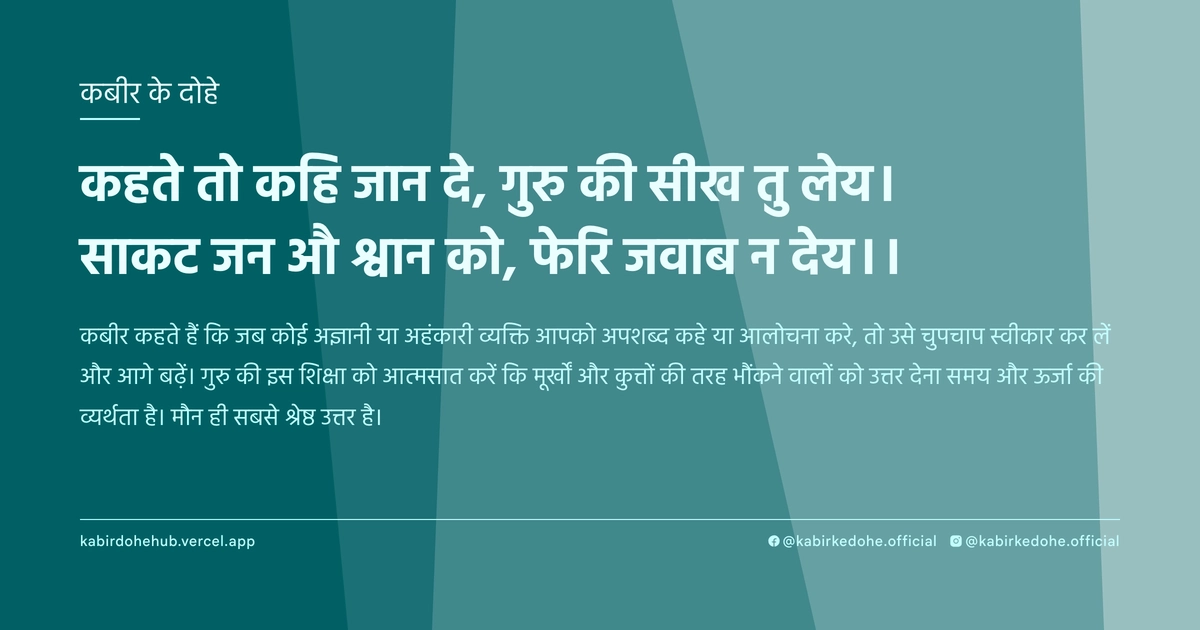
कहते तो कहि जान दे, गुरु की सीख तु लेय।
साकट जन औ श्वान को, फेरि जवाब न देय।।
Kahte to kahi jaan de, guru ki seekh tu ley. Saakat jan au shwan ko, pheri jawab na dey.
इस पृष्ठ पर इस कबीर दोहे का अर्थ (meaning), हिंदी व्याख्या और अंग्रेज़ी अनुवाद, दार्शनिक विश्लेषण और व्यावहारिक जीवन सीख दी गई है। यह दोहा गुरु महत्व (The Guru's Importance) विषय से जुड़ा है — Kabir doha meaning and explanation in Hindi and English.
अर्थ (Meaning):
कबीर कहते हैं कि जब कोई अज्ञानी या अहंकारी व्यक्ति आपको अपशब्द कहे या आलोचना करे, तो उसे चुपचाप स्वीकार कर लें और आगे बढ़ें। गुरु की इस शिक्षा को आत्मसात करें कि मूर्खों और कुत्तों की तरह भौंकने वालों को उत्तर देना समय और ऊर्जा की व्यर्थता है। मौन ही सबसे श्रेष्ठ उत्तर है।
Kabir advises that when an ignorant or arrogant person insults you or criticizes you unfairly, accept it silently and move forward. Embrace the Guru's teaching that responding to those who act like mindless dogs or foolish people is a waste of spiritual energy. Silence is the most profound and powerful response to ignorance.
व्याख्या (Interpretation):
शाब्दिक अर्थ यह है कि मूर्खों से बहस न करें। लेकिन आध्यात्मिक स्तर पर, यह 'अहंकार' के विसर्जन की प्रक्रिया है। जब कोई हमें गाली देता है, तो हमारा 'अहं' (Ego) घायल होता है और प्रतिक्रिया करना चाहता है। यह प्रतिक्रिया ही हमें माया के बंधन में जकड़े रखती है। निर्गुण भक्ति में, साधक स्वयं को शून्य करता है। यदि आप प्रतिक्रिया नहीं करते, तो आप उस द्वंद्व से मुक्त हो जाते हैं जो आत्मा और परमात्मा के बीच की दूरी बढ़ाता है। यह अद्वैत वेदांत के उस सिद्धांत की ओर संकेत है जहाँ ज्ञाता और ज्ञेय का भेद मिट जाता है, और बाहरी शोर केवल एक भ्रम बन जाता है।
Literally, it warns against arguing with fools. Spiritually, however, this is a process of dissolving the 'Ahamkara' or ego. When insulted, the ego feels wounded and demands a reaction; this reaction is the very chain that binds us to Maya (illusion). In Nirgun Bhakti, the seeker strives for 'Shunya' (emptiness). By refusing to react, one transcends the duality of offense and defense, which otherwise obscures the realization of Atman-Brahman non-duality. It suggests that the external noise of the world is a mere ripple on the surface of a deep, silent ocean of consciousness.
दार्शनिक विश्लेषण (Philosophical Analysis):
कबीर का यह दोहा उस सामाजिक और धार्मिक परिवेश में रचा गया था जहाँ कट्टरता और बाहरी आडंबर चरम पर थे। कबीर ने देखा कि लोग धर्म के नाम पर एक-दूसरे को नीचा दिखाते हैं और व्यर्थ के विवादों में उलझे रहते हैं। यहाँ वे कर्मकांडों के बजाय आंतरिक शांति और विवेक पर बल देते हैं।
यह विचार सूफी मत के 'फना' (अहंकार का विनाश) से मेल खाता है, जहाँ साधक अपनी व्यक्तिगत पहचान को ईश्वर की इच्छा में विलीन कर देता है। जब व्यक्ति यह जान लेता है कि वह शरीर नहीं बल्कि अविनाशी आत्मा है, तो बाहरी शब्दों का प्रभाव समाप्त हो जाता है।
अद्वैत वेदांत के अनुसार, संसार एक मिथ्या है। यदि कोई आपको गाली देता है, तो वह वास्तव में अपनी ही अज्ञानता को प्रकट कर रहा होता है। यदि आप क्रोधित होते हैं, तो आप उस अज्ञानता के जाल में फंस जाते हैं। कबीर यहाँ 'साक्षी भाव' (Witness Consciousness) विकसित करने की प्रेरणा दे रहे हैं।
यह दोहा केवल सामाजिक शिष्टाचार नहीं है, बल्कि एक मनोवैज्ञानिक उपकरण है। यह सिखाता है कि हमारी शांति दूसरों के व्यवहार पर निर्भर नहीं होनी चाहिए। प्रतिक्रिया न करना कमजोरी नहीं, बल्कि उच्चतम स्तर की आत्म-नियंत्रण शक्ति है।
अंततः, कबीर यह स्पष्ट करते हैं कि सत्य की खोज बाहरी विवादों से नहीं, बल्कि आंतरिक मौन से होती है। जो व्यक्ति अपनी ऊर्जा को बाहरी शोर से हटाकर अंतर्मुखी करता है, वही वास्तविक ज्ञान प्राप्त कर सकता है।
Kabir composed this couplet during an era of intense religious bigotry and ritualistic rigidity. He observed how people, in the name of faith, demeaned others and became entangled in futile disputes. Here, he prioritizes internal equanimity and discernment over external religious performance.
This philosophy aligns with the Sufi concept of 'Fana' (annihilation of the self), where the seeker dissolves their individual ego into the Divine Will. Once a person realizes they are not the transient body but the eternal Soul, the impact of external words vanishes.
According to Advaita Vedanta, the perceived world is Maya. When someone insults you, they are merely projecting their own ignorance. If you react with anger, you succumb to that same ignorance. Kabir encourages the cultivation of 'Sakshi Bhava' or Witness Consciousness.
This verse is not merely about social etiquette; it is a psychological tool for liberation. It teaches that one's inner peace must not be contingent upon the behavior of others. Non-reaction is not a sign of weakness, but of supreme self-mastery.
Ultimately, Kabir asserts that the path to Truth is not found through external conflict but through internal silence. Only the one who diverts energy from the noise of the world toward the inner self can attain genuine enlightenment.
मूल संदेश (Core Message):
- बाहरी शोर केवल एक परीक्षा है, आंतरिक मौन ही वास्तविक विजय है।
- अहंकार की प्रतिक्रिया ही बंधन है, तटस्थता ही मुक्ति का मार्ग है।
- मूर्खता को तर्क से नहीं, बल्कि उपेक्षा और करुणा से जीता जाता है।
- आपकी शांति आपकी अपनी जिम्मेदारी है, इसे दूसरों के हाथों में न सौंपें।
- जब 'मैं' मिट जाता है, तब गाली देने वाला और सुनने वाला एक हो जाते हैं।
- External noise is but a test; internal silence is the only true victory.
- Reacting through ego is bondage; neutrality is the path to liberation.
- Ignorance is not conquered by logic, but by indifference and compassion.
- Your peace is your own responsibility; do not hand the key to others.
- When the 'I' vanishes, the insulter and the insulted merge into one truth.
व्यावहारिक उदाहरण (Practical Example):
एक समय की बात है, वाराणसी के घाटों पर एक वृद्ध विधवा रहती थी, जिसका नाम जानकी था। वह अपना पूरा समय भजन-कीर्तन और अन्य विधवाओं की सेवा में बिताती थी।
उसी मोहल्ले में एक अहंकारी व्यक्ति रहता था जो खुद को बहुत बड़ा विद्वान मानता था। वह अक्सर जानकी के पास आता और उसकी सादगी और उसकी भक्ति का उपहास करता था।
वह उसे 'मूर्ख' कहता, उसके मंत्रों का मजाक उड़ाता और उसे समाज की नजरों में गिराने की कोशिश करता। वह चाहता था कि जानकी अपनी रक्षा में कुछ कहे ताकि वह उसे और अधिक नीचा दिखा सके।
जानकी ने कबीर की इस सीख को अपने जीवन में उतारा था। जब वह व्यक्ति चिल्लाता, जानकी बस मंद मुस्कान के साथ उसे देखती और अपना काम जारी रखती।
एक दिन उस व्यक्ति ने जानकी के सामने उसकी सबसे प्रिय माला फेंक दी और उसे बहुत बुरा-भला कहा। आसपास के लोग उम्मीद कर रहे थे कि अब जानकी क्रोधित होगी।
लेकिन जानकी ने शांति से माला उठाई, उसे साफ किया और उस व्यक्ति की आँखों में करुणा के साथ देखा। उसने एक शब्द भी नहीं कहा।
उस व्यक्ति को अचानक महसूस हुआ कि उसकी सारी ताकत, उसकी सारी गालियाँ जानकी की शांति के सामने बौनी पड़ गई हैं। उसे अपनी ही मूर्खता का अहसास हुआ।
वह व्यक्ति पहली बार शर्मिंदा हुआ। उसने महसूस किया कि जिस शांति को वह ढूंढ रहा था, वह उस महिला के पास थी जिसे वह मूर्ख समझता था।
उसने जानकी के चरणों में गिरकर क्षमा मांगी। जानकी के मौन ने उस व्यक्ति के अहंकार को तोड़ दिया था, जो हजारों शब्दों से संभव नहीं था।
यह 'कबीर ट्विस्ट' था—जहाँ प्रतिक्रिया की अनुपस्थिति ने शत्रु को मित्र में बदल दिया और अज्ञानता को आत्म-बोध में बदल दिया।
Once, on the ghats of Varanasi, lived an elderly widow named Janaki. She spent her entire existence in devotion and serving other widows in her community.
In the same neighborhood lived an arrogant man who considered himself a great scholar. He frequently approached Janaki to mock her simplicity and her form of devotion.
He called her 'foolish,' ridiculed her chants, and tried to demean her in the eyes of the community. He longed for her to defend herself so that he could further belittle her.
Janaki had internalized Kabir's teaching. Whenever the man shouted or insulted her, she would simply look at him with a gentle smile and continue her work.
One day, the man threw Janaki's most cherished prayer beads on the ground and hurled a barrage of insults at her. The onlookers expected Janaki to finally snap.
Instead, Janaki calmly picked up the beads, cleaned them, and looked into the man's eyes with profound compassion. She did not utter a single word in response.
Suddenly, the man felt that all his power and all his insults were dwarfed by Janaki's immense peace. He was confronted by the mirror of his own ignorance.
For the first time, the man felt a deep sense of shame. He realized that the peace he had been searching for resided in the very woman he had deemed a fool.
He fell at Janaki's feet and begged for forgiveness. Janaki's silence had shattered his ego in a way that a thousand arguments never could have.
This was the 'Kabir Twist'—where the absolute absence of reaction transformed an enemy into a seeker and ignorance into self-realization.
अभ्यास मार्गदर्शन (Practice Guidance):
- दैनिक अभ्यास: दिन में कम से कम एक बार जब कोई आपको उकसाए, तो जानबूझकर 10 सेकंड का मौन रखें और अपनी सांसों पर ध्यान केंद्रित करें।
- आत्म-पूछताछ जर्नल: लिखें कि किस व्यक्ति की कौन सी बात आपको सबसे अधिक विचलित करती है और क्यों? क्या यह आपकी आत्मा को चोट पहुँचा रही है या केवल आपके अहंकार को?
- व्यवहारिक परिवर्तन: विवादों में 'जीतने' की इच्छा को त्यागें। यह अभ्यास करें कि दूसरे की गलत धारणा आपके बारे में आपके आंतरिक सत्य को नहीं बदल सकती।
- डायग्नोस्टिक चेकलिस्ट: क्या मैं दूसरों की राय से विचलित होता हूँ? क्या मेरी शांति दूसरों के व्यवहार पर निर्भर है? क्या मैं प्रतिक्रिया देने के बाद पछतावा करता हूँ? (यदि हाँ, तो आप अभी भी अहंकार के प्रभाव में हैं)।
- Daily Practice: At least once a day, when provoked, consciously maintain silence for 10 seconds and focus entirely on your breath.
- Self-Inquiry Journal: Document which specific comments from others disturb you the most and why. Ask: Is it my Soul that is hurt, or merely my Ego?
- Behavioral Shift: Abandon the desire to 'win' an argument. Practice the realization that another person's misconception of you does not alter your internal truth.
- Diagnostic Checklist: Do I feel unsettled by others' opinions? Is my peace contingent on how others treat me? Do I regret my reactions later? (If yes, the ego is still dominant).
चिंतन प्रश्न (Reflection Questions):
- यदि आपकी सामाजिक छवि पूरी तरह नष्ट हो जाए, तो आपके भीतर क्या बचेगा?
- आप अपनी डिजिटल पहचान (सोशल मीडिया) पर दूसरों की आलोचना का जवाब क्यों देते हैं? क्या वह 'आप' हैं या आपका निर्मित अहंकार?
- क्या आप वास्तव में क्षमा करते हैं, या आप केवल अपनी श्रेष्ठता सिद्ध करने के लिए क्षमा का ढोंग करते हैं?
- वह कौन सा डर है जो आपको चुप रहने से रोकता है? क्या वह डर है कि लोग आपको कमजोर समझेंगे?
- जब आप किसी को 'मूर्ख' कहते हैं, तो क्या आप वास्तव में उनकी अज्ञानता देख रहे होते हैं या अपनी श्रेष्ठता की पुष्टि कर रहे होते हैं?
- If your entire social image were destroyed tomorrow, what would remain within you?
- Why do you feel the need to respond to criticism in your digital identity? Is it 'you' reacting, or a constructed ego?
- Do you truly forgive, or do you pretend to forgive simply to establish your own moral superiority?
- What is the specific fear that prevents you from remaining silent? Is it the fear of being perceived as weak?
- When you label someone as a 'fool,' are you seeing their ignorance, or are you merely seeking confirmation of your own superiority?