
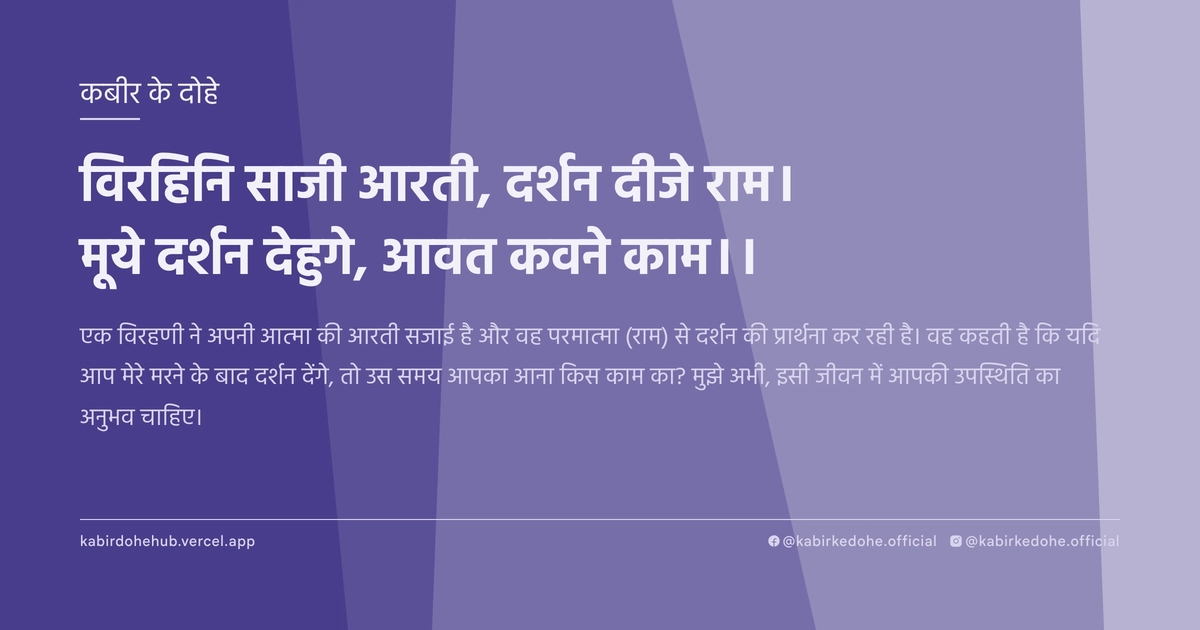
विरहिनि साजी आरती, दर्शन दीजे राम।
मूये दर्शन देहुगे, आवत कवने काम।।
Virahini saaji aarti, darshan deeje Ram. Mooye darshan dehuge, aavat kavne kaam.
इस पृष्ठ पर इस कबीर दोहे का अर्थ (meaning), हिंदी व्याख्या और अंग्रेज़ी अनुवाद, दार्शनिक विश्लेषण और व्यावहारिक जीवन सीख दी गई है। यह दोहा भक्ति (Bhakti) विषय से जुड़ा है — Kabir doha meaning and explanation in Hindi and English.
अर्थ (Meaning):
एक विरहणी ने अपनी आत्मा की आरती सजाई है और वह परमात्मा (राम) से दर्शन की प्रार्थना कर रही है। वह कहती है कि यदि आप मेरे मरने के बाद दर्शन देंगे, तो उस समय आपका आना किस काम का? मुझे अभी, इसी जीवन में आपकी उपस्थिति का अनुभव चाहिए।
A soul longing in separation has prepared the lamp of devotion and prays for a vision of the Divine (Ram). She questions, 'If You grant me Your vision only after I have died, what purpose does Your arrival serve then?' She demands a living, present realization of the Truth here and now.
व्याख्या (Interpretation):
यह दोहा आत्मा की तीव्र तड़प और वर्तमान क्षण की महत्ता को दर्शाता है। 'विरहिनि' केवल एक स्त्री नहीं, बल्कि वह साधक है जो द्वैत के दुख से पीड़ित है। आरती यहाँ बाहरी कर्मकांड नहीं, बल्कि आंतरिक शुद्धि और प्रेम का प्रतीक है। कबीर यहाँ 'राम' को किसी पौराणिक राजा के रूप में नहीं, बल्कि निर्गुण ब्रह्म के रूप में देखते हैं। यह विरह माया के पर्दे के कारण है जो आत्मा को परमात्मा से अलग करता है। अंततः, यह संदेश देता है कि मोक्ष मृत्यु के बाद की घटना नहीं, बल्कि जीवित रहते हुए चेतना का रूपांतरण है। यह अद्वैत वेदांत के उस सत्य को पुष्ट करता है जहाँ जीव और ब्रह्म की एकता का अनुभव इसी शरीर में संभव है।
This couplet captures the intense longing of the soul and the absolute primacy of the present moment. The 'Virahini' (separated woman) is a metaphor for the spiritual seeker suffering from the agony of duality. The 'Aarti' is not a ritualistic lamp but the internal purification of the heart through love. Kabir refers to 'Ram' not as a historical figure, but as the Nirgun Brahman—the formless absolute. The separation is caused by Maya, the cosmic illusion that veils the inherent unity of the self. Ultimately, it asserts that liberation is not a post-mortem reward but a living transformation of consciousness. It aligns with Advaita Vedanta, suggesting that the realization of non-duality must occur while the breath still flows.
दार्शनिक विश्लेषण (Philosophical Analysis):
कबीर का यह दोहा उस युग की प्रतिक्रिया है जहाँ धर्म केवल मृत्यु के बाद के स्वर्ग या नरक की कल्पनाओं तक सीमित था। उन्होंने पुरोहितवाद और कर्मकांडों पर प्रहार किया जो यह सिखाते थे कि ईश्वर केवल मृत्यु के बाद या कठिन तपस्या के बाद मिलते हैं। कबीर का दर्शन 'सहज मार्ग' का है, जहाँ ईश्वर को खोजने के लिए कहीं बाहर जाने की आवश्यकता नहीं है।
यहाँ सूफीवाद का गहरा प्रभाव दिखता है, विशेष रूप से 'इश्क-ए-हकीकी' (ईश्वरीय प्रेम) का, जहाँ प्रेमी अपने प्रिय के विरह में तड़पता है। यह तड़प ही अहंकार को गलाने का एकमात्र साधन है। जब तक 'मैं' जीवित है, तब तक 'राम' नहीं मिल सकते। विरह की यह अग्नि साधक के भीतर के कूड़े-करकट (अहंकार, मोह, राग) को जला देती है।
अद्वैत वेदांत के परिप्रेक्ष्य में, यह दोहा 'जीव' और 'ब्रह्म' के बीच के आभासी अंतर को मिटाने की पुकार है। कबीर कहते हैं कि यदि सत्य का अनुभव इसी देह में नहीं हुआ, तो वह अनुभव व्यर्थ है। वे मृत्यु के बाद के किसी काल्पनिक मिलन का उपहास करते हैं, क्योंकि जो सत्य समय और स्थान से परे है, उसे वर्तमान क्षण में ही घटित होना चाहिए।
यह रचना सामाजिक रूढ़ियों को भी चुनौती देती है। आरती का उपयोग, जो आमतौर पर मंदिरों में होता था, यहाँ आंतरिक भक्ति के लिए किया गया है। यह संकेत है कि वास्तविक मंदिर हृदय है और वास्तविक पूजा आत्म-साक्षात्कार है।
मनोवैज्ञानिक स्तर पर, यह 'तत्काल संतुष्टि' की मांग नहीं, बल्कि 'जागरूकता' की मांग है। कबीर हमें चेतावनी देते हैं कि हम अपनी आध्यात्मिक यात्रा को कल पर न टालें। मृत्यु के बाद का दर्शन केवल एक वैचारिक सांत्वना है, जबकि जीवित दर्शन एक वास्तविक क्रांति है जो जीवन जीने के ढंग को पूरी तरह बदल देती है।
Kabir's verse is a visceral reaction to an era where religion was confined to imaginations of heaven or hell after death. He attacked the priestly class and the ritualistic frameworks that taught that God is only attainable after death or through grueling asceticism. Kabir's philosophy is that of the 'Sahaj Marg' (the Natural Path), where the Divine is not found in distant lands but within the self.
There is a profound influence of Sufism here, specifically 'Ishq-e-Haqiqi' (Divine Love), where the lover pines for the Beloved. This longing is the only tool capable of dissolving the ego. As long as the 'I' exists, 'Ram' cannot be realized. The fire of separation burns away the dross of attachment, greed, and pride.
From the perspective of Advaita Vedanta, this couplet is a cry to erase the illusory boundary between the Jiva (individual soul) and Brahman (Universal Soul). Kabir argues that if the Truth is not experienced within this physical vessel, the experience is meaningless. He mocks the notion of a post-mortem union, for a Truth that transcends time and space must manifest in the immediate present.
The poem also challenges social orthodoxies. By repurposing the 'Aarti'—typically a temple ritual—as a symbol of internal devotion, Kabir signals that the true temple is the heart and the only valid worship is self-realization.
Psychologically, this is not a demand for instant gratification but a demand for absolute awareness. Kabir warns against postponing the spiritual journey. A vision after death is merely a conceptual consolation, whereas a living vision is a revolution that fundamentally alters one's way of existing in the world.
मूल संदेश (Core Message):
- भविष्य का मोक्ष एक भ्रम है; वर्तमान का बोध ही सत्य है।
- आंतरिक तड़प को बाहरी कर्मकांडों में न बदलें।
- परमात्मा कहीं दूर नहीं, बल्कि आपकी अपनी जागरूकता में है।
- अहंकार का विसर्जन ही वास्तविक 'आरती' है।
- जीवित रहते हुए जागना ही सबसे बड़ी आध्यात्मिक उपलब्धि है।
- Post-mortem salvation is an illusion; present awareness is the only truth.
- Do not translate internal longing into external ritualism.
- The Divine is not distant, but resides within your own awareness.
- The dissolution of the ego is the only true 'Aarti'.
- Awakening while alive is the greatest spiritual achievement.
व्यावहारिक उदाहरण (Practical Example):
एक समय की बात है, वाराणसी के घाटों पर रहने वाला एक वृद्ध बुनकर था जिसका नाम माधव था। माधव दिन भर कपड़े बुनता, लेकिन उसका मन हमेशा इस बात में उलझा रहता कि मृत्यु के बाद उसे मोक्ष मिलेगा या नहीं। वह घंटों पंडितों की बातें सुनता कि कैसे मृत्यु के बाद आत्मा परमात्मा में विलीन होती है।
माधव का जीवन एक अंतहीन प्रतीक्षा बन गया था। वह वर्तमान की खुशियों को त्याग कर एक काल्पनिक भविष्य के लिए प्रार्थना करता था। वह अपने परिवार से कटा हुआ था और केवल मृत्यु के बाद के मिलन के सपने देखता था।
एक दिन उसकी मुलाकात एक फकीर से हुई जिसने उसे कबीर का यह दोहा सुनाया। फकीर ने पूछा, "माधव, यदि तुम प्यासे हो और मैं कहूँ कि मैं तुम्हें पानी तुम्हारी मृत्यु के बाद दूँगा, तो क्या तुम संतुष्ट रहोगे?"
माधव हँसा और बोला, "नहीं बाबा, तब तक तो मैं मर ही जाऊँगा! प्यास तो अभी है।"
फकीर ने गंभीरता से कहा, "यही तुम्हारी आध्यात्मिक स्थिति है। तुम उस ईश्वर की प्रतीक्षा कर रहे हो जो केवल श्मशान में मिलेगा। क्या तुम उस राम को अभी, इसी क्षण, अपनी सांसों में महसूस नहीं कर सकते?"
यह बात माधव के हृदय में बिजली की तरह कौंधी। उसे समझ आया कि वह 'मृत्यु के बाद' के लालच में 'जीवन' को खो रहा था। उसने अपनी आँखें बंद कीं और पहली बार अपने भीतर की शांति को महसूस किया।
उसने महसूस किया कि जिस राम को वह मृत्यु के बाद ढूंढ रहा था, वह तो उसके करघे की आवाज़ में, गंगा की लहरों में और उसके बच्चों की मुस्कान में पहले से ही मौजूद था।
उस दिन के बाद माधव ने मोक्ष की चिंता छोड़ दी। उसने अपने काम को ही पूजा बना लिया। वह अब केवल कपड़े नहीं बुनता था, बल्कि हर धागे में प्रेम पिरोता था।
उसका व्यवहार बदल गया। वह अब दूसरों की मदद बिना किसी फल की इच्छा के करने लगा। उसका चेहरा अब भय से नहीं, बल्कि एक गहरी शांति और आनंद से चमकता था।
माधव ने जान लिया था कि परमात्मा कोई मंजिल नहीं है जहाँ पहुँचना है, बल्कि वह एक यात्रा है जिसे हर पल जीना है।
Once, in the ghats of Varanasi, lived an elderly weaver named Madhav. Madhav spent his days weaving cloth, but his mind was perpetually entangled in the worry of whether he would attain salvation after death. He spent hours listening to priests describe how the soul merges with the Divine only after the body perishes.
Madhav's life became an endless waiting room. He sacrificed the joys of the present, praying for a hypothetical future. He grew distant from his family, dreaming only of a post-mortem union with God.
One day, he encountered a wandering dervish who recited this specific Doha of Kabir. The dervish asked, "Madhav, if you were dying of thirst and I told you that I would give you water after you die, would you be satisfied?"
Madhav laughed and replied, "No, Baba! By then I would be gone. The thirst is here, now!"
The dervish replied solemnly, "This is your spiritual state. You are waiting for a God who only appears at the cremation ground. Can you not feel that same Ram right now, in your very breath?"
These words struck Madhav like a bolt of lightning. He realized he was losing his 'life' in the greed for 'after-life'. He closed his eyes and, for the first time, felt a profound stillness within.
He realized that the Ram he was seeking after death was already present in the rhythmic clack of his loom, in the ripples of the Ganges, and in the smiles of his children.
From that day on, Madhav stopped worrying about Moksha. He turned his work into worship. He no longer just wove cloth; he wove love into every thread.
His behavior transformed. He began helping others without expecting any reward. His face, once clouded by fear, now glowed with a deep, abiding peace.
Madhav had understood that the Divine is not a destination to be reached, but a presence to be lived in every single moment.
अभ्यास मार्गदर्शन (Practice Guidance):
- प्रतिदिन 20 मिनट मौन बैठें और यह विचार करें कि 'ईश्वर' कोई बाहरी व्यक्ति नहीं, बल्कि आपकी अपनी चेतना का शुद्धतम रूप है।
- एक डायरी लिखें जिसमें आप उन क्षणों को दर्ज करें जब आपने वर्तमान में पूर्णता महसूस की, बजाय इसके कि आप भविष्य की किसी उपलब्धि का इंतजार करें।
- व्यवहार परिवर्तन: जब भी आप किसी कार्य को 'कल' या 'बाद में' बेहतर करने का वादा करें, तो रुकें और पूछें, "मैं इसे अभी पूर्णता से कैसे कर सकता हूँ?"
- डायग्नोस्टिक चेकलिस्ट: क्या आप अक्सर मृत्यु, स्वर्ग या नरक के डर से प्रेरित होते हैं? क्या आपकी प्रार्थनाएँ केवल भविष्य की माँगों के बारे में हैं? यदि हाँ, तो आप 'विरह' में हैं, 'मिलन' में नहीं।
- Sit in silence for 20 minutes daily, contemplating that 'God' is not an external entity but the purest form of your own consciousness.
- Maintain a journal recording moments where you felt absolute wholeness in the present, rather than waiting for a future achievement.
- Behavioral Shift: Whenever you promise to do something 'better' tomorrow or 'later', stop and ask, "How can I perform this with absolute presence and perfection right now?"
- Diagnostic Checklist: Are you often driven by fear of death, heaven, or hell? Are your prayers merely a list of future demands? If yes, you are living in 'separation' rather than 'union'.
चिंतन प्रश्न (Reflection Questions):
- क्या मेरी आध्यात्मिक खोज वास्तव में सत्य की प्यास है, या केवल मृत्यु के बाद के डर से बचने का एक तरीका?
- मैं अपनी पहचान को 'भविष्य की आशाओं' से कितना जोड़ता हूँ, और इस प्रक्रिया में मैं वर्तमान के कितने जीवित क्षणों को खो रहा हूँ?
- यदि मुझे पता चले कि कोई 'परलोक' नहीं है, तो क्या मेरी भक्ति और नैतिकता अभी भी बनी रहेगी?
- मेरे जीवन में 'आरती' (शुद्धि) क्या है—दिखावा या वास्तविक आंतरिक रूपांतरण?
- मैं किन मानसिक पर्दों (माया) के कारण स्वयं को परमात्मा से अलग महसूस करता हूँ?
- Is my spiritual quest a genuine thirst for Truth, or merely a mechanism to escape the fear of death?
- How much do I tie my identity to 'future hopes', and in doing so, how many living moments am I sacrificing?
- If I discovered there is no 'afterlife', would my devotion and ethics remain intact?
- What constitutes the 'Aarti' (purification) in my life—outward show or genuine internal transformation?
- Which mental veils (Maya) cause me to feel separate from the Divine?