
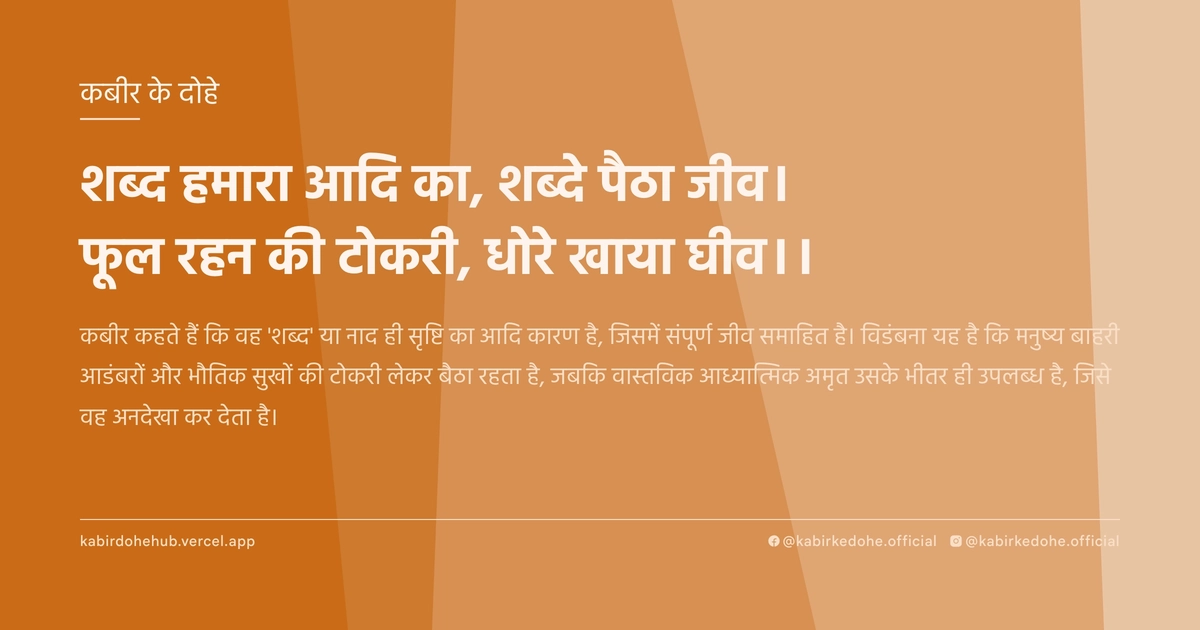
शब्द हमारा आदि का, शब्दे पैठा जीव।
फूल रहन की टोकरी, धोरे खाया घीव।।
Shabd hamara aadi ka, shabde paitha jeev. Phool rahan ki tokri, dhore khaya gheev.
इस पृष्ठ पर इस कबीर दोहे का अर्थ (meaning), हिंदी व्याख्या और अंग्रेज़ी अनुवाद, दार्शनिक विश्लेषण और व्यावहारिक जीवन सीख दी गई है। यह दोहा निर्गुण ब्रह्म (Nirguna Brahman) विषय से जुड़ा है — Kabir doha meaning and explanation in Hindi and English.
अर्थ (Meaning):
कबीर कहते हैं कि वह 'शब्द' या नाद ही सृष्टि का आदि कारण है, जिसमें संपूर्ण जीव समाहित है। विडंबना यह है कि मनुष्य बाहरी आडंबरों और भौतिक सुखों की टोकरी लेकर बैठा रहता है, जबकि वास्तविक आध्यात्मिक अमृत उसके भीतर ही उपलब्ध है, जिसे वह अनदेखा कर देता है।
Kabir asserts that the 'Shabd' (the Primordial Sound or Word) is the origin of all existence, and within this vibration, the soul is embedded. He laments the irony of human existence: people cling to the empty basket of external rituals and material pursuits, while the divine nectar of spiritual realization is available right beside them, yet remains untouched.
व्याख्या (Interpretation):
यहाँ 'शब्द' का अर्थ केवल बोला गया शब्द नहीं, बल्कि वह अनाहत नाद है जो ब्रह्मांड की रचना का आधार है। कबीर समझाते हैं कि जीव इस शब्दमय चेतना का हिस्सा है, फिर भी वह माया के वशीभूत होकर बाहरी दुनिया में सत्य खोजता है। 'फूल रहन की टोकरी' एक रूपक है उन व्यर्थ के धार्मिक कर्मकांडों और सामाजिक प्रतिष्ठा के लिए, जिन्हें मनुष्य संजोकर रखता है। 'धोरे खाया घीव' का अर्थ है कि परम आनंद और मोक्ष बिल्कुल करीब हैं, लेकिन अज्ञानता के कारण मनुष्य उन्हें देख नहीं पाता। यह स्थिति अद्वैत वेदांत के उस सिद्धांत को दर्शाती है जहाँ ब्रह्म और जीव एक ही हैं, परंतु 'अविद्या' के कारण पृथकता का भ्रम बना रहता है। यह विरोधाभास है कि हम जिसे बाहर खोज रहे हैं, वह हमारे अस्तित्व का मूल आधार है।
In this context, 'Shabd' does not refer to spoken language but to the Anahata Nada—the unstruck primordial vibration that serves as the blueprint of the universe. Kabir posits that the soul is intrinsically woven into this cosmic sound, yet blinded by Maya, the individual seeks truth in the external periphery. The 'basket of flowers' serves as a poignant metaphor for the hollow rituals, social status, and superficial piety that humans meticulously preserve. The phrase 'eating ghee nearby' signifies that the ultimate bliss and liberation are immediate and accessible, yet ignored due to spiritual blindness. This mirrors the Advaita Vedanta principle where Atman and Brahman are non-dual, but the illusion of separation persists due to Avidya. It highlights the central paradox: the seeker is the very destination they are searching for, yet they wander in the wilderness of form.
दार्शनिक विश्लेषण (Philosophical Analysis):
कबीर का यह दोहा निर्गुण भक्ति की उस पराकाष्ठा को दर्शाता है जहाँ ईश्वर किसी मूर्ति या मंदिर में नहीं, बल्कि 'शब्द' या आंतरिक ध्वनि में स्थित है। यह दृष्टिकोण सूफी मत के 'कलाम' और 'जिक्र' से गहराई से मेल खाता है, जहाँ ध्वनि को परमात्मा तक पहुँचने का सेतु माना गया है। कबीर ने अपने समय के उन पंडितों और मुल्लाओं पर प्रहार किया है जो केवल बाहरी दिखावे और शास्त्रार्थ में उलझे थे, जबकि वास्तविक अनुभव आंतरिक मौन में निहित था।
दार्शनिक स्तर पर, यह दोहा 'माया' के सूक्ष्म जाल की व्याख्या करता है। मनुष्य को लगता है कि वह पूजा-पाठ या तीर्थयात्रा (फूलों की टोकरी) से मोक्ष पा लेगा, लेकिन कबीर कहते हैं कि यह केवल एक मानसिक भटकाव है। जब तक अहंकार का विसर्जन नहीं होता, तब तक व्यक्ति उस 'घी' या आध्यात्मिक रस का स्वाद नहीं ले सकता जो उसके अपने भीतर प्रवाहित है।
अद्वैत वेदांत के अनुसार, जीव और ब्रह्म का संबंध अभिन्न है। कबीर इस एकता को 'शब्द' के माध्यम से समझाते हैं। वे तर्क देते हैं कि यदि जीव उस मूल ध्वनि में लीन हो जाए, तो वह स्वयं को ब्रह्मांडीय चेतना के रूप में अनुभव करेगा। यहाँ 'शब्द' वह सेतु है जो सीमित अहंकार को असीमित परमात्मा से जोड़ता है।
यह शिक्षण मनोवैज्ञानिक रूपांतरण की मांग करता है। कबीर चाहते हैं कि साधक अपनी दृष्टि को बाहर से हटाकर भीतर की ओर मोड़े। यह 'अंतर्मुखी' होने की प्रक्रिया है। जब व्यक्ति बाहरी शोर को शांत करता है, तब उसे वह आदि शब्द सुनाई देता है जो उसे उसकी वास्तविक पहचान से परिचित कराता है।
अंततः, कबीर का संदेश यह है कि सत्य किसी जटिल विधि या कठिन तपस्या में नहीं, बल्कि सरल आत्म-साक्षात्कार में है। वे कर्मकांडीय धर्म को नकारते हुए 'सहज मार्ग' का समर्थन करते हैं। उनके लिए धर्म वह नहीं जो टोकरी में सजाकर रखा जाए, बल्कि वह है जो जीवन के हर क्षण में अनुभव किया जाए।
This couplet epitomizes the pinnacle of Nirgun Bhakti, where the Divine is not localized in idols or temples but resides in the 'Shabd'—the internal, formless vibration. This perspective aligns profoundly with the Sufi concepts of 'Kalam' and 'Zikr', where sound is viewed as the bridge to the Beloved. Kabir critiques the religious orthodoxy of his era, targeting the scholars who were entangled in superficial rituals and dialectics while ignoring the silent truth within.
Philosophically, the verse dissects the subtle web of 'Maya'. The human tendency to believe that liberation can be achieved through external piety or pilgrimage (the basket of flowers) is dismissed as a mental distraction. Kabir suggests that until the ego is annihilated, the individual cannot taste the 'ghee'—the spiritual nectar—that flows within their own being.
Drawing from Advaita Vedanta, the relationship between the Jiva (individual soul) and Brahman (universal consciousness) is one of non-duality. Kabir uses 'Shabd' as the medium to explain this unity. He argues that by merging into this primordial sound, the soul transcends its limited identity and realizes its cosmic nature. The 'Shabd' is the catalyst that dissolves the boundary between the seeker and the sought.
This teaching demands a psychological transformation. Kabir urges the practitioner to shift their gaze from the external world to the internal void. This is the process of becoming 'Antarmukhi' (introverted). Only when the external noise is silenced can the primordial vibration be heard, revealing the true identity of the self.
Ultimately, Kabir asserts that truth is not found in complex methodologies or rigorous asceticism, but in simple self-realization. He rejects ritualistic religion in favor of the 'Sahaj Marg' (the Natural Path). For him, spirituality is not a collection of ornaments to be carried in a basket, but a living experience integrated into every breath.
मूल संदेश (Core Message):
- बाहरी आडंबर केवल भ्रम हैं, सत्य भीतर गूँज रहा है।
- अहंकार की टोकरी को छोड़कर मौन के रस को चखें।
- ईश्वर कोई व्यक्ति नहीं, बल्कि एक आदि ध्वनि है।
- सत्य की खोज बाहर नहीं, अंतर्मुखी होने में है।
- जब 'मैं' मिटता है, तब 'शब्द' सुनाई देता है।
- External rituals are mere illusions; Truth resonates within.
- Discard the basket of ego to taste the nectar of silence.
- The Divine is not a person, but a primordial vibration.
- The search for Truth is not outward, but an inward journey.
- When the 'I' dissolves, the 'Shabd' becomes audible.
व्यावहारिक उदाहरण (Practical Example):
एक समय की बात है, वाराणसी के घाटों पर रहने वाला एक वृद्ध बुनकर था जिसका नाम माधव था। माधव अपनी पूरी जिंदगी बेहतरीन रेशमी वस्त्र बुनने में बिता चुका था। वह शहर के सबसे बड़े मंदिरों में दान देता था और हर साल बड़े धूमधाम से त्योहार मनाता था। वह अपनी 'पुण्य की टोकरी' को भरने में इतना व्यस्त था कि उसने कभी अपने मन की शांति के लिए समय नहीं निकाला।
माधव का मानना था कि जितना अधिक वह बाहरी अनुष्ठानों में समय बिताएगा, ईश्वर उसके उतना ही करीब होगा। वह घंटों तक मंत्रों का जाप करता, लेकिन उसका मन हमेशा इस बात में रहता कि लोग उसकी भक्ति की प्रशंसा कर रहे हैं या नहीं। वह एक ऐसी टोकरी सजा रहा था जिसमें केवल दिखावे के फूल थे।
एक दिन उसकी मुलाकात एक घुमक्कड़ फकीर से हुई, जिसने माधव को एक साधारण सा सवाल पूछा: "तुम्हारी इस टोकरी में बहुत फूल हैं, लेकिन क्या तुमने कभी उस सुगंध को महसूस किया है जो तुम्हारे भीतर से आ रही है?"
माधव हँसा और बोला, "सुगंध तो फूलों में होती है, मेरे भीतर क्या होगा?"
फकीर ने उसे चुप रहने को कहा और उसकी आँखें बंद करवा दीं। उसने माधव को अपने भीतर की धड़कन और सांसों के बीच के मौन को सुनने के लिए प्रेरित किया। फकीर ने कहा, "तुम बाहर घी खोज रहे हो, जबकि तुम्हारा पूरा अस्तित्व उस दिव्य रस से बना है। बस इस शोर को शांत करो।"
शुरुआत में माधव को बहुत बेचैनी हुई। उसे लगा कि बिना मंत्रों और मालाओं के वह ईश्वर से कैसे जुड़ पाएगा। लेकिन जैसे-जैसे वह मौन में गहरा उतरा, उसे एक सूक्ष्म गूंज सुनाई देने लगी। वह गूंज किसी शब्द की नहीं थी, बल्कि एक गहरे सुकून की थी।
उसे अचानक अहसास हुआ कि वह जिस शांति को मंदिरों और दान-पुण्य में खोज रहा था, वह तो उसके अपने हृदय की धड़कन में छिपी थी। वह 'शब्द' जो सृष्टि के आदि में था, वही उसके भीतर गूँज रहा था।
माधव की 'फूलों की टोकरी' यानी उसका अहंकार और दिखावा अचानक गिर गया। उसने महसूस किया कि वह अब तक केवल बाहरी आवरण को पूज रहा था, जबकि असली खजाना उसके भीतर था।
उस दिन के बाद माधव ने दिखावे की भक्ति छोड़ दी। वह अब भी वस्त्र बुनता था, लेकिन अब उसका हर धागा उस आंतरिक संगीत के साथ जुड़ा था। वह जान गया था कि असली घी (आनंद) बाहर नहीं, बल्कि भीतर के मौन में है।
उसका जीवन बदल गया। वह अब क्रोध और अहंकार से मुक्त था, क्योंकि उसने जान लिया था कि वह स्वयं उस अनंत शब्द का हिस्सा है।
Once, in the ghats of Varanasi, lived an elderly weaver named Madhav. Madhav had spent his entire life weaving the finest silk fabrics. He donated generously to the city's largest temples and celebrated every festival with immense grandeur. He was so preoccupied with filling his 'basket of merit' that he never carved out a moment for inner silence.
Madhav believed that the more time he invested in external rituals, the closer he would get to God. He spent hours chanting mantras, yet his mind was always preoccupied with whether people were admiring his devotion. He was decorating a basket filled only with the flowers of vanity.
One day, he encountered a wandering fakir who asked him a simple question: "Your basket is full of flowers, but have you ever felt the fragrance that is emanating from within you?"
Madhav laughed and replied, "Fragrance belongs to flowers; what could possibly be within me?"
The fakir asked him to be silent and guided him to close his eyes. He encouraged Madhav to listen to the silence between his heartbeats and breaths. The fakir whispered, "You are searching for ghee outside, while your entire existence is composed of that divine nectar. Just silence the noise."
Initially, Madhav felt restless. He wondered how he could connect with the Divine without mantras or prayer beads. But as he sank deeper into the silence, he began to hear a subtle resonance. It wasn't a word in any language, but a vibration of profound peace.
He suddenly realized that the peace he had been seeking in temples and charities was hidden within the very rhythm of his own heart. The 'Shabd' that existed at the dawn of creation was echoing inside him.
Madhav's 'basket of flowers'—his ego and superficiality—collapsed instantly. He realized he had been worshipping the outer shell while the true treasure lay within.
After that day, Madhav abandoned performative piety. He continued to weave, but now every thread was aligned with that internal music. He understood that the true 'ghee' (bliss) was not external, but found in the silence within.
His life was transformed. He became free from anger and pride, for he knew he was an integral part of that infinite, primordial vibration.
He lived the rest of his days not as a seeker, but as a witness to the divine sound flowing through all things.
अभ्यास मार्गदर्शन (Practice Guidance):
- प्रतिदिन 20 मिनट 'अनाहत नाद' का अभ्यास करें: शांत बैठकर अपनी सांसों की आवाज़ और हृदय की धड़कन के बीच के शून्य को सुनने का प्रयास करें।
- आत्म-पूछताछ जर्नल: प्रतिदिन लिखें कि आज आपने अपनी 'पुण्य की टोकरी' (दिखावे) को भरने के लिए क्या किया और वास्तव में आंतरिक शांति के लिए क्या किया।
- मौन व्रत: सप्ताह में एक दिन या दिन में कुछ घंटे पूर्ण मौन रहें, ताकि बाहरी शब्दों का शोर कम हो और आंतरिक शब्द सुनाई दे।
- निदान चेकलिस्ट: यदि आप अभी भी दूसरों की प्रशंसा के लिए दान या पूजा कर रहे हैं, या यदि आप शांति के लिए बाहरी स्थानों पर निर्भर हैं, तो आप अभी भी 'फूलों की टोकरी' लेकर बैठे हैं।
- Practice 'Anahata Nada' for 20 minutes daily: Sit in stillness and attempt to listen to the void between your breath and your heartbeat.
- Self-Inquiry Journaling: Daily record instances where you tried to fill your 'basket of merit' (external validation) versus moments of genuine internal stillness.
- Vow of Silence: Observe complete silence for a few hours a day or one day a week to diminish external noise and amplify the internal vibration.
- Diagnostic Checklist: If you still perform acts of charity or worship for social recognition, or if your peace depends on external environments, you are still clinging to the 'basket of flowers'.
चिंतन प्रश्न (Reflection Questions):
- मेरी 'फूलों की टोकरी' क्या है—मेरी कौन सी सामाजिक पहचान या धार्मिक मान्यता मुझे सत्य देखने से रोक रही है?
- क्या मेरी आध्यात्मिक साधना वास्तव में मुक्ति के लिए है, या यह केवल मेरे अहंकार को संतुष्ट करने का एक परिष्कृत तरीका है?
- यदि मुझसे मेरी सारी उपलब्धियां और पद छीन लिए जाएं, तो क्या मेरे भीतर कोई ऐसा 'शब्द' बचेगा जो मुझे पूर्ण महसूस कराए?
- मैं बाहरी शोर (सोशल मीडिया, दूसरों की राय) को शांत करने के लिए कितना प्रयास करता हूँ ताकि मैं स्वयं को सुन सकूँ?
- क्या मैं वास्तव में उस 'घी' का स्वाद ले रहा हूँ, या मैं केवल दूसरों को बता रहा हूँ कि मुझे स्वाद पता है?
- What is my 'basket of flowers'—which social identity or religious belief is preventing me from seeing the Truth?
- Is my spiritual practice truly for liberation, or is it merely a sophisticated way to feed my ego?
- If all my achievements and titles were stripped away, would there be a 'Shabd' within me that still feels complete?
- How much effort do I put into silencing the external noise (social media, opinions) to actually hear myself?
- Am I truly tasting the 'ghee' of inner bliss, or am I merely performing the act of being a 'spiritual person' for others?