
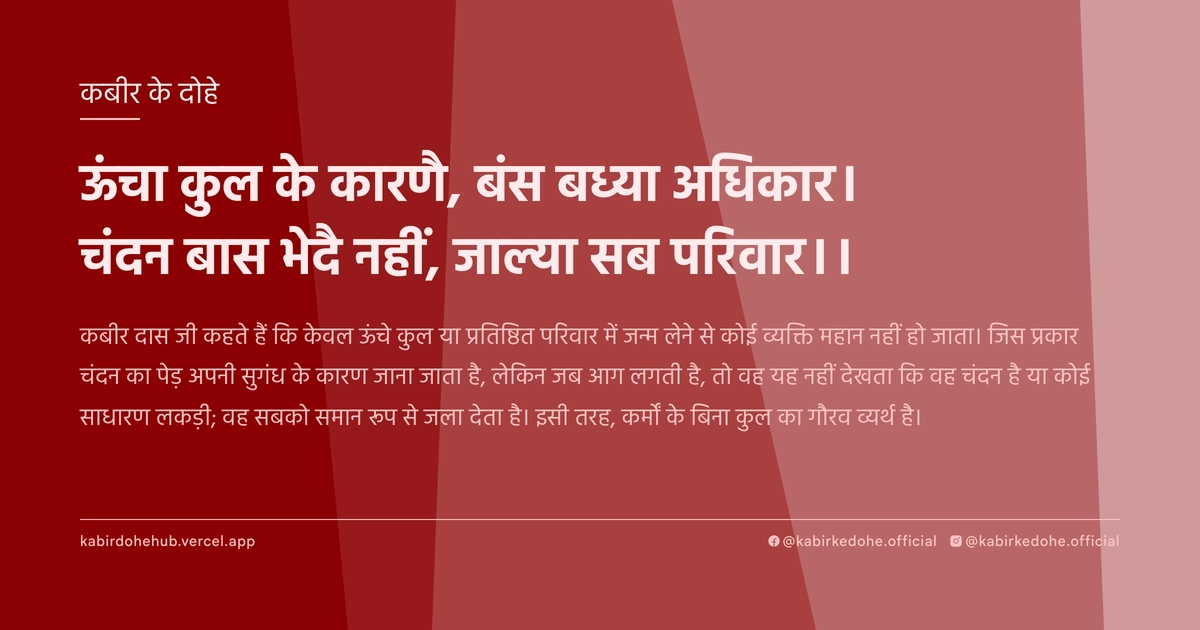
ऊंचा कुल के कारणै, बंस बध्या अधिकार।
चंदन बास भेदै नहीं, जाल्या सब परिवार।।
Uncha kul ke karanai, bans badhya adhikaar. Chandan baas bhedai nahi, jaalya sab parivaar.
इस पृष्ठ पर इस कबीर दोहे का अर्थ (meaning), हिंदी व्याख्या और अंग्रेज़ी अनुवाद, दार्शनिक विश्लेषण और व्यावहारिक जीवन सीख दी गई है। यह दोहा जाति विरोध (Anti-casteism) विषय से जुड़ा है — Kabir doha meaning and explanation in Hindi and English.
अर्थ (Meaning):
कबीर दास जी कहते हैं कि केवल ऊंचे कुल या प्रतिष्ठित परिवार में जन्म लेने से कोई व्यक्ति महान नहीं हो जाता। जिस प्रकार चंदन का पेड़ अपनी सुगंध के कारण जाना जाता है, लेकिन जब आग लगती है, तो वह यह नहीं देखता कि वह चंदन है या कोई साधारण लकड़ी; वह सबको समान रूप से जला देता है। इसी तरह, कर्मों के बिना कुल का गौरव व्यर्थ है।
Kabir asserts that being born into a high-caste or prestigious lineage does not inherently grant a person spiritual or moral superiority. He uses the metaphor of sandalwood: while it is prized for its fragrance, when consumed by fire, the flames do not distinguish between the precious sandalwood and ordinary wood. Both are reduced to ash, proving that lineage is irrelevant in the face of ultimate truth and action.
व्याख्या (Interpretation):
यह दोहा सामाजिक प्रतिष्ठा और आध्यात्मिक वास्तविकता के बीच के विरोधाभास को दर्शाता है। 'ऊंचा कुल' माया के उस भ्रम का प्रतीक है जहाँ मनुष्य अपनी पहचान बाहरी लेबल से जोड़ता है। कबीर यहाँ निरगुण भक्ति का संदेश देते हैं, जहाँ ईश्वर किसी जाति या कुल में नहीं, बल्कि शुद्ध अंतःकरण में बसता है। चंदन की सुगंध उसकी आंतरिक विशेषता है, लेकिन अग्नि (मृत्यु या सत्य) बाहरी आवरण को नष्ट कर देती है। यह अद्वैत वेदांत के उस सिद्धांत की ओर संकेत करता है जहाँ आत्मा की कोई जाति नहीं होती। जब अहंकार का पर्दा गिरता है, तो केवल कर्म शेष रहते हैं। अंततः, यह दोहा सिखाता है कि जन्म एक संयोग है, जबकि चरित्र एक चुनाव है।
This couplet highlights the paradox between social prestige and spiritual reality. 'High lineage' symbolizes the illusion of Maya, where humans anchor their identity to external labels. Kabir invokes Nirgun Bhakti, suggesting that the Divine resides not in a caste, but in a purified heart. The fragrance of sandalwood represents an inherent quality, yet fire—symbolizing death or ultimate truth—destroys all external veneers. This aligns with Advaita Vedanta, asserting that the Atman (Soul) possesses no caste or creed. When the veil of ego falls, only one's actions remain. Ultimately, the verse teaches that birth is a mere accident, while character is a conscious choice.
दार्शनिक विश्लेषण (Philosophical Analysis):
कबीर का यह प्रहार उनके युग के कट्टरपंथी सामाजिक ढांचे पर था, जहाँ जन्म के आधार पर मनुष्य की योग्यता तय की जाती थी। उन्होंने पुरोहितवाद और कर्मकांडीय श्रेष्ठता को सिरे से नकार दिया। उनका दर्शन सूफीवाद के 'इश्क' और वेदांत के 'अद्वैत' का संगम है, जहाँ केवल प्रेम और सत्य ही एकमात्र मापदंड हैं।
दार्शनिक स्तर पर, कबीर यहाँ 'अहंकार' (Ego) के विनाश की बात कर रहे हैं। जब व्यक्ति यह मानता है कि वह अपने कुल के कारण श्रेष्ठ है, तो वह वास्तव में अपनी आध्यात्मिक प्रगति को रोक देता है क्योंकि वह 'मैं' के भ्रम में फँस जाता है। यह अहंकार ही वह पर्दा है जो जीव को ब्रह्म से अलग करता है।
वेदांत के अनुसार, ब्रह्म सर्वव्यापी है। यदि ईश्वर हर कण में है, तो किसी एक कुल को श्रेष्ठ मानना ईश्वर की सर्वव्यापकता का अपमान है। कबीर इस सत्य को अत्यंत सरल लेकिन तीखे उदाहरण से समझाते हैं कि प्रकृति (अग्नि) किसी के कुल का सम्मान नहीं करती।
सूफी परंपरा में इसे 'फना' कहा गया है—स्वयं के झूठे अस्तित्व का मिट जाना। जब तक व्यक्ति अपनी सामाजिक पहचान (कुल, पद, जाति) को ढोता रहता है, वह सत्य का साक्षात्कार नहीं कर सकता। सत्य केवल तभी प्रकट होता है जब व्यक्ति अपनी पहचान को शून्य कर लेता है।
यह दोहा केवल जातिवाद पर प्रहार नहीं है, बल्कि यह एक मनोवैज्ञानिक विश्लेषण है कि कैसे बाहरी पहचान हमें आंतरिक विकास से विमुख करती है। कबीर हमें चेतावनी देते हैं कि यदि हम केवल विरासत पर गर्व करेंगे, तो हम उस चंदन की तरह होंगे जो जलते समय अपनी सुगंध खो देता है, क्योंकि वह सुगंध केवल बाहरी आवरण का हिस्सा थी, आत्मा का नहीं।
Kabir's critique is a direct assault on the rigid social hierarchies of his era, where human worth was predetermined by birth. He categorically rejected priestly hegemony and ritualistic superiority, blending the Sufi concept of 'Ishq' (Divine Love) with the Vedantic principle of 'Advaita' (Non-duality), asserting that only truth and love are valid metrics of a human being.
Philosophically, Kabir addresses the annihilation of the 'Ahamkara' (Ego). When an individual believes they are superior due to their lineage, they inadvertently halt their spiritual evolution by becoming trapped in the illusion of 'I'. This ego is the primary veil separating the Jiva (individual soul) from Brahman (Universal Consciousness).
According to Advaita Vedanta, Brahman is omnipresent. To claim one lineage is superior is to deny the omnipresence of the Divine. Kabir illustrates this through the visceral image of fire, proving that nature—and by extension, the laws of the universe—does not respect social constructs or hereditary prestige.
In Sufism, this process is known as 'Fana'—the dissolution of the false self. As long as a person clings to their social identity (caste, rank, family), they cannot experience the ultimate Truth. Truth reveals itself only when the individual reduces their perceived identity to zero.
This verse is not merely a critique of casteism but a psychological analysis of how external identities alienate us from internal growth. Kabir warns that pride in heritage is a fragile shield; like sandalwood in a fire, the prestige vanishes, leaving behind only the raw reality of one's deeds and spiritual state.
मूल संदेश (Core Message):
- कुल का गर्व एक मानसिक बेड़ी है जो आत्मा को मुक्त नहीं होने देती।
- सच्ची श्रेष्ठता जन्म से नहीं, बल्कि आंतरिक शुद्धि और कर्मों से आती है।
- मृत्यु और सत्य के सामने सभी सामाजिक पद और प्रतिष्ठा राख के समान हैं।
- अहंकार का त्याग ही वह द्वार है जिससे वास्तविक ज्ञान का प्रवेश होता है।
- मानवता ही एकमात्र वास्तविक धर्म है, बाकी सब केवल सामाजिक दिखावा है।
- Pride in lineage is a mental shackle that prevents the soul's liberation.
- True superiority is born of inner purity and action, not birth.
- Before death and ultimate truth, all social ranks are reduced to ash.
- The surrender of ego is the only gateway through which real wisdom enters.
- Humanity is the only true religion; everything else is mere social theater.
व्यावहारिक उदाहरण (Practical Example):
एक समय की बात है, वाराणसी के घाटों पर रहने वाला एक वृद्ध बुनकर था, जिसका नाम माधव था। माधव के पूर्वज शहर के सबसे प्रतिष्ठित विद्वान और राजपुरोहित रहे थे। माधव अपनी इस विरासत पर बहुत गर्व करता था और अक्सर अन्य बुनकरों को नीची नजर से देखता था, यह मानते हुए कि उसके रक्त में ज्ञान और पवित्रता बसी है।
माधव का एक शिष्य था, कन्हैया, जो एक अछूत परिवार से आता था। कन्हैया में सीखने की तीव्र इच्छा थी और वह दिन-रात मेहनत करता था, लेकिन माधव उसे अक्सर यह कहकर नीचा दिखाता कि "तुम चाहे कितनी भी कोशिश कर लो, लेकिन तुम्हारे कुल में वह संस्कार नहीं हैं जो मेरे पास जन्मजात हैं।"
एक बार शहर में भीषण आग लगी। माधव के घर में उसकी पुश्तैनी पांडुलिपियाँ और रेशमी वस्त्र थे, जिन्हें वह अपनी कुल की शान मानता था। आग इतनी भयानक थी कि देखते ही देखते पूरा मोहल्ला जलने लगा। माधव अपनी उन बहुमूल्य वस्तुओं को बचाने की कोशिश कर रहा था, जबकि कन्हैया अपनी जान जोखिम में डालकर दूसरों की मदद कर रहा था।
जब आग शांत हुई, तो माधव के पास कुछ नहीं बचा था। उसकी वे 'पवित्र' पांडुलिपियाँ और रेशमी वस्त्र अब केवल काली राख के ढेर थे। वह राख किसी भी अन्य साधारण घर की राख जैसी ही दिख रही थी। उस राख को देखकर माधव को अचानक कबीर का वह दोहा याद आया कि आग यह नहीं देखती कि वह चंदन है या आम की लकड़ी।
उसी समय उसने देखा कि कन्हैया को शहर के लोगों द्वारा उनकी निस्वार्थ सेवा के लिए सम्मानित किया जा रहा था। माधव को अहसास हुआ कि उसकी 'कुल की श्रेष्ठता' केवल एक मानसिक भ्रम था। उसने महसूस किया कि उसने वर्षों तक जिस विरासत पर गर्व किया, वह वास्तव में उसे दूसरों से अलग कर रही थी और उसे अंधा बना रही थी।
माधव की आँखों में आँसू आ गए। उसने कन्हैया के पास जाकर उसके पैर छुए और अपनी गलती की क्षमा मांगी। उसने स्वीकार किया कि पवित्रता रक्त में नहीं, बल्कि कर्मों और करुणा में होती है।
उस दिन के बाद, माधव ने अपनी जातिगत पहचान को त्याग दिया। उसने अपनी पूरी ऊर्जा केवल बेहतरीन कपड़े बुनने और गरीबों की सेवा करने में लगा दी। अब वह खुद को 'विद्वान कुल का वंशज' नहीं, बल्कि केवल एक 'साधक' कहने लगा।
माधव का जीवन पूरी तरह बदल गया। अब उसके मन में कोई द्वेष नहीं था, और उसकी बुनाई में एक नई चमक आ गई थी, क्योंकि अब वह अहंकार से नहीं, बल्कि प्रेम से काम कर रहा था।
Once, on the ghats of Varanasi, lived an elderly weaver named Madhav. Madhav's ancestors had been the city's most prestigious scholars and royal priests. Madhav took immense pride in this heritage, often looking down upon other weavers, believing that knowledge and purity were inherent in his bloodline.
Madhav had a disciple named Kanhaiya, who came from an 'untouchable' family. Kanhaiya possessed an intense desire to learn and worked tirelessly, but Madhav frequently belittled him, saying, "No matter how hard you try, you lack the innate संस्कारों (values) that I possess by birth."
One day, a devastating fire broke out in the city. Madhav's home contained ancestral manuscripts and silk robes, which he viewed as the glory of his lineage. The fire was so ferocious that it consumed the entire neighborhood. While Madhav desperately tried to save his precious belongings, Kanhaiya risked his own life to rescue others from the flames.
When the fire finally subsided, Madhav was left with nothing. His 'sacred' manuscripts and silk robes were now merely piles of black ash. That ash looked identical to the ash of any other ordinary house. Looking at the ruins, Madhav suddenly recalled Kabir's verse: fire does not distinguish between sandalwood and common wood.
At that moment, he saw Kanhaiya being honored by the townspeople for his selfless service. Madhav realized that his 'lineage superiority' was nothing but a mental illusion. He understood that the heritage he had spent years boasting about had actually isolated him and blinded him to the truth.
Tears streamed down Madhav's face. He approached Kanhaiya and touched his feet, seeking forgiveness. He acknowledged that purity does not reside in blood, but in actions and compassion.
From that day forward, Madhav discarded his caste identity. He dedicated his energy solely to weaving the finest cloth and serving the poor. He no longer called himself a 'descendant of a scholarly clan' but simply a 'seeker'.
Madhav's life was completely transformed. The malice vanished from his heart, and a new radiance appeared in his weaving, for he was no longer working from a place of ego, but from a place of love.
अभ्यास मार्गदर्शन (Practice Guidance):
- प्रतिदिन 15 मिनट मौन ध्यान करें और विचार करें कि यदि आपकी सभी सामाजिक पहचान (नाम, पद, कुल) छीन ली जाएं, तो आपके भीतर क्या शेष बचेगा।
- एक 'अहंकार डायरी' लिखें: दिन भर में उन क्षणों को नोट करें जब आपने खुद को किसी से श्रेष्ठ या निम्न महसूस किया। विश्लेषण करें कि यह भावना किस 'लेबल' के कारण आई।
- सचेत व्यवहार परिवर्तन: सप्ताह में एक बार ऐसे व्यक्ति की सेवा करें या उससे सीखें जिसे समाज 'निम्न' मानता है, ताकि आपके भीतर का श्रेष्ठता बोध समाप्त हो सके।
- निदान चेकलिस्ट: क्या आप किसी की योग्यता को उसके परिवार या डिग्री से आंकते हैं? क्या आप अपनी उपलब्धियों का श्रेय अपने 'संस्कारों' या 'कुल' को देते हैं? यदि हाँ, तो आप अभी भी माया के प्रभाव में हैं।
- Practice 15 minutes of silent meditation daily, contemplating what would remain of your essence if all your social identities (name, rank, lineage) were stripped away.
- Maintain an 'Ego Diary': Note moments throughout the day when you felt superior or inferior to someone. Analyze which specific 'label' triggered this feeling.
- Conscious Behavioral Shift: Once a week, serve or learn from someone whom society deems 'lower' to systematically dismantle your internal sense of superiority.
- Diagnostic Checklist: Do you judge a person's merit based on their family or degree? Do you attribute your success to your 'lineage' or 'upbringing'? If yes, you are still operating under the illusion of Maya.
चिंतन प्रश्न (Reflection Questions):
- यदि आप एक अनजान देश में हों जहाँ कोई आपकी जाति या परिवार को नहीं जानता, तो आप अपनी पहचान कैसे परिभाषित करेंगे?
- आपकी वह कौन सी 'छिपी हुई श्रेष्ठता' है जो आपको दूसरों के प्रति सूक्ष्म रूप से कठोर बनाती है?
- क्या आप वास्तव में अपनी उपलब्धियों के मालिक हैं, या आप केवल अपने पूर्वजों के संचित पुण्य का उपभोग कर रहे हैं?
- जब आप किसी को 'नीचा' देखते हैं, तो क्या आप वास्तव में उस व्यक्ति को देख रहे होते हैं, या अपनी अपनी पूर्वधारणाओं के प्रतिबिंब को?
- क्या आपका डिजिटल व्यक्तित्व (Social Media Profile) आपके वास्तविक आंतरिक स्वरूप से अधिक महत्वपूर्ण हो गया है?
- If you were in a foreign land where no one knew your caste or family, how would you define your identity?
- What is that 'hidden superiority' within you that makes you subtly harsh toward others?
- Are you truly the owner of your achievements, or are you merely consuming the accumulated merit of your ancestors?
- When you look down upon someone, are you seeing that person, or are you seeing a reflection of your own preconceptions?
- Has your digital persona (social media profile) become more significant than your actual internal state?