
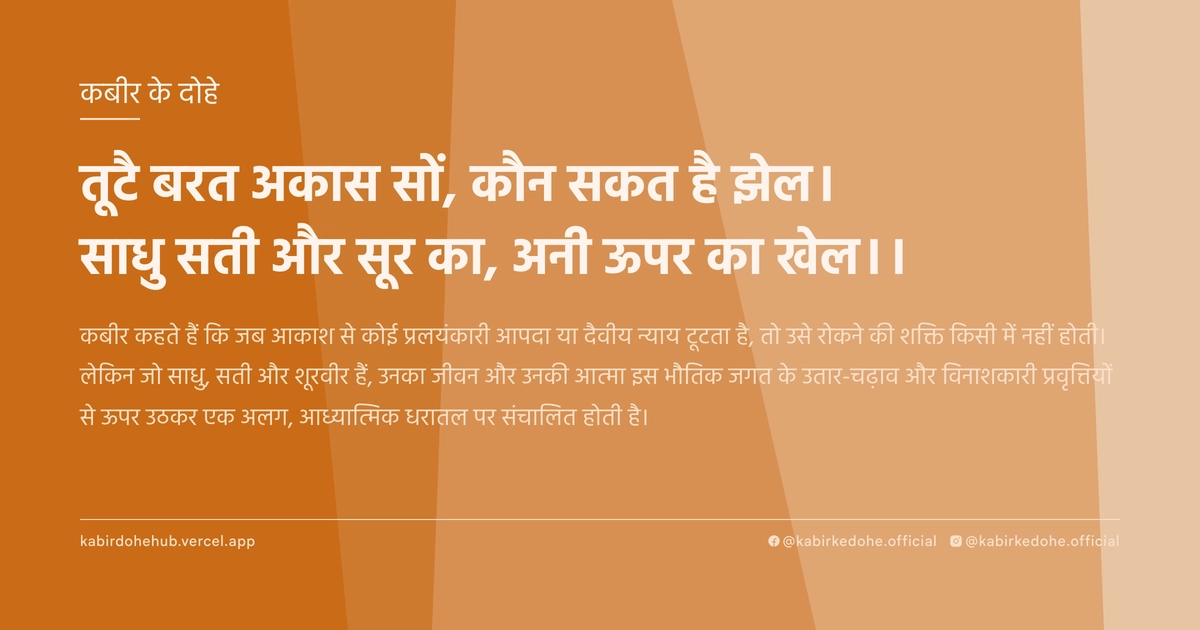
तूटै बरत अकास सों, कौन सकत है झेल।
साधु सती और सूर का, अनी ऊपर का खेल।।
Tutai barat akas son, kaun sakat hai jhel. Sadhu sati aur sur ka, ani upar ka khel.
इस पृष्ठ पर इस कबीर दोहे का अर्थ (meaning), हिंदी व्याख्या और अंग्रेज़ी अनुवाद, दार्शनिक विश्लेषण और व्यावहारिक जीवन सीख दी गई है। यह दोहा निष्ठा (Integrity) विषय से जुड़ा है — Kabir doha meaning and explanation in Hindi and English.
अर्थ (Meaning):
कबीर कहते हैं कि जब आकाश से कोई प्रलयंकारी आपदा या दैवीय न्याय टूटता है, तो उसे रोकने की शक्ति किसी में नहीं होती। लेकिन जो साधु, सती और शूरवीर हैं, उनका जीवन और उनकी आत्मा इस भौतिक जगत के उतार-चढ़ाव और विनाशकारी प्रवृत्तियों से ऊपर उठकर एक अलग, आध्यात्मिक धरातल पर संचालित होती है।
Kabir asserts that when a cosmic upheaval or divine decree descends from the heavens, no mortal power can withstand or halt its force. However, the lives of the saintly, the virtuous, and the courageous operate on a plane beyond these material fluctuations, remaining untouched by the destructive games of the physical world.
व्याख्या (Interpretation):
यहाँ 'आकाश से टूटना' भौतिक विनाश या प्रारब्ध के कठोर प्रहार का प्रतीक है। कबीर समझाते हैं कि माया का जाल और समय का चक्र सबको अपनी चपेट में लेता है, लेकिन 'साधु' (ज्ञानी), 'सती' (पवित्र) और 'सूर' (साहसी) ने अपनी चेतना को अहंकार से मुक्त कर लिया है। यह निर्गुण भक्ति का सार है जहाँ आत्मा स्वयं को ब्रह्म के साथ एकाकार कर लेती है। जब व्यक्ति 'मैं' और 'मेरा' के बोध से ऊपर उठकर अद्वैत की स्थिति में पहुँचता है, तो वह संसार के द्वंद्वों—सुख-दुख, लाभ-हानि—से अप्रभावित रहता है। यह विरोधाभास है कि जो दुनिया की नजर में नष्ट हो रहे हैं, वे वास्तव में शाश्वत सत्य में विलीन हो रहे हैं।
The phrase 'falling from the sky' symbolizes cosmic catastrophe or the relentless strike of destiny. Kabir explains that while the web of Maya and the wheel of time entrap all, the 'Sadhu' (the wise), the 'Sati' (the pure), and the 'Sur' (the brave) have liberated their consciousness from the ego. This is the essence of Nirgun Bhakti, where the soul merges with the Formless Brahman. When an individual transcends the notions of 'I' and 'mine' to reach the state of Advaita (non-duality), they remain unaffected by the dualities of the world—pleasure and pain, gain and loss. It is a profound paradox: those who appear destroyed by the world's standards are actually dissolving into the Eternal Truth.
दार्शनिक विश्लेषण (Philosophical Analysis):
कबीर का यह दोहा उस युग की उपज है जहाँ कर्मकांड और बाहरी आडंबरों का बोलबाला था। कबीर ने स्पष्ट किया कि मोक्ष किसी मंदिर, मस्जिद या कठिन व्रत से नहीं, बल्कि आंतरिक शुद्धि और साहस से मिलता है। यहाँ 'साधु' केवल भगवा वस्त्र पहनने वाला नहीं, बल्कि वह है जिसने अपनी इंद्रियों को जीत लिया है।
अद्वैत वेदांत के परिप्रेक्ष्य में, यह दोहा जीव और ईश्वर के अभेद संबंध को दर्शाता है। जब साधक यह जान लेता है कि वह शरीर नहीं बल्कि शुद्ध चेतना है, तो बाहरी दुनिया की कोई भी आपदा उसे विचलित नहीं कर सकती। यह स्थिति सूफीवाद के 'फना' (अहंकार का विनाश) के समान है, जहाँ प्रेमी अपने अस्तित्व को परमात्मा में विलीन कर देता है।
कबीर जाति और वर्ग के भेदभाव को नकारते हुए कहते हैं कि वीरता (सूर) और पवित्रता (सती) किसी विशेष कुल की बपौती नहीं है, बल्कि यह मानसिक अवस्थाएँ हैं। उन्होंने ritualism का विरोध किया क्योंकि बाहरी अनुष्ठान केवल अहंकार को पुष्ट करते हैं, जबकि आंतरिक रूपांतरण अहंकार को नष्ट करता है।
मनोवैज्ञानिक स्तर पर, यह दोहा 'Stoicism' और 'Samatva' (समत्व) की बात करता है। जब मनुष्य यह स्वीकार कर लेता है कि बाहरी परिस्थितियाँ उसके नियंत्रण में नहीं हैं, तो वह अपनी आंतरिक शांति की खोज करता है। यह भय से मुक्ति की यात्रा है।
अंततः, कबीर यह संदेश देते हैं कि आध्यात्मिक उत्कर्ष वह ढाल है जो हमें संसार के 'खेल' से बचाती है। यह खेल माया का है, और इससे बचने का एकमात्र तरीका ज्ञान और प्रेम का समन्वय है।
This couplet emerges from an era dominated by rigid rituals and outward displays of piety. Kabir clarifies that liberation is not achieved through temples, mosques, or austere fasts, but through internal purification and courage. Here, a 'Sadhu' is not merely one wearing saffron robes, but one who has conquered their senses.
From the perspective of Advaita Vedanta, this verse highlights the non-dual relationship between the individual soul and the Divine. When the seeker realizes they are not the physical body but pure consciousness, no external calamity can disturb them. This state mirrors the Sufi concept of 'Fana' (annihilation of the ego), where the lover dissolves their existence into the Beloved.
Rejecting caste and class hierarchies, Kabir argues that courage (Sur) and purity (Sati) are not the birthright of any specific lineage but are states of consciousness. He opposed ritualism because external rites often reinforce the ego, whereas internal transformation annihilates it.
Psychologically, the verse speaks to 'Samatva' (equanimity). When a human accepts that external circumstances are beyond their control, they pivot toward finding internal peace. It is a journey from fear to liberation.
Ultimately, Kabir suggests that spiritual transcendence is the only shield against the 'game' of the world. This game is played by Maya, and the only way to exit it is through the synthesis of knowledge (Gyan) and love (Prem).
मूल संदेश (Core Message):
- बाहरी आपदाएं केवल शरीर और संपत्ति को नष्ट करती हैं, आत्मा को नहीं।
- सच्ची वीरता डर का अभाव नहीं, बल्कि सत्य के प्रति अडिग समर्पण है।
- अहंकार का विसर्जन ही एकमात्र सुरक्षा कवच है।
- माया का खेल केवल उन्हीं के लिए है जो स्वयं को पृथक मानते हैं।
- निर्गुण ब्रह्म में लीन होना ही परम शांति का मार्ग है।
- External calamities destroy only the body and possessions, never the soul.
- True courage is not the absence of fear, but unwavering surrender to Truth.
- The dissolution of the ego is the only absolute shield.
- The game of Maya only affects those who perceive themselves as separate.
- Merging with the Formless Brahman is the only path to ultimate peace.
व्यावहारिक उदाहरण (Practical Example):
वाराणसी के घाटों पर रहने वाली एक वृद्ध विधवा, जानकी, का जीवन अत्यंत कठिन था। वह दूसरों के घरों में बर्तन मांजकर अपना गुजारा करती थी। समाज उसे 'अशुभ' मानता था और लोग उससे दूरी बनाकर रखते थे। जानकी के पास न तो धन था, न ही कोई सहारा, केवल एक पुरानी माला और कबीर के दोहे थे।
एक समय ऐसा आया जब शहर में भीषण बाढ़ आई। गंगा का जलस्तर इतना बढ़ गया कि जानकी की छोटी सी झोपड़ी, जिसमें उसकी जीवन भर की मामूली जमापूंजी और यादें थीं, पल भर में बह गई। उसके आस-पास के लोग चीख रहे थे, विलाप कर रहे थे और अपनी संपत्ति खोने के डर से पागल हो रहे थे।
जानकी शांत खड़ी थी। उसने देखा कि कैसे प्रकृति का प्रहार सबको समान रूप से प्रभावित कर रहा है। उसने महसूस किया कि जिस घर को वह अपना कह रही थी, वह वास्तव में कभी उसका था ही नहीं। वह केवल एक अस्थायी आश्रय था।
जब अन्य लोग अपनी खोई हुई वस्तुओं के लिए ईश्वर को कोस रहे थे, जानकी ने मुस्कुराकर कहा, 'जो आया है, वह जाएगा। केवल वह सत्य है जो कभी नहीं बदलता।' उसकी यह शांति देखकर लोग हैरान थे।
एक धनी व्यापारी, जिसने अपनी पूरी दुकान खो दी थी, उसके पास आया और गुस्से में पूछा, 'तुम्हारे पास तो कुछ था ही नहीं, फिर भी तुम इतनी शांत कैसे हो? क्या तुम्हें दुख नहीं है?'
जानकी ने उत्तर दिया, 'बेटा, दुख तब होता है जब हम किसी चीज़ को पकड़कर रखते हैं। मैंने तो सब कुछ पहले ही उस निराकार को सौंप दिया था। अब जब वह ले गया, तो मैं क्यों रोऊँ?'
व्यापारी को पहली बार समझ आया कि असली संपत्ति सोना-चांदी नहीं, बल्कि वह मानसिक स्थिरता है जो किसी भी परिस्थिति में विचलित न हो। उसने जानकी के चरणों में सिर झुकाया।
जानकी की इस 'कबीर ट्विस्ट' ने उस व्यापारी के जीवन को बदल दिया। उसने भौतिक संग्रह की दौड़ छोड़ दी और सेवा मार्ग पर चल पड़ा।
जानकी ने साबित किया कि एक 'सती' और 'साधु' हृदय वाला व्यक्ति आपदाओं के बीच भी आनंदित रह सकता है क्योंकि उसका आधार भौतिक नहीं, आध्यात्मिक है।
उसकी कहानी यह सिखाती है कि जब हम अपनी पहचान को वस्तुओं से अलग कर लेते हैं, तो हम वास्तव में स्वतंत्र हो जाते हैं।
Janaki, an elderly widow living on the ghats of Varanasi, led a life of extreme hardship. She earned a meager living scrubbing pots in other people's homes. Society labeled her 'inauspicious,' and people kept their distance. Janaki possessed neither wealth nor support—only an old rosary and the couplets of Kabir.
There came a time when a devastating flood hit the city. The waters of the Ganges rose so high that Janaki's tiny hut, containing her life's modest savings and memories, was swept away in an instant. Around her, people were screaming, wailing, and driven mad by the fear of losing their possessions.
Janaki stood calm. She observed how the strike of nature affected everyone equally. She realized that the home she called 'hers' was never truly hers; it was merely a temporary shelter.
While others cursed God for their losses, Janaki smiled and said, 'What has come must go. Only that which never changes is Truth.' People were astonished by her serenity.
A wealthy merchant, who had lost his entire shop, approached her and asked angrily, 'You had nothing to begin with, yet you are so calm. Do you feel no grief?'
Janaki replied, 'Son, grief occurs when we cling to things. I had already surrendered everything to the Formless One. Now that He has taken it, why should I weep?'
For the first time, the merchant understood that true wealth is not gold or silver, but the mental stability that remains unshaken in any circumstance.
This 'Kabir Twist' transformed the merchant's life. He abandoned the race for material accumulation and turned toward a path of service.
Janaki proved that a person with a 'Sati' and 'Sadhu' heart can remain blissful even amidst catastrophes because their foundation is spiritual, not material.
Her story teaches that when we detach our identity from possessions, we become truly free.
अभ्यास मार्गदर्शन (Practice Guidance):
- प्रतिदिन 20 मिनट मौन रहकर यह विचार करें कि आपके जीवन की कौन सी वस्तुएं स्थायी हैं और कौन सी अस्थायी।
- एक डायरी लिखें जिसमें आप उन घटनाओं को दर्ज करें जब आपने अपनी 'ईगो' या 'अहंकार' को किसी नुकसान के समय बीच में आने दिया।
- व्यवहार परिवर्तन: जब भी कोई अप्रत्याशित समस्या आए, तो तुरंत प्रतिक्रिया देने के बजाय 10 गहरी सांसें लें और स्वयं से पूछें—'क्या यह मेरी आत्मा को प्रभावित कर रहा है या केवल मेरी छवि को?'
- निदान चेकलिस्ट: क्या मैं छोटी बातों पर विचलित होता हूँ? क्या मैं अपनी पहचान अपनी उपलब्धियों से जोड़ता हूँ? क्या मुझे दूसरों की सफलता से ईर्ष्या होती है? (यदि हाँ, तो आप अभी भी 'खेल' के भीतर हैं)।
- Spend 20 minutes in silence daily contemplating which aspects of your life are permanent and which are transient.
- Maintain a journal recording instances where your 'ego' intervened during a moment of loss or failure.
- Behavioral Change: When an unexpected problem arises, instead of reacting instantly, take 10 deep breaths and ask yourself—'Is this affecting my soul, or merely my image?'
- Diagnostic Checklist: Do I get agitated by trivial matters? Do I tie my identity to my achievements? Do I feel envy toward others' success? (If yes, you are still trapped within the 'game').
चिंतन प्रश्न (Reflection Questions):
- यदि आज आपकी सारी सामाजिक प्रतिष्ठा और भौतिक संपत्ति छीन ली जाए, तो आपके पास 'स्वयं' के रूप में क्या बचेगा?
- आपकी वह कौन सी छिपी हुई धारणा है जो आपको यह विश्वास दिलाती है कि आप दूसरों से श्रेष्ठ हैं?
- क्या आपकी डिजिटल पहचान (सोशल मीडिया) आपके वास्तविक आंतरिक शून्य को ढकने का एक प्रयास है?
- आप किस डर के कारण सत्य को स्वीकार करने से बचते हैं?
- क्या आप वास्तव में स्वतंत्र हैं, या आप अपनी इच्छाओं के गुलाम हैं जिन्हें आप 'स्वतंत्रता' कहते हैं?
- If all your social status and material wealth were stripped away today, what would remain of 'you'?
- What hidden belief convinces you that you are superior to others?
- Is your digital identity (social media) an attempt to mask your actual internal void?
- What fear prevents you from accepting the absolute Truth?
- Are you truly free, or are you a slave to desires that you mislabel as 'freedom'?