
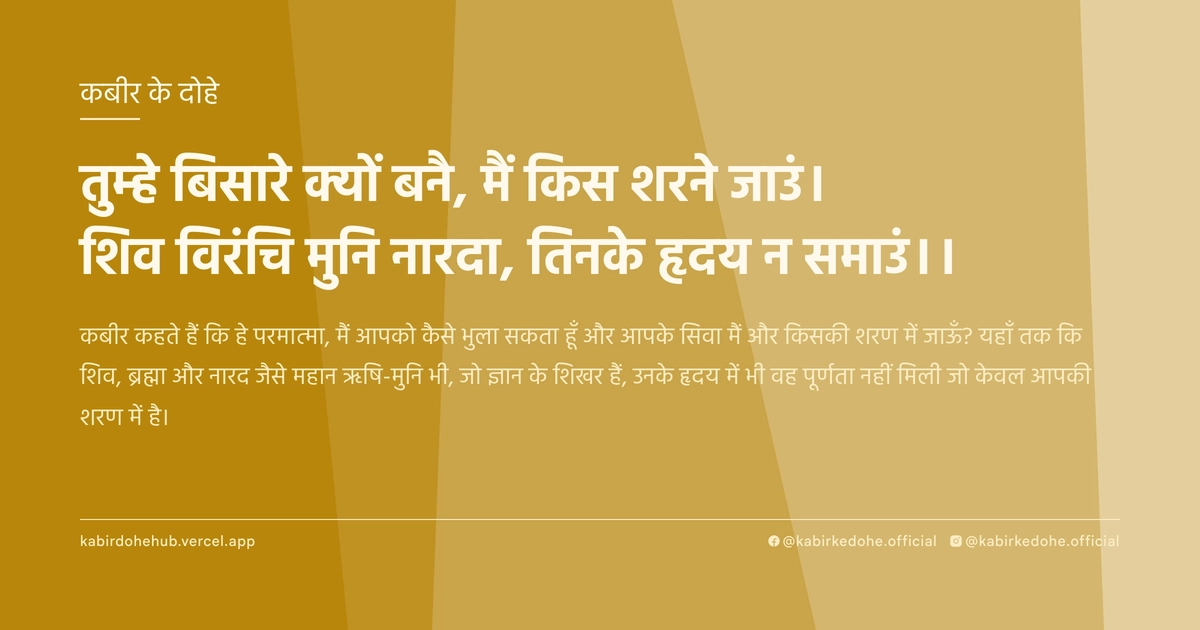
तुम्हे बिसारे क्यों बनै, मैं किस शरने जाउं।
शिव विरंचि मुनि नारदा, तिनके हृदय न समाउं।।
Tumhe bisare kyon banai, main kis sharne jaun. Shiv viranchi muni narada, tinke hriday na samaun.
इस पृष्ठ पर इस कबीर दोहे का अर्थ (meaning), हिंदी व्याख्या और अंग्रेज़ी अनुवाद, दार्शनिक विश्लेषण और व्यावहारिक जीवन सीख दी गई है। यह दोहा प्रपत्ति (Surrender) विषय से जुड़ा है — Kabir doha meaning and explanation in Hindi and English.
अर्थ (Meaning):
कबीर कहते हैं कि हे परमात्मा, मैं आपको कैसे भुला सकता हूँ और आपके सिवा मैं और किसकी शरण में जाऊँ? यहाँ तक कि शिव, ब्रह्मा और नारद जैसे महान ऋषि-मुनि भी, जो ज्ञान के शिखर हैं, उनके हृदय में भी वह पूर्णता नहीं मिली जो केवल आपकी शरण में है।
Kabir asks the Divine, "How could I ever forget You, and whose refuge could I possibly seek other than Yours?" He asserts that even the highest deities and sages like Shiva, Brahma, and Narada could not encapsulate the totality of the Absolute within their own hearts, making the Divine the only true sanctuary.
व्याख्या (Interpretation):
यह दोहा आत्मा की परमात्मा के प्रति पूर्ण समर्पण की पराकाष्ठा है। 'बिसारे' शब्द यहाँ केवल विस्मृति नहीं, बल्कि द्वैत की स्थिति को दर्शाता है। कबीर यह स्पष्ट करते हैं कि जब एक बार निराकार ब्रह्म का अनुभव हो जाता है, तो संसार के अन्य सभी सहारे तुच्छ लगने लगते हैं। शिव और ब्रह्मा यहाँ प्रतीकात्मक हैं, जो यह दर्शाते हैं कि व्यक्तिगत अहंकार या पद, चाहे वह ईश्वरीय पद ही क्यों न हो, पूर्ण सत्य को नहीं समेट सकता। यह निर्गुण भक्ति का सार है जहाँ साधक केवल उस एक 'अविनाशी' तत्व की खोज करता है। यहाँ विरोधाभास यह है कि जिसे हम बाहर खोजते हैं, वह वास्तव में हमारे भीतर ही है, लेकिन उसे पाने के लिए बाहरी सभी आश्रयों का त्याग करना पड़ता है।
This couplet represents the pinnacle of the soul's absolute surrender to the Divine. The word 'bisare' (forgetting) refers not merely to memory loss, but to the state of duality. Kabir clarifies that once the experience of the Formless Brahman is attained, all other worldly refuges appear trivial. Shiva and Brahma are used symbolically to demonstrate that individual ego or status, even divine status, cannot encapsulate the Absolute Truth. This is the essence of Nirgun Bhakti, where the seeker pursues only the one 'Indestructible' element. The central paradox is that while we search for the Divine externally, it resides within; however, to realize this, one must first abandon all external dependencies.
दार्शनिक विश्लेषण (Philosophical Analysis):
ऐतिहासिक रूप से, कबीर का समय धार्मिक कट्टरता और कर्मकांडों का युग था। इस दोहे में वे सूक्ष्मता से यह संदेश दे रहे हैं कि मोक्ष किसी बाहरी संस्था, मंदिर या किसी विशिष्ट देवता की पूजा से नहीं, बल्कि आंतरिक समर्पण से मिलता है। यह अद्वैत वेदांत के उस सिद्धांत से मेल खाता है जहाँ जीव और ब्रह्म की एकता स्थापित होती है। कबीर यहाँ 'शरण' शब्द का प्रयोग कर रहे हैं, जो सूफीवाद के 'फना' (अहंकार का विनाश) के करीब है।
वे यह तर्क देते हैं कि यदि ब्रह्मा (सृष्टि के रचयिता) और शिव (संहारकर्ता) जैसे सर्वोच्च सत्ताएँ भी उस परम तत्व में पूरी तरह विलीन नहीं हो पाएँ या उसे अपने सीमित हृदय में न समा सकेँ, तो एक साधारण मनुष्य के लिए बाहरी आडंबरों के माध्यम से उसे पाना असंभव है। यह कर्मकांडीय धर्म के विरुद्ध एक सशक्त प्रहार है।
मनोवैज्ञानिक स्तर पर, यह दोहा 'अटैचमेंट' (आसक्ति) के स्थानांतरण की बात करता है। जब मनुष्य अपनी पहचान को सामाजिक या धार्मिक लेबल से हटाकर सीधे ब्रह्मांडीय चेतना से जोड़ता है, तब वह भयमुक्त हो जाता है। कबीर यहाँ यह समझा रहे हैं कि वास्तविक सुरक्षा किसी व्यक्ति या देवता में नहीं, बल्कि उस शून्य या पूर्णता में है जो सर्वव्यापी है।
यहाँ 'हृदय न समाउं' का अर्थ यह है कि सीमित बुद्धि या सीमित हृदय उस असीम सत्य को नहीं पकड़ सकता। सत्य को पकड़ा नहीं जाता, उसमें घुला जाता है। यह विचार हमें सिखाता है कि ज्ञान (Knowledge) और अनुभव (Realization) के बीच एक गहरी खाई है। नारद और मुनि ज्ञान के प्रतीक हैं, लेकिन कबीर 'अनुभव' की बात कर रहे हैं।
अंततः, यह विश्लेषण हमें इस निष्कर्ष पर ले जाता है कि भक्ति का मार्ग वास्तव में स्वयं को मिटाने का मार्ग है। जब 'मैं' मिट जाता है, तब केवल 'वह' बचता है। यही वह बिंदु है जहाँ भक्त और भगवान एक हो जाते हैं, और फिर शरण लेने वाला और शरण देने वाला, दोनों एक ही अस्तित्व बन जाते हैं।
Historically, Kabir lived in an era of religious rigidity and ritualism. In this couplet, he subtly conveys that liberation is not achieved through external institutions, temples, or the worship of specific deities, but through internal surrender. This aligns with the Advaita Vedanta principle where the unity of the Jiva (individual soul) and Brahman (Universal Soul) is established. Kabir's use of the word 'sharan' (refuge) closely mirrors the Sufi concept of 'Fana' (the annihilation of the ego).
He argues that if supreme entities like Brahma (the Creator) and Shiva (the Destroyer) could not fully merge into or encapsulate the Absolute Truth within their limited hearts, then it is impossible for an ordinary human to attain it through ritualistic pretenses. This is a powerful critique of ceremonial religion.
On a psychological level, this verse discusses the shift of 'attachment.' When a human detaches their identity from social or religious labels and connects directly to the cosmic consciousness, they become fearless. Kabir explains that true security is not found in a person or a deity, but in that void or fullness that is omnipresent.
The phrase 'hriday na samaaun' implies that a limited intellect or a finite heart cannot grasp the infinite truth. Truth is not captured; one dissolves into it. This thought teaches us that there is a profound gap between intellectual knowledge and spiritual realization. Narada and the sages symbolize knowledge, but Kabir speaks of direct experience.
Ultimately, this analysis leads to the conclusion that the path of Bhakti is actually the path of self-effacement. When the 'I' vanishes, only 'That' remains. This is the point where the devotee and the Divine become one, and the seeker and the refuge merge into a single existence.
मूल संदेश (Core Message):
- बाहरी आश्रय केवल भ्रम हैं, वास्तविक शरण आंतरिक चेतना में है।
- ज्ञान का अहंकार (जैसे मुनियों का) भी सत्य के मार्ग में बाधा बन सकता है।
- परमात्मा कोई व्यक्ति नहीं, बल्कि एक सर्वव्यापी अनुभव है।
- समर्पण का अर्थ है अपनी सीमित पहचान को असीम में विलीन कर देना।
- सत्य को पाने के लिए पहले यह मानना होगा कि हम उससे अलग नहीं हैं।
- External refuges are mere illusions; true sanctuary lies within inner consciousness.
- The ego of knowledge (like that of the sages) can also become a barrier to Truth.
- The Divine is not a person, but an omnipresent experience.
- Surrender means dissolving one's limited identity into the Infinite.
- To find the Truth, one must first realize that they are not separate from it.
व्यावहारिक उदाहरण (Practical Example):
एक समय की बात है, वाराणसी के घाटों पर रहने वाला एक वृद्ध बुनकर था जिसका नाम माधव था। माधव जीवन भर केवल कपड़े बुनता रहा और अपनी छोटी सी दुनिया में संतुष्ट था, लेकिन उसके मन में हमेशा एक बेचैनी रहती थी कि वह ईश्वर को कैसे पाए।
वह अक्सर बड़े-बड़े पंडितों के पास जाता, कठिन मंत्रों का जाप करता और महंगे अनुष्ठान करवाता। उसने सुना था कि जितना अधिक दान और कठिन तपस्या होगी, ईश्वर उतना ही करीब आएगा।
एक दिन माधव ने देखा कि एक छोटा बच्चा नदी के किनारे बैठकर बस चुपचाप पानी की लहरों को देख रहा था, उसके चेहरे पर एक ऐसी शांति थी जो माधव ने बड़े-बड़े विद्वानों के चेहरे पर भी नहीं देखी थी।
माधव ने उस बच्चे से पूछा, "बेटा, तुमने कौन सा मंत्र पढ़ा है कि तुम इतने शांत हो?" बच्चे ने मासूमियत से जवाब दिया, "काका, मैं बस यह देख रहा हूँ कि यह पानी कहाँ से आया और कहाँ जा रहा है, और मुझे लगता है कि मैं भी इसी पानी का एक छोटा सा हिस्सा हूँ।"
यह बात माधव के दिल पर चोट कर गई। उसे याद आया कि वह अब तक ईश्वर को एक 'बाहरी शक्ति' मानकर उसे पाने की कोशिश कर रहा था, जैसे कोई वस्तु खरीदी जाती है।
उसे अहसास हुआ कि वह जिन पंडितों और अनुष्ठानों की शरण में जा रहा था, वे केवल माध्यम थे, मंजिल नहीं। उसने महसूस किया कि वह खुद को उन बाहरी ढांचों में फिट करने की कोशिश कर रहा था, जबकि सत्य तो उन ढांचों से कहीं बड़ा है।
उसने अपनी आँखें बंद कीं और पहली बार यह नहीं माँगा कि "मुझे ईश्वर दे दो", बल्कि यह कहा, "मैं जो कुछ भी हूँ, वह आपका ही अंश हूँ, मुझे मुझमें ही आपको देखने दें।"
उस क्षण माधव के भीतर का अहंकार, जो उसे लगता था कि वह 'भक्त' है, पूरी तरह टूट गया। उसे समझ आया कि शिव या नारद जैसे महान लोग भी यदि केवल 'पद' के अहंकार में रहे, तो वे भी सत्य से दूर हो जाएंगे।
माधव ने फिर कभी किसी मंदिर या पंडित की शरण नहीं ली। वह अपने करघे पर बैठता, धागों को बुनता और हर धागे में उसी निराकार ईश्वर को देखता।
उसका जीवन बदल गया; अब वह केवल कपड़े नहीं बुन रहा था, बल्कि वह अपने जीवन के हर पल को परमात्मा के साथ बुन रहा था। उसकी शांति अब बाहरी परिस्थितियों पर निर्भर नहीं थी।
Once, there was an elderly weaver named Madhav who lived on the ghats of Varanasi. Madhav spent his life weaving cloth and was content in his small world, yet he harbored a persistent restlessness about how to find God.
He frequently visited learned pundits, chanted complex mantras, and performed expensive rituals. He had been told that the more charity and rigorous penance one performed, the closer God would come.
One day, Madhav noticed a small child sitting by the river, silently watching the ripples of the water. There was a serenity on the child's face that Madhav had never seen even on the most learned scholars.
Madhav asked the child, "Son, which mantra have you recited to be so peaceful?" The child replied innocently, "Uncle, I am just watching where this water comes from and where it goes, and I feel that I am just a small part of this water."
These words struck a chord in Madhav's heart. He realized that until now, he had been treating God as an 'external power' to be acquired, like a commodity to be bought.
He understood that the pundits and rituals he had sought refuge in were merely mediums, not the destination. He realized he was trying to fit himself into external structures, while the Truth is far greater than any structure.
He closed his eyes and, for the first time, did not pray, "Give me God," but instead said, "Whatever I am, I am a part of You; let me see You within myself."
In that moment, the ego within Madhav—the belief that he was a 'devotee'—completely shattered. He understood that even great beings like Shiva or Narada would remain distant from the Truth if they clung to the ego of their 'status.'
Madhav never again sought refuge in any temple or pundit. He would sit at his loom, weave the threads, and see that formless Divine in every single strand.
His life transformed; he was no longer just weaving cloth, but weaving every moment of his life with the Divine. His peace was no longer dependent on external circumstances.
अभ्यास मार्गदर्शन (Practice Guidance):
- प्रतिदिन 20 मिनट मौन अभ्यास करें, जहाँ आप किसी भी देवता या रूप की कल्पना करने के बजाय केवल अपनी श्वास और अस्तित्व की उपस्थिति को महसूस करें।
- एक डायरी लिखें जिसमें आप उन सभी 'बाहरी आश्रयों' (जैसे सामाजिक प्रतिष्ठा, दूसरों की प्रशंसा, या धार्मिक पहचान) की सूची बनाएं जिनसे आप अपनी सुरक्षा महसूस करते हैं, और फिर विचार करें कि यदि ये सब छिन जाएं, तो आप कौन हैं।
- व्यवहार परिवर्तन: जब भी आप किसी समस्या में हों, तुरंत किसी बाहरी व्यक्ति या समाधान की तलाश करने के बजाय, 5 मिनट के लिए रुकें और स्वयं से पूछें, "क्या इस स्थिति में भी वह निराकार सत्य मौजूद है?"
- डायग्नोस्टिक चेकलिस्ट: क्या आप अभी भी यह महसूस करते हैं कि ईश्वर आपसे अलग है? क्या आप अपनी आध्यात्मिक प्रगति को दूसरों की तुलना में मापते हैं? यदि हाँ, तो आप अभी भी 'शरण' के भ्रम में हैं।
- Practice 20 minutes of daily silence, where instead of imagining any deity or form, you simply feel your breath and the presence of your existence.
- Keep a journal listing all the 'external refuges' (such as social status, praise from others, or religious identity) that make you feel secure, and then contemplate: if all these were gone, who would you be?
- Behavioral Change: Whenever you face a problem, instead of immediately seeking an external person or solution, pause for 5 minutes and ask yourself, "Is the formless Truth present even in this situation?"
- Diagnostic Checklist: Do you still feel that God is separate from you? Do you measure your spiritual progress in comparison to others? If yes, you are still under the illusion of seeking an external 'refuge'.
चिंतन प्रश्न (Reflection Questions):
- आप अपनी पहचान के लिए किन बाहरी लेबलों (जाति, धर्म, पद) का सहारा लेते हैं, और यदि ये हटा दिए जाएं, तो आपके भीतर क्या बचेगा?
- क्या आपकी भक्ति वास्तव में समर्पण है, या यह केवल एक 'सुरक्षित महसूस' करने का तरीका है?
- आप किन लोगों को अपने से अधिक आध्यात्मिक मानते हैं, और क्या यह धारणा आपके और सत्य के बीच की दीवार है?
- जब आप अकेले और पूरी तरह असहाय होते हैं, तब आप वास्तव में किसकी शरण में जाते हैं—अपने डर की या उस अनंत शांति की?
- क्या आप सत्य को 'जानना' चाहते हैं या सत्य में 'विलीन' होना चाहते हैं? इन दोनों के बीच का अंतर आपके जीवन में कैसे दिखता है?
- Which external labels (caste, religion, status) do you rely on for your identity, and if they were removed, what would remain within you?
- Is your devotion truly surrender, or is it merely a way to feel 'secure'?
- Whom do you consider more spiritual than yourself, and is this perception a wall between you and the Truth?
- When you are alone and completely helpless, whose refuge do you actually seek—your fear or that infinite peace?
- Do you want to 'know' the Truth or 'dissolve' into the Truth? How does the difference between these two manifest in your life?