
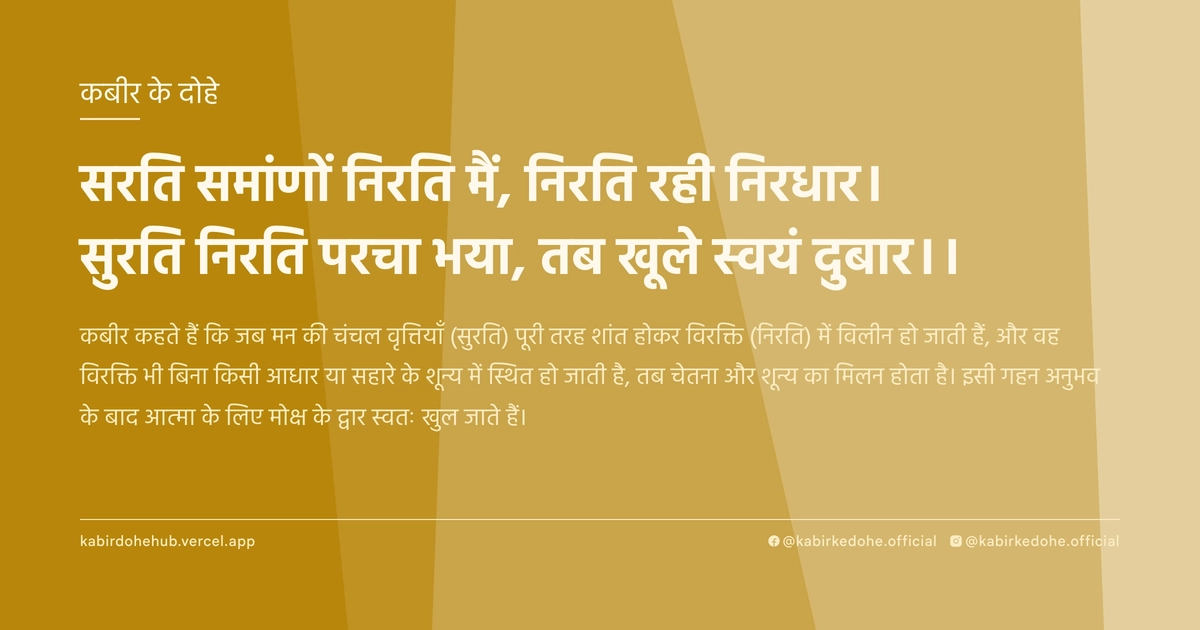
सरति समांणों निरति मैं, निरति रही निरधार।
सुरति निरति परचा भया, तब खूले स्वयं दुबार।।
Sarati samano nirati main, nirati rahi nirdhaar. Surati nirati parcha bhaya, tab khoole swayam dubaar.
इस पृष्ठ पर इस कबीर दोहे का अर्थ (meaning), हिंदी व्याख्या और अंग्रेज़ी अनुवाद, दार्शनिक विश्लेषण और व्यावहारिक जीवन सीख दी गई है। यह दोहा ध्यान (Meditation) विषय से जुड़ा है — Kabir doha meaning and explanation in Hindi and English.
अर्थ (Meaning):
कबीर कहते हैं कि जब मन की चंचल वृत्तियाँ (सुरति) पूरी तरह शांत होकर विरक्ति (निरति) में विलीन हो जाती हैं, और वह विरक्ति भी बिना किसी आधार या सहारे के शून्य में स्थित हो जाती है, तब चेतना और शून्य का मिलन होता है। इसी गहन अनुभव के बाद आत्मा के लिए मोक्ष के द्वार स्वतः खुल जाते हैं।
Kabir explains that when the flickering currents of the mind (Surati) merge completely into detachment (Nirati), and that detachment itself becomes baseless and void of all support, a profound realization occurs. When the conscious attention and the state of void unite, the doors to the ultimate self and liberation open spontaneously.
व्याख्या (Interpretation):
इस दोहे में 'सुरति' का अर्थ है वह जागरूकता जो बाहरी दुनिया में भटकती है, और 'निरति' का अर्थ है वह विरक्ति जो संसार से मोह को समाप्त करती है। कबीर एक सूक्ष्म आध्यात्मिक प्रक्रिया का वर्णन कर रहे हैं जहाँ साधक पहले बाहरी दुनिया से हटता है, फिर उस 'हटने' के अहंकार से भी मुक्त होता है। यह अवस्था 'निरधार' है, जिसका अर्थ है कि अब कोई मानसिक सहारा या संकल्प शेष नहीं रहा। यह अद्वैत वेदांत की उस स्थिति के समान है जहाँ ज्ञाता, ज्ञान और ज्ञेय का भेद मिट जाता है। जब सुरति (चेतना) और निरति (शून्यता) एक हो जाते हैं, तो द्वैत समाप्त हो जाता है। यह विरोधाभास है कि जब हम सब कुछ छोड़ देते हैं, तब हम वास्तव में सब कुछ पा लेते हैं। अंततः, यह आत्म-साक्षात्कार का वह क्षण है जहाँ 'स्वयं' के द्वार खुलते हैं, जो कि माया के पर्दों का गिरना है।
In this verse, 'Surati' refers to the conscious attention that wanders in the external world, while 'Nirati' signifies the detachment that erases worldly attachment. Kabir describes a subtle spiritual alchemy where the seeker first detaches from the world, and then detaches from the very identity of being 'detached'. This state is 'Nirdhaar', meaning it is baseless, devoid of any mental crutch or conceptual support. This mirrors the Advaita Vedanta state where the distinction between the knower, the known, and the knowledge vanishes. When Surati (consciousness) and Nirati (void) merge, duality ceases to exist. It is the central paradox: only when we relinquish everything do we truly possess everything. Ultimately, this is the moment of self-realization where the doors of the 'Self' open, signifying the collapse of the veils of Maya.
दार्शनिक विश्लेषण (Philosophical Analysis):
कबीर का यह दोहा निर्गुण भक्ति की पराकाष्ठा को दर्शाता है, जहाँ ईश्वर किसी मूर्ति या नाम में नहीं, बल्कि चेतना की उच्चतम अवस्था में पाया जाता है। ऐतिहासिक रूप से, कबीर ने अपने समय के उन कर्मकांडों का विरोध किया जो बाहरी दिखावे पर आधारित थे। उन्होंने तर्क दिया कि मोक्ष किसी तीर्थ या मंदिर में नहीं, बल्कि मन की आंतरिक यात्रा में है।
दार्शनिक स्तर पर, यह 'शून्य' की अवधारणा है जो सूफी मत के 'फना' (अहंकार का विनाश) और बौद्ध धर्म के 'निर्वाण' से गहराई से मेल खाती है। जब साधक अपनी पहचान को पूरी तरह मिटा देता है, तो वह ब्रह्मांडीय चेतना (ब्रह्म) के साथ एक हो जाता है। यहाँ 'निरति' केवल वैराग्य नहीं है, बल्कि एक सक्रिय मनोवैज्ञानिक विखंडन है जहाँ व्यक्ति अपनी सामाजिक, धार्मिक और व्यक्तिगत पहचान को त्याग देता है।
अद्वैत वेदांत के अनुसार, हम माया के कारण स्वयं को शरीर और मन समझते हैं। कबीर यहाँ उस प्रक्रिया को समझा रहे हैं जिससे माया का पर्दा हटता है। जब सुरति और निरति का मिलन होता है, तो वह 'परचा' या प्रमाण बन जाता है कि आत्मा और परमात्मा अलग नहीं हैं।
यह विश्लेषण स्पष्ट करता है कि कबीर केवल एक कवि नहीं, बल्कि एक मनोवैज्ञानिक थे। वे जानते थे कि जब तक मन में 'मैं' का सूक्ष्म अंश भी रहता है, तब तक सत्य का द्वार नहीं खुल सकता। यह 'निरधार' अवस्था उस पूर्ण मौन की स्थिति है जहाँ विचार समाप्त हो जाते हैं और केवल अस्तित्व बचता है।
अतः, यह दोहा हमें सिखाता है कि आध्यात्मिक प्रगति केवल ज्ञान पढ़ने से नहीं, बल्कि अनुभव के माध्यम से अहंकार के पूर्ण विलोपन से आती है। यह एक ऐसी यात्रा है जहाँ साधक स्वयं अपनी बाधा बन जाता है और फिर स्वयं ही उस बाधा को हटाकर अनंत में विलीन हो जाता है।
This couplet represents the pinnacle of Nirgun Bhakti, where the Divine is found not in idols or names, but in the highest state of consciousness. Historically, Kabir opposed the ritualism of his era, which relied on external displays of piety. He argued that liberation is not found in pilgrimages or temples, but in the internal journey of the mind.
Philosophically, this aligns with the concept of 'Shunya' (Void), mirroring the Sufi concept of 'Fana' (annihilation of the ego) and the Buddhist 'Nirvana'. When the seeker completely erases their identity, they merge with the cosmic consciousness (Brahman). Here, 'Nirati' is not mere asceticism, but an active psychological dismantling where one sheds social, religious, and personal identities.
According to Advaita Vedanta, we perceive ourselves as body and mind due to Maya (illusion). Kabir describes the process of lifting this veil. When Surati and Nirati merge, it becomes the 'Parcha' or evidence that the Atman and Brahman are non-dual.
This analysis reveals Kabir as a psychologist of the spirit. He understood that as long as a microscopic trace of 'I' remains, the door to Truth cannot open. The 'Nirdhaar' state is that absolute silence where thoughts cease and only pure existence remains.
Thus, the verse teaches that spiritual progress comes not from reading scriptures, but through the experiential annihilation of the ego. It is a journey where the seeker is their own obstacle and eventually the one who removes the obstacle to merge into the infinite.
मूल संदेश (Core Message):
- बाहरी दुनिया की जागरूकता को आंतरिक शांति में बदलें।
- वैराग्य को भी एक अहंकार बनने से रोकें।
- जब अंतिम मानसिक सहारा टूटता है, तब सत्य प्रकट होता है।
- शून्यता ही वह द्वार है जो अनंत की ओर ले जाता है।
- अहंकार का पूर्ण विलोपन ही वास्तविक मोक्ष है।
- Transform external awareness into internal stillness.
- Prevent detachment from becoming another form of ego.
- Truth reveals itself only when the last mental anchor breaks.
- Emptiness is the only gateway that leads to the infinite.
- The total annihilation of ego is the only true liberation.
व्यावहारिक उदाहरण (Practical Example):
वाराणसी के एक पुराने घाट पर रहने वाले एक वृद्ध बुनकर थे, जिनका नाम माधव था। माधव जीवन भर रेशमी साड़ियाँ बुनते रहे, लेकिन उनका मन हमेशा इस बात से परेशान रहता था कि लोग उनके काम की प्रशंसा करें या उनकी गरीबी का मजाक उड़ाएं। वे घंटों तक इस सोच में डूबे रहते कि समाज उन्हें कैसे देखता है—यही उनकी 'सुरति' थी, जो बाहरी दुनिया की प्रशंसा और आलोचना में उलझी थी।
एक दिन, एक भ्रमणकारी संत ने उनसे कहा, "माधव, तुम धागों को नहीं बुन रहे, तुम अपनी इच्छाओं का जाल बुन रहे हो।" इस बात ने माधव को झकझोर दिया। उन्होंने तय किया कि वे अब केवल काम करेंगे, परिणाम की चिंता नहीं करेंगे। धीरे-धीरे उन्होंने अपनी पहचान एक "प्रसिद्ध बुनकर" या "गरीब आदमी" के रूप में देखना बंद कर दिया। यह उनकी 'निरति' की शुरुआत थी।
लेकिन माधव ने देखा कि अब वे इस बात पर गर्व करने लगे थे कि वे कितने "वैरागी" हो गए हैं। वे खुद को दूसरों से श्रेष्ठ समझने लगे क्योंकि वे अब प्रशंसा की परवाह नहीं करते थे। यह एक नया सूक्ष्म अहंकार था, एक नया आधार था।
फिर एक रात, गंगा के किनारे ध्यान करते हुए, उन्हें महसूस हुआ कि यह "वैरागी होने का गर्व" भी उसी माया का हिस्सा है। उन्होंने उस अंतिम सहारे को भी छोड़ दिया। अब न तो प्रशंसा की चाह थी, न ही वैराग्य का अहंकार। वे पूरी तरह 'निरधार' हो गए—बिना किसी मानसिक सहारे के।
उस क्षण, माधव को एक असीम शांति का अनुभव हुआ। उन्हें महसूस हुआ कि वे केवल एक बुनकर नहीं हैं, बल्कि उस अनंत चेतना का हिस्सा हैं जो पूरे ब्रह्मांड को बुन रही है। उनके भीतर का द्वंद्व समाप्त हो गया।
जब वे अगले दिन काम पर लौटे, तो उनकी बुनाई में एक अद्भुत चमक थी। वे अब काम इसलिए नहीं कर रहे थे कि उन्हें कुछ पाना था, बल्कि इसलिए क्योंकि काम ही उनकी प्रार्थना बन गया था।
गाँव के लोग हैरान थे कि माधव के चेहरे पर अब एक ऐसी मुस्कान रहती थी जो किसी बाहरी परिस्थिति पर निर्भर नहीं थी। उन्होंने अपनी पहचान के बोझ को उतार फेंका था।
माधव की कहानी हमें सिखाती है कि केवल दुनिया छोड़ना काफी नहीं है; उस "छोड़ने वाले" के अहंकार को भी छोड़ना पड़ता है, तभी सत्य का द्वार खुलता है।
On an old ghat in Varanasi lived an elderly weaver named Madhav. All his life, Madhav wove exquisite silk sarees, but his mind was constantly troubled by whether people praised his work or mocked his poverty. He spent hours dwelling on how society perceived him—this was his 'Surati', entangled in the external world's validation.
One day, a wandering saint told him, "Madhav, you are not weaving threads; you are weaving a web of desires." This shook Madhav. He decided to work without concern for the result. Gradually, he stopped identifying as a "famous weaver" or a "poor man." This was the beginning of his 'Nirati'.
However, Madhav noticed that he began to take pride in how "detached" he had become. He started viewing himself as superior to others because he no longer craved praise. This was a new, subtle ego—a new mental support.
Then one night, meditating by the Ganges, he realized that this "pride of detachment" was also part of the same Maya. He let go of that final anchor. Now, there was neither a desire for praise nor the ego of being a renunciant. He became 'Nirdhaar'—without any mental support.
In that moment, Madhav experienced an infinite peace. He felt that he was not merely a weaver, but a part of the cosmic consciousness weaving the entire universe. His internal conflict vanished.
When he returned to work the next day, there was a divine luster in his weaving. He no longer worked to achieve something; rather, the work itself became his prayer.
The villagers were amazed that Madhav now carried a smile that did not depend on any external circumstance. He had cast off the burden of identity.
Madhav's story teaches us that merely leaving the world is not enough; one must also relinquish the ego of the "one who has left," only then do the doors of truth open.
अभ्यास मार्गदर्शन (Practice Guidance):
- प्रतिदिन 20 मिनट 'साक्षी भाव' का अभ्यास करें: अपने विचारों को देखें बिना उनसे जुड़े, जैसे आप किसी अजनबी को देख रहे हों।
- स्व-पूछताछ जर्नल: लिखें कि आज आपने किस बात पर गर्व महसूस किया या कहाँ आप अपनी पहचान (Identity) को बचाने की कोशिश कर रहे थे।
- मौन का अभ्यास: दिन में एक घंटा पूर्ण मौन रहें, जहाँ न केवल वाणी शांत हो, बल्कि मानसिक संवाद को भी न्यूनतम करने का प्रयास करें।
- निदान चेकलिस्ट: क्या मैं अभी भी इस बात से परेशान हूँ कि लोग मेरे बारे में क्या सोचते हैं? क्या मैं अपनी 'आध्यात्मिक प्रगति' का अहंकार कर रहा हूँ? यदि हाँ, तो आप अभी भी 'आधार' (Support) से बंधे हैं।
- Practice 'Witness Consciousness' for 20 minutes daily: Observe your thoughts without attaching to them, as if watching a stranger.
- Self-Inquiry Journaling: Record moments where you felt pride or where you tried to protect your social/spiritual identity.
- Practice of Silence: Spend one hour in complete silence daily, aiming to quiet not just the voice, but the internal mental dialogue.
- Diagnostic Checklist: Am I still bothered by others' perceptions? Am I proud of my 'spiritual progress'? If yes, you are still clinging to a 'support' (Aadhar).
चिंतन प्रश्न (Reflection Questions):
- यदि आपकी सारी उपलब्धियाँ और आपकी सामाजिक पहचान छीन ली जाए, तो आपके भीतर क्या बचेगा?
- क्या आपका 'अध्यात्म' आपको विनम्र बना रहा है, या यह आपको दूसरों से श्रेष्ठ महसूस कराने का एक नया तरीका बन गया है?
- आप किन मानसिक धारणाओं (Beliefs) के सहारे अपनी मानसिक शांति बनाए रखते हैं, और क्या होगा यदि वे सब अचानक गायब हो जाएं?
- आपकी डिजिटल पहचान (Social Media Persona) आपके वास्तविक आंतरिक शून्य से कितनी दूर है?
- क्या आप वास्तव में शांत होना चाहते हैं, या आप केवल शांति का 'अनुभव' करने की इच्छा रखते हैं?
- If all your achievements and social identities were stripped away, what would remain within you?
- Is your 'spirituality' making you humble, or has it become a new way to feel superior to others?
- What mental anchors do you rely on for peace, and what would happen if they all suddenly vanished?
- How far is your digital persona from your actual internal void?
- Do you truly desire stillness, or do you merely desire the 'experience' of feeling peaceful?