
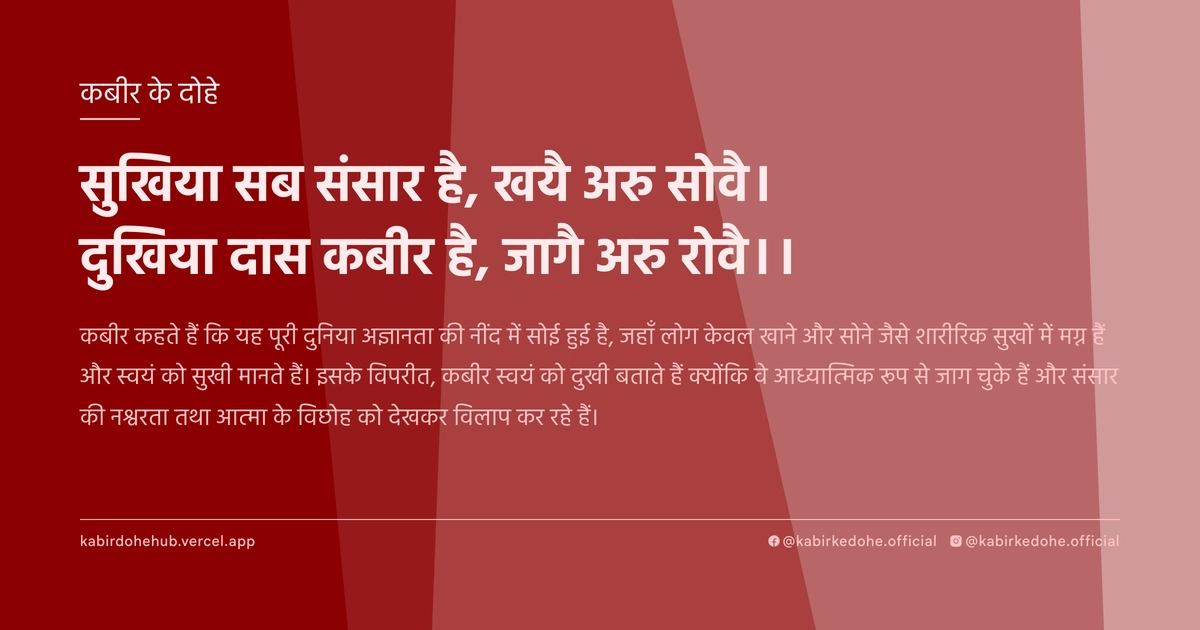
सुखिया सब संसार है, खयै अरु सोवै।
दुखिया दास कबीर है, जागै अरु रोवै।।
Sukhiya sab sansar hai, khaye aru sovai. Dukhiya das Kabir hai, jaage aru rovai.
इस पृष्ठ पर इस कबीर दोहे का अर्थ (meaning), हिंदी व्याख्या और अंग्रेज़ी अनुवाद, दार्शनिक विश्लेषण और व्यावहारिक जीवन सीख दी गई है। यह दोहा जागृति (The Wake-up Call) विषय से जुड़ा है — Kabir doha meaning and explanation in Hindi and English.
अर्थ (Meaning):
कबीर कहते हैं कि यह पूरी दुनिया अज्ञानता की नींद में सोई हुई है, जहाँ लोग केवल खाने और सोने जैसे शारीरिक सुखों में मग्न हैं और स्वयं को सुखी मानते हैं। इसके विपरीत, कबीर स्वयं को दुखी बताते हैं क्योंकि वे आध्यात्मिक रूप से जाग चुके हैं और संसार की नश्वरता तथा आत्मा के विछोह को देखकर विलाप कर रहे हैं।
Kabir observes that the entire world is immersed in the slumber of ignorance, believing themselves happy while preoccupied with the primal urges of eating and sleeping. In stark contrast, Kabir describes himself as sorrowful, for he has awakened spiritually and weeps upon realizing the transient nature of existence and the soul's separation from the Divine.
व्याख्या (Interpretation):
इस दोहे का शाब्दिक अर्थ भौतिक सुख और आध्यात्मिक जागृति के बीच के अंतर को दर्शाता है। यहाँ "सोना" केवल नींद नहीं, बल्कि 'माया' के प्रभाव में होने का प्रतीक है, जहाँ मनुष्य अपनी वास्तविक पहचान भूलकर इंद्रिय सुखों को ही अंतिम सत्य मान लेता है। "जागना" आत्म-साक्षात्कार या बोध का प्रतीक है। कबीर का "रोना" कोई साधारण दुख नहीं, बल्कि 'विरह' है—वह तड़प जो एक साधक तब महसूस करता है जब उसे पता चलता है कि वह अनंत सत्य से दूर एक सीमित शरीर में कैद है। यह विरोधाभास दर्शाता है कि जिसे दुनिया सुख कहती है, वह वास्तव में गहरी बेहोशी है, और जिसे दुनिया दुख कहती है, वह वास्तव में मुक्ति की ओर पहला कदम है। यह निर्गुण भक्ति का सार है, जहाँ बाहरी आडंबरों के बजाय आंतरिक सत्य की खोज की जाती है।
The literal meaning highlights the chasm between material contentment and spiritual awakening. Here, "sleeping" is not mere physical rest but a metaphor for being under the spell of 'Maya' (illusion), where humans mistake sensory gratifications for ultimate reality. "Awakening" symbolizes the dawn of self-realization. Kabir's "weeping" is not mundane grief but 'Viraha'—the intense longing of a seeker who realizes their entrapment in a limited physical form, separated from the Infinite Truth. This paradox suggests that what the world perceives as happiness is actually a profound unconsciousness, while what is perceived as sorrow is the first step toward liberation. It embodies the essence of Nirgun Bhakti, prioritizing internal realization over external rituals.
दार्शनिक विश्लेषण (Philosophical Analysis):
यह दोहा कबीर के उस क्रांतिकारी दृष्टिकोण को प्रस्तुत करता है जो सामाजिक और धार्मिक रूढ़ियों से ऊपर उठकर मनुष्य की चेतना की बात करता है। कबीर के समय में धर्म केवल कर्मकांडों और बाहरी दिखावे तक सीमित था। उन्होंने इस बात पर प्रहार किया कि कैसे मनुष्य धर्म के नाम पर केवल अपनी वासनाओं को संतुष्ट कर रहा है। यह विश्लेषण अद्वैत वेदांत के उस सिद्धांत से मेल खाता है जहाँ 'अविद्या' (ignorance) ही सभी दुखों का मूल कारण है। जब तक मनुष्य स्वयं को शरीर मानता है, वह माया के जाल में फंसा रहता है।
सूफी मत के परिप्रेक्ष्य में, कबीर की यह स्थिति 'इश्क-ए-हकीकी' (ईश्वरीय प्रेम) की तड़प है। सूफी संत भी मानते हैं कि जब तक हृदय में विरह की अग्नि नहीं जलती, तब तक परमात्मा का मिलन संभव नहीं है। कबीर यहाँ यह स्पष्ट कर रहे हैं कि भौतिक सुख वास्तव में एक मानसिक कारागार है जो हमें हमारी वास्तविक प्रकृति से दूर रखता है।
कबीर का यह विलाप वास्तव में एक 'सकारात्मक दुख' है। यह वह दुख है जो अहंकार के विनाश की शुरुआत करता है। जब व्यक्ति यह महसूस करता है कि वह जिस दुनिया को अपना घर समझ रहा था, वह केवल एक सपना है, तब उसकी वास्तविक यात्रा शुरू होती है। यह मनोवैज्ञानिक रूपांतरण की वह अवस्था है जहाँ व्यक्ति 'स्व' (ego) से 'सर्व' (universal consciousness) की ओर बढ़ता है।
यहाँ कबीर जाति, वर्ण और संप्रदाय के भेदों को पूरी तरह नकार देते हैं। उनके लिए 'संसार' का अर्थ केवल एक विशेष समूह नहीं, बल्कि वह हर व्यक्ति है जो चेतना के स्तर पर सोया हुआ है। यह संदेश सार्वभौमिक है कि आध्यात्मिक प्रगति के लिए सबसे पहले अपनी वर्तमान स्थिति के प्रति असंतोष होना आवश्यक है।
अंततः, यह दोहा हमें सिखाता है कि सत्य की खोज का मार्ग एकाकी होता है। जब आप भीड़ से अलग होकर अपनी अंतरात्मा की पुकार सुनते हैं, तो आप दुनिया की नजर में 'दुखी' या 'पागल' लग सकते हैं, लेकिन वास्तव में आप ही एकमात्र ऐसे व्यक्ति हैं जो वास्तव में जीवित और जागृत हैं।
This couplet presents Kabir's revolutionary perspective, transcending social and religious dogmas to address the state of human consciousness. In Kabir's era, religion was largely reduced to rituals and outward displays. He critiqued how humans used religion merely to satisfy their base desires. This analysis aligns with the Advaita Vedanta principle that 'Avidya' (ignorance) is the root cause of all suffering. As long as a human identifies solely with the body, they remain trapped in the web of Maya.
From the perspective of Sufism, Kabir's state represents the longing of 'Ishq-e-Haqiqi' (Divine Love). Sufi saints similarly believe that union with the Divine is impossible without the fire of separation (Viraha). Kabir clarifies that material pleasures are essentially a mental prison that alienates us from our true nature.
Kabir's lament is, in fact, a 'positive sorrow.' It is the grief that initiates the annihilation of the ego. When an individual realizes that the world they considered home is merely a dream, their true journey begins. This is a stage of psychological transformation where one moves from the 'ego' to 'universal consciousness.'
Here, Kabir completely rejects the divisions of caste, creed, and sect. For him, 'the world' does not refer to a specific group, but to anyone who remains asleep at the level of consciousness. The message is universal: spiritual progress requires an initial dissatisfaction with one's current state of existence.
Ultimately, this doha teaches that the path to truth is solitary. When you detach from the crowd to listen to the call of your inner soul, you may appear 'miserable' or 'mad' to the world, but in reality, you are the only one who is truly alive and awake.
मूल संदेश (Core Message):
- भौतिक सुख अक्सर आध्यात्मिक अंधापन का पर्दा होते हैं।
- सच्ची जागृति के साथ एक अनिवार्य विरह और दुख आता है।
- अहंकार का विसर्जन ही वास्तविक आनंद की पहली शर्त है।
- माया की नींद से जागना ही मनुष्य का परम लक्ष्य है।
- आंतरिक तड़प ही परमात्मा से मिलन का मार्ग प्रशस्त करती है।
- Material pleasures are often veils for spiritual blindness.
- True awakening is inevitably accompanied by a sense of longing and sorrow.
- The dissolution of the ego is the primary condition for real bliss.
- Awakening from the sleep of Maya is the ultimate goal of human existence.
- Inner longing is the only path that leads to union with the Divine.
व्यावहारिक उदाहरण (Practical Example):
वाराणसी के घाटों पर रहने वाले एक वृद्ध बुनकर, माधव, की कहानी है। माधव अपने जीवन के साठ साल केवल कपड़े बुनने और परिवार की जरूरतों को पूरा करने में बिता चुका था। वह शहर के सबसे समृद्ध बुनकरों में से एक था, जिसे लोग 'सुखी' मानते थे क्योंकि उसके पास धन और मान-सम्मान दोनों थे।
एक दिन माधव ने देखा कि उसका सबसे पुराना मित्र, जो एक साधारण साधु था, घाट की सीढ़ियों पर बैठकर रो रहा था। माधव ने उससे पूछा, "तुम्हारे पास सब कुछ तो नहीं है, फिर भी तुम इस शांतिपूर्ण वातावरण में क्यों रो रहे हो? क्या तुम्हें जीवन के सुख नहीं दिखते?"
साधु ने मुस्कुराते हुए कहा, "माधव, तुम जिसे सुख कह रहे हो, वह केवल एक गहरी नींद है। तुम कपड़े बुन रहे हो, लेकिन तुमने यह नहीं देखा कि समय तुम्हारे जीवन के धागों को धीरे-धीरे काट रहा है। मैं इसलिए रो रहा हूँ क्योंकि मैं जाग गया हूँ और देख पा रहा हूँ कि हम सब एक ऐसे सपने में जी रहे हैं जिसका कोई अंत नहीं है।"
यह बात माधव के हृदय में चुभ गई। उसे पहली बार महसूस हुआ कि उसकी समृद्धि वास्तव में एक पर्दा थी जिसने उसे उसकी आत्मा की पुकार सुनने से रोका था। उसे लगा कि वह अब तक केवल 'खा रहा था और सो रहा था'—न केवल शारीरिक रूप से, बल्कि मानसिक रूप से भी।
अगले कुछ महीनों तक माधव गहरे अवसाद में रहा। वह अपने धन और प्रतिष्ठा को तुच्छ समझने लगा। उसे लगने लगा कि वह अब तक एक मृत शरीर की तरह जी रहा था। उसने अपनी सारी संपत्ति का एक हिस्सा गरीबों में बाँटना शुरू किया, लेकिन यह दान अहंकार से नहीं, बल्कि वैराग्य से उपजा था।
उसने अपने काम को अब केवल जीविका का साधन नहीं, बल्कि एक ध्यान (meditation) बना लिया। वह हर धागे को बुनते समय यह याद करता कि यह जीवन भी एक बुनकरी है, जहाँ ईश्वर हमें अपनी इच्छा से बुनता है और फिर एक दिन उधेड़ देता है।
माधव की पत्नी और बच्चे उसे 'पागल' और 'दुखी' कहने लगे क्योंकि उसने विलासिता का त्याग कर दिया था। लेकिन माधव के चेहरे पर एक ऐसी शांति थी जो उसने पहले कभी महसूस नहीं की थी। वह अब दुनिया की नजरों में 'दुखी' था, लेकिन आंतरिक रूप से वह मुक्त हो रहा था।
उसने महसूस किया कि वह रोना वास्तव में उसकी आत्मा का शुद्धिकरण था। वह अब केवल भौतिक सुखों का दास नहीं था, बल्कि सत्य की खोज में एक जागृत यात्री बन गया था।
अंत में, माधव ने समझा कि असली सुख वह नहीं है जो बाहरी परिस्थितियों से मिलता है, बल्कि वह है जो तब मिलता है जब आप माया की नींद से जागकर अपने वास्तविक स्वरूप को पहचान लेते हैं।
इस प्रकार, माधव ने कबीर के दोहे को अपने जीवन में उतारा—उसने भौतिक नींद को त्यागकर आध्यात्मिक जागृति के 'दुख' को चुना, जो वास्तव में परम आनंद का द्वार था।
This is the story of Madhav, an elderly weaver living on the ghats of Varanasi. Madhav had spent sixty years of his life weaving cloth and fulfilling family needs. He was one of the wealthiest weavers in the city, regarded by people as 'happy' because he possessed both wealth and social prestige.
One day, Madhav noticed his oldest friend, a simple monk, sitting on the steps of the ghat and weeping. Madhav asked him, "You have nothing to your name, yet why do you weep in this peaceful environment? Do you not see the joys of life?"
The monk smiled and replied, "Madhav, what you call happiness is merely a deep sleep. You are weaving cloth, but you have not seen that time is slowly cutting the threads of your own life. I weep because I have awakened and can see that we are all living in a dream with no end."
These words pierced Madhav's heart. For the first time, he felt that his prosperity was actually a veil that had prevented him from hearing the call of his soul. He realized that he had been merely 'eating and sleeping'—not just physically, but mentally as well.
For the next few months, Madhav lived in deep contemplation. He began to view his wealth and prestige as trivial. He felt as though he had been living like a dead body until that moment.
He started distributing a portion of his wealth to the poor, but this charity did not stem from ego; it arose from a sense of detachment (Vairagya).
He transformed his work from a mere means of livelihood into a form of meditation. With every thread he wove, he reminded himself that life is also a weaving process, where the Divine weaves us according to His will and then one day unravels us.
Madhav's wife and children began calling him 'mad' and 'miserable' because he had renounced luxury. However, there was a peace on Madhav's face that he had never experienced before. In the eyes of the world, he was 'unhappy,' but internally, he was becoming free.
He realized that his weeping was actually a purification of his soul. He was no longer a slave to material pleasures but had become an awakened traveler in search of Truth.
Eventually, Madhav understood that true happiness is not derived from external circumstances, but from the realization of one's true nature after awakening from the sleep of Maya.
Thus, Madhav embodied Kabir's doha—he chose the 'sorrow' of spiritual awakening over the material sleep, which in reality was the gateway to supreme bliss.
अभ्यास मार्गदर्शन (Practice Guidance):
- प्रतिदिन 20 मिनट मौन रहकर यह विचार करें कि आपके जीवन के कौन से सुख वास्तव में 'नींद' (अज्ञान) हैं और कौन से वास्तविक संतोष।
- एक डायरी लिखें जिसमें आप उन क्षणों को दर्ज करें जब आपने अपनी सामाजिक पहचान (जैसे पद, प्रतिष्ठा) को अपने वास्तविक स्वरूप से ऊपर रखा।
- व्यवहार परिवर्तन: दिन में कम से कम एक बार किसी ऐसी वस्तु या सुख का त्याग करें जिसके प्रति आप अत्यधिक आसक्त हैं, ताकि आप आसक्ति के बंधन को तोड़ सकें।
- निदान चेकलिस्ट: क्या आप छोटी-छोटी समस्याओं पर अत्यधिक विचलित होते हैं? क्या आप केवल भौतिक उपलब्धियों में खुशी ढूंढ रहे हैं? यदि हाँ, तो आप अभी भी 'सो रहे' हैं।
- Spend 20 minutes daily in silence, contemplating which of your life's pleasures are actually 'sleep' (ignorance) and which are true contentment.
- Maintain a journal recording moments where you prioritized your social identity (status, prestige) over your true essential nature.
- Behavioral Change: At least once a day, consciously renounce a luxury or object you are overly attached to, in order to break the bonds of attachment.
- Diagnostic Checklist: Do you become excessively distressed by trivial problems? Are you seeking happiness solely in material achievements? If yes, you are still 'asleep'.
चिंतन प्रश्न (Reflection Questions):
- यदि आपका सारा धन और सामाजिक सम्मान आज छीन लिया जाए, तो आपके भीतर क्या बचेगा?
- आप अपनी 'डिजिटल पहचान' (सोशल मीडिया इमेज) को बनाए रखने के लिए कितनी मानसिक ऊर्जा खर्च कर रहे हैं, और क्या यह आपको सत्य से दूर ले जा रहा है?
- क्या आप वास्तव में सुखी हैं, या आप केवल दूसरों द्वारा परिभाषित 'सुख' की नकल कर रहे हैं?
- वह कौन सा डर है जो आपको अपनी सुख-सुविधाओं की 'नींद' को छोड़ने से रोकता है?
- क्या आपने कभी उस 'पवित्र दुख' को महसूस किया है जो आपको अपनी आत्मा की गहराई में ले जाता है?
- If all your wealth and social prestige were stripped away today, what would remain within you?
- How much mental energy are you spending to maintain your 'digital identity,' and is this distancing you from the Truth?
- Are you truly happy, or are you merely mimicking a version of 'happiness' defined by others?
- What is the specific fear that prevents you from leaving the 'sleep' of your comforts?
- Have you ever experienced that 'sacred sorrow' which pulls you deeper into the depths of your own soul?