
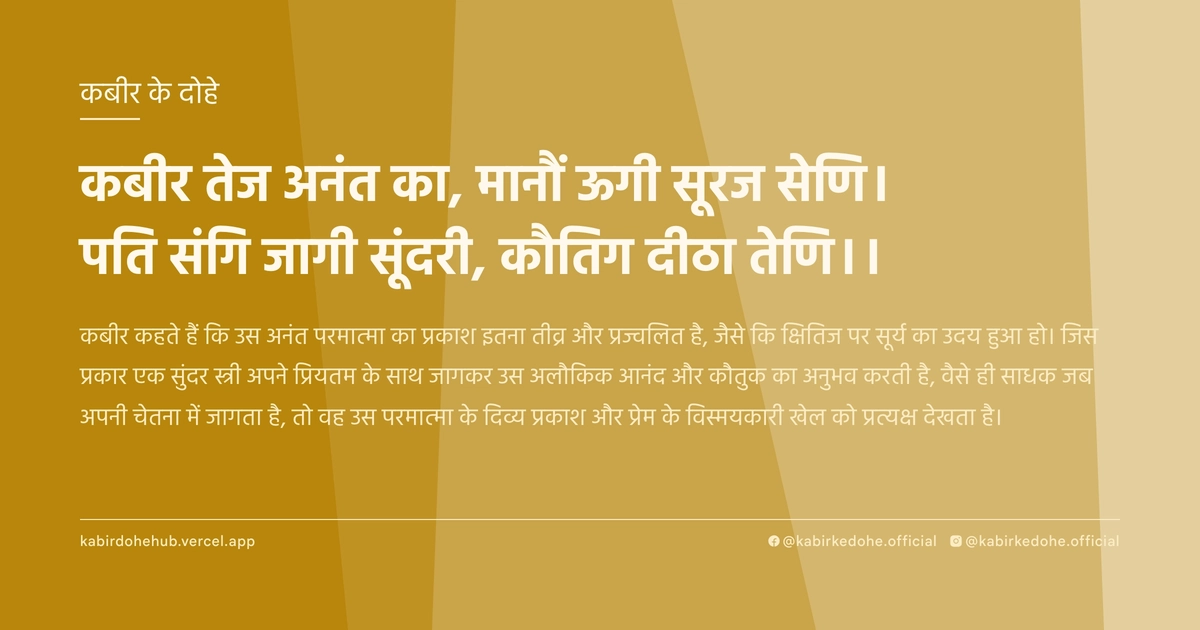
कबीर तेज अनंत का, मानौं ऊगी सूरज सेणि।
पति संगि जागी सूंदरी, कौतिग दीठा तेणि।।
Kabir tej anant ka, maanau oogi suraj seni. Pati sangi jaagi sundari, kautig deetha teni.
इस पृष्ठ पर इस कबीर दोहे का अर्थ (meaning), हिंदी व्याख्या और अंग्रेज़ी अनुवाद, दार्शनिक विश्लेषण और व्यावहारिक जीवन सीख दी गई है। यह दोहा अंतर ज्योति (The Inner Light) विषय से जुड़ा है — Kabir doha meaning and explanation in Hindi and English.
अर्थ (Meaning):
कबीर कहते हैं कि उस अनंत परमात्मा का प्रकाश इतना तीव्र और प्रज्वलित है, जैसे कि क्षितिज पर सूर्य का उदय हुआ हो। जिस प्रकार एक सुंदर स्त्री अपने प्रियतम के साथ जागकर उस अलौकिक आनंद और कौतुक का अनुभव करती है, वैसे ही साधक जब अपनी चेतना में जागता है, तो वह उस परमात्मा के दिव्य प्रकाश और प्रेम के विस्मयकारी खेल को प्रत्यक्ष देखता है।
Kabir describes the radiance of the Infinite Divine as being as blinding and magnificent as the rising sun. He likens the spiritual awakening of a seeker to a beautiful woman waking up beside her beloved; in that moment of conscious union, she witnesses the wondrous play of love and light, symbolizing the soul's ecstatic realization of the Divine presence within.
व्याख्या (Interpretation):
यहाँ 'तेज अनंत' उस निराकार ब्रह्म के प्रकाश का प्रतीक है जो अज्ञान के अंधकार को मिटा देता है। सूर्य का उदय होना केवल एक प्राकृतिक घटना नहीं, बल्कि आध्यात्मिक बोध (Enlightenment) का रूपक है। 'सुंदरी' यहाँ जीवात्मा का प्रतीक है और 'पति' उस परमात्मा का, जो आत्मा का वास्तविक स्वामी है। जब आत्मा माया की निद्रा से जागती है, तो उसे यह बोध होता है कि वह परमात्मा से अलग नहीं है। यह मिलन कामुक नहीं, बल्कि आध्यात्मिक है, जहाँ द्वैत समाप्त हो जाता है। यह स्थिति निर्गुण भक्ति की पराकाष्ठा है, जहाँ साधक शब्दों से परे एक अलौकिक आनंद (Kautig) का अनुभव करता है। अंततः, यह दोहा अद्वैत वेदांत के उस सत्य को दर्शाता है जहाँ आत्मा और परमात्मा एक ही ज्योति के दो रूप हैं।
The 'infinite radiance' symbolizes the light of the formless Brahman that obliterates the darkness of ignorance. The rising sun is not a mere celestial event but a metaphor for spiritual awakening. The 'beautiful woman' represents the individual soul (Jivatma), and the 'husband' represents the Divine (Paramatma), the true owner of the soul. When the soul awakens from the slumber of Maya, it realizes its non-duality with the Divine. This union is not carnal but metaphysical, marking the end of duality. It represents the pinnacle of Nirgun Bhakti, where the seeker experiences a wondrous joy (Kautig) beyond linguistic description. Ultimately, the verse mirrors the Advaita Vedanta truth that the Atman and Brahman are one and the same light.
दार्शनिक विश्लेषण (Philosophical Analysis):
कबीर का यह दोहा उस समय की सामाजिक और धार्मिक जड़ता के विरुद्ध एक शक्तिशाली प्रहार है, जहाँ ईश्वर को केवल मूर्तियों या कठिन कर्मकांडों में खोजा जाता था। कबीर 'निर्गुण' मार्ग के प्रणेता थे, जिन्होंने तर्क दिया कि परमात्मा किसी मंदिर या मस्जिद में नहीं, बल्कि स्वयं के भीतर के प्रकाश में स्थित है। यहाँ वे सूफी मत के 'इश्क-ए-हकीकी' (दिव्य प्रेम) और वेदांत के 'अद्वैत' का समन्वय करते हैं।
ऐतिहासिक रूप से, कबीर ने जाति और धर्म के भेदभाव को मिटाने के लिए प्रेम और आंतरिक अनुभव को प्राथमिकता दी। उनके लिए 'तेज' वह ज्ञान है जो बाहरी आडंबरों को जलाकर भस्म कर देता है। वे बताते हैं कि जब तक मनुष्य अहंकार (Ego) की नींद में सोया है, वह इस प्रकाश को नहीं देख सकता। जैसे ही अहंकार मिटता है, आत्मा का परमात्मा से मिलन होता है, जो कि सबसे बड़ा कौतुक या चमत्कार है।
यह विश्लेषण हमें बताता है कि कबीर के लिए आध्यात्मिकता कोई शुष्क दर्शन नहीं, बल्कि एक जीवंत अनुभव था। वे ritualism का विरोध करते हुए यह समझाते हैं कि वास्तविक पूजा स्वयं के भीतर जागना है। यह जागृति ही मनुष्य को पशुता से देवत्व की ओर ले जाती है।
मनोवैज्ञानिक स्तर पर, यह दोहा चेतना के विस्तार की बात करता है। जब हम अपनी संकीर्ण पहचान (नाम, पद, जाति) को छोड़ते हैं, तो हम उस अनंत प्रकाश का हिस्सा बन जाते हैं। यह 'अहं ब्रह्मास्मि' की अनुभूति है, जहाँ देखने वाला और जो देखा जा रहा है, दोनों एक हो जाते हैं।
अंततः, कबीर यह संदेश देते हैं कि सत्य अत्यंत सरल है, लेकिन हमारी दृष्टि धुंधली है। जैसे सूर्य हमेशा मौजूद रहता है पर रात में नहीं दिखता, वैसे ही परमात्मा सदैव उपस्थित है, बस हमारी चेतना के जागने की प्रतीक्षा है।
This couplet is a potent strike against the social and religious rigidity of Kabir's era, where the Divine was sought only in idols or complex rituals. As a proponent of the 'Nirgun' path, Kabir argued that the Infinite is not confined to temples or mosques but resides within the inner light of the self. Here, he synthesizes the Sufi concept of 'Ishq-e-Haqiqi' (Divine Love) with the Advaita Vedanta principle of non-duality.
Historically, Kabir prioritized inner experience over caste and creed to dismantle social hierarchies. For him, 'Tej' (radiance) is the gnosis that incinerates external pretenses. He posits that as long as a human is asleep in the slumber of the ego, this light remains invisible. The moment the ego dissolves, the union of the soul with the Divine occurs—the ultimate 'Kautig' or cosmic wonder.
This analysis reveals that for Kabir, spirituality was not a dry philosophy but a lived, visceral experience. By rejecting ritualism, he taught that true worship is the act of awakening within. This awakening is the bridge that transforms human instinct into divine consciousness.
Psychologically, the verse speaks to the expansion of consciousness. When we shed our narrow identities—name, status, caste—we merge into that infinite radiance. This is the realization of 'Aham Brahmasmi' (I am Brahman), where the observer and the observed become one.
Ultimately, Kabir suggests that Truth is simple, yet our vision is clouded. Just as the sun always exists even during the night, the Divine is ever-present, merely awaiting the awakening of our consciousness.
मूल संदेश (Core Message):
- बाहरी खोज एक भ्रम है; सत्य केवल भीतर है।
- अहंकार की नींद को त्यागना ही वास्तविक जागरण है।
- परमात्मा कोई व्यक्ति नहीं, बल्कि एक अनंत प्रकाश है।
- प्रेम और भक्ति ही वह सेतु हैं जो आत्मा को ब्रह्म से जोड़ते हैं।
- जब द्वैत मिटता है, तब जीवन एक दिव्य कौतुक बन जाता है।
- External searching is an illusion; Truth resides only within.
- Shedding the sleep of ego is the only true awakening.
- The Divine is not a person, but an infinite, all-pervading light.
- Love and devotion are the bridges connecting the soul to Brahman.
- When duality vanishes, life becomes a divine cosmic play.
व्यावहारिक उदाहरण (Practical Example):
एक समय की बात है, बनारस के घाटों पर माधव नाम का एक वृद्ध बुनकर रहता था। माधव दिन भर सूत कातता और रात को कबीर के पदों का गान करता। उसके जीवन में सब कुछ था—एक छोटा सा घर, कुछ पुराने मित्र और अपनी कला के प्रति प्रेम। लेकिन उसके मन में एक गहरी बेचैनी थी। वह सोचता था कि क्या ईश्वर वास्तव में उसे देख रहा है, या वह केवल एक कल्पना है।
माधव अक्सर मंदिर जाता, घंटों लंबी कतारों में खड़ा रहता और पंडितों से कहता कि उसे ईश्वर का दर्शन कराना। पंडित उसे कठिन व्रत और दान-पुण्य की सलाह देते। माधव ने अपनी सारी जमापूंजी दान कर दी, कई दिनों तक उपवास रखा, लेकिन उसके मन का अंधेरा कम नहीं हुआ। वह जितना बाहर खोजता, उतना ही खोखला महसूस करता।
एक दिन, माधव बहुत थककर अपने करघे (loom) पर बैठा था। अचानक उसकी नजर खिड़की से अंदर आ रही सूरज की एक किरण पर पड़ी, जिसने हवा में उड़ रहे धूल के कणों को सोने की तरह चमका दिया था। उस क्षण, उसे महसूस हुआ कि वह प्रकाश केवल बाहर नहीं है, बल्कि उसके भीतर भी एक ऐसी ही ज्योति जल रही है, जिसे उसने अब तक अनदेखा किया था।
उसे याद आया कबीर का वह दोहा—'तेज अनंत का'। उसे समझ आया कि वह अब तक जिसे बाहर खोज रहा था, वह उसके अपने ही भीतर सोया हुआ था। उसने अपनी आँखें बंद कीं और उस आंतरिक प्रकाश पर ध्यान केंद्रित किया। अचानक, उसे एक ऐसा आनंद मिला जैसा किसी प्रेमी को अपने प्रियतम को पाकर मिलता है।
उसका पूरा अस्तित्व उस प्रकाश में विलीन हो गया। उसे महसूस हुआ कि वह केवल एक बुनकर नहीं है, बल्कि उस अनंत चेतना का एक छोटा सा हिस्सा है। उसकी बेचैनी समाप्त हो गई और उसकी जगह एक गहरे मौन और संतोष ने ले ली।
अगले दिन जब वह उठा, तो उसकी दुनिया बदल चुकी थी। उसने देखा कि उसके पड़ोसी, जिनसे वह अक्सर झगड़ता था, अब उसे अपने ही रूप के विस्तार लग रहे थे। उसने महसूस किया कि जब आप स्वयं के भीतर उस 'अनंत तेज' को देख लेते हैं, तो दुनिया का हर चेहरा ईश्वर का प्रतिबिंब बन जाता है।
माधव ने अब मंदिर जाना छोड़ दिया, लेकिन वह हर समय मंदिर जैसा ही रहने लगा। वह अब केवल कपड़े नहीं बुनता था, बल्कि अपने व्यवहार से प्रेम और करुणा के धागे बुनने लगा। लोग उसकी शांति को देखकर हैरान थे और उससे पूछने लगे कि उसने क्या पाया है।
माधव बस मुस्कुराता और कहता, "मैंने बस जागना सीखा है। जब तक मैं सो रहा था, मुझे अंधेरा दिख रहा था; जब मैं जागा, तो पाया कि सूरज तो हमेशा से यहीं था।"
Once, in the ghats of Varanasi, lived an elderly weaver named Madhav. Madhav spent his days spinning yarn and his nights singing the verses of Kabir. He had a modest life—a small hut, a few old friends, and a passion for his craft. Yet, a deep restlessness gnawed at him. He wondered if God truly saw him or if the Divine was merely a comforting fiction.
Madhav frequently visited temples, standing in long queues for hours, pleading with priests to grant him a vision of God. The priests advised him to undertake rigorous fasts and give lavish donations. Madhav gave away his meager savings and starved himself for days, but the darkness in his heart did not recede. The more he searched externally, the emptier he felt.
One day, exhausted, Madhav sat at his loom. Suddenly, his gaze fell upon a single ray of sunlight streaming through the window, turning the floating dust motes into shimmering gold. In that instant, he realized that this light was not just outside; a similar radiance was burning within him, one he had ignored for a lifetime.
He recalled Kabir's verse—'the infinite radiance'. He understood that what he had been seeking externally was actually asleep within him. He closed his eyes and focused on that inner light. Suddenly, he was washed over by a joy akin to a lover finally reuniting with their beloved.
His entire existence seemed to merge into that light. He realized he was not merely a weaver, but a tiny fragment of an infinite consciousness. His restlessness vanished, replaced by a profound silence and contentment.
When he woke the next morning, his world had transformed. He looked at his neighbors, with whom he had often quarreled, and saw them as extensions of his own being. He realized that once you witness the 'infinite light' within, every face in the world becomes a reflection of the Divine.
Madhav stopped visiting the temples, but he himself became a living temple. He no longer just wove cloth; he began weaving threads of love and compassion into his every interaction. People were astonished by his serenity and asked what he had discovered.
Madhav would simply smile and say, "I have only learned to wake up. While I slept, I saw only darkness; when I awoke, I found that the sun had been here all along."
अभ्यास मार्गदर्शन (Practice Guidance):
- प्रतिदिन 20 मिनट 'अंतर्मुखी ध्यान' करें: अपनी आँखें बंद करें और कल्पना करें कि आपके हृदय के केंद्र में एक छोटा सा सूर्य उदय हो रहा है, जो धीरे-धीरे आपके पूरे शरीर को आलोकित कर रहा है।
- आत्म-पूछताछ जर्नल: प्रतिदिन लिखें कि आज आपने अपने अहंकार (Ego) को कहाँ महसूस किया और उस क्षण में आप कैसे 'सोए हुए' थे।
- मौन का अभ्यास: दिन में एक घंटा पूर्ण मौन रहें। बाहरी शोर को कम करें ताकि आप अपने भीतर के 'अनंत तेज' की सूक्ष्म ध्वनि को सुन सकें।
- निदान चेकलिस्ट: क्या आप अभी भी दूसरों में दोष खोज रहे हैं? क्या आप अपनी खुशी के लिए बाहरी परिस्थितियों पर निर्भर हैं? यदि हाँ, तो इसका अर्थ है कि आप अभी भी माया की निद्रा में हैं।
- Daily 'Introverted Meditation' (20 mins): Close your eyes and visualize a small sun rising in the center of your heart, gradually illuminating your entire being.
- Self-Inquiry Journaling: Record daily instances where your ego took over and analyze how you were 'asleep' to the truth in those moments.
- Practice of Silence: Spend one hour in complete silence daily. Reduce external noise to hear the subtle vibration of the 'infinite radiance' within.
- Diagnostic Checklist: Are you still searching for flaws in others? Are you dependent on external circumstances for your happiness? If yes, you are still slumbering in the illusion of Maya.
चिंतन प्रश्न (Reflection Questions):
- क्या मेरा 'धार्मिक' व्यक्तित्व वास्तव में मेरी आध्यात्मिक प्रगति है, या यह केवल एक सामाजिक मुखौटा है?
- मैं किन मानसिक आदतों के कारण उस आंतरिक प्रकाश को देखने में असमर्थ हूँ जो मेरे भीतर सदैव मौजूद है?
- यदि मैं अपनी सभी उपलब्धियों और पहचानों को हटा दूँ, तो जो बचेगा, क्या वह प्रकाश होगा या शून्य?
- मेरे जीवन में 'प्रियतम' (परमात्मा) की कमी है, या मेरी जागने की इच्छा की कमी है?
- क्या मैं सत्य को जानने की कोशिश कर रहा हूँ, या केवल सत्य के बारे में पढ़ने का संतोष कर रहा हूँ?
- Is my 'religious' identity a sign of spiritual progress, or merely a social mask?
- Which mental habits prevent me from seeing the inner light that is eternally present within me?
- If I strip away all my achievements and identities, would what remain be light or a void?
- Is it the absence of the 'Beloved' (Divine) in my life, or the absence of my will to awaken?
- Am I striving to realize the Truth, or am I merely satisfied with reading about it?