
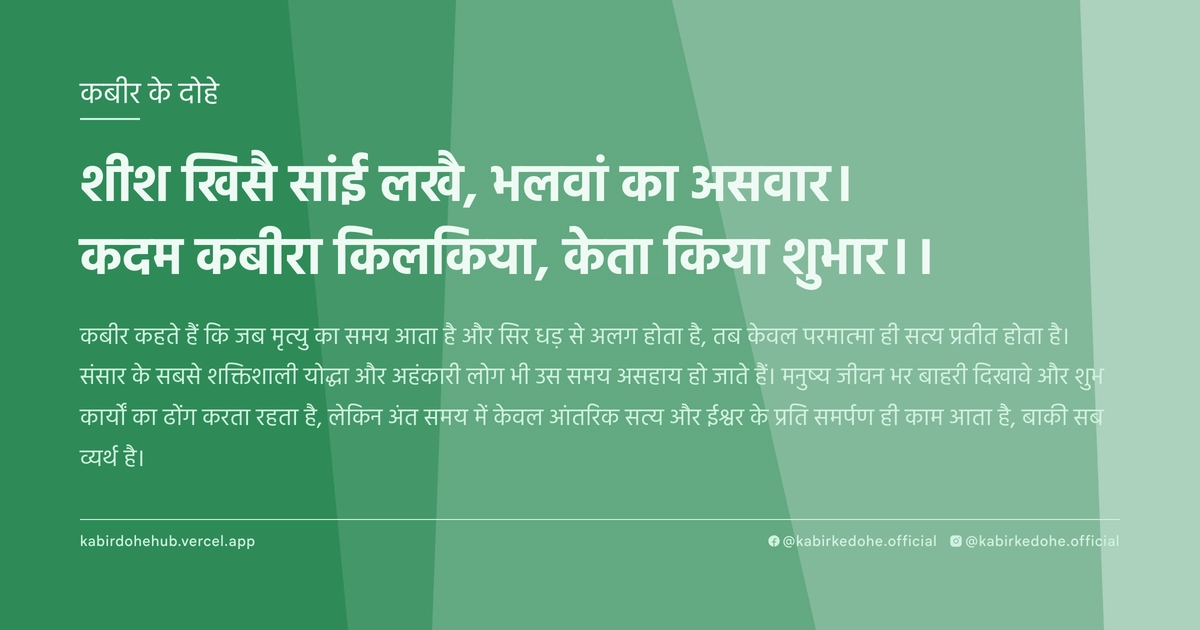
शीश खिसै सांई लखै, भलवां का असवार।
कदम कबीरा किलकिया, केता किया शुभार।।
Sheesh khisai sai lakhai, bhalwan ka aswar. Kadam kabira kilakiya, keta kiya shubar.
इस पृष्ठ पर इस कबीर दोहे का अर्थ (meaning), हिंदी व्याख्या और अंग्रेज़ी अनुवाद, दार्शनिक विश्लेषण और व्यावहारिक जीवन सीख दी गई है। यह दोहा मुक्ति (Liberation) विषय से जुड़ा है — Kabir doha meaning and explanation in Hindi and English.
अर्थ (Meaning):
कबीर कहते हैं कि जब मृत्यु का समय आता है और सिर धड़ से अलग होता है, तब केवल परमात्मा ही सत्य प्रतीत होता है। संसार के सबसे शक्तिशाली योद्धा और अहंकारी लोग भी उस समय असहाय हो जाते हैं। मनुष्य जीवन भर बाहरी दिखावे और शुभ कार्यों का ढोंग करता रहता है, लेकिन अंत समय में केवल आंतरिक सत्य और ईश्वर के प्रति समर्पण ही काम आता है, बाकी सब व्यर्थ है।
Kabir asserts that at the moment of inevitable death, when the head departs from the body, only the Divine remains visible. Even the most powerful warriors and arrogant rulers of the world become helpless. Throughout life, man engages in superficial displays of virtue and ritualistic 'auspicious' acts, yet in the final hour, only the internal truth and surrender to the Formless One hold value; all external pretenses vanish.
व्याख्या (Interpretation):
इस दोहे का शाब्दिक अर्थ मृत्यु की अनिवार्यता और अहंकार की निरर्थकता को दर्शाता है। 'शीश खिसै' मृत्यु का प्रतीक है, जहाँ भौतिक पहचान समाप्त हो जाती है। यहाँ कबीर निरगुण भक्ति का संदेश देते हैं कि जब माया का पर्दा गिरता है, तब केवल 'सांई' (परमात्मा) ही शेष रहता है। यह अद्वैत वेदांत के उस सिद्धांत को पुष्ट करता है जहाँ आत्मा और ब्रह्म की एकता केवल अहंकार के विसर्जन के बाद अनुभव होती है। 'भलवां का असवार' उन लोगों का प्रतीक है जो स्वयं को दुनिया का स्वामी मानते हैं, लेकिन मृत्यु के सामने उनकी सारी शक्ति शून्य है। कबीर यहाँ एक विरोधाभास प्रस्तुत करते हैं: जिसे हम 'शुभ' (shubhaar) मानते हैं, वह अक्सर केवल सामाजिक दिखावा होता है, जबकि वास्तविक शुभता आत्मा का परमात्मा में विलीन होना है।
The literal meaning of this couplet highlights the inevitability of death and the futility of ego. 'Sheesh khisai' symbolizes the moment of death where physical identity is severed. Kabir conveys the essence of Nirgun Bhakti, suggesting that when the veil of Maya falls, only 'Saai' (the Divine) remains. This reinforces the Advaita Vedanta principle that the non-duality of Atman and Brahman is realized only after the annihilation of the ego. The 'powerful rider' represents those who perceive themselves as masters of the world, yet find their strength void in the face of mortality. Kabir presents a central paradox: what society deems 'auspicious' (shubhaar) is often mere superficiality, whereas true auspiciousness lies in the soul's merger with the Formless Absolute.
दार्शनिक विश्लेषण (Philosophical Analysis):
कबीर का यह दोहा उस कालखंड की उपज है जहाँ धार्मिक कट्टरता और बाहरी कर्मकांड अपने चरम पर थे। उन्होंने देखा कि लोग तीर्थयात्राओं और दिखावटी दान-पुण्य के माध्यम से मोक्ष पाने की कोशिश कर रहे थे, जबकि उनके भीतर का अहंकार जीवित था। कबीर इस 'धार्मिक पाखंड' का खंडन करते हुए कहते हैं कि मृत्यु एक ऐसा सत्य है जो सभी सामाजिक श्रेणियों, जातियों और पदवियों को मिटा देता है।
दार्शनिक स्तर पर, यह सूफी मत के 'फना' (अहंकार का विनाश) और वेदांत के 'माया' के सिद्धांत से मेल खाता है। जब तक मनुष्य स्वयं को शरीर या पद से पहचानता है, वह भ्रम में है। मृत्यु वह क्षण है जब यह भ्रम अनिवार्य रूप से टूटता है। कबीर चेतावनी देते हैं कि यदि इस बोध को मृत्यु के समय के लिए छोड़ दिया गया, तो जीवन व्यर्थ गया। बुद्धिमान वह है जो जीवित रहते हुए ही 'अहं' का त्याग कर दे।
यहाँ 'शुभ' शब्द पर प्रहार है। समाज जिसे शुभ मानता है—जैसे बड़े उत्सव या महंगे अनुष्ठान—कबीर की दृष्टि में वे केवल मानसिक बंधन हैं। वास्तविक शुभता आंतरिक शुद्धि और सत्य का साक्षात्कार है। यह विचार उस समय के सामंती ढांचे को चुनौती देता था, जहाँ शक्ति और संपत्ति को आध्यात्मिक श्रेष्ठता का पैमाना माना जाता था।
मनोवैज्ञानिक रूप से, यह दोहा 'मृत्यु-चिंतन' (Memento Mori) के माध्यम से वर्तमान जीवन को सचेत करने का प्रयास है। जब हम यह स्वीकार करते हैं कि अंततः हम शून्य हो जाएंगे, तो हमारी प्रतिस्पर्धा, ईर्ष्या और घृणा स्वतः समाप्त होने लगती है। यह अहंकार का विसर्जन ही वास्तविक आध्यात्मिक प्रगति है।
अंततः, कबीर यह स्पष्ट करते हैं कि परमात्मा किसी मंदिर या मस्जिद में नहीं, बल्कि उस शून्य में है जो अहंकार के मिटने के बाद प्रकट होता है। यह निरगुण भक्ति का चरम है, जहाँ ईश्वर कोई व्यक्ति नहीं, बल्कि एक सार्वभौमिक चेतना है जिसमें सब कुछ विलीन हो जाता है।
This couplet is a product of an era characterized by intense religious bigotry and superficial ritualism. Kabir observed people attempting to secure salvation through pilgrimages and ostentatious charity while their internal ego remained untouched. He rejects this 'religious hypocrisy,' asserting that death is the ultimate equalizer that erases all social hierarchies, castes, and titles.
Philosophically, this aligns with the Sufi concept of 'Fana' (annihilation of the self) and the Vedantic doctrine of 'Maya.' As long as a human identifies with the body or a social role, they exist in illusion. Death is the moment this illusion is forcibly shattered. Kabir warns that if this realization is deferred until the final breath, the life has been squandered. The wise are those who practice the dissolution of the 'I' while still living.
There is a pointed critique of the word 'auspicious' (shubhaar). What society labels as auspicious—grand festivals or expensive rituals—are, in Kabir's view, merely mental shackles. True auspiciousness is internal purification and the realization of Truth. This challenged the feudal structures of his time, where power and wealth were erroneously equated with spiritual superiority.
Psychologically, the poem employs 'Memento Mori' to awaken the practitioner to the present. By accepting the inevitability of becoming nothing, competition, jealousy, and hatred naturally dissipate. This shedding of the ego is the only genuine spiritual progress.
Ultimately, Kabir clarifies that the Divine is not found in temples or mosques, but in the void that emerges after the ego vanishes. This is the pinnacle of Nirgun Bhakti, where God is not a persona but a universal consciousness into which all existence eventually merges.
मूल संदेश (Core Message):
- अहंकार एक ऐसा पर्दा है जो हमें परमात्मा से अलग करता है।
- बाहरी कर्मकांडों की तुलना में आंतरिक शुद्धि अधिक महत्वपूर्ण है।
- मृत्यु अटल है, इसलिए वर्तमान में ही अहंकार का त्याग करें।
- सच्ची शुभता पद या प्रतिष्ठा में नहीं, बल्कि समर्पण में है।
- जब 'मैं' मिटता है, तभी 'वह' (परमात्मा) प्रकट होता है।
- Ego is the veil that separates the individual from the Divine.
- Internal purification outweighs the value of external rituals.
- Death is inevitable; therefore, renounce the ego in the present.
- True auspiciousness lies in surrender, not in rank or prestige.
- Only when the 'I' vanishes does the 'He' (Divine) manifest.
व्यावहारिक उदाहरण (Practical Example):
वाराणसी के एक पुराने घाट पर माधव नाम का एक अत्यंत अहंकारी पंडित रहता था। वह अपनी विद्वत्ता और शास्त्रों के ज्ञान पर इतना गर्व करता था कि वह अन्य साधकों को तुच्छ समझता था। वह प्रतिदिन बड़े आडंबर के साथ पूजा करता और स्वयं को धर्म का रक्षक मानता था।
एक दिन उसकी मुलाकात एक साधारण से बुनकर से हुई, जिसने उसे कबीर का यह दोहा सुनाया। माधव ने हँसते हुए कहा, "मैं तो शास्त्रों का ज्ञाता हूँ, मुझे मृत्यु का भय नहीं, क्योंकि मैंने सभी शुभ कर्म किए हैं।"
कुछ समय बाद, माधव गंभीर रूप से बीमार पड़ा। उसके पास उसके वे सभी शिष्य और अनुयायी थे जो उसकी प्रशंसा करते थे, लेकिन जैसे ही मृत्यु का समय निकट आया, वह अपनी सारी विद्वत्ता और प्रतिष्ठा भूल गया।
अंतिम क्षणों में, उसे महसूस हुआ कि जिन शास्त्रों के अहंकार में उसने जीवन बिताया, वे उसे शांति नहीं दे रहे थे। उसे याद आया कि उसने कभी किसी गरीब की निस्वार्थ सेवा नहीं की थी, केवल 'शुभ' दिखने वाले कर्म किए थे।
उसे वह बुनकर याद आया और वह दोहा गूँजने लगा—"शीश खिसै सांई लखै"। उसे समझ आया कि उसकी सारी विद्वत्ता केवल एक मुखौटा थी।
उसने अपनी आँखें बंद कीं और पहली बार अपने भीतर के उस अहंकार को देखा जिसने उसे सत्य से दूर रखा था। उसने महसूस किया कि वह जिसे 'शुभ' समझ रहा था, वह वास्तव में उसकी अपनी छवि को चमकाने का प्रयास था।
उसने अंतिम सांस लेते समय अपनी सारी उपाधियों का त्याग किया और केवल उस निराकार परमात्मा को पुकारा, जिसे उसने कभी किताबों में खोजा था लेकिन हृदय में कभी नहीं उतारा।
उसका चेहरा, जो पहले कठोरता और गर्व से भरा था, अब एक शांत समर्पण में बदल गया था। उसने जान लिया था कि अंत में केवल प्रेम और सत्य ही साथ चलते हैं, अहंकार नहीं।
उसकी मृत्यु के बाद, उसके शिष्यों ने देखा कि वह पंडित, जो कभी दूसरों को नीचा दिखाता था, अंततः एक साधारण मनुष्य की तरह शांत विदा हुआ।
यह बदलाव इस बात का प्रमाण था कि मृत्यु के द्वार पर पहुँचकर ही माधव का वास्तविक 'शुभ' कार्य शुरू हुआ—अहंकार का विसर्जन।
On an ancient ghat in Varanasi lived a highly arrogant priest named Madhav. He took such pride in his scholarship and knowledge of the scriptures that he viewed other seekers as insignificant. He performed his rituals with great pomp, believing himself to be the guardian of righteousness.
One day, he encountered a simple weaver who recited this specific doha of Kabir to him. Madhav laughed and replied, "I am a master of the scriptures; I fear no death, for I have performed all the auspicious acts."
Some time later, Madhav fell gravely ill. All the disciples and followers who once praised him were present, but as the moment of death approached, he forgot all his erudition and prestige.
In his final moments, he realized that the scholarship he had spent his life guarding provided no peace. He remembered that he had never served a poor soul selflessly; he had only performed acts that 'looked' auspicious to the world.
He recalled the weaver and the words echoed in his mind—"Sheesh khisai saai lakhai." He understood that his entire intellectual identity was merely a mask.
Closing his eyes, he witnessed for the first time the ego that had kept him distanced from the Truth. He realized that what he perceived as 'auspicious' was actually an attempt to polish his own public image.
As he took his final breath, he renounced all his titles and called out to the Formless Divine, whom he had sought in books but never invited into his heart.
His face, once etched with rigidity and pride, transformed into a mask of serene surrender.
After his passing, his disciples noticed that the priest who once looked down upon others had finally departed with the simplicity of an ordinary human.
This transformation proved that only at the threshold of death did Madhav's truly 'auspicious' work begin—the dissolution of the ego.
अभ्यास मार्गदर्शन (Practice Guidance):
- दैनिक चिंतन: प्रतिदिन 15 मिनट मौन बैठें और विचार करें कि यदि आज अंतिम दिन हो, तो आपकी कौन सी उपलब्धियाँ वास्तव में मायने रखेंगी और कौन सी केवल सामाजिक मुखौटे हैं।
- आत्म-पूछताछ जर्नल: एक डायरी लिखें जिसमें उन क्षणों को दर्ज करें जब आपने 'सही' दिखने के लिए कोई कार्य किया, न कि 'सत्य' होने के लिए।
- व्यवहारिक परिवर्तन: किसी ऐसे व्यक्ति की गुप्त रूप से सहायता करें जिससे आप घृणा करते हैं या जिसे आप अपने से छोटा समझते हैं, ताकि आपके भीतर का श्रेष्ठता-बोध समाप्त हो सके।
- निदान चेकलिस्ट: क्या आप दूसरों की प्रशंसा पर निर्भर हैं? क्या आप अपनी उपलब्धियों को अपनी पहचान मानते हैं? यदि हाँ, तो आप अभी भी 'माया' के प्रभाव में हैं।
- Daily Contemplation: Spend 15 minutes in silence daily, reflecting on which of your achievements would truly matter if today were your last day, and which are merely social masks.
- Self-Inquiry Journal: Maintain a diary recording moments where you acted to 'appear right' rather than to 'be true.'
- Behavioral Shift: Secretly help someone you dislike or perceive as inferior to dismantle your internal sense of superiority.
- Diagnostic Checklist: Are you dependent on external praise? Do you equate your achievements with your identity? If yes, you are still under the influence of Maya.
चिंतन प्रश्न (Reflection Questions):
- वह कौन सा मुखौटा है जिसे आप दुनिया के सामने पहनते हैं, लेकिन अकेले में वह आपको बोझ लगता है?
- यदि आपकी सारी डिग्रियाँ, पद और संपत्ति छीन ली जाएँ, तो आपके पास अपनी पहचान के लिए क्या बचेगा?
- क्या आपकी 'धार्मिकता' वास्तव में करुणा से प्रेरित है, या यह दूसरों को नीचा दिखाने का एक सूक्ष्म तरीका है?
- आप अपनी डिजिटल पहचान (सोशल मीडिया) को कितना सच मानते हैं और वह आपके वास्तविक स्वरूप से कितना अलग है?
- मृत्यु का विचार आपको डराता है या यह आपको जीवन की निरर्थक दौड़ से मुक्त करता है?
- What is the mask you wear for the world that feels like a burden when you are alone?
- If all your degrees, titles, and assets were stripped away, what would remain of your identity?
- Is your 'righteousness' truly driven by compassion, or is it a subtle tool to feel superior to others?
- How much of your digital identity is authentic, and how far does it deviate from your true self?
- Does the thought of death frighten you, or does it liberate you from the futile race of life?