
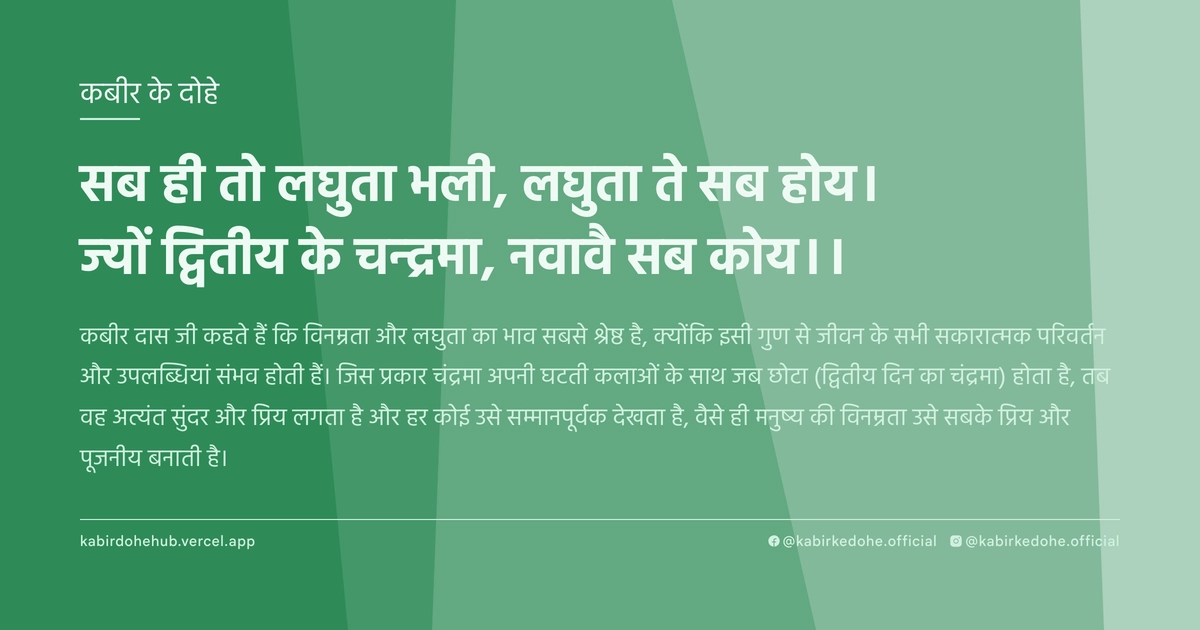
सब ही तो लघुता भली, लघुता ते सब होय।
ज्यों द्वितीय के चन्द्रमा, नवावै सब कोय।।
Sab hi to laghuta bhali, laghuta te sab hoye. Jyon dwitiya ke chandrama, navavai sab koy.
इस पृष्ठ पर इस कबीर दोहे का अर्थ (meaning), हिंदी व्याख्या और अंग्रेज़ी अनुवाद, दार्शनिक विश्लेषण और व्यावहारिक जीवन सीख दी गई है। यह दोहा विनम्रता (Humility) विषय से जुड़ा है — Kabir doha meaning and explanation in Hindi and English.
अर्थ (Meaning):
कबीर दास जी कहते हैं कि विनम्रता और लघुता का भाव सबसे श्रेष्ठ है, क्योंकि इसी गुण से जीवन के सभी सकारात्मक परिवर्तन और उपलब्धियां संभव होती हैं। जिस प्रकार चंद्रमा अपनी घटती कलाओं के साथ जब छोटा (द्वितीय दिन का चंद्रमा) होता है, तब वह अत्यंत सुंदर और प्रिय लगता है और हर कोई उसे सम्मानपूर्वक देखता है, वैसे ही मनुष्य की विनम्रता उसे सबके प्रिय और पूजनीय बनाती है।
Kabir asserts that humility and the quality of being 'small' or unassuming are the most virtuous traits, as all true spiritual and worldly growth stems from this state. He uses the metaphor of the waning moon; when the moon is in its second phase (small/crescent), its beauty is most poignant and captivating, drawing the admiration of all. Similarly, a person who sheds the burden of ego and embraces humility becomes a magnet for grace and respect.
व्याख्या (Interpretation):
इस दोहे का शाब्दिक अर्थ विनम्रता की प्रशंसा है, परंतु इसका आध्यात्मिक संकेत 'अहंकार के विसर्जन' की ओर है। 'लघुता' यहाँ केवल बाहरी विनम्रता नहीं, बल्कि स्वयं को शून्य करने की प्रक्रिया है। निर्गुण भक्ति के संदर्भ में, जब तक साधक 'मैं' (अहंकार) के विस्तार में रहता है, वह परमात्मा से दूर रहता है। जैसे ही वह स्वयं को लघु या शून्य मानता है, वह ब्रह्म के साथ एकाकार होने योग्य बनता है। यह माया के उस भ्रम को तोड़ता है जहाँ मनुष्य अपनी उपलब्धियों को अपनी शक्ति मानता है। वास्तव में, लघुता वह द्वार है जिससे होकर आत्मा परमात्मा की अनंतता में विलीन होती है, क्योंकि पूर्णता केवल शून्य होने के बाद ही प्राप्त होती है।
While the literal meaning praises humility, the spiritual core addresses the 'dissolution of the ego.' 'Laghuta' (smallness) is not mere modesty but the process of becoming 'Shunya' (zero). In Nirgun Bhakti, as long as the seeker exists in the expansion of 'I' (the ego), they remain separated from the Divine. Only by embracing smallness does one become eligible to merge with the infinite Brahman. This dismantles the illusion of Maya, where humans mistake their achievements for their own power. In essence, humility is the portal through which the Atman merges into the universal consciousness, for true wholeness is only attained after the annihilation of the false self.
दार्शनिक विश्लेषण (Philosophical Analysis):
कबीर का यह दृष्टिकोण उनके युग के सामाजिक और धार्मिक पाखंडों के विरुद्ध एक सशक्त प्रहार है। उस समय समाज जाति, कुल और पद के अहंकार में डूबा था। कबीर ने 'लघुता' को एक आध्यात्मिक हथियार के रूप में प्रस्तुत किया, जो न केवल सामाजिक भेदभाव को मिटाता है बल्कि व्यक्ति को आंतरिक शांति की ओर ले जाता है।
अद्वैत वेदांत के अनुसार, अहंकार वह पर्दा है जो जीव और ईश्वर के बीच खड़ा है। जब कबीर कहते हैं कि 'लघुता भली', तो वे वास्तव में उस पर्दे को हटाने की बात कर रहे हैं। जब 'मैं' छोटा होता है, तब 'वह' (परमात्मा) बड़ा होता है, और अंततः दोनों एक हो जाते हैं। यह सूफीवाद के 'फना' (Fana) के सिद्धांत के समान है, जहाँ प्रेमी अपने अस्तित्व को मिटाकर परमात्मा में लीन हो जाता है।
कबीर कर्मकांडों और बाहरी आडंबरों का विरोध करते थे क्योंकि वे अहंकार को पुष्ट करते हैं। मंदिर, मस्जिद या तीर्थयात्रा यदि केवल श्रेष्ठता सिद्ध करने के लिए की जाए, तो वे बंधन बन जाते हैं। वास्तविक भक्ति वह है जो मनुष्य को झुकना सिखाए।
मनोवैज्ञानिक स्तर पर, अहंकार का विस्तार तनाव और संघर्ष पैदा करता है। जब व्यक्ति स्वयं को 'लघु' स्वीकार करता है, तो वह दूसरों के प्रति करुणा और प्रेम विकसित करता है। यह एक प्रकार का मानसिक विरेचन है जहाँ व्यक्ति अपनी कृत्रिम पहचान को त्यागकर अपनी वास्तविक प्रकृति को पहचानता है।
अंततः, यह दोहा हमें सिखाता है कि महानता प्राप्त करने का एकमात्र मार्ग लघु होना है। जो झुकता है, वही फल पाता है। यह विरोधाभास ही कबीर की mysticism की विशेषता है—शून्य होकर ही अनंत होना संभव है।
Kabir's perspective is a potent strike against the social and religious hypocrisies of his era. At a time when society was steeped in the arrogance of caste, lineage, and status, Kabir presented 'smallness' as a spiritual tool that not only erases social discrimination but leads the individual toward inner peace.
According to Advaita Vedanta, the ego is the veil standing between the Jiva (individual soul) and Ishvara (the Divine). When Kabir suggests that 'smallness is good,' he is referring to the removal of this veil. As the 'I' diminishes, the Divine expands, and eventually, the two merge. This mirrors the Sufi concept of 'Fana' (annihilation), where the lover erases their own existence to be absorbed into the Beloved.
Kabir opposed rituals and outward displays because they often reinforce the ego. Temples, mosques, or pilgrimages, if undertaken merely to prove superiority, become shackles. True devotion is that which teaches a human to bow.
Psychologically, the expansion of the ego creates tension and conflict. When a person accepts their 'smallness,' they develop compassion and love for others. This is a form of mental catharsis where the individual discards their artificial identity to recognize their true nature.
Ultimately, this couplet teaches that the only path to true greatness is to be small. Only those who bow can receive the fruit of grace. This paradox is the hallmark of Kabir's mysticism—only by becoming zero can one become infinite.
मूल संदेश (Core Message):
- अहंकार आत्मा की प्रगति में सबसे बड़ी बाधा है।
- विनम्रता केवल व्यवहार नहीं, बल्कि एक आध्यात्मिक अवस्था है।
- स्वयं को शून्य करना ही अनंत से जुड़ने का एकमात्र मार्ग है।
- बाहरी महानता अक्सर आंतरिक रिक्तता का मुखौटा होती है।
- सच्ची शक्ति झुकने की क्षमता में निहित है, न कि दबाने में।
- लघुता वह बीज है जिससे करुणा और प्रेम का वृक्ष जन्म लेता है।
- Ego is the primary obstacle to the soul's evolution.
- Humility is not just a behavior, but a profound spiritual state.
- Becoming zero is the only gateway to connecting with the Infinite.
- External greatness is often a mask for internal emptiness.
- True power lies in the capacity to bow, not in the will to dominate.
- Smallness is the seed from which the tree of compassion and love grows.
व्यावहारिक उदाहरण (Practical Example):
वाराणसी के एक पुराने घाट पर रामदीन नाम का एक वृद्ध नाविक रहता था। वह अपनी नाव चलाने में निपुण था, लेकिन उसका स्वभाव अत्यंत अहंकारी था। वह मानता था कि गंगा की लहरों को उससे बेहतर कोई नहीं समझता और वह अक्सर अन्य नाविकों को नीचा दिखाता था। वह अपनी श्रेष्ठता के मद में इतना अंधा था कि उसने अपने सहयोगियों से संबंध तोड़ लिए थे।
एक दिन, एक शांत और सौम्य संन्यासी उसकी नाव पर सवार हुए। संन्यासी ने देखा कि रामदीन अपनी कुशलता का बखान कर रहा था और साथ ही अन्य नाविकों की आलोचना कर रहा था। संन्यासी ने कुछ नहीं कहा, बस मुस्कुराते हुए आकाश की ओर इशारा किया जहाँ एक पतला सा अर्धचंद्र चमक रहा था।
संन्यासी ने पूछा, "रामदीन, क्या तुम्हें यह चंद्रमा सुंदर लगता है?" रामदीन ने कहा, "हाँ महाराज, यह बहुत मनमोहक है।"
संन्यासी ने धीरे से कहा, "यह चंद्रमा तभी सबसे सुंदर लगता है जब यह छोटा होता है। जब यह पूर्ण गोल हो जाता है, तो लोग इसकी उतनी प्रशंसा नहीं करते जितनी इस शुरुआती crescent की करते हैं। मनुष्य का जीवन भी ऐसा ही है। जब वह अपनी महानता का ढिंढोरा पीटता है, तो वह बोझिल हो जाता है, लेकिन जब वह विनम्र होता है, तो वह सबके प्रिय बन जाता है।"
रामदीन को यह बात चुभी, लेकिन उसने गहराई से सोचना शुरू किया। उसने महसूस किया कि उसकी 'महानता' ने उसे अकेला कर दिया था, जबकि उसकी 'लघुता' उसे सबके करीब ला सकती थी।
अगले दिन, रामदीन ने सबसे पहले उन नाविकों से माफी मांगी जिन्हें उसने अपमानित किया था। उसने अपनी नाव की सवारी मुफ्त में उन लोगों को दी जो वास्तव में जरूरतमंद थे।
धीरे-धीरे, घाट के सभी लोग रामदीन का सम्मान करने लगे। अब वह केवल अपनी कुशलता के लिए नहीं, बल्कि अपनी दयालुता और विनम्रता के लिए जाना जाता था।
रामदीन ने पाया कि जब उसने खुद को 'छोटा' कर लिया, तो उसका हृदय वास्तव में 'बड़ा' हो गया। उसकी नाव अब केवल शरीर को पार नहीं कराती थी, बल्कि प्रेम के सेतु का काम कर रही थी।
उसने सीखा कि अहंकार एक भारी पत्थर की तरह था जिसने उसे डुबो रखा था, और विनम्रता वह हवा थी जिसने उसकी जीवन-नौका को सही दिशा दी।
On an ancient ghat in Varanasi lived an elderly boatman named Ramdeen. He was an expert at navigating the currents of the Ganges, but his nature was profoundly arrogant. He believed no one understood the river's whims better than he did, and he frequently belittled other boatmen, eventually alienating his peers.
One day, a serene and gentle monk boarded his boat. The monk observed Ramdeen boasting about his skills while simultaneously criticizing others. The monk remained silent, simply pointing toward the sky where a slender crescent moon was shimmering.
The monk asked, "Ramdeen, do you find this moon beautiful?" Ramdeen replied, "Yes, Maharaj, it is truly captivating."
The monk softly remarked, "This moon is most cherished when it is small. When it becomes a full circle, people admire it less than they do this initial crescent. Human life is similar. When a man trumpets his greatness, he becomes a burden; but when he is humble, he becomes beloved to all."
Ramdeen felt a sting of conviction, but he began to reflect deeply. He realized that his 'greatness' had left him isolated, while 'smallness' could bring him closer to everyone.
The following day, Ramdeen first apologized to the boatmen he had insulted. He began offering free rides to those who were truly in need.
Gradually, everyone on the ghat began to respect Ramdeen. He was no longer known merely for his skill, but for his kindness and humility.
Ramdeen discovered that by making himself 'small,' his heart had actually become 'large.' His boat no longer just transported bodies across the water; it became a bridge of love.
He learned that ego was like a heavy stone that had kept him sinking, and humility was the wind that finally steered his life-boat in the right direction.
अभ्यास मार्गदर्शन (Practice Guidance):
- दैनिक अभ्यास: प्रतिदिन 15 मिनट मौन बैठें और विचार करें कि आपकी कौन सी उपलब्धि आपको दूसरों से 'श्रेष्ठ' महसूस कराती है। उस भावना को पहचानें और उसे धीरे-धीरे विसर्जित करें।
- आत्म-पूछताछ जर्नल: लिखें कि पिछले एक सप्ताह में आपने कितनी बार अपनी श्रेष्ठता सिद्ध करने की कोशिश की और उस समय आपके भीतर की बेचैनी कैसी थी।
- व्यवहारिक परिवर्तन: दिन भर में कम से कम तीन बार ऐसे लोगों की मदद करें या उनकी प्रशंसा करें जिन्हें समाज 'लघु' या 'तुच्छ' मानता है, बिना उन्हें यह महसूस कराए कि आप उनकी मदद कर रहे हैं।
- निदान चेकलिस्ट: यदि आप दूसरों की आलोचना करते समय संतुष्टि महसूस करते हैं, तो आप अहंकार के प्रभाव में हैं। यदि आप दूसरों की सफलता पर वास्तव में प्रसन्न होते हैं, तो आप लघुता के मार्ग पर हैं।
- Daily Practice: Sit in silence for 15 minutes daily and contemplate which achievement makes you feel 'superior' to others. Identify that feeling and consciously let it dissolve.
- Self-Inquiry Journal: Document instances from the past week where you attempted to prove your superiority and describe the inner restlessness you felt during those moments.
- Behavioral Shift: At least three times a day, help or genuinely praise people whom society deems 'small' or 'insignificant,' ensuring they do not feel you are acting from a position of power.
- Diagnostic Checklist: If you feel a sense of satisfaction while criticizing others, you are under the influence of ego. If you feel genuine joy in others' success, you are walking the path of humility.
चिंतन प्रश्न (Reflection Questions):
- क्या आपकी विनम्रता वास्तव में आंतरिक है, या यह दूसरों से प्रशंसा पाने का एक रणनीतिक तरीका है?
- जब आप किसी से 'नीचे' महसूस करते हैं, तो क्या वह भावना आपको असुरक्षित बनाती है या वास्तव में शांत?
- आपकी डिजिटल पहचान (सोशल मीडिया) आपके वास्तविक 'लघु' स्वरूप को कितना ढक लेती है?
- क्या आप अपनी गलतियों को स्वीकार करने में सक्षम हैं, या आपका अहंकार उन्हें सही ठहराने के तर्क गढ़ता है?
- यदि आपकी सभी उपाधियाँ और उपलब्धियाँ छीन ली जाएँ, तो आपके भीतर क्या शेष बचेगा?
- क्या आप उस व्यक्ति को क्षमा कर सकते हैं जिसने आपको सबसे अधिक अपमानित किया, बिना अपनी श्रेष्ठता महसूस किए?
- Is your humility truly internal, or is it a strategic tool to gain admiration from others?
- When you feel 'inferior' to someone, does that feeling make you insecure or genuinely peaceful?
- To what extent does your digital identity (social media) mask your true 'small' self?
- Are you capable of admitting your mistakes, or does your ego construct arguments to justify them?
- If all your titles and achievements were stripped away, what would remain within you?
- Can you forgive the person who humiliated you the most without feeling superior in the act of forgiving?