
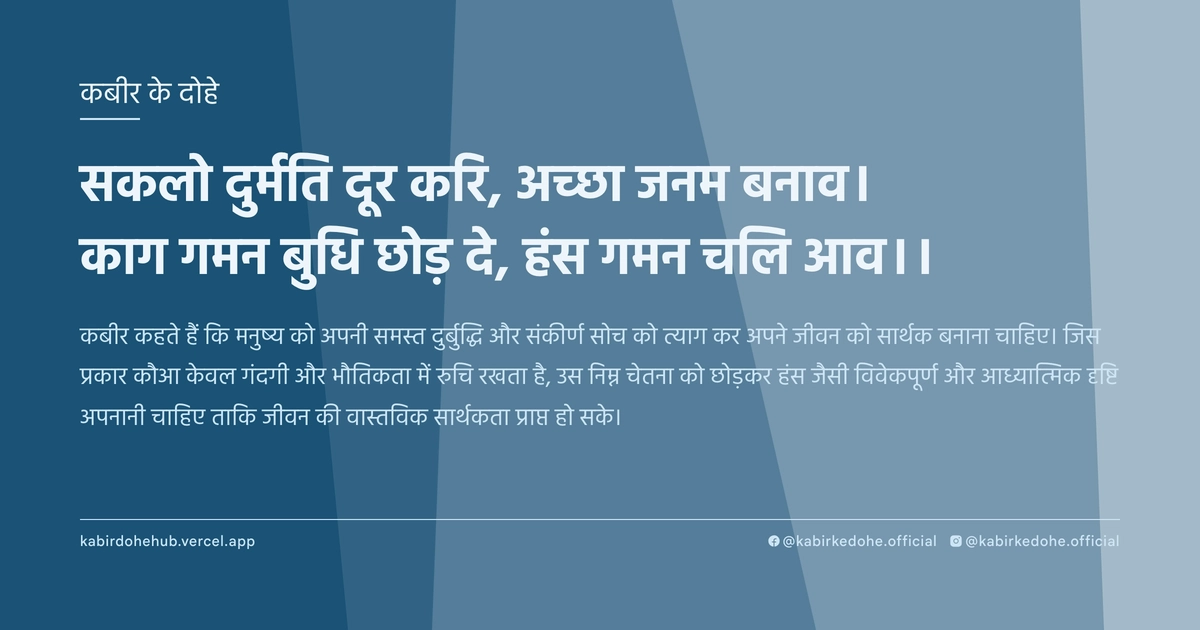
सकलो दुर्मति दूर करि, अच्छा जनम बनाव।
काग गमन बुधि छोड़ दे, हंस गमन चलि आव।।
Sakalo durmati door kari, achha janam banav. Kaag gaman budhi chhod de, hans gaman chali aav.
इस पृष्ठ पर इस कबीर दोहे का अर्थ (meaning), हिंदी व्याख्या और अंग्रेज़ी अनुवाद, दार्शनिक विश्लेषण और व्यावहारिक जीवन सीख दी गई है। यह दोहा जागृति (The Wake-up Call) विषय से जुड़ा है — Kabir doha meaning and explanation in Hindi and English.
अर्थ (Meaning):
कबीर कहते हैं कि मनुष्य को अपनी समस्त दुर्बुद्धि और संकीर्ण सोच को त्याग कर अपने जीवन को सार्थक बनाना चाहिए। जिस प्रकार कौआ केवल गंदगी और भौतिकता में रुचि रखता है, उस निम्न चेतना को छोड़कर हंस जैसी विवेकपूर्ण और आध्यात्मिक दृष्टि अपनानी चाहिए ताकि जीवन की वास्तविक सार्थकता प्राप्त हो सके।
Kabir urges the seeker to cast away all wicked inclinations and narrow-mindedness to make this human birth meaningful. He advises abandoning the 'crow-like' intellect—which is attracted to filth and superficiality—and instead adopting the 'swan-like' wisdom, which possesses the discernment to separate the eternal from the transient.
व्याख्या (Interpretation):
यहाँ 'काग' (कौआ) और 'हंस' केवल पक्षी नहीं, बल्कि मानवीय चेतना की दो अवस्थाएँ हैं। कौआ उस मन का प्रतीक है जो वासना, ईर्ष्या और सांसारिक मोह-माया (माया) में फँसा रहता है, जबकि हंस उस शुद्ध आत्मा (आत्मा) का प्रतीक है जो सत्य और असत्य के बीच भेद कर सकता है। यह दोहा निर्गुण भक्ति के उस सिद्धांत पर आधारित है जहाँ साधक को अपनी निम्न प्रवृत्तियों का विसर्जन कर ब्रह्म के साथ एकाकार होना होता। जब तक अहंकार और अज्ञान का पर्दा है, मनुष्य कौए की तरह भटकता रहता है; जैसे ही विवेक जागता है, वह हंस बनकर शून्य में विलीन हो जाता है। यह द्वैत से अद्वैत की ओर संक्रमण की यात्रा है।
In this verse, the 'crow' and the 'swan' are not mere birds but metaphors for two distinct states of human consciousness. The crow symbolizes the mind trapped in lust, envy, and the illusions of Maya, while the swan represents the awakened soul capable of 'Neera-Ksheera Viveka'—the discernment to separate the eternal essence from the transient dross. This aligns with Nirgun Bhakti, where the seeker must dissolve the lower ego to realize the formless Divine. The central paradox is that the swan is already within the crow; it is merely obscured by the filth of ignorance. The transition from 'crow-logic' to 'swan-logic' is the journey from duality to non-duality (Advaita), where the individual self merges into the universal consciousness.
दार्शनिक विश्लेषण (Philosophical Analysis):
कबीर का यह दोहा उनके समय के सामाजिक और धार्मिक पाखंडों पर एक गहरा प्रहार है। उस युग में लोग बाहरी कर्मकांडों और जातिगत श्रेष्ठता को ही धर्म मानते थे, जिसे कबीर 'दुर्मति' कहते हैं। वे तर्क देते हैं कि यदि आपका मन अभी भी ईर्ष्या और भेदभाव से भरा है, तो आप चाहे कितने भी तीर्थ करें, आपकी चेतना 'कौए' जैसी ही रहेगी।
अद्वैत वेदांत के परिप्रेक्ष्य में, यह दोहा 'अविद्या' (अज्ञान) के विनाश की बात करता है। कबीर का मानना है कि मनुष्य का जन्म दुर्लभ है, और इसे केवल भौतिक सुखों में व्यतीत करना एक आध्यात्मिक त्रासदी है। वे सूफी मत के 'फना' (अहंकार का विनाश) के करीब हैं, जहाँ साधक अपनी पुरानी पहचान को मिटाकर ईश्वर में लीन होता है।
यहाँ 'हंस' का उल्लेख केवल पवित्रता के लिए नहीं, बल्कि 'हंस' को भारतीय परंपरा में ज्ञानियों का प्रतीक माना गया है। कबीर यह स्पष्ट करते हैं कि ज्ञान पुस्तकों से नहीं, बल्कि आंतरिक शुद्धिकरण से आता है। जब मनुष्य अपनी वासनाओं को जीत लेता है, तब वह सहज ही सत्य को देखने लगता है।
यह विश्लेषण यह भी दर्शाता है कि कबीर किसी बाहरी ईश्वर की पूजा के बजाय आंतरिक रूपांतरण पर जोर देते हैं। उनके लिए 'अच्छा जनम' वह है जिसमें व्यक्ति अपनी सामाजिक पहचान (जाति, धर्म) को छोड़कर एक वैश्विक चेतना के रूप में विकसित हो।
अंततः, यह दोहा मनोवैज्ञानिक स्तर पर संज्ञानात्मक पुनर्गठन (Cognitive Restructuring) की बात करता है। यह हमें सिखाता है कि हमारी धारणाएँ (Perceptions) ही हमारा संसार बनाती हैं। यदि हम नकारात्मकता (कौआ) को चुनते हैं, तो हमारा जीवन अंधकारमय होगा; यदि हम विवेक (हंस) को चुनते हैं, तो हम मोक्ष की ओर अग्रसर होंगे।
Kabir’s couplet serves as a profound critique of the social and religious hypocrisies of his era. During his time, spiritual merit was often equated with external rituals and caste superiority—notions Kabir dismisses as 'durmati' or wicked intellect. He argues that if the mind remains steeped in envy and discrimination, no amount of pilgrimage can elevate the consciousness beyond that of a 'crow'.
From the lens of Advaita Vedanta, this verse addresses the eradication of 'Avidya' (primordial ignorance). Kabir views the human birth as a rare opportunity, and spending it solely in the pursuit of material cravings is a spiritual tragedy. His philosophy mirrors the Sufi concept of 'Fana'—the annihilation of the ego—where the seeker must dissolve the false self to realize the True Self.
The reference to the 'swan' is deeply rooted in Indian spiritual symbolism, where the Hamsa represents the liberated soul and the master of discernment. Kabir clarifies that true knowledge is not derived from scriptures but from internal purification. Once the noise of desire is silenced, the truth reveals itself spontaneously.
Furthermore, Kabir emphasizes internal transformation over external worship. For him, a 'meaningful birth' is one where an individual transcends their social identity—caste, creed, and nationality—to evolve into a universal consciousness, recognizing the same spark of divinity in all beings.
Psychologically, this is a call for a fundamental shift in perception. It suggests that our mental filters determine our reality. By consciously choosing to abandon the 'crow-like' habit of focusing on the mundane and the negative, and adopting the 'swan-like' quality of seeking the essence, one transforms their entire existence from a state of survival to a state of liberation.
मूल संदेश (Core Message):
- अज्ञानता का त्याग ही वास्तविक ज्ञान की पहली सीढ़ी है।
- बाहरी शुद्धता से अधिक आंतरिक विवेक का मूल्य है।
- मानवीय जन्म की सार्थकता अहंकार के विसर्जन में निहित है।
- नकारात्मकता एक आदत है, जबकि विवेक एक साधना है।
- स्वयं को पहचानना ही सबसे बड़ी आध्यात्मिक उपलब्धि है।
- The abandonment of ignorance is the first step toward true enlightenment.
- Internal discernment is far more valuable than external piety.
- The purpose of human life lies in the dissolution of the ego.
- Negativity is a habit; discernment is a disciplined spiritual practice.
- Self-realization is the ultimate achievement of the human journey.
व्यावहारिक उदाहरण (Practical Example):
वाराणसी के एक पुराने घाट पर रहने वाले रामदीन नाम के एक वृद्ध नाविक थे। रामदीन का पूरा जीवन दूसरों की आलोचना करने और छोटी-छोटी बातों पर झगड़ने में बीता था। वे हमेशा इस बात से परेशान रहते थे कि दूसरे नाविक उनसे अधिक पैसे कमा रहे हैं या उनके पास बेहतर नाव है। उनकी यह ईर्ष्या उनके मन में एक 'कौए' की तरह थी, जो केवल गंदगी और कड़वाहट को देखता था।
एक दिन, उन्होंने एक शांत साधु को देखा जो घाट की भीड़ और शोर के बीच भी अत्यंत प्रसन्न और स्थिर थे। रामदीन ने उनसे पूछा कि इस शोर-शराबे में भी शांति कैसे संभव है। साधु ने मुस्कुराते हुए कहा, 'रामदीन, तुम दुनिया को देख रहे हो या अपनी नजर को? कौआ केवल कचरा देखता है, लेकिन हंस उसी पानी से मोती चुन लेता है। तुम अपनी नजर बदलो, दुनिया बदल जाएगी।'
यह बात रामदीन के दिल में गहरे तक उतर गई। उन्होंने महसूस किया कि उनकी सारी मानसिक पीड़ा बाहरी दुनिया के कारण नहीं, बल्कि उनकी अपनी 'दुर्मति' के कारण थी। उन्होंने तय किया कि वे अब दूसरों की कमियाँ ढूँढने के बजाय, हर व्यक्ति में कुछ अच्छा ढूँढेंगे।
शुरुआत में यह कठिन था। जब कोई ग्राहक उनसे बदतमीजी करता, तो उनका पुराना 'कौआ' जाग जाता। लेकिन वे तुरंत खुद को याद दिलाते, 'हंस गमन चलि आव'। वे क्रोध के बजाय करुणा का भाव लाने का प्रयास करने लगे।
धीरे-धीरे उनके व्यवहार में बदलाव आया। जो लोग उनसे डरते थे या नफरत करते थे, वे अब उनका सम्मान करने लगे। रामदीन ने पाया कि जब उन्होंने अपनी आंतरिक कड़वाहट छोड़ी, तो उनके जीवन में सुख और शांति का प्रवाह अपने आप होने लगा।
उन्होंने अपनी नाव का उपयोग केवल पैसे कमाने के लिए नहीं, बल्कि कभी-कभी गरीब यात्रियों को मुफ्त में पार कराने के लिए भी करना शुरू किया। इस निस्वार्थ भाव ने उन्हें एक ऐसी खुशी दी जो उन्होंने पहले कभी महसूस नहीं की थी।
रामदीन अब केवल एक नाविक नहीं थे, बल्कि घाट पर आने वाले लोगों के लिए शांति और विवेक का एक जीवित उदाहरण बन गए थे। उनकी ईर्ष्या पूरी तरह समाप्त हो चुकी थी।
अंत में, रामदीन ने समझा कि 'अच्छा जनम' बनाने का अर्थ यह नहीं है कि आप कहाँ पैदा हुए या आपके पास क्या है, बल्कि यह है कि आपने अपनी चेतना को किस स्तर पर विकसित किया है।
In the ancient ghats of Varanasi lived an elderly boatman named Ramdeen. For decades, Ramdeen’s life had been defined by criticism and petty conflicts. He spent his days obsessing over how other boatmen earned more or possessed better vessels. This envy resided in him like a 'crow,' perpetually attracted to the filth of resentment and comparison.
One afternoon, he observed a serene monk who remained profoundly peaceful despite the chaotic noise and crowds of the ghat. Intrigued, Ramdeen asked how such stillness was possible in the midst of turmoil. The monk smiled and replied, 'Ramdeen, are you looking at the world, or at the lens through which you see it? A crow sees only the refuse, but a swan filters the pearl from the water. Change your vision, and the world changes.'
These words struck a chord deep within Ramdeen. He realized that his mental anguish was not caused by external circumstances, but by his own 'durmati'—his distorted intellect. He decided to consciously shift his focus from finding faults in others to discovering the goodness in everyone.
Initially, the transition was grueling. Whenever a passenger was rude, his old 'crow-like' instinct to react with anger would flare up. However, he would immediately remind himself, 'Adopt the gait of the swan.' He began practicing compassion in place of irritation.
Gradually, his aura shifted. People who once avoided him or spoke ill of him began to treat him with genuine respect. Ramdeen discovered that as he discarded his internal bitterness, peace and joy flowed into his life effortlessly.
He began using his boat not just for profit, but occasionally to ferry poor pilgrims across the river for free. This act of selfless service brought him a level of fulfillment he had never known in his pursuit of material gain.
Ramdeen was no longer just a boatman; he became a living example of wisdom and tranquility for all who visited the ghats. His envy had been completely incinerated by the fire of awareness.
Ultimately, Ramdeen understood that making a 'meaningful birth' does not depend on one's origin or possessions, but on the elevation of one's consciousness from the mundane to the divine.
अभ्यास मार्गदर्शन (Practice Guidance):
- प्रतिदिन 20 मिनट मौन बैठें और अपने विचारों का निरीक्षण करें। जब भी कोई नकारात्मक या ईर्ष्यालु विचार आए, तो उसे 'कौआ' मानकर मानसिक रूप से विदा करें।
- एक 'विवेक डायरी' बनाएँ। दिन भर में हुई उन घटनाओं को लिखें जहाँ आपने प्रतिक्रिया (Reaction) के बजाय प्रतिक्रिया-बोध (Response) का चुनाव किया।
- व्यवहार परिवर्तन: दिन में कम से कम एक व्यक्ति की ऐसी खूबी खोजें जिसे आप नापसंद करते हों, और उसे मन ही मन सराहें।
- निदान चेकलिस्ट: क्या मैं दूसरों की सफलता से जलता हूँ? क्या मैं केवल दूसरों की गलतियाँ देखता हूँ? यदि हाँ, तो मेरी 'कौआ बुद्धि' सक्रिय है। क्या मैं विपरीत परिस्थितियों में भी शांति खोज पाता हूँ? यदि हाँ, तो 'हंस गमन' शुरू हो चुका है।
- Practice 20 minutes of daily silence. Observe your thoughts as a witness. Whenever a negative or envious thought arises, label it as the 'crow' and consciously let it drift away.
- Maintain a 'Discernment Journal'. Record instances where you chose a conscious response over an impulsive reaction, effectively filtering the 'essence' from the 'noise'.
- Behavioral Shift: Identify one quality you admire in someone you generally dislike. Focus on this quality for a week to break the habit of judgmental perception.
- Diagnostic Checklist: Do I feel a sting of envy at others' success? Do I instinctively look for flaws in people? (Crow-intellect active). Can I find a core of truth or beauty in a chaotic situation? (Swan-intellect emerging).
चिंतन प्रश्न (Reflection Questions):
- मेरे व्यक्तित्व का वह कौन सा हिस्सा है जो अभी भी 'कौए' की तरह दूसरों की गंदगी और कमियों पर केंद्रित है?
- मैं अपनी सामाजिक पहचान (पद, प्रतिष्ठा, जाति) को कितना महत्व देता हूँ, और यह मेरे आध्यात्मिक विकास में कैसे बाधा बन रहा है?
- क्या मेरी करुणा वास्तविक है, या यह केवल मेरी अपनी छवि को 'अच्छा' दिखाने का एक मुखौटा है?
- यदि मैं आज अपनी सभी उपलब्धियों और उपाधियों को खो दूँ, तो मेरे भीतर क्या शेष बचेगा?
- मैं किन मानसिक आदतों को 'दुर्मति' मानता हूँ, और उन्हें बदलने के लिए मैं वास्तव में कितना प्रयास कर रहा हूँ?
- Which part of my identity still functions like a 'crow,' obsessing over the flaws and failures of others?
- How much weight do I give to my social labels (status, title, caste), and how is this hindering my spiritual evolution?
- Is my compassion genuine, or is it merely a mask to maintain a 'virtuous' public image?
- If I were stripped of all my achievements and titles today, what essence of 'me' would actually remain?
- Which specific mental patterns do I recognize as 'durmati,' and am I truly putting in the effort to dismantle them?