
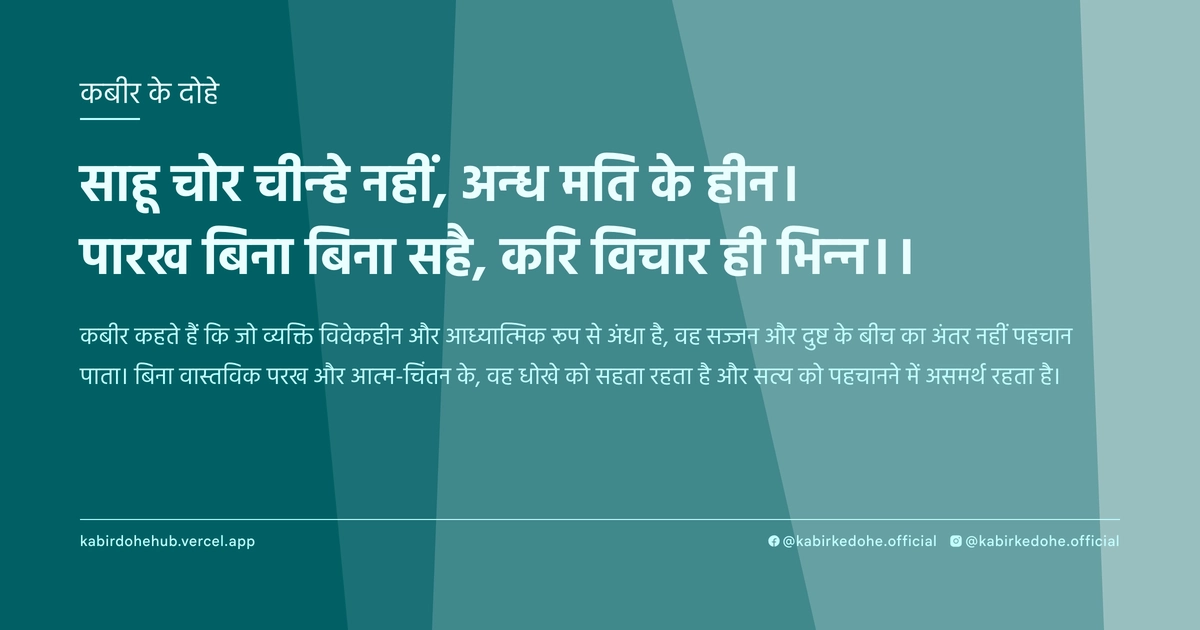
साहू चोर चीन्हे नहीं, अन्ध मति के हीन।
पारख बिना बिना सहै, करि विचार ही भिन्न।।
Sahu chor chinhe nahi, andh mati ke heen. Parakh bina bina sahai, kari vichar hi bhinn.
इस पृष्ठ पर इस कबीर दोहे का अर्थ (meaning), हिंदी व्याख्या और अंग्रेज़ी अनुवाद, दार्शनिक विश्लेषण और व्यावहारिक जीवन सीख दी गई है। यह दोहा आत्मनिरीक्षण (Self-introspection) विषय से जुड़ा है — Kabir doha meaning and explanation in Hindi and English.
अर्थ (Meaning):
कबीर कहते हैं कि जो व्यक्ति विवेकहीन और आध्यात्मिक रूप से अंधा है, वह सज्जन और दुष्ट के बीच का अंतर नहीं पहचान पाता। बिना वास्तविक परख और आत्म-चिंतन के, वह धोखे को सहता रहता है और सत्य को पहचानने में असमर्थ रहता है।
Kabir asserts that an individual devoid of spiritual discernment and clouded by ignorance cannot distinguish between a true saint and a deceptive thief. Without the capacity for critical inquiry and inner verification, one suffers under illusion, unable to separate the genuine from the counterfeit.
व्याख्या (Interpretation):
यहाँ 'साहू' (सज्जन) और 'चोर' केवल बाहरी व्यक्तियों के प्रतीक नहीं हैं, बल्कि मन की दो अवस्थाओं को दर्शाते हैं। 'अंध मति' उस अज्ञानता का प्रतीक है जो माया के प्रभाव से उत्पन्न होती है। यह दोहा निरगुण भक्ति के उस सिद्धांत पर आधारित है जहाँ बाहरी आडंबरों को त्यागकर अंतर्मन की 'पारख' (परख) को महत्व दिया गया है। जब तक साधक अपनी चेतना को जाग्रत नहीं करता, वह मायावी प्रपंचों को ही सत्य मान बैठता है। यह अद्वैत वेदांत के उस सत्य की ओर संकेत है जहाँ अज्ञानता ही एकमात्र बंधन है। अंततः, विचार और विवेक ही वह उपकरण हैं जो आत्मा को भ्रम के जाल से मुक्त कर ब्रह्म के साथ एकाकार करते हैं।
In this verse, the 'Sahu' (Saint) and 'Chor' (Thief) are not merely external figures but metaphors for the dual nature of the mind and the spiritual path. 'Andh mati' represents the spiritual blindness induced by Maya, the cosmic illusion. This aligns with Nirgun Bhakti, which emphasizes inner discernment over external rituals. The 'thief' symbolizes the ego and deceptive desires that steal one's peace and spiritual progress. Without 'Parakh'—the alchemy of critical self-awareness—the seeker remains trapped in a cycle of suffering. The paradox lies in the fact that the truth is visible, yet the blind mind perceives a lie. Only through the annihilation of the ego and the awakening of the Atman can the non-duality of existence be realized, distinguishing the eternal from the ephemeral.
दार्शनिक विश्लेषण (Philosophical Analysis):
कबीर का यह दोहा उनके समय के सामाजिक और धार्मिक पाखंड पर एक तीखा प्रहार है। 15वीं शताब्दी में, धर्म के नाम पर कई ऐसे 'गुरु' और 'पंडित' उभर कर आए थे जो वास्तव में आध्यात्मिक चोर थे, जो लोगों की श्रद्धा का लाभ उठाकर उन्हें भ्रमित करते थे। कबीर ने इस व्यवस्था को चुनौती देते हुए कहा कि किसी की वेशभूषा या उपाधि से उसकी पवित्रता का निर्धारण नहीं किया जा सकता।
दार्शनिक स्तर पर, यह सूफीवाद के 'इन्सान-ए-कामिल' (पूर्ण मानव) की अवधारणा से मिलता-जुलता है, जहाँ सत्य की पहचान केवल अनुभव और अंतर्दृष्टि से होती है, न कि किताबी ज्ञान से। कबीर यहाँ 'विवेक' को सर्वोच्च मानते हैं। उनके लिए, बिना विचार के की गई भक्ति केवल अंधानुकरण है, जो व्यक्ति को सत्य से और दूर ले जाता है।
अद्वैत वेदांत के परिप्रेक्ष्य में, यह 'अविद्या' (ignorance) का वर्णन है। जब तक साधक यह नहीं समझता कि वह स्वयं ब्रह्म है, वह बाहरी दुनिया के द्वैत (सज्जन बनाम दुष्ट) में उलझा रहता है। कबीर सिखाते हैं कि असली चोर वह 'अहंकार' है जो हमें हमारी अपनी वास्तविकता से दूर रखता है।
यह दोहा कर्मकांडों के प्रति कबीर की घृणा को भी दर्शाता है। वे मानते थे कि माला फेरना या तिलक लगाना 'साहू' होने का प्रमाण नहीं है। यदि हृदय में करुणा और सत्य नहीं है, तो वह व्यक्ति केवल एक 'चोर' है जो धर्म का मुखौटा पहने हुए है।
मनोवैज्ञानिक रूप से, यह संदेश हमें अपनी 'पुष्टि पूर्वाग्रह' (confirmation bias) से बचने की चेतावनी देता है। हम अक्सर वही देखते हैं जो हम देखना चाहते हैं, न कि वह जो वास्तव में है। कबीर हमें अपनी धारणाओं को चुनौती देने और सत्य की कठोर परीक्षा करने के लिए प्रेरित करते हैं ताकि हम मानसिक दासता से मुक्त हो सकें।
Kabir's couplet is a searing critique of the religious and social hypocrisy prevalent during the 15th century. During his era, many self-proclaimed gurus and priests acted as spiritual 'thieves,' exploiting the faith of the masses to maintain power and prestige. Kabir challenged this by asserting that external attire or titles are not indicators of spiritual authenticity.
Philosophically, this resonates with the Sufi concept of 'Insan-e-Kamil' (the Perfect Human), where truth is realized through direct experiential knowledge (Ma'rifat) rather than rote learning. Kabir elevates 'Viveka' (discernment) as the primary tool for liberation. He argues that devotion without critical inquiry is mere blind imitation, which further entrenches the soul in the illusions of Maya.
From the lens of Advaita Vedanta, this is an exploration of 'Avidya' (primordial ignorance). As long as the seeker perceives a separation between the self and the absolute, they remain susceptible to the duality of 'saint' and 'sinner.' Kabir suggests that the ultimate thief is the 'Ahamkara' (ego), which steals the awareness of one's own divinity.
Furthermore, the verse underscores Kabir's rejection of ritualism. He posits that beads, incense, and pilgrimages are superficial markers. If a person lacks compassion and truth, their religious performance is a facade—a theft of spiritual essence. He urges a shift from formal religion to an internalized, living spirituality.
Psychologically, this teaching warns against the dangers of cognitive biases. Humans often perceive what they wish to see rather than what is. Kabir encourages a rigorous process of self-inquiry and verification, urging the seeker to dismantle their preconceived notions to achieve true mental and spiritual autonomy.
मूल संदेश (Core Message):
- बाहरी चमक अक्सर आंतरिक अंधकार को छुपाती है।
- बिना विवेक की भक्ति केवल एक भ्रम है।
- सत्य की पहचान केवल अनुभव और परख से संभव है।
- अहंकार वह चोर है जो हमारी चेतना चुरा लेता है।
- प्रश्न पूछना आध्यात्मिक जागृति की पहली सीढ़ी है।
- आत्मा का प्रकाश ही वास्तविक मार्गदर्शक है।
- External brilliance often masks internal darkness.
- Devotion without discernment is merely a delusion.
- Truth is recognized only through experience and verification.
- The ego is the thief that steals our consciousness.
- Questioning is the first step toward spiritual awakening.
- The light of the soul is the only true guide.
व्यावहारिक उदाहरण (Practical Example):
वाराणसी के एक पुराने घाट पर, रामदीन नाम का एक वृद्ध नाविक रहता था। वह स्वभाव से सरल था और हर उस व्यक्ति पर विश्वास कर लेता था जो धर्म की बातें करता था। एक दिन, एक भव्य वस्त्र पहने हुए एक व्यक्ति उसके पास आया और स्वयं को एक महान सिद्ध पुरुष बताया। उसने रामदीन से कहा कि यदि वह अपनी जीवन भर की जमा पूँजी उसे दे दे, तो वह उसे मोक्ष का गुप्त मार्ग बता देगा और उसके जीवन के सभी पाप धो देगा।
रामदीन, जो 'अंध मति' का शिकार था, उस व्यक्ति की चमक-धमक और शब्दों के जाल में फंस गया। उसने बिना किसी सोच-विचार के अपनी सारी बचत उस व्यक्ति को सौंप दी। वह व्यक्ति वास्तव में एक ठग था, जिसने रामदीन की सरलता का लाभ उठाया और रातों-रात गायब हो गया।
रामदीन टूट गया और गहरे अवसाद में डूब गया। वह सोचने लगा कि धर्म के नाम पर ऐसा धोखा कैसे मिल सकता है। उसी समय, उसकी मुलाकात एक साधारण से बुनकर से हुई, जो कबीर के पदों का गायन करता था। उस बुनकर ने रामदीन को यह दोहा सुनाया: "साहू चोर चीन्हे नहीं..."
बुनकर ने रामदीन को समझाया, "भाई, तुमने उसकी बाहरी चमक को देखा, लेकिन उसके चरित्र की परख नहीं की। तुमने उसे 'साहू' मान लिया क्योंकि वह वैसा दिख रहा था, जबकि वह वास्तव में एक 'चोर' था। असली संत वह नहीं जो आपसे कुछ मांगे, बल्कि वह है जो आपको स्वयं को पहचानने की शक्ति दे।"
इस बात ने रामदीन की आँखों से पर्दा हटा दिया। उसने महसूस किया कि उसकी समस्या उस ठग की चालाकी नहीं, बल्कि उसकी अपनी विवेकहीनता थी। उसने तय किया कि अब वह किसी की बातों पर आँख मूँदकर विश्वास नहीं करेगा।
रामदीन ने अब अपना ध्यान बाहरी चमत्कार खोजने के बजाय अपने भीतर की शांति खोजने पर लगाया। उसने सीखा कि सत्य शब्दों में नहीं, बल्कि आचरण में होता है।
उसने अपने जीवन के शेष वर्ष अन्य सरल लोगों को जागरूक करने में बिताए, ताकि वे बाहरी आडंबरों के झांसे में न आएं। उसने सीखा कि संदेह करना कभी-कभी सबसे बड़ी भक्ति होती है, क्योंकि यह सत्य की खोज का पहला कदम है।
अंततः, रामदीन ने पाया कि जिस मोक्ष की तलाश में वह भटक रहा था, वह किसी बाहरी व्यक्ति के पास नहीं, बल्कि उसके अपने भीतर के संतोष और जागरूकता में छिपा था। उसका जीवन अब भय और अंधविश्वास से मुक्त होकर वास्तविक बोध की ओर अग्रसर था।
On an ancient ghat in Varanasi lived an elderly boatman named Ramdeen. Simple-hearted and devout, Ramdeen tended to trust anyone who spoke of God and spirituality. One day, a man dressed in opulent saffron robes approached him, claiming to be a realized master. He told Ramdeen that if he surrendered all his life savings, the master would reveal a secret path to salvation and cleanse him of all karmic sins.
Ramdeen, clouded by 'Andh mati' (spiritual blindness), was captivated by the man's aura and persuasive rhetoric. Without any critical reflection or verification, he handed over every coin he had saved over decades. The man was, in reality, a sophisticated con artist who vanished into the night with the money.
Devastated, Ramdeen fell into a deep depression, questioning how someone in the garb of a saint could commit such a theft. During his grief, he encountered a humble weaver who spent his evenings singing the verses of Kabir. The weaver shared the doha: "Sahu chor chinne nahi..."
The weaver explained, "Brother, you saw the glitter of his clothes, but you did not examine the quality of his soul. You assumed he was a 'Sahu' because of his appearance, while he was a 'Chor' in essence. A true saint does not ask for your wealth; he gives you the strength to find yourself."
These words acted as a catalyst, stripping away the veil of illusion from Ramdeen's eyes. He realized that his tragedy was not the con man's cunning, but his own lack of discernment. He understood that he had been blind to the truth because he wanted a shortcut to spirituality.
Ramdeen decided that henceforth, he would not follow anyone blindly. He shifted his focus from seeking external miracles to cultivating inner stillness and awareness.
He spent the remainder of his years educating other simple folk on the ghats, warning them against the traps of superficial piety. He learned that a healthy dose of skepticism is often the first step toward genuine faith.
Eventually, Ramdeen discovered that the salvation he sought was not a secret held by a guru, but a state of being found in contentment and presence. His life, once driven by blind faith, was now guided by a clear, awakened consciousness.
अभ्यास मार्गदर्शन (Practice Guidance):
- प्रतिदिन 20 मिनट मौन बैठें और अपने विचारों का निरीक्षण करें। यह देखें कि आप किन धारणाओं के आधार पर लोगों का आकलन करते हैं।
- आत्म-पूछताछ जर्नल: लिखें कि हाल ही में आपने किस बात पर बिना सोचे-समझे विश्वास किया और उसका परिणाम क्या रहा।
- व्यवहार परिवर्तन: किसी भी आध्यात्मिक गुरु या मार्गदर्शक के पीछे चलने से पहले उनके शब्दों को अपने जीवन के अनुभवों की कसौटी पर परखें।
- निदान चेकलिस्ट: क्या मैं केवल बाहरी प्रतीकों (कपड़े, भाषा, पद) से प्रभावित हो रहा हूँ? क्या मैं सत्य जानने के बजाय केवल सांत्वना खोज रहा हूँ? क्या मैं प्रश्न पूछने से डरता हूँ?
- Practice 20 minutes of daily silence to observe your thoughts. Analyze the subconscious biases you use to judge others as 'good' or 'bad'.
- Self-Inquiry Journaling: Document instances where you blindly trusted a narrative and analyze the outcome. Ask, "What was the illusion I wanted to believe?"
- Behavioral Shift: Before following any spiritual guide, test their teachings against your own lived experience and logic rather than accepting them as absolute truth.
- Diagnostic Checklist: Am I being swayed by external symbols (attire, titles, rhetoric)? Am I seeking comfort instead of truth? Do I feel fear or hesitation when asking critical questions?
चिंतन प्रश्न (Reflection Questions):
- मेरे जीवन में ऐसे कौन से 'आध्यात्मिक चोर' हैं जो मेरी ऊर्जा और समय चुरा रहे हैं?
- मैं अपनी सार्वजनिक छवि को बनाए रखने के लिए अपने भीतर के किस सच को नजरअंदाज कर रहा हूँ?
- क्या मेरी श्रद्धा वास्तव में सत्य के प्रति है, या मैं केवल अपनी असुरक्षाओं को शांत करना चाहता हूँ?
- यदि मैं सभी धार्मिक प्रतीकों को हटा दूँ, तो क्या मैं अभी भी सत्य को पहचान पाऊँगा?
- मेरे भीतर का वह कौन सा 'अंधापन' है जो मुझे अपनों में ही शत्रु और शत्रुओं में मित्र देखने पर मजबूर करता है?
- Who are the 'spiritual thieves' in my life currently stealing my energy and time?
- What internal truth am I ignoring to maintain my curated public identity?
- Is my faith truly directed toward the Truth, or am I merely seeking a sedative for my insecurities?
- If I stripped away all religious symbols, would I still be able to recognize the Divine?
- What is the specific 'blindness' within me that causes me to mistake enemies for friends and vice versa?