
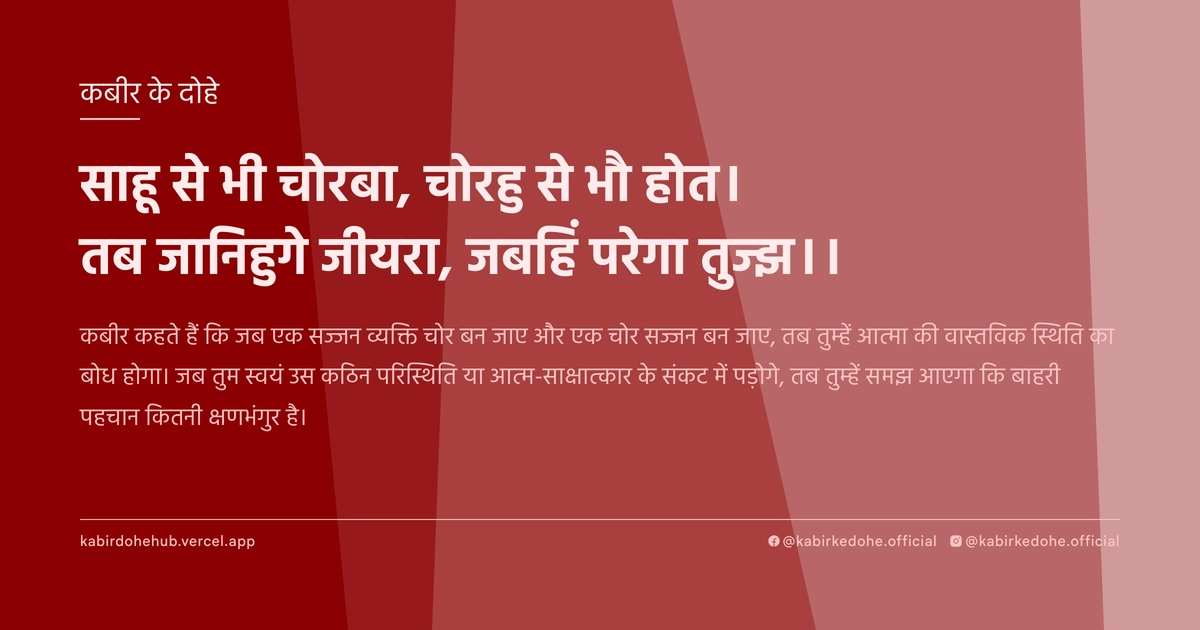
साहू से भी चोरबा, चोरहु से भौ होत।
तब जानिहुगे जीयरा, जबहिं परेगा तुज्झ।।
Sahu se bhi chorba, chorhu se bhau hot. Tab janihuge jiyara, jabahin parega tujjh.
इस पृष्ठ पर इस कबीर दोहे का अर्थ (meaning), हिंदी व्याख्या और अंग्रेज़ी अनुवाद, दार्शनिक विश्लेषण और व्यावहारिक जीवन सीख दी गई है। यह दोहा अहंकार (The Ego) विषय से जुड़ा है — Kabir doha meaning and explanation in Hindi and English.
अर्थ (Meaning):
कबीर कहते हैं कि जब एक सज्जन व्यक्ति चोर बन जाए और एक चोर सज्जन बन जाए, तब तुम्हें आत्मा की वास्तविक स्थिति का बोध होगा। जब तुम स्वयं उस कठिन परिस्थिति या आत्म-साक्षात्कार के संकट में पड़ोगे, तब तुम्हें समझ आएगा कि बाहरी पहचान कितनी क्षणभंगुर है।
Kabir suggests that when the virtuous become thieves and the thieves become virtuous, only then will the soul realize the true nature of existence. You will truly understand the essence of the self only when you are thrust into the crucible of such a profound internal crisis or transformation.
व्याख्या (Interpretation):
यह दोहा बाहरी पहचान और आंतरिक सत्य के बीच के विरोधाभास को दर्शाता है। 'साहू' (सज्जन) और 'चोर' यहाँ केवल सामाजिक श्रेणियों नहीं, बल्कि अहंकार के मुखौटों का प्रतीक हैं। कबीर निरगुण भक्ति के माध्यम से समझाते हैं कि जब तक मनुष्य अपनी सामाजिक छवि (माया) से चिपका रहता है, वह सत्य को नहीं देख पाता। जब ये पहचानें उलट जाती हैं, तब 'अद्वैत' की स्थिति उत्पन्न होती है जहाँ कोई भेद नहीं रहता। यह आत्मा (Atman) का वह क्षण है जब वह अपनी झूठी पहचान को त्याग कर ब्रह्म (Brahman) में विलीन होने की दहलीज पर खड़ा होता है। यह विरोधाभास यह सिखाता है कि पवित्रता और पाप केवल मन के भ्रम हैं।
This couplet illustrates the paradox between external identity and internal truth. 'Sahu' (the virtuous) and 'Chor' (the thief) are not merely social categories but symbols of the masks worn by the ego. Through the lens of Nirgun Bhakti, Kabir explains that as long as a human clings to their social image (Maya), they cannot perceive the Truth. When these identities are inverted, a state of 'Advaita' or non-duality emerges where all distinctions vanish. This represents the moment the Atman sheds its illusory identity to merge with Brahman. The central paradox highlights that perceived purity and sin are merely constructs of the conditioned mind, and true realization occurs only when these constructs collapse.
दार्शनिक विश्लेषण (Philosophical Analysis):
कबीर का यह कथन उनके युग के धार्मिक पाखंड और जातिगत श्रेष्ठता पर एक तीखा प्रहार है। उस समय समाज 'साहू' और 'पापी' के बीच एक स्पष्ट विभाजन रेखा खींचता था, जिसे कबीर ने निरर्थक माना। वे तर्क देते हैं कि धर्म केवल कर्मकांडों या बाहरी आचरण में नहीं, बल्कि आंतरिक ईमानदारी में है।
अद्वैत वेदांत के दृष्टिकोण से, यह दोहा 'माया' के पर्दों को हटाने की बात करता है। जब एक व्यक्ति खुद को 'सज्जन' मानकर अहंकार करता है, तो वह वास्तव में सत्य से दूर होता है। वहीं, एक 'चोर' जो अपनी ग्लानि और शून्य को पहचान लेता है, वह सत्य के अधिक निकट हो सकता है। यह अहंकार के विनाश (Annihilation of Ego) की प्रक्रिया है।
सूफी मत के 'फना' (Fana) के सिद्धांत से इसकी गहरी समानता है, जहाँ साधक अपनी व्यक्तिगत पहचान को ईश्वर की इच्छा में मिटा देता है। कबीर यहाँ चेतावनी दे रहे हैं कि जब तक आप खुद को किसी विशेष श्रेणी में सुरक्षित महसूस करते हैं, आप जागृत नहीं हैं। वास्तविक ज्ञान तब आता है जब आपकी सारी धारणाएं ध्वस्त हो जाती हैं।
मनोवैज्ञानिक स्तर पर, यह 'कॉग्निटिव डिसोनेंस' की स्थिति है। जब व्यक्ति का आत्म-छवि (Self-image) वास्तविकता से टकराती है, तब वह सत्य को खोजने के लिए मजबूर होता है। कबीर यहाँ उस 'अंधेरे' की बात कर रहे हैं जहाँ से प्रकाश का जन्म होता है।
अंततः, यह दोहा यह स्थापित करता है कि ईश्वर किसी मंदिर, मस्जिद या सामाजिक प्रतिष्ठा में नहीं, बल्कि उस शून्य में है जहाँ 'मैं' और 'तू' का भेद समाप्त हो जाता है। यह ritualism के पूर्ण बहिष्कार और आंतरिक शुद्धि का आह्वान है।
Kabir's statement is a sharp critique of the religious hypocrisy and caste-based superiority prevalent during his era. Society drew a rigid line between the 'virtuous' and the 'sinner,' a distinction Kabir viewed as meaningless. He argues that true spirituality lies not in rituals or outward conduct, but in internal honesty.
From the perspective of Advaita Vedanta, this doha speaks of piercing the veils of 'Maya.' When a person clings to the identity of being 'virtuous,' they are often blinded by a subtle ego, distancing themselves from the Truth. Conversely, a 'thief' who recognizes their own void and guilt may actually be closer to liberation. This is the process of the annihilation of the ego.
There is a profound resonance here with the Sufi concept of 'Fana,' where the seeker dissolves their individual identity into the Divine Will. Kabir warns that as long as one feels secure within a social category, they remain asleep. True awakening occurs only when all preconceived notions are shattered.
Psychologically, this describes a state of profound cognitive dissonance. When one's self-image clashes violently with reality, they are forced to seek a deeper truth. Kabir refers to the 'dark night of the soul' from which the light of consciousness is born.
Ultimately, the doha establishes that the Divine is not found in temples, mosques, or social prestige, but in the void where the distinction between 'I' and 'Thou' ceases to exist. It is a call for the total rejection of ritualism in favor of internal purification.
मूल संदेश (Core Message):
- बाहरी छवि एक भ्रम है जो सत्य को ढकता है।
- अहंकार की पवित्रता सबसे बड़ा आध्यात्मिक अवरोध है।
- अपनी कमियों को स्वीकार करना ही वास्तविक शुद्धि है।
- सत्य तब प्रकट होता है जब सामाजिक मुखौटे टूट जाते हैं।
- आत्मा की पहचान किसी श्रेणी या लेबल में नहीं है।
- अद्वैत का अनुभव विरोधाभासों के विलीनीकरण में है।
- External image is an illusion that veils the Truth.
- The pride of being 'virtuous' is the greatest spiritual obstacle.
- Accepting one's flaws is the beginning of true purification.
- Truth emerges only when social masks are shattered.
- The soul's identity cannot be contained in a label or category.
- The experience of non-duality lies in the merging of paradoxes.
व्यावहारिक उदाहरण (Practical Example):
वाराणसी के एक पुराने घाट पर रहने वाले माधव एक अत्यंत प्रतिष्ठित पंडित थे। पूरा शहर उन्हें 'साहू' मानता था क्योंकि वे दिन भर शास्त्रों का पाठ करते और धर्म की बातें बताते थे। उनका अहंकार उनकी विनम्रता के पीछे छिपा था।
उसी घाट के कोने में कन्हैया नाम का एक व्यक्ति रहता था, जिसे समाज ने 'चोर' घोषित कर दिया था क्योंकि उसने कभी अपनी भूख मिटाने के लिए चोरी की थी। कन्हैया अब एक एकांतवासी था, जो केवल मौन और पश्चाताप में जीता था।
एक समय ऐसा आया जब माधव के परिवार में एक बड़ा संकट आया और उनकी सारी संपत्ति और प्रतिष्ठा एक कानूनी विवाद में चली गई। अचानक, वह 'साहू' समाज की नजरों में गिर गया और उसे अपनी झूठी गरिमा का अंत दिखा।
उसी समय, कन्हैया ने अपनी पूरी जिंदगी की जमापूंजी, जो उसने मेहनत से बचाई थी, उन अनाथ बच्चों की शिक्षा के लिए दान कर दी, जिन्हें समाज ने ठुकरा दिया था। उसकी निस्वार्थता ने उसे लोगों की नजरों में एक संत बना दिया।
माधव ने देखा कि जिस 'पवित्रता' का वह दावा करता था, वह केवल एक मुखौटा था। जब वह सब कुछ खो बैठा, तब उसे एहसास हुआ कि वह वास्तव में अंदर से खाली और 'चोर' जैसा था, जिसने सत्य को चुराया था।
दूसरी ओर, कन्हैया, जिसे दुनिया ने चोर कहा, उसने अपने अहंकार को पहले ही मार दिया था। उसकी ग्लानि ही उसकी सबसे बड़ी शुद्धि बन गई थी।
माधव और कन्हैया की मुलाकात एक शाम घाट पर हुई। माधव ने कन्हैया के चरणों में गिरकर पूछा, "मैंने जीवन भर धर्म पढ़ा, फिर भी मैं अंधा था। तुमने कभी शास्त्र नहीं पढ़े, फिर भी तुम जागृत हो।"
कन्हैया ने मुस्कुराकर कहा, "जब तक आप खुद को 'साहू' मानते रहे, आप अपनी छवि के चोर थे। जिस दिन आप अपनी असलियत के सामने नंगे खड़े हुए, उसी दिन आप मुक्त हुए।"
यह 'कबीर ट्विस्ट' माधव के जीवन का मोड़ बना। उसने शास्त्रों का प्रदर्शन छोड़कर सेवा का मार्ग अपनाया और अपनी आंतरिक पहचान को खोजा।
माधव अब समाज के लिए पंडित नहीं, बल्कि एक सच्चा साधक बन गया, जिसने यह जान लिया था कि असली चोर वह है जो अपनी आत्मा को झूठ के पर्दे में छिपाता है।
On the ancient ghats of Varanasi lived Madhav, a highly respected priest. The entire city viewed him as a 'Sahu' (virtuous man) because he spent his days reciting scriptures and preaching morality. However, his ego was cleverly hidden behind a veneer of humility.
In a secluded corner of the same ghat lived Kanhaiya, a man branded a 'thief' by society for a crime he committed in his youth to satisfy hunger. Kanhaiya had since become a recluse, living in silence and deep repentance.
Time passed, and a severe crisis struck Madhav's family. A legal dispute stripped him of his wealth and social standing. Suddenly, the 'virtuous' man fell from grace, and his false sense of dignity vanished.
Simultaneously, Kanhaiya donated all the meager savings he had earned through hard labor to educate orphaned children who had been shunned by society. His selfless act transformed him into a saint in the eyes of the people.
Madhav realized that the 'purity' he had claimed was merely a mask. In losing everything, he discovered that he had been a 'thief' all along—a thief who had stolen the truth from his own soul to maintain a public image.
On the other hand, Kanhaiya, whom the world called a thief, had already annihilated his ego. His guilt had become his greatest purification.
One evening, Madhav encountered Kanhaiya on the ghat. Falling at his feet, Madhav asked, "I studied the scriptures my whole life, yet I was blind. You never read a book, yet you are awake."
Kanhaiya smiled and replied, "As long as you believed yourself to be 'virtuous,' you were a thief of your own authenticity. The day you stood naked before your own reality was the day you became free."
This 'Kabir Twist' became the turning point in Madhav's life. He stopped performing piety and began practicing genuine service, seeking his internal identity.
Madhav was no longer a priest for the sake of society, but a true seeker who understood that the real thief is the one who hides their soul behind a curtain of lies.
अभ्यास मार्गदर्शन (Practice Guidance):
- प्रतिदिन 20 मिनट मौन ध्यान करें, जहाँ आप अपनी सामाजिक पहचान (पुत्र, पिता, अधिकारी, विद्वान) को मानसिक रूप से उतार दें और केवल एक 'साक्षी' बनकर रहें।
- एक 'छाया पत्रिका' (Shadow Journal) लिखें: उन गुणों को लिखें जिन्हें आप दुनिया से छिपाते हैं और उन गुणों को चुनौती दें जिन्हें आप अपनी 'श्रेष्ठता' मानते हैं।
- व्यवहार परिवर्तन: दिन में कम से कम एक बार ऐसा कार्य करें जिसमें आपकी प्रशंसा न हो, बल्कि आप अपनी किसी कमजोरी को स्वीकार करें।
- डायग्नोस्टिक चेकलिस्ट: क्या मैं किसी की मदद इसलिए करता हूँ ताकि मैं 'अच्छा' दिखूँ? क्या मुझे तब क्रोध आता है जब मेरी 'सज्जनता' पर सवाल उठता है? यदि हाँ, तो आप अभी भी छवि के चोर हैं।
- Practice 20 minutes of silent meditation daily, mentally stripping away your social identities (son, father, officer, scholar) and remaining only as a 'Witness'.
- Maintain a 'Shadow Journal': Document the traits you hide from the world and challenge the traits you consider your 'superiority'.
- Behavioral Shift: Perform at least one act daily where you seek no praise, but instead consciously acknowledge a personal flaw or vulnerability.
- Diagnostic Checklist: Do I help others primarily to appear 'good'? Do I feel anger when my 'virtue' is questioned? If yes, you are still a thief of your own authenticity.
चिंतन प्रश्न (Reflection Questions):
- यदि आपकी सारी उपलब्धियाँ और पद छीन लिए जाएँ, तो आपके पास 'मैं' कहने के लिए क्या बचेगा?
- क्या आपकी 'अच्छाई' वास्तव में करुणा है, या यह केवल समाज द्वारा स्वीकृत होने की एक रणनीति है?
- आप अपने जीवन के किस हिस्से में एक 'चोर' की तरह व्यवहार कर रहे हैं, जहाँ आप सत्य को छिपाकर झूठ का प्रदर्शन कर रहे हैं?
- क्या आप उस व्यक्ति को क्षमा कर सकते हैं जिसे समाज 'पापी' कहता है, यदि वह आपसे अधिक ईमानदार है?
- आपकी डिजिटल पहचान (सोशल मीडिया) आपकी वास्तविक आंतरिक स्थिति से कितनी दूर है?
- क्या आप अपनी छवि के टूटने के डर से सत्य बोलने से बचते हैं?
- If all your achievements and titles were stripped away, what would remain for you to call 'I'?
- Is your 'goodness' truly compassion, or is it merely a strategy to be accepted by society?
- In which part of your life are you acting like a 'thief,' hiding the truth to project a lie?
- Can you forgive someone whom society calls a 'sinner' if they are more honest than you?
- How far is your digital identity (social media) from your actual internal state?
- Do you avoid speaking the truth for fear of your public image shattering?