
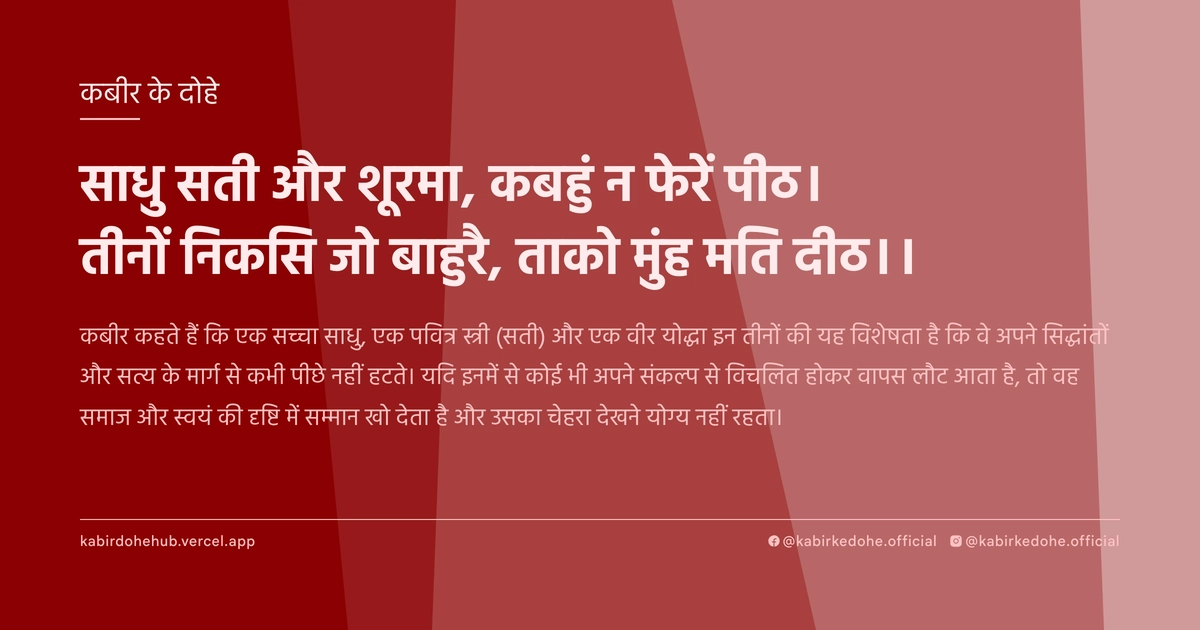
साधु सती और शूरमा, कबहुं न फेरें पीठ।
तीनों निकसि जो बाहुरै, ताको मुंह मति दीठ।।
Sadhu sati aur shoorma, kabhun na pheren peeth. Teeno niksi jo bahurai, taako munh mati deeth.
इस पृष्ठ पर इस कबीर दोहे का अर्थ (meaning), हिंदी व्याख्या और अंग्रेज़ी अनुवाद, दार्शनिक विश्लेषण और व्यावहारिक जीवन सीख दी गई है। यह दोहा निष्ठा (Integrity) विषय से जुड़ा है — Kabir doha meaning and explanation in Hindi and English.
अर्थ (Meaning):
कबीर कहते हैं कि एक सच्चा साधु, एक पवित्र स्त्री (सती) और एक वीर योद्धा इन तीनों की यह विशेषता है कि वे अपने सिद्धांतों और सत्य के मार्ग से कभी पीछे नहीं हटते। यदि इनमें से कोई भी अपने संकल्प से विचलित होकर वापस लौट आता है, तो वह समाज और स्वयं की दृष्टि में सम्मान खो देता है और उसका चेहरा देखने योग्य नहीं रहता।
Kabir asserts that a true seeker, a virtuous soul, and a brave warrior share a common trait: they never retreat from their path of truth and righteousness. If any of these three, having embarked on their spiritual or moral journey, turn back or abandon their resolve, they lose their integrity and become unworthy of respect in the eyes of the world and the self.
व्याख्या (Interpretation):
यह दोहा केवल सामाजिक मर्यादा की बात नहीं करता, बल्कि यह 'दृढ़ संकल्प' (Sankalpa) की आध्यात्मिक अनिवार्यता को दर्शाता है। यहाँ 'साधु' आत्म-साक्षात्कार के खोजी को, 'सती' नैतिक पवित्रता को और 'शूरमा' अहंकार के विरुद्ध लड़ने वाले योद्धा को दर्शाता है। जब एक साधक निरगुण भक्ति के मार्ग पर चलता है, तो वह माया के प्रलोभनों और संसार के द्वंद्वों से टकराता है। यदि वह इस युद्ध में डरकर पीछे हटता है, तो वह अपनी आध्यात्मिक प्रगति को शून्य कर देता है। यह 'पीठ फेरना' वास्तव में आत्मा का परमात्मा से विमुख होना है। अद्वैत वेदांत के अनुसार, एक बार जब व्यक्ति को यह बोध हो जाता है कि वह ब्रह्म है, तो वापस अज्ञान की स्थिति में लौटना एक आत्मघाती कृत्य है। यह विरोधाभास है कि मुक्ति के लिए पूर्ण समर्पण आवश्यक है, लेकिन उस समर्पण को बनाए रखने के लिए लौह जैसा संकल्प चाहिए।
This couplet transcends mere social morality to highlight the spiritual necessity of 'Sankalpa' or unwavering resolve. The 'Sadhu' represents the seeker of self-realization, the 'Sati' embodies moral purity, and the 'Shoorma' symbolizes the warrior fighting the internal battle against the ego. In the path of Nirgun Bhakti, the seeker encounters the illusions of Maya and the contradictions of existence. To 'turn one's back' is not a physical act but a spiritual regression—a retreat from the truth back into the slumber of ignorance. According to Advaita Vedanta, once the spark of non-duality is lit, returning to the fragmented identity of the ego is a betrayal of the Atman. The central paradox lies in the fact that while liberation requires total surrender, the act of surrendering to the Divine requires a will stronger than any earthly desire. To retreat is to admit that the ego's fear was greater than the soul's longing for Truth.
दार्शनिक विश्लेषण (Philosophical Analysis):
कबीर का यह कथन उस युग की पृष्ठभूमि में है जहाँ धर्म केवल कर्मकांडों और बाहरी दिखावे तक सीमित था। कबीर ने ritualism का विरोध करते हुए 'आंतरिक सत्य' और 'चरित्र की दृढ़ता' पर बल दिया। उनके लिए धर्म मंदिर या मस्जिद में नहीं, बल्कि उस साहस में है जो व्यक्ति को सत्य के मार्ग पर अडिग रखता है। यह दृष्टिकोण सूफीवाद के 'इश्क-ए-हकीकी' (ईश्वरीय प्रेम) से मेल खाता है, जहाँ प्रेमी को अपने मार्ग में आने वाली हर बाधा को सहना पड़ता है और पीछे हटने का विकल्प नहीं होता।
दार्शनिक स्तर पर, यह दोहा 'अहंकार के विसर्जन' की प्रक्रिया को समझाता है। एक योद्धा जब युद्धभूमि में होता है, तो उसका व्यक्तिगत अस्तित्व समाप्त हो जाता है और केवल उसका कर्तव्य बचता है। इसी प्रकार, एक साधु जब भक्ति में लीन होता है, तो उसका 'मैं' मिट जाता है। यदि वह वापस लौटता है, तो वह पुनः उस 'मैं' (ego) को जीवित कर देता है, जो बंधन का मूल कारण है। कबीर यहाँ चेतावनी दे रहे हैं कि आध्यात्मिक मार्ग पर 'आंशिक सफलता' जैसा कुछ नहीं होता; या तो आप पूर्णतः समर्पित होते हैं या आप शून्य हैं।
यह विचार जाति और वर्ण व्यवस्था के विरुद्ध एक प्रहार भी है। कबीर यह कह रहे हैं कि सम्मान जन्म से नहीं, बल्कि संकल्प की दृढ़ता से आता है। एक निम्न जाति का व्यक्ति यदि अपने सत्य पर अडिग है, तो वह उस उच्च कुल के व्यक्ति से कहीं अधिक 'साधु' है जो डरकर अपने सिद्धांतों को बदल लेता है। यह सामाजिक पदानुक्रम को नैतिक पदानुक्रम में बदलने का प्रयास है।
मनोवैज्ञानिक रूप से, यह 'संज्ञानात्मक विसंगति' (cognitive dissonance) के समाधान की बात करता है। जब हम अपने मूल्यों के विपरीत कार्य करते हैं, तो आंतरिक संघर्ष पैदा होता है। कबीर का सुझाव है कि इस संघर्ष से बचने का एकमात्र तरीका है—अपने सत्य के प्रति पूर्ण निष्ठा। जो व्यक्ति अपने शब्दों और कार्यों में एकरूपता रखता है, वही वास्तविक शांति प्राप्त करता है।
अंततः, यह दोहा हमें याद दिलाता है कि सत्य का मार्ग कठिन है और इसमें 'वापसी' का कोई रास्ता नहीं है। एक बार जब चेतना जागृत हो जाती है, तो अज्ञान की नींद वापस पाना असंभव और निंदनीय है। यह एक आध्यात्मिक 'point of no return' है, जहाँ केवल आगे बढ़ना ही एकमात्र विकल्प है।
Kabir's assertion emerges from an era where religion was largely reduced to empty rituals and external displays. By rejecting ritualism, Kabir emphasizes 'internal truth' and 'steadfastness of character.' For him, divinity is not found in temples or mosques but in the courage to remain unwavering on the path of Truth. This aligns closely with the Sufi concept of 'Ishq-e-Haqiqi' (Divine Love), where the lover must endure every hardship without the option of retreat; to turn back is to fail the test of love.
On a deeper philosophical level, this couplet explains the process of 'annihilation of the ego.' Just as a warrior in the heat of battle transcends personal identity to embody duty, a seeker in deep devotion must dissolve the 'I.' To retreat is to revive the ego, which is the primary cause of bondage in the cycle of Samsara. Kabir warns that there is no such thing as 'partial success' on the spiritual path; one is either completely surrendered or remains in total ignorance.
This teaching also serves as a critique of the caste system. Kabir suggests that respect is not a birthright but a result of moral fortitude. A person from the lowest social strata who remains steadfast in their truth is far more of a 'Sadhu' than a high-born individual who compromises their principles out of fear. He replaces social hierarchy with a hierarchy of integrity.
Psychologically, this addresses the resolution of cognitive dissonance. When our actions contradict our core values, internal turmoil ensues. Kabir proposes that the only remedy is absolute alignment between one's truth and one's actions. The individual who achieves congruence between word and deed attains a state of psychological and spiritual equilibrium.
Ultimately, the couplet reminds us that the path to Truth is a one-way journey. Once the consciousness has awakened to the reality of the Atman-Brahman non-duality, returning to the illusion of separation is not just a failure, but a spiritual tragedy. It is a 'point of no return' where the only way is forward, deeper into the heart of the Divine.
मूल संदेश (Core Message):
- अडिगता ही आध्यात्मिक वीरता की पहली शर्त है।
- सत्य के मार्ग पर वापसी का अर्थ है—अस्तित्व का विलोपन।
- बाहरी सम्मान क्षणिक है, लेकिन आत्म-सम्मान शाश्वत है।
- अहंकार का त्याग ही वास्तविक साहस की नींव है।
- जो स्वयं के प्रति सच्चा है, वह ईश्वर के निकट है।
- Steadfastness is the primary prerequisite for spiritual heroism.
- To retreat from the path of Truth is to annihilate one's own essence.
- External validation is fleeting; internal integrity is eternal.
- The dissolution of ego is the foundation of true courage.
- He who is true to himself is closest to the Divine.
व्यावहारिक उदाहरण (Practical Example):
एक समय की बात है, वाराणसी के घाटों पर माधव नाम का एक वृद्ध बुनकर रहता था। वह अपनी सादगी और सत्यनिष्ठा के लिए जाना जाता था। माधव ने जीवन भर यह संकल्प लिया था कि वह कभी भी किसी को धोखा नहीं देगा, चाहे परिस्थिति कैसी भी हो।
एक बार शहर के एक समृद्ध व्यापारी ने माधव को एक बहुत ही कीमती रेशमी वस्त्र बुनने का काम दिया। व्यापारी ने वादा किया कि यदि वस्त्र समय पर और त्रुटिहीन बना, तो वह उसे सोने की मुद्राओं से पुरस्कृत करेगा। माधव ने दिन-रात एक कर दिया और एक अद्भुत वस्त्र तैयार किया।
जब वस्त्र तैयार हुआ, तो व्यापारी ने उसे देखा और उसकी सुंदरता से दंग रह गया। लेकिन अपनी लालच और चालाकी के कारण, व्यापारी ने माधव पर आरोप लगाया कि वस्त्र के एक कोने में एक छोटा सा धागा गलत लगा है, और इस आधार पर उसने भुगतान करने से मना कर दिया।
व्यापारी ने माधव को प्रस्ताव दिया, "यदि तुम अपनी गलती मान लो और सार्वजनिक रूप से स्वीकार करो कि तुम एक असफल बुनकर हो, तो मैं तुम्हें कुछ सिक्के दे दूँगा। अन्यथा, तुम्हें कुछ नहीं मिलेगा।"
माधव के पास पैसे नहीं थे, उसका परिवार भूखा था, और समाज उसे एक असफल व्यक्ति के रूप में देख रहा था। उसके मन में एक पल के लिए आया कि वह झूठ बोल दे और अपनी गलती मान ले ताकि उसे कुछ पैसे मिल सकें।
तभी उसे कबीर का वह दोहा याद आया—"साधु सती और शूरमा, कबहुं न फेरें पीठ।" उसे अहसास हुआ कि यदि वह आज अपने सत्य से पीछे हटा, तो वह केवल पैसे नहीं, बल्कि अपनी आत्मा का सम्मान खो देगा।
माधव ने शांत स्वर में कहा, "मेरा वस्त्र मेरी सत्यनिष्ठा का प्रमाण है। यदि आप इसे त्रुटिपूर्ण मानते हैं, तो यह आपकी दृष्टि की कमी है, मेरी कला की नहीं। मुझे आपके सिक्कों की आवश्यकता नहीं है, क्योंकि मेरा संतोष मेरे सत्य में है।"
व्यापारी उसकी अडिगता देखकर हैरान रह गया। उसे अपनी तुच्छता का अहसास हुआ। उसने न केवल माधव को पूरा भुगतान किया, बल्कि उसके चरणों में गिरकर क्षमा मांगी।
माधव की इस अडिगता ने पूरे मोहल्ले के लोगों को प्रेरित किया। उन्होंने सीखा कि भौतिक हानि सहना आसान है, लेकिन अपने सिद्धांतों से पीछे हटना एक ऐसी हार है जिससे उबरना असंभव है।
माधव का जीवन एक उदाहरण बन गया कि जब व्यक्ति अपने सत्य पर अडिग रहता है, तो पूरी कायनात उसे सम्मान देने के लिए मजबूर हो जाती है।
Once in the ancient ghats of Varanasi, there lived an elderly weaver named Madhav. He was renowned not for his wealth, but for his unwavering integrity. Madhav had taken a lifelong vow never to deceive anyone, regardless of the cost.
One day, a wealthy merchant commissioned Madhav to weave a priceless silk garment. The merchant promised a reward of gold coins if the fabric was flawless and delivered on time. Madhav poured his soul into the work, spending sleepless nights to create a masterpiece.
When the garment was finished, the merchant was mesmerized by its beauty. However, driven by greed and a desire to dominate, the merchant pointed to a microscopic imperfection—a single misplaced thread—and refused to pay the agreed price.
The merchant offered a deal: "If you admit your failure and publicly confess that you are an incompetent weaver, I will give you a few coins. Otherwise, you shall receive nothing."
Madhav was destitute; his family was hungry, and the community looked upon him as a failure. For a fleeting moment, he considered lying just to secure the money for his children's survival.
In that moment of crisis, Kabir's words echoed in his mind: "The seeker, the virtuous, and the brave never turn their backs." He realized that if he retreated from his truth now, he would lose not just money, but the very essence of his soul.
With a calm and steady voice, Madhav replied, "My garment is the evidence of my integrity. If you see a flaw, it is a reflection of your sight, not my art. I do not need your coins, for my contentment lies in my truth."
The merchant was stunned by this absolute resolve. He felt the weight of his own pettiness. Overwhelmed by Madhav's strength, he not only paid the full amount but fell at the weaver's feet, seeking forgiveness.
Madhav's steadfastness became a legend in the neighborhood. People learned that while material loss is bearable, retreating from one's principles is a defeat from which one never truly recovers.
Madhav's life became a living testament that when a person stands immovable in their truth, the entire universe eventually bows in respect.
अभ्यास मार्गदर्शन (Practice Guidance):
- प्रतिदिन 15 मिनट मौन साधना करें और विचार करें कि आपके जीवन का वह कौन सा 'सत्य' है जिससे आप अक्सर डरकर पीछे हट जाते हैं।
- एक 'सत्य-डायरी' बनाएँ। जब भी आप किसी दबाव में आकर अपने मूल्यों से समझौता करें, उसे लिखें और विश्लेषण करें कि उस समय आपके भीतर किस डर ने काम किया।
- व्यवहार परिवर्तन: दिन में कम से कम एक बार ऐसा कार्य करें जो सही हो, भले ही वह आपको असुविधाजनक लगे या आपके सामाजिक प्रभाव को कम करे।
- निदान चेकलिस्ट: क्या मैं दूसरों की प्रशंसा के लिए अपने विचारों को बदल रहा हूँ? क्या मैं अपनी गलतियों को स्वीकार करने के बजाय उन्हें छिपाने के लिए झूठ बोल रहा हूँ? क्या मेरा आंतरिक स्वर मेरी बाहरी बातों से मेल खाता है?
- Practice 15 minutes of daily silent meditation, contemplating the specific 'Truth' in your life from which you frequently retreat due to fear.
- Maintain a 'Truth-Journal.' Whenever you compromise your values under pressure, record the incident and analyze which specific fear triggered the retreat.
- Behavioral Shift: Once a day, consciously perform an action that is right, even if it causes you personal discomfort or diminishes your social standing.
- Diagnostic Checklist: Am I altering my views to gain external validation? Am I lying to cover mistakes instead of owning them? Does my internal voice align with my external speech?
चिंतन प्रश्न (Reflection Questions):
- वह कौन सा मुखौटा है जिसे मैं दुनिया के सामने पहनता हूँ, जबकि मेरा आंतरिक सत्य कुछ और है?
- क्या मेरी 'नैतिकता' वास्तव में मेरी अपनी है, या यह केवल समाज द्वारा दिए गए डर का परिणाम है?
- यदि आज मुझे अपने सबसे गहरे सत्य को सार्वजनिक करना पड़े, तो मैं कितना डरूँगा और क्यों?
- मैं किन परिस्थितियों में 'पीठ फेरने' को अपनी मजबूरी कहता हूँ, जबकि वह वास्तव में मेरा डर है?
- क्या मैं अपनी डिजिटल पहचान (Social Media) को बनाए रखने के लिए अपने वास्तविक मूल्यों की बलि दे रहा हूँ?
- मेरे जीवन का वह कौन सा युद्ध है जिसे मैं अधूरा छोड़कर भाग रहा हूँ?
- What is the mask I wear for the world, while my internal truth remains hidden and different?
- Is my 'morality' truly my own, or is it merely a byproduct of social conditioning and fear?
- If I were forced to make my deepest truth public today, how much fear would I feel, and why?
- In which situations do I label 'retreating' as a necessity, when it is actually just cowardice?
- Am I sacrificing my authentic values to maintain a curated digital identity on social media?
- Which internal battle in my life have I abandoned, and what prevents me from returning to it?