
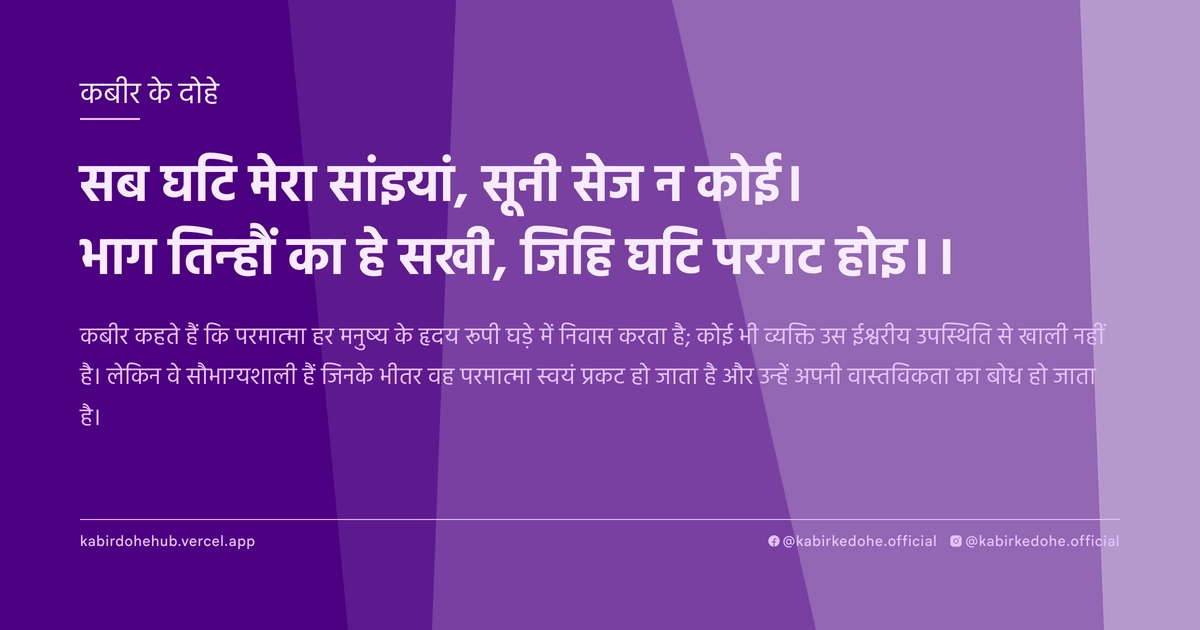
सब घटि मेरा सांइयां, सूनी सेज न कोई।
भाग तिन्हौं का हे सखी, जिहि घटि परगट होइ।।
Sab ghat mera saiyan, sooni sej na koi. Bhag tinhaun ka he sakhi, jih ghat pargat hoye.
इस पृष्ठ पर इस कबीर दोहे का अर्थ (meaning), हिंदी व्याख्या और अंग्रेज़ी अनुवाद, दार्शनिक विश्लेषण और व्यावहारिक जीवन सीख दी गई है। यह दोहा निर्गुण ब्रह्म (Nirguna Brahman) विषय से जुड़ा है — Kabir doha meaning and explanation in Hindi and English.
अर्थ (Meaning):
कबीर कहते हैं कि परमात्मा हर मनुष्य के हृदय रूपी घड़े में निवास करता है; कोई भी व्यक्ति उस ईश्वरीय उपस्थिति से खाली नहीं है। लेकिन वे सौभाग्यशाली हैं जिनके भीतर वह परमात्मा स्वयं प्रकट हो जाता है और उन्हें अपनी वास्तविकता का बोध हो जाता है।
Kabir asserts that the Divine resides within the vessel of every single human heart; there is not a single soul devoid of this sacred presence. However, truly fortunate are those within whom this Divine essence awakens and reveals itself, transforming mere existence into conscious realization.
व्याख्या (Interpretation):
शाब्दिक अर्थ यह है कि ईश्वर सर्वव्यापी है और हर शरीर में मौजूद है। रूपकात्मक स्तर पर, 'घट' या घड़ा मानव शरीर और अहंकार का प्रतीक है। कबीर यहाँ निर्गुण भक्ति का संदेश दे रहे हैं, जहाँ ईश्वर किसी मंदिर या मस्जिद में नहीं, बल्कि अंतरात्मा में स्थित है। यह अद्वैत वेदांत के उस सिद्धांत को पुष्ट करता है जहाँ आत्मा और ब्रह्म एक ही हैं। माया का पर्दा हमें इस सत्य को देखने से रोकता है, जिससे हमें लगता है कि हम ईश्वर से अलग हैं। जब यह अज्ञान मिटता है, तब 'परगट' होने की प्रक्रिया शुरू होती है। यह विरोधाभास है कि जो सबसे करीब है, उसे खोजने में हमें पूरा जीवन लग जाता है।
Literally, the verse claims God is omnipresent and dwells in every body. Metaphorically, the 'ghat' or pot symbolizes the human physical form and the egoic shell. Kabir propagates the essence of Nirgun Bhakti, where the Divine is not confined to temples or mosques but resides within the innermost consciousness. This aligns with Advaita Vedanta's non-duality, suggesting that Atman and Brahman are identical. The veil of Maya creates the illusion of separation, making the inherent divinity invisible to the sleeper. When this ignorance dissolves, the 'revelation' or manifestation occurs. It is the central paradox of the human condition: that which is closest to us is the hardest to perceive.
दार्शनिक विश्लेषण (Philosophical Analysis):
कबीर का यह दोहा उनके युग के धार्मिक पाखंड और बाहरी कर्मकांडों पर एक गहरा प्रहार है। उस समय समाज जाति और धर्म के आधार पर विभाजित था, जहाँ कुछ लोगों का दावा था कि ईश्वर केवल उच्च कुल या विशिष्ट अनुष्ठानों के माध्यम से प्राप्त किया जा सकता है। कबीर इस धारणा को ध्वस्त करते हुए कहते हैं कि परमात्मा का निवास किसी विशेष वर्ग तक सीमित नहीं है, बल्कि वह सार्वभौमिक है। यह दृष्टिकोण सूफी मत के 'वहदत-अल-वजूद' (अस्तित्व की एकता) के समान है, जहाँ पूरी सृष्टि ईश्वर का ही प्रतिबिंब मानी जाती है।
दार्शनिक रूप से, यह दोहा 'अहं' के विलोपन की बात करता है। जब तक मनुष्य स्वयं को एक अलग इकाई मानता है, वह उस आंतरिक संगीत को नहीं सुन पाता। निर्गुण भक्ति का मार्ग यह सिखाता है कि ईश्वर का कोई आकार नहीं है, इसलिए उसे बाहर खोजना व्यर्थ है। यहाँ 'सूनी सेज' का अर्थ केवल भौतिक शून्यता नहीं, बल्कि आध्यात्मिक रिक्तता का भ्रम है। कबीर स्पष्ट करते हैं कि कोई भी वास्तव में रिक्त नहीं है; केवल हमारी दृष्टि धुंधली है।
यह विश्लेषण हमें यह समझने में मदद करता है कि कबीर केवल एक कवि नहीं, बल्कि एक मनोवैज्ञानिक थे। वे जानते थे कि मनुष्य अपनी पहचान बाहरी उपाधियों में खोजता है। जब वे कहते हैं कि 'सब घटि मेरा सांइयां', तो वे व्यक्ति को उसकी अपनी गरिमा और दिव्यता का एहसास करा रहे होते हैं। यह सामाजिक समानता का सबसे प्रबल आध्यात्मिक आधार है—यदि ईश्वर सबमें है, तो कोई छोटा या बड़ा कैसे हो सकता है?
अद्वैत वेदांत के परिप्रेक्ष्य में, यह 'तत्वमसि' (वह तू ही है) का सरल रूपांतरण है। कबीर यहाँ यह समझा रहे हैं कि साधना का अर्थ कुछ नया प्राप्त करना नहीं, बल्कि उस सत्य को पहचानना है जो पहले से मौजूद है। यह 'प्राप्ति' नहीं, बल्कि 'प्रकटीकरण' है। अधिकांश लोग ईश्वर को एक बाहरी सत्ता मानकर उसकी प्रार्थना करते हैं, जबकि कबीर उसे एक आंतरिक अनुभव बनाने पर जोर देते हैं।
अंततः, यह दोहा हमें यह सिखाता है कि आध्यात्मिक जागृति कोई बाहरी चमत्कार नहीं है, बल्कि आंतरिक परतों का हटना है। जब अहंकार की दीवार गिरती है, तो जो बचता है वह केवल परमात्मा है। यह प्रक्रिया व्यक्ति को संकीर्णता से मुक्त कर उसे वैश्विक प्रेम और करुणा से जोड़ती है, क्योंकि अब वह हर व्यक्ति में अपने ही 'सांइयां' को देखने लगता है।
This couplet serves as a profound critique of the religious hypocrisy and external ritualism prevalent during Kabir's era. At a time when society was fractured by caste and creed, and certain elites claimed that the Divine was accessible only through specific lineages or complex rituals, Kabir dismantles these hierarchies. He asserts that the Divine is not the monopoly of a chosen few but is universal, residing in every heart regardless of social standing.
Philosophically, this aligns with the Sufi concept of 'Wahdat-al-Wujud' (Unity of Existence), where the entire universe is seen as a reflection of the One. Kabir emphasizes the annihilation of the ego; as long as a human perceives themselves as a separate, isolated entity, they remain deaf to the internal divine melody. The path of Nirgun Bhakti teaches that since the Divine is formless, searching for Him in external structures is a futile exercise.
The phrase 'sooni sej' (empty bed) does not refer to physical loneliness but to the illusion of spiritual void. Kabir clarifies that no soul is truly empty; it is only our perception that is clouded. From a psychological standpoint, Kabir addresses the human tendency to seek identity in external labels. By stating that the Divine is in every 'ghat', he restores the inherent dignity and divinity of every individual, providing a spiritual foundation for absolute social equality.
In the context of Advaita Vedanta, this is a poetic rendering of 'Tat Tvam Asi' (Thou Art That). Kabir suggests that spiritual practice is not about acquiring something new from the outside, but about recognizing the truth that has always been present. It is not an 'acquisition' but a 'revelation'. While most treat God as an external deity to be appeased, Kabir treats the Divine as an internal experience to be realized.
Ultimately, the doha teaches that spiritual awakening is not a miracle bestowed from above, but the removal of internal layers of ignorance. When the wall of the ego collapses, only the Divine remains. This process liberates the individual from narrowness and connects them to universal love and compassion, as they begin to see their own 'Saaiyan' in every living being they encounter.
मूल संदेश (Core Message):
- बाहरी खोज एक भ्रम है; सत्य केवल भीतर है।
- अहंकार वह पर्दा है जो परमात्मा को ओझल करता है।
- हर मनुष्य एक पवित्र मंदिर है, इसे पहचानें।
- प्रेम और करुणा ही ईश्वर तक पहुँचने के वास्तविक मार्ग हैं।
- जब 'मैं' मिटता है, तब 'वह' प्रकट होता है।
- External searching is an illusion; Truth resides only within.
- The ego is the veil that obscures the Divine presence.
- Every human being is a sacred temple; recognize this.
- Love and compassion are the only authentic paths to God.
- When the 'I' dissolves, the 'He' manifests.
व्यावहारिक उदाहरण (Practical Example):
एक समय की बात है, वाराणसी के घाटों पर माधव नाम का एक वृद्ध नाविक रहता था। माधव का जीवन संघर्षपूर्ण था, और वह अक्सर अपनी गरीबी और अकेलेपन से दुखी रहता था। वह देखता था कि बड़े-बड़े पंडित और धनी लोग गंगा किनारे बैठकर घंटों मंत्रोच्चार करते हैं और महंगे अनुष्ठान करते हैं, जबकि वह केवल अपनी नाव चलाकर पेट भरता था। उसे लगता था कि ईश्वर केवल उन विद्वानों के करीब है जो संस्कृत जानते हैं और कठिन व्रत रखते हैं।
माधव के मन में यह गहरी टीस थी कि वह 'अछूत' और 'अज्ञानी' है, इसलिए ईश्वर उसे कभी नहीं मिलेंगे। वह अक्सर मंदिर की सीढ़ियों के पास खड़ा होकर देखता, लेकिन अंदर जाने का साहस नहीं करता था। उसे लगता था कि उसका हृदय एक 'सूनी सेज' है, जहाँ शांति और दिव्यता का कोई स्थान नहीं है।
एक दिन, उसकी नाव पर एक फकीर सवार हुआ। वह फकीर शांत था और उसकी आँखों में एक अजीब सी चमक थी। जब माधव ने अपनी व्यथा सुनाई कि वह कितना तुच्छ है और ईश्वर उससे कितनी दूर हैं, तो फकीर ने मुस्कुराते हुए माधव के सीने पर हाथ रखा और कहा, "माधव, तू जिसे बाहर खोज रहा है, वह इसी घड़े के भीतर बैठा तेरा इंतजार कर रहा है। तूने अपनी नाव को तो साफ रखा, पर अपने भीतर के दर्पण पर धूल जमने दी।"
फकीर ने उसे समझाया कि ईश्वर किसी भाषा या जाति का मोहताज नहीं है। उसने माधव से कहा, "जब तू किसी प्यासे को पानी पिलाता है या किसी डूबते को बचाता है, तब तू वास्तव में अपने भीतर के उसी सांइयां की सेवा कर रहा होता है। बस तूने उसे पहचाना नहीं।"
माधव को यह बात पहले तो समझ नहीं आई, लेकिन उसने एक प्रयोग करने का निर्णय लिया। उसने तय किया कि वह अब ईश्वर को मंदिर में नहीं, बल्कि हर उस व्यक्ति में खोजेगा जो उसकी नाव पर सवार होगा। उसने हर यात्री के प्रति करुणा और प्रेम दिखाना शुरू किया, चाहे वह अमीर हो या गरीब, उच्च जाति का हो या निम्न।
धीरे-धीरे माधव के व्यवहार में बदलाव आया। अब वह अपनी गरीबी का रोना नहीं रोता था। उसने महसूस किया कि जब वह किसी दुखी व्यक्ति की मदद करता, तो उसके हृदय में एक असीम शांति का अनुभव होता था। उसे लगने लगा कि वह शांति ही वह 'सांइयां' है जिसकी वह तलाश कर रहा था।
एक दिन, एक बहुत बड़ा विद्वान उसकी नाव पर आया और माधव की विनम्रता और आंतरिक शांति को देखकर दंग रह गया। उस विद्वान ने पूछा, "तुमने कौन सी कठिन साधना की है कि तुम्हारे चेहरे पर ऐसा तेज है?"
माधव ने सरलता से उत्तर दिया, "मैंने कोई साधना नहीं की, बस यह जान लिया कि मेरा सांइयां मेरे भीतर ही है और हर उस इंसान में भी, जिसे मैं देखता हूँ। अब मेरी सेज सूनी नहीं रही।"
इस 'कबीर ट्विस्ट' ने माधव के जीवन को पूरी तरह बदल दिया। वह अब केवल एक नाविक नहीं था, बल्कि एक जीवित मंदिर बन चुका था। उसने सीखा कि दिव्यता का अनुभव करने के लिए किसी बाहरी माध्यम की आवश्यकता नहीं है, केवल एक शुद्ध और प्रेमपूर्ण हृदय ही पर्याप्त है।
Once, on the ghats of Varanasi, lived an elderly boatman named Madhav. Madhav's life was a struggle, and he often felt consumed by his poverty and loneliness. He watched as wealthy merchants and learned pundits spent hours chanting mantras and performing expensive rituals by the Ganges, while he merely rowed his boat to survive. He believed that God was close only to those who knew Sanskrit and observed rigorous fasts.
Deep within Madhav was a lingering pain—the belief that because he was 'low-born' and 'uneducated,' the Divine would never visit him. He would often stand near the temple steps, watching from a distance, never daring to enter. He felt his heart was a 'sooni sej'—an empty bed where peace and divinity had no place.
One day, a wandering fakir boarded his boat. The fakir was serene, with a peculiar spark in his eyes. When Madhav shared his sorrow about his insignificance and the distance between him and God, the fakir smiled, placed a hand on Madhav's chest, and said, "Madhav, the one you seek outside is sitting right here inside this pot, waiting for you. You have kept your boat clean, but you let dust settle on the mirror of your soul."
The fakir explained that God is not bound by language or caste. He told Madhav, "When you give water to a thirsty soul or save someone from drowning, you are actually serving that same 'Saaiyan' within you. You simply failed to recognize Him."
Madhav didn't understand immediately, but he decided to experiment. He resolved to stop looking for God in temples and instead look for Him in every person who stepped onto his boat. He began treating every passenger with profound compassion and love, regardless of their wealth or social status.
Gradually, a transformation occurred. Madhav stopped lamenting his poverty. He noticed that whenever he helped a suffering person, an immense peace flooded his heart. He began to realize that this peace was the very 'Saaiyan' he had been searching for all his life.
One day, a renowned scholar boarded his boat. Struck by Madhav's humility and the radiance of his presence, the scholar asked, "What rigorous penance have you performed to attain such inner light?"
Madhav replied simply, "I performed no penance. I only realized that my Saaiyan resides within me and in every human being I encounter. My bed is no longer empty."
This 'Kabir Twist' completely altered Madhav's existence. He was no longer just a boatman; he had become a living temple. He learned that realizing divinity requires no external medium—only a pure and loving heart is sufficient.
अभ्यास मार्गदर्शन (Practice Guidance):
- दैनिक अंतर्मुखी ध्यान: प्रतिदिन 20 मिनट मौन रहकर अपने हृदय की धड़कन पर ध्यान केंद्रित करें और यह अनुभव करें कि प्रत्येक सांस के साथ ईश्वरीय ऊर्जा आपके भीतर प्रवाहित हो रही है।
- आत्म-पूछताछ जर्नलिंग: प्रतिदिन एक ऐसी घटना लिखें जहाँ आपने किसी दूसरे व्यक्ति में अपनी ही छवि या दिव्यता देखी हो। प्रश्न पूछें: "उस व्यक्ति के किस गुण ने मुझे मेरे अपने आंतरिक सत्य की याद दिलाई?"
- व्यवहारिक परिवर्तन: दिन में कम से कम एक बार किसी ऐसे व्यक्ति की निस्वार्थ मदद करें जिससे आप असहमत हैं, यह याद रखते हुए कि वह व्यक्ति भी उसी परमात्मा का एक रूप है।
- निदान चेकलिस्ट: क्या मैं अभी भी दूसरों को उनकी जाति, धर्म या पद से आंक रहा हूँ? क्या मैं शांति के लिए बाहरी स्थानों पर निर्भर हूँ? यदि हाँ, तो इसका अर्थ है कि मैं अभी भी 'सूनी सेज' के भ्रम में हूँ।
- Daily Introverted Meditation: Spend 20 minutes in silence, focusing on your heartbeat and experiencing the divine energy flowing through you with every breath.
- Self-Inquiry Journaling: Daily record one instance where you saw your own reflection or divinity in another person. Ask: "Which quality in that person reminded me of my own internal truth?"
- Behavioral Shift: At least once a day, help someone selflessly, especially someone you disagree with, remembering that they are also a manifestation of the same Divine.
- Diagnostic Checklist: Am I still judging others by their caste, religion, or status? Am I dependent on external locations for peace? If yes, I am still living in the illusion of the 'empty bed'.
चिंतन प्रश्न (Reflection Questions):
- मैं अपनी सार्वजनिक पहचान (पद, प्रतिष्ठा) को बचाने के लिए अपने भीतर की कितनी मौलिक सच्चाई को दबा देता हूँ?
- क्या मेरा 'धार्मिक' होना वास्तव में मुझे दूसरों के प्रति अधिक संवेदनशील बनाता है, या यह मेरे अहंकार को और पुष्ट करता है?
- मेरे जीवन में वह कौन सा 'खालीपन' है जिसे मैं बाहरी चीजों से भरने की कोशिश कर रहा हूँ, जबकि वह वास्तव में आंतरिक जागृति की पुकार है?
- यदि मैं वास्तव में यह मान लूँ कि मेरा शत्रु भी उसी ईश्वर का अंश है, तो मेरा उसके प्रति व्यवहार कैसे बदल जाएगा?
- क्या मैं ईश्वर को एक 'पुरस्कार' के रूप में देखता हूँ जिसे पाना है, या एक 'तत्व' के रूप में जो मैं पहले से ही हूँ?
- How much of my authentic inner truth do I suppress to maintain my public identity (status, reputation)?
- Does my 'religiosity' actually make me more sensitive to others, or does it merely reinforce my ego?
- What is the 'emptiness' in my life that I try to fill with external things, when it is actually a call for internal awakening?
- If I truly accepted that my enemy is also a fragment of the same Divine, how would my behavior toward them change?
- Do I view God as a 'reward' to be earned, or as an 'essence' that I already am?