
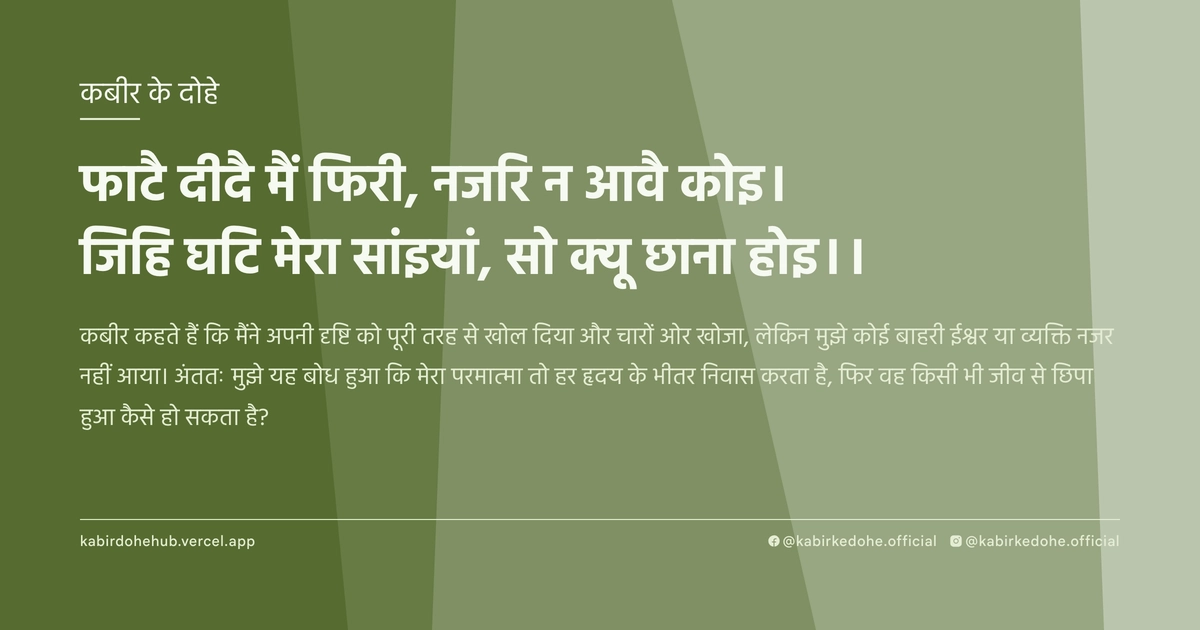
फाटै दीदै मैं फिरी, नजरि न आवै कोइ।
जिहि घटि मेरा सांइयां, सो क्यू छाना होइ।।
Phatai didai main phiri, najari na aavai koi. Jih ghat mera saiyan, so kyun chhana hoye.
इस पृष्ठ पर इस कबीर दोहे का अर्थ (meaning), हिंदी व्याख्या और अंग्रेज़ी अनुवाद, दार्शनिक विश्लेषण और व्यावहारिक जीवन सीख दी गई है। यह दोहा निर्गुण ब्रह्म (Nirguna Brahman) विषय से जुड़ा है — Kabir doha meaning and explanation in Hindi and English.
अर्थ (Meaning):
कबीर कहते हैं कि मैंने अपनी दृष्टि को पूरी तरह से खोल दिया और चारों ओर खोजा, लेकिन मुझे कोई बाहरी ईश्वर या व्यक्ति नजर नहीं आया। अंततः मुझे यह बोध हुआ कि मेरा परमात्मा तो हर हृदय के भीतर निवास करता है, फिर वह किसी भी जीव से छिपा हुआ कैसे हो सकता है?
Kabir proclaims that he searched the entire horizon with an open, piercing gaze, yet found no external deity or savior. He concludes with the realization that since the Divine resides within the heart of every single being, it is impossible for the Truth to be hidden or absent from any living soul.
व्याख्या (Interpretation):
इस दोहे का शाब्दिक अर्थ है कि साधक ने बाहरी दुनिया में ईश्वर को ढूंढने का प्रयास किया पर असफल रहा। रूपक के स्तर पर, "फाटै दीदै" का अर्थ है अज्ञान की परतों का फटना और दिव्य दृष्टि का जागृत होना। यह निर्गुण भक्ति का सार है, जहाँ ईश्वर किसी मंदिर या मस्जिद में नहीं, बल्कि 'घट' यानी मानव शरीर के भीतर स्थित है। यह अद्वैत वेदांत के उस सिद्धांत को दर्शाता है जहाँ आत्मा और परमात्मा एक ही हैं। माया हमें यह विश्वास दिलाती है कि ईश्वर दूर है, जबकि वास्तव में वह हमारे अस्तित्व का मूल आधार है। यहाँ विरोधाभास यह है कि जिसे हम पूरी दुनिया में खोजते हैं, वह खोजने वाले के भीतर ही छिपा होता है।
Literally, the poet describes a search for the Divine in the external world that yields nothing. Metaphorically, "phatai didai" signifies the rupturing of the veil of ignorance and the awakening of spiritual vision. This is the essence of Nirgun Bhakti, where the Divine is not localized in a temple or mosque but resides within the "ghat" or the human vessel. It aligns with Advaita Vedanta's non-duality, asserting that the Atman and Brahman are one. Maya creates the illusion of separation, making us seek the Truth externally, while the Truth is the very essence of the seeker. The central paradox is that the object of the search is the one performing the search.
दार्शनिक विश्लेषण (Philosophical Analysis):
कबीर का यह विचार उनके युग के कट्टरपंथी धार्मिक ढांचे पर एक गहरा प्रहार है। उस समय धर्म बाहरी कर्मकांडों, तीर्थयात्राओं और मूर्ति पूजा तक सीमित था। कबीर ने इन सभी को नकारते हुए 'सहज मार्ग' की बात की। उनका दर्शन सूफीवाद के "अनल हक़" (मैं सत्य हूँ) और वेदांत के "अहं ब्रह्मास्मि" का संगम है। वे तर्क देते हैं कि यदि ईश्वर सर्वव्यापी है, तो उसे किसी विशेष स्थान पर खोजना अतार्किक है।
यह विश्लेषण अहंकार के विसर्जन पर केंद्रित है। जब तक 'मैं' (अहंकार) जीवित है, तब तक ईश्वर 'बाहर' प्रतीत होता है। जैसे ही यह अहंकार फटता है, यह बोध होता है कि सृष्टि का कण-कण उसी एक चेतना का विस्तार है। कबीर यहाँ जाति और धर्म के भेदभाव को पूरी तरह मिटा देते हैं, क्योंकि यदि हर घट में वही सांइयां है, तो कोई भी मनुष्य अछूत या निम्न नहीं हो सकता।
ऐतिहासिक रूप से, कबीर ने एक ऐसे समाज का निर्माण करना चाहा जहाँ मनुष्य अपनी अंतरात्मा की आवाज सुने। उन्होंने बताया कि ईश्वर की प्राप्ति के लिए किसी मध्यस्थ (पुजारी या मौलवी) की आवश्यकता नहीं है। यह सीधा संबंध आत्मा का परमात्मा से है, जो केवल आंतरिक मौन और शुद्धता से संभव है।
मनोवैज्ञानिक स्तर पर, यह दोहा बाहरी सत्यापन (External Validation) की अंतहीन दौड़ को रोकने का आह्वान है। हम अक्सर अपनी खुशी और शांति को बाहरी परिस्थितियों या व्यक्तियों में खोजते हैं, जो अंततः निराशा देता है। कबीर हमें वापस केंद्र की ओर, स्वयं की ओर मुड़ने के लिए प्रेरित करते हैं।
अंततः, यह दर्शन यह स्पष्ट करता है कि 'छिपा होना' ईश्वर की विशेषता नहीं, बल्कि हमारी दृष्टि का दोष है। जब दृष्टि शुद्ध होती है, तो पूरा ब्रह्मांड एक मंदिर बन जाता है और हर मनुष्य एक पवित्र तीर्थ।
Kabir's insight is a profound critique of the rigid religious frameworks of his era. During his time, spirituality was confined to external rituals, pilgrimages, and idol worship. Kabir rejected these, advocating for the "Sahaj Marg" or the natural path. His philosophy is a confluence of the Sufi concept of "Anal Haq" (I am the Truth) and the Vedantic "Aham Brahmasmi" (I am Brahman).
He argues that if the Divine is omnipresent, seeking it in a specific location is logically flawed. This analysis centers on the annihilation of the ego. As long as the 'I' (ego) persists, the Divine appears external. Once this veil ruptures, the realization dawns that every particle of creation is an extension of a single consciousness.
Historically, Kabir sought to build a society where humans listen to their inner voice. He asserted that no intermediary—be it a priest or a cleric—is necessary for spiritual realization. The connection is direct, from the soul to the Absolute, achievable only through inner silence and purity.
Psychologically, this verse is a call to cease the endless pursuit of external validation. We often seek peace and fulfillment in external circumstances or people, which inevitably leads to disappointment. Kabir urges us to return to the center, to the self.
Ultimately, the philosophy clarifies that the "hiddenness" of the Divine is not a quality of God, but a defect of our perception. When the vision is purified, the entire universe becomes a temple, and every human being becomes a sacred pilgrimage site.
मूल संदेश (Core Message):
- बाहरी खोज एक भ्रम है; सत्य भीतर है।
- अहंकार का फटना ही वास्तविक ज्ञान की शुरुआत है।
- ईश्वर कोई व्यक्ति नहीं, बल्कि एक सर्वव्यापी चेतना है।
- हर मनुष्य का हृदय परमात्मा का पवित्र मंदिर है।
- दृष्टि की शुद्धि ही मोक्ष का एकमात्र मार्ग है।
- External searching is an illusion; Truth is within.
- The rupturing of ego is the dawn of true knowledge.
- God is not a person, but an omnipresent consciousness.
- Every human heart is a sacred temple of the Divine.
- Purification of vision is the only path to liberation.
व्यावहारिक उदाहरण (Practical Example):
एक समय की बात है, वाराणसी के घाटों पर माधव नाम का एक वृद्ध कुम्हार रहता था। माधव अपनी पूरी जिंदगी मिट्टी के बर्तन बनाने में बिता चुका था, लेकिन उसके मन में एक गहरी बेचैनी थी। वह अक्सर शहर के बड़े पंडितों और संतों के पास जाता, उनसे पूछता कि ईश्वर कहाँ मिलेगा। कोई उसे हिमालय जाने को कहता, तो कोई गंगा में डुबकी लगाने की सलाह देता। माधव ने अपनी जमा-पूंजी खर्च कर दी, कई तीर्थ यात्राएं कीं, लेकिन उसे वह शांति नहीं मिली जिसकी वह तलाश कर रहा था।
एक दिन, माधव बहुत निराश होकर अपने चाक पर बैठा था। उसने देखा कि उसके सामने एक छोटा बच्चा बैठा है, जो मिट्टी के एक ढेले के साथ खेल रहा था। बच्चा उस मिट्टी को बड़े प्यार से सहला रहा था, जैसे वह कोई कीमती रत्न हो। माधव ने बच्चे से पूछा, "बेटा, तुम इस साधारण मिट्टी में क्या देख रहे हो?"
बच्चा मुस्कुराया और बोला, "बाबा, मैं इसमें वह देख रहा हूँ जो आप अपनी बंद आँखों से ढूंढ रहे हैं। यह मिट्टी ही तो वह जादू है जिससे सब कुछ बना है।"
माधव स्तब्ध रह गया। उसे अचानक कबीर का वह दोहा याद आया जो उसने कभी सुना था। उसे महसूस हुआ कि वह अब तक जिस ईश्वर को पहाड़ों और नदियों में ढूंढ रहा था, वह वास्तव में उसी मिट्टी में था जिसे वह रोज छूता था, और उसी सांस में था जो वह ले रहा था।
उस क्षण माधव का अहंकार टूट गया। उसने महसूस किया कि उसकी खोज बाहरी थी, जबकि सत्य आंतरिक था। उसने पंडितों के पास जाना बंद कर दिया और अपनी कला में ही ईश्वर को खोजने लगा।
अब माधव जब भी कोई बर्तन बनाता, वह उसे केवल मिट्टी का पात्र नहीं मानता, बल्कि उसमें उस परमात्मा की छवि देखता। उसकी कला में एक नई दिव्यता आ गई।
उसने अपने जीवन के अंतिम वर्षों में गरीब बच्चों को मुफ्त में मिट्टी का काम सिखाना शुरू किया। वह अब उन्हें यह नहीं सिखाता था कि बर्तन कैसे बनाते हैं, बल्कि यह कि हर इंसान के भीतर एक दिव्य बीज है।
उसका व्यवहार पूरी तरह बदल गया। वह अब किसी से ऊंच-नीच नहीं करता था, क्योंकि वह हर व्यक्ति में उसी 'सांइयां' को देखता था।
माधव की शांति अब बाहरी परिस्थितियों पर निर्भर नहीं थी। उसने जान लिया था कि जब दृष्टि बदलती है, तो दुनिया बदल जाती है।
Once, on the ghats of Varanasi, lived an elderly potter named Madhav. Madhav had spent his entire life shaping clay, yet a deep restlessness gnawed at his soul. He frequently visited the city's prominent pundits and saints, asking where God could be found. Some told him to trek to the Himalayas, others advised him to immerse himself in the Ganges. Madhav spent his meager savings on pilgrimages, but the peace he sought remained elusive.
One day, consumed by despair, Madhav sat at his potter's wheel. He noticed a small child sitting nearby, playing with a lump of clay. The child was stroking the earth with immense tenderness, as if it were a precious gem.
Madhav asked the child, "Son, what do you see in this ordinary mud?"
The child smiled and replied, "Baba, I see in this what you are searching for with closed eyes. This clay is the very magic from which everything is made."
Madhav was stunned. Suddenly, a verse of Kabir he had once heard echoed in his mind. He realized that the God he had been seeking in mountains and rivers was actually in the very clay he touched every day, and in the very breath he drew.
In that moment, Madhav's ego shattered. He understood that his search had been external, while the Truth was internal.
He stopped visiting the pundits and began seeking the Divine within his own craft. Now, whenever Madhav shaped a pot, he didn't see it as mere clay, but as a reflection of the Absolute.
A new divinity entered his art. In his final years, he began teaching poor children the art of pottery for free. He didn't just teach them how to make pots, but how to recognize the divine seed within every human.
His behavior transformed completely. He no longer distinguished between people based on status, for he saw the same "Saaiyan" in everyone.
Madhav's peace was no longer dependent on external circumstances. He had learned that when the vision changes, the world changes.
अभ्यास मार्गदर्शन (Practice Guidance):
- प्रतिदिन 20 मिनट के लिए मौन बैठें और अपना ध्यान बाहरी दुनिया से हटाकर अपनी सांसों और हृदय की धड़कन पर केंद्रित करें।
- एक डायरी लिखें जिसमें आप उन क्षणों को दर्ज करें जब आपने दूसरों में अपनी ही छवि या ईश्वर का अंश देखा हो।
- व्यवहार परिवर्तन: दिन में कम से कम एक बार किसी ऐसे व्यक्ति की मदद करें जिसे समाज 'निम्न' मानता है, यह याद रखते हुए कि उसमें भी वही परमात्मा है।
- निदान चेकलिस्ट: क्या मैं अभी भी शांति को बाहरी वस्तुओं या लोगों में ढूंढ रहा हूँ? क्या मैं दूसरों को उनके पद या जाति से आंक रहा हूँ? यदि हाँ, तो आप अभी भी 'माया' के प्रभाव में हैं।
- Sit in silence for 20 minutes daily, shifting your attention from the external world to your breath and the beating of your heart.
- Maintain a journal recording moments where you recognized your own essence or a spark of the Divine in others.
- Behavioral Shift: At least once a day, help someone whom society deems 'inferior,' consciously remembering that the same Absolute resides within them.
- Diagnostic Checklist: Am I still seeking peace in external objects or people? Do I judge others by their status or caste? If yes, you are still under the influence of Maya.
चिंतन प्रश्न (Reflection Questions):
- मैं अपनी पहचान किन बाहरी लेबलों (पद, धर्म, संपत्ति) से जोड़ता हूँ, और यदि ये सब छीन लिए जाएं, तो मैं कौन हूँ?
- मेरे भीतर का वह कौन सा पूर्वाग्रह है जो मुझे कुछ लोगों को 'अपवित्र' या 'अयोग्य' मानने पर मजबूर करता है?
- क्या मेरी आध्यात्मिक खोज वास्तव में सत्य की प्यास है, या केवल मानसिक शांति पाने का एक स्वार्थी प्रयास?
- यदि ईश्वर वास्तव में हर किसी में है, तो मैं अपने शत्रुओं के प्रति अपनी घृणा को कैसे बदल सकता हूँ?
- मेरे जीवन का वह कौन सा हिस्सा है जहाँ मैं अभी भी 'दिखावे' के लिए धर्म का पालन कर रहा हूँ?
- Which external labels (status, religion, wealth) do I attach my identity to, and who am I if all these are stripped away?
- What is the bias within me that forces me to perceive certain people as 'impure' or 'unworthy'?
- Is my spiritual pursuit a genuine thirst for Truth, or merely a selfish attempt to find mental comfort?
- If the Divine truly resides in everyone, how can I transform my hatred toward my enemies?
- Which part of my life is still governed by a performative adherence to religion rather than internal conviction?