
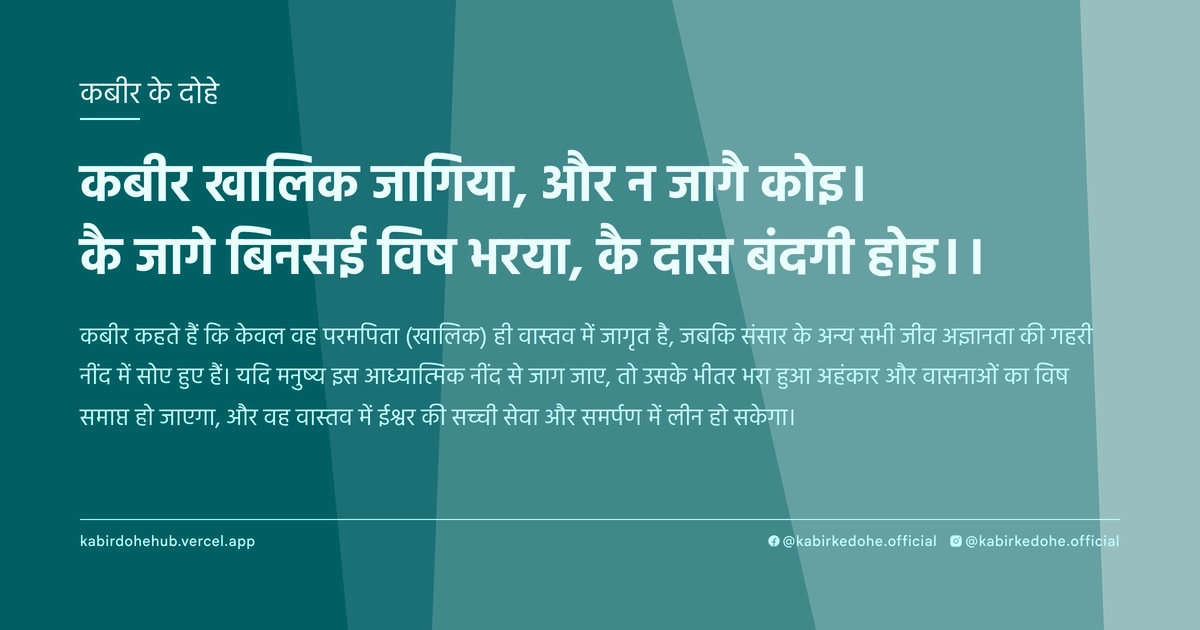
कबीर खालिक जागिया, और न जागै कोइ।
कै जागे बिनसई विष भरया, कै दास बंदगी होइ।।
Kabir khalik jaagiya, aur na jaagai koi. Kai jaage binsai vish bharya, kai das bandagi hoye.
इस पृष्ठ पर इस कबीर दोहे का अर्थ (meaning), हिंदी व्याख्या और अंग्रेज़ी अनुवाद, दार्शनिक विश्लेषण और व्यावहारिक जीवन सीख दी गई है। यह दोहा जागृति (The Wake-up Call) विषय से जुड़ा है — Kabir doha meaning and explanation in Hindi and English.
अर्थ (Meaning):
कबीर कहते हैं कि केवल वह परमपिता (खालिक) ही वास्तव में जागृत है, जबकि संसार के अन्य सभी जीव अज्ञानता की गहरी नींद में सोए हुए हैं। यदि मनुष्य इस आध्यात्मिक नींद से जाग जाए, तो उसके भीतर भरा हुआ अहंकार और वासनाओं का विष समाप्त हो जाएगा, और वह वास्तव में ईश्वर की सच्ची सेवा और समर्पण में लीन हो सकेगा।
Kabir asserts that only the Creator (Khalik) is truly awake, while the rest of the world slumbers in the depths of ignorance. He suggests that if a human being can awaken from this spiritual lethargy, the poison of ego and worldly desires within them will be annihilated, allowing them to achieve a state of genuine devotion and selfless service to the Divine.
व्याख्या (Interpretation):
इस दोहे में 'जागने' का अर्थ शारीरिक नींद से नहीं, बल्कि अज्ञानता (माया) के पर्दे के हटने से है। कबीर यहाँ एक विरोधाभास प्रस्तुत करते हैं: हम स्वयं को जागृत मानते हैं, लेकिन वास्तव में हम अपनी इंद्रियों और सामाजिक पहचान के भ्रम में सोए हुए हैं। 'विष' यहाँ क्रोध, लोभ और अहंकार का प्रतीक है जो आत्मा को परमात्मा से अलग करता है। जब साधक निर्गुण भक्ति के माध्यम से इस सत्य को पहचानता है कि वह और ब्रह्म एक ही हैं, तब द्वैत का विष समाप्त होता है। यह जागृति ही वास्तविक 'बंदगी' या समर्पण है, जहाँ सेवक और स्वामी का भेद मिट जाता है और केवल शुद्ध चेतना शेष रहती है।
In this couplet, 'awakening' does not refer to physical alertness but to the lifting of the veil of ignorance (Maya). Kabir presents a profound paradox: while we believe ourselves to be awake, we are actually slumbering within the illusions of sensory perception and social identity. The 'poison' symbolizes anger, greed, and the ego that separates the Atman from Brahman. When a seeker, through Nirgun Bhakti, realizes the non-duality of the self and the Absolute, the poison of duality is neutralized. This awakening is the essence of true 'bandagi' or surrender, where the distinction between the servant and the Master dissolves, leaving only pure, undivided consciousness.
दार्शनिक विश्लेषण (Philosophical Analysis):
कबीर का यह दर्शन सूफी मत के 'इन्सान-ए-कामिल' (पूर्ण मानव) और अद्वैत वेदांत के 'जीवो ब्रह्मैव नाप्यः' के संगम पर स्थित है। 'खालिक' शब्द का प्रयोग सूफी प्रभाव को दर्शाता है, जो ईश्वर को सृजक के रूप में देखता है, लेकिन कबीर इसे आंतरिक चेतना से जोड़ते हैं। उनके समय में धर्म केवल बाहरी कर्मकांडों और जातिगत श्रेष्ठता तक सीमित था; कबीर ने इस 'नींद' पर प्रहार किया कि लोग मंदिर-मस्जिद में तो जाते हैं, लेकिन अपने भीतर के अंधेरे को नहीं देखते।
यहाँ 'विष' का मनोवैज्ञानिक विश्लेषण यह है कि अहंकार मनुष्य की सबसे बड़ी बाधा है। जब तक व्यक्ति स्वयं को शरीर या नाम मानता है, वह सो रहा है। जागृति का अर्थ है अपनी पहचान को विस्तृत करना—स्वयं से समाज तक और समाज से ब्रह्मांड तक। यह प्रक्रिया 'अहं ब्रह्मास्मि' की अनुभूति के समान है, जहाँ व्यक्तिगत अहंकार का विसर्जन होता है।
कबीर ritualism (कर्मकांड) का विरोध करते हैं क्योंकि उनके अनुसार बाहरी पूजा एक प्रकार की आध्यात्मिक नींद है, जो व्यक्ति को भ्रमित करती है कि उसने सत्य पा लिया है। वास्तविक भक्ति वह है जो आंतरिक रूपांतरण लाए। वे सिखाते हैं कि ईश्वर बाहर नहीं, बल्कि उस जागृत चेतना में है जो हर सांस में मौजूद है।
दार्शनिक रूप से, यह दोहा द्वैतवाद (Dualism) से अद्वैतवाद (Non-dualism) की यात्रा है। जब तक 'मैं' और 'तू' का भेद है, तब तक विष मौजूद है। जैसे ही यह भेद मिटता है, साधक 'दास' (सेवक) से 'स्वामी' (परमात्मा) के स्वरूप में विलीन हो जाता है।
अंततः, कबीर का संदेश यह है कि मुक्ति किसी बाहरी कृपा से नहीं, बल्कि आंतरिक जागरूकता से आती है। यह एक क्रांतिकारी विचार था जिसने मध्यकालीन भारत में आम आदमी को यह विश्वास दिलाया कि ईश्वर तक पहुँचने के लिए किसी पुरोहित या मध्यस्थ की आवश्यकता नहीं है, केवल स्वयं के भीतर जागने की आवश्यकता है।
Kabir's philosophy here stands at the intersection of the Sufi concept of 'Insan-e-Kamil' (the Perfect Human) and the Advaita Vedanta principle of 'Jivo Brahmaiva Napyah' (the individual soul is none other than Brahman). The use of the word 'Khalik' reflects Sufi influence, viewing God as the Creator, yet Kabir anchors this in internal consciousness. During his era, religion was largely confined to external rituals and caste hierarchies; Kabir attacked this 'slumber,' noting that people visited temples and mosques while remaining blind to the darkness within.
Psychologically, the 'poison' represents the ego, the primary obstacle to enlightenment. As long as an individual identifies with the body or a social label, they are asleep. Awakening means expanding one's identity—from the self to society, and from society to the cosmos. This process mirrors the realization of 'Aham Brahmasmi' (I am Brahman), where the personal ego is dissolved into the universal whole.
Kabir rejects ritualism because he views external piety as a form of spiritual sleep, creating a false sense of achievement. True devotion is that which brings about an internal transformation. He teaches that the Divine is not located in a distant heaven but in the awakened consciousness present in every breath.
Philosophically, this doha charts the journey from Dualism to Non-dualism. As long as the distinction between 'I' and 'Thou' exists, the poison of separation remains. Once this boundary vanishes, the seeker transitions from being a 'das' (servant) to merging with the Master.
Ultimately, Kabir's message is that liberation comes not from external grace or intermediaries, but from internal awareness. This was a revolutionary stance in medieval India, empowering the common person to seek the Truth without the need for priests, emphasizing that the only requirement for union with the Divine is to wake up from the dream of the ego.
मूल संदेश (Core Message):
- अज्ञानता की नींद ही सबसे बड़ा बंधन है।
- अहंकार वह विष है जो आत्मा को धुंधला करता है।
- जागृति का अर्थ है स्वयं को ब्रह्मांडीय चेतना में देखना।
- सच्ची भक्ति बाहरी दिखावे में नहीं, आंतरिक रूपांतरण में है।
- जब 'मैं' मिटता है, तब केवल 'वह' (परमात्मा) शेष रहता है।
- The sleep of ignorance is the greatest bondage of all.
- Ego is the poison that obscures the radiance of the soul.
- Awakening is the act of seeing oneself as universal consciousness.
- True devotion lies in internal transformation, not external display.
- When the 'I' dissolves, only the 'Divine' remains.
व्यावहारिक उदाहरण (Practical Example):
एक समय की बात है, वाराणसी के घाटों पर माधव नाम का एक वृद्ध बुनकर रहता था। माधव अपनी कला में निपुण था, लेकिन उसका मन हमेशा इस बात से क्षुब्ध रहता था कि उसके पड़ोसी उससे अधिक समृद्ध थे। वह दिन-रात अपनी गरीबी और भाग्य को कोसता, और इसी कड़वाहट के कारण वह अपने परिवार और समाज से कट गया था। उसका हृदय ईर्ष्या और क्रोध के 'विष' से भरा हुआ था, जिसे वह अपनी नियति मान चुका था।
एक दिन, माधव की मुलाकात एक घुमक्कड़ फकीर से हुई जो घाट की सीढ़ियों पर चुपचाप बैठा था। फकीर ने माधव की आँखों में वही पुरानी कड़वाहट देखी और उससे पूछा, "माधव, तुम इस सुंदर शहर में रहते हुए भी एक अंधेरे कमरे में क्यों कैद हो?"
माधव ने झुंझलाकर कहा, "मेरी गरीबी और मेरा दुर्भाग्य ही मेरा अंधेरा है। दुनिया मुझे धोखा दे रही है।"
फकीर मुस्कुराया और बोला, "गरीबी तो केवल वस्त्रों की कमी है, लेकिन तुम तो चेतना की गरीबी से जूझ रहे हो। तुम सोए हुए हो, माधव। तुम यह सपना देख रहे हो कि तुम एक 'दुखी बुनकर' हो, जबकि तुम वास्तव में वह अनंत प्रकाश हो जिसने इस दुनिया को बुना है।"
माधव को यह बात समझ नहीं आई, लेकिन फकीर ने उसे एक चुनौती दी: "अगले सात दिनों तक, जब भी तुम्हें किसी के प्रति क्रोध या ईर्ष्या महसूस हो, तो बस यह सोचना कि वह व्यक्ति भी उसी एक चेतना का हिस्सा है जिससे तुम बने हो। देखना कि तुम्हारा विष कैसे कम होता है।"
शुरुआत में माधव को यह असंभव लगा। जब उसने देखा कि उसके पड़ोसी ने एक नया बड़ा करघा खरीदा है, तो उसका पुराना गुस्सा फिर जागा। लेकिन तभी उसे फकीर की बात याद आई। उसने अपनी आँखें बंद कीं और सोचा, "क्या यह खुशी उसकी है, या उस ईश्वर की जो हम दोनों में है?"
धीरे-धीरे, माधव ने महसूस किया कि उसकी कड़वाहट वास्तव में उसकी अपनी पहचान से चिपके रहने का परिणाम थी। जिस क्षण उसने 'मैं' और 'मेरा' के मोह को छोड़ा, उसे ऐसा लगा जैसे वह एक गहरी नींद से जाग गया हो। उसका मन हल्का हो गया और वह ईर्ष्या के विष से मुक्त होने लगा।
माधव ने अब अपने काम को केवल पैसे कमाने का जरिया नहीं, बल्कि ईश्वर की सेवा माना। वह अब अपने पड़ोसियों की मदद करने लगा, और आश्चर्यजनक रूप से, उसकी मानसिक शांति ने उसके काम की गुणवत्ता बढ़ा दी, जिससे उसकी आर्थिक स्थिति में भी सुधार हुआ।
उसने महसूस किया कि 'बंदगी' केवल माला जपने में नहीं, बल्कि हर जीव में उसी एक 'खालिक' को देखने में है। माधव अब केवल एक बुनकर नहीं था, वह एक जागृत आत्मा बन चुका था जिसने अपने भीतर के विष को प्रेम में बदल दिया था।
Once, on the ghats of Varanasi, lived an elderly weaver named Madhav. Madhav was skilled in his craft, but his heart was perpetually clouded by resentment, believing his neighbors were far more prosperous than he. He spent his days cursing his poverty and fate, and this bitterness isolated him from his family and community. His heart was filled with the 'poison' of envy and anger, which he had accepted as his inevitable destiny.
One day, Madhav encountered a wandering fakir sitting silently on the stone steps of the ghat. The fakir saw the ancient bitterness in Madhav's eyes and asked, "Madhav, why do you remain imprisoned in a dark room while living in such a beautiful city?"
Madhav replied irritably, "My poverty and misfortune are my darkness. The world has cheated me."
The fakir smiled and said, "Poverty is merely a lack of clothes, but you are struggling with a poverty of consciousness. You are asleep, Madhav. You are dreaming that you are a 'miserable weaver,' while in reality, you are the infinite light that wove this entire world."
Madhav did not understand, but the fakir gave him a challenge: "For the next seven days, whenever you feel anger or envy toward someone, simply remember that the other person is a part of the same consciousness that you are. See how your poison diminishes."
Initially, Madhav found this impossible. When he saw his neighbor purchase a larger loom, his old rage flared up. But then, he remembered the fakir's words. He closed his eyes and wondered, "Is this joy belonging to him, or to the Divine that resides in both of us?"
Gradually, Madhav realized that his bitterness was the result of clinging to a narrow identity. The moment he let go of the attachment to 'I' and 'mine,' he felt as if he had awakened from a deep slumber. His heart lightened, and the poison of envy began to evaporate.
Madhav no longer viewed his weaving as a mere means of earning money, but as a form of service to the Divine. He began helping his neighbors, and surprisingly, his newfound mental peace improved the quality of his work, which eventually led to better financial stability.
He realized that 'bandagi' (devotion) was not found in the mechanical chanting of beads, but in recognizing the same 'Khalik' (Creator) in every living being. Madhav was no longer just a weaver; he had become an awakened soul who had transformed his inner poison into universal love.
अभ्यास मार्गदर्शन (Practice Guidance):
- प्रतिदिन 20 मिनट मौन ध्यान करें, जहाँ आप अपने विचारों को केवल एक दर्शक की तरह देखें, बिना किसी निर्णय के, यह महसूस करते हुए कि आप विचार नहीं, बल्कि वह चेतना हैं जो उन्हें देख रही है।
- एक 'जागरूकता डायरी' बनाएँ। दिन भर में जब भी आपको क्रोध, ईर्ष्या या घृणा महसूस हो, उसे लिखें और फिर स्वयं से पूछें: "यह भावना किस 'झूठी पहचान' से पैदा हो रही है?"
- व्यवहार परिवर्तन: दिन में कम से कम एक बार किसी ऐसे व्यक्ति की मदद करें जिससे आपका वैचारिक मतभेद हो, यह मानते हुए कि आप दोनों एक ही सार्वभौमिक आत्मा के अंश हैं।
- निदान चेकलिस्ट: क्या आप दूसरों की सफलता से विचलित होते हैं? क्या आप अपनी पहचान को अपने पद, धन या जाति से जोड़ते हैं? यदि हाँ, तो आप अभी भी 'आध्यात्मिक नींद' में हैं।
- Practice 20 minutes of silent meditation daily, observing your thoughts as a witness without judgment, realizing that you are not the thoughts, but the consciousness observing them.
- Maintain an 'Awareness Journal.' Whenever you feel anger, envy, or hatred during the day, record it and ask yourself: "Which 'false identity' is triggering this emotion?"
- Behavioral Shift: At least once a day, help someone with whom you have a conceptual or personal conflict, acknowledging that both of you are fragments of the same universal soul.
- Diagnostic Checklist: Do you feel unsettled by others' success? Do you tie your identity to your rank, wealth, or caste? If yes, you are still in a state of 'spiritual slumber.'
चिंतन प्रश्न (Reflection Questions):
- यदि आपकी सामाजिक पहचान (नाम, पद, प्रतिष्ठा) छीन ली जाए, तो आपके भीतर क्या बचेगा?
- आपकी कौन सी ऐसी आदतें हैं जो आपको यह विश्वास दिलाती हैं कि आप दूसरों से श्रेष्ठ या निम्न हैं?
- क्या आपका 'धार्मिक' होना वास्तव में जागृति है, या यह केवल एक नया सामाजिक मुखौटा है?
- वह कौन सा 'विष' (क्रोध, लोभ, मोह) है जिसे आप अपनी परिस्थिति का दोष बताकर पाल रहे हैं?
- क्या आप वास्तव में स्वतंत्र हैं, या आप अपनी इच्छाओं के सपनों में सोए हुए हैं?
- If your social identity (name, rank, reputation) were stripped away, what would remain within you?
- Which of your habits reinforce the belief that you are superior or inferior to others?
- Is your 'religiosity' a genuine awakening, or is it merely a new social mask?
- What is the 'poison' (anger, greed, attachment) that you nurture by blaming your circumstances?
- Are you truly free, or are you slumbering within the dreams of your own desires?