
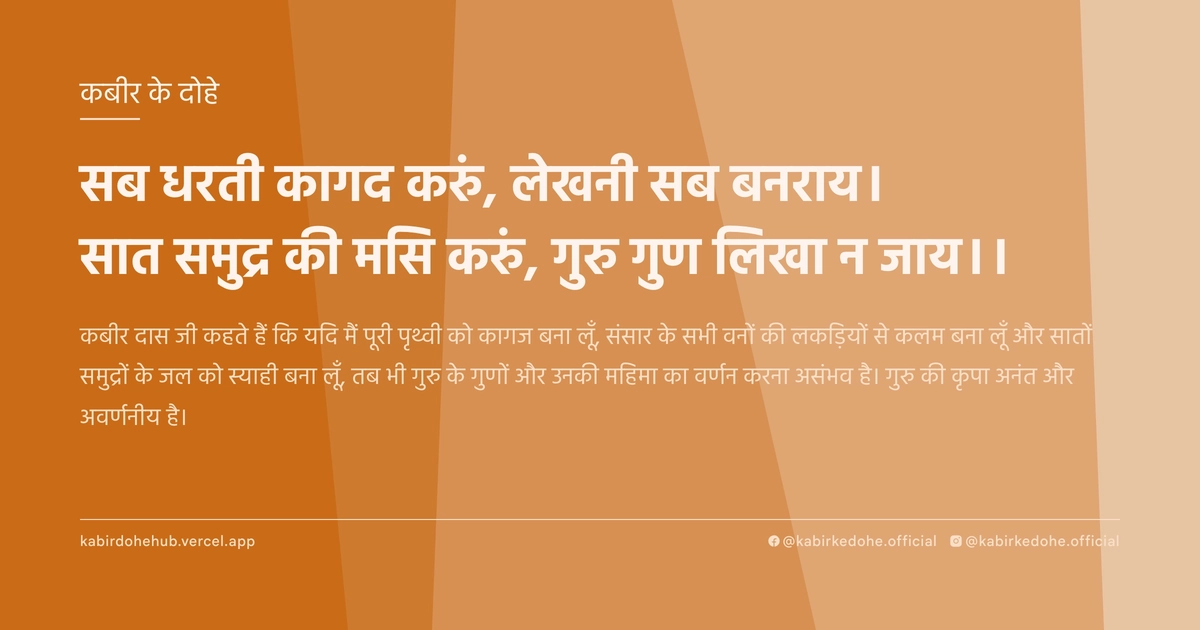
सब धरती कागद करुं, लेखनी सब बनराय।
सात समुद्र की मसि करुं, गुरु गुण लिखा न जाय।।
Sab dharti kagad karun, lekhani sab banray. Saat samudra ki masi karun, guru gun likha na jaaye.
इस पृष्ठ पर इस कबीर दोहे का अर्थ (meaning), हिंदी व्याख्या और अंग्रेज़ी अनुवाद, दार्शनिक विश्लेषण और व्यावहारिक जीवन सीख दी गई है। यह दोहा गुरु महत्व (The Guru's Importance) विषय से जुड़ा है — Kabir doha meaning and explanation in Hindi and English.
अर्थ (Meaning):
कबीर दास जी कहते हैं कि यदि मैं पूरी पृथ्वी को कागज बना लूँ, संसार के सभी वनों की लकड़ियों से कलम बना लूँ और सातों समुद्रों के जल को स्याही बना लूँ, तब भी गुरु के गुणों और उनकी महिमा का वर्णन करना असंभव है। गुरु की कृपा अनंत और अवर्णनीय है।
Kabir asserts that even if the entire earth were transformed into paper, every forest in the world into a writing quill, and the waters of the seven vast oceans into ink, the infinite virtues and spiritual grace of the Guru would still remain unwritten. The Guru's essence transcends all physical measurement.
व्याख्या (Interpretation):
यह दोहा गुरु की अपार महिमा का एक अतिशयोक्तिपूर्ण लेकिन गहरा आध्यात्मिक चित्रण है। शाब्दिक अर्थ में यह गुरु के प्रति समर्पण को दर्शाता है, परंतु प्रतीकात्मक रूप से 'गुरु' यहाँ केवल एक व्यक्ति नहीं, बल्कि उस 'तत्व' या 'चेतना' का प्रतीक है जो अज्ञान के अंधकार को मिटाता है। यह निर्गुण भक्ति की उस अवस्था को दर्शाता है जहाँ गुरु वह माध्यम है जो साधक को माया के भ्रम से निकालकर आत्मा और ब्रह्म की एकता (अद्वैत) का अनुभव कराता है। यहाँ 'लिखा न जाय' का अर्थ है कि सत्य अनुभव का विषय है, शब्दों का नहीं। जब साधक अपनी सीमित अहंकारमय पहचान को मिटाता है, तब उसे समझ आता है कि वह जिसे बाहर खोज रहा था, वह गुरु के मार्गदर्शन से उसके भीतर ही विद्यमान था। यह विरोधाभास है कि जिस सत्य को शब्दों में बांधने का प्रयास किया जा रहा है, वह स्वयं शब्दों से परे है।
This couplet employs a grand hyperbole to illustrate the immeasurable nature of the Guru's grace. Literally, it expresses profound gratitude, but metaphorically, the 'Guru' represents the awakening consciousness or the Divine Spark that dispels the darkness of ignorance. In the context of Nirgun Bhakti, the Guru is not merely a human teacher but the catalyst for the realization of the formless Absolute. The phrase "cannot be written" signifies that ultimate truth is an experiential reality, not a linguistic one. It highlights the central paradox: the Truth that liberates the soul is beyond the reach of conceptual thought and descriptive language. By linking the physical elements of earth, forest, and ocean to the act of writing, Kabir suggests that the entire material universe (Maya) is insufficient to encapsulate the spiritual magnitude of enlightenment. The Guru is the bridge between the finite ego and the infinite Brahman, and this transition is an alchemy that defies documentation.
दार्शनिक विश्लेषण (Philosophical Analysis):
कबीर का यह दृष्टिकोण उनके युग के धार्मिक पाखंडों और कर्मकांडों के विरुद्ध एक सशक्त प्रतिक्रिया था। उस समय धर्म केवल ग्रंथों और बाहरी अनुष्ठानों तक सीमित था, जबकि कबीर ने 'अनुभव' को सर्वोच्च प्रमाण माना। वे इस बात पर जोर देते हैं कि ईश्वर या सत्य किसी पुस्तक में नहीं, बल्कि जीवित गुरु के मार्गदर्शन और आंतरिक खोज में है। यह विचार अद्वैत वेदांत के करीब है, जहाँ जीव और ब्रह्म की एकता की बात की गई है। गुरु यहाँ वह 'प्रकाश' है जो माया के पर्दे को हटाता है।
सूफी मत के 'पीर' की अवधारणा के साथ इसका गहरा संबंध है, जहाँ मुर्शिद (गुरु) के बिना आध्यात्मिक यात्रा असंभव मानी जाती है। कबीर ने जाति, धर्म और सामाजिक स्तर की सीमाओं को तोड़कर प्रेम और ज्ञान को प्राथमिकता दी। उनके लिए गुरु वह नहीं जो केवल शास्त्र पढ़ाए, बल्कि वह है जो साधक के अहंकार का विनाश कर दे।
दार्शनिक रूप से, यह दोहा 'शब्द' और 'मौन' के बीच के संघर्ष को दर्शाता है। जब हम किसी चीज़ को लिखने या नाम देने की कोशिश करते हैं, तो हम उसे सीमित कर देते हैं। गुरु के गुण 'अनंत' हैं, और अनंत को सीमित शब्दों में नहीं बांधा जा सकता। यह मनोवैज्ञानिक रूपांतरण की प्रक्रिया है, जहाँ साधक अपनी बौद्धिक श्रेष्ठता का त्याग कर पूर्ण समर्पण (Surrender) की स्थिति में आता है।
कबीर यहाँ यह स्पष्ट करते हैं कि आध्यात्मिक ज्ञान कोई सूचना (Information) नहीं है जिसे कागज पर उतारा जा सके, बल्कि यह एक रूपांतरण (Transformation) है। जो व्यक्ति केवल ग्रंथों को पढ़कर स्वयं को ज्ञानी मानता है, वह वास्तव में माया के जाल में और अधिक उलझ जाता है। वास्तविक ज्ञान वह है जो व्यवहार में उतरे और हृदय को शुद्ध करे।
अंततः, यह दोहा हमें सिखाता है कि श्रद्धा और कृतज्ञता ही वे द्वार हैं जिनसे सत्य का अनुभव संभव है। जब अहंकार 'मैं' समाप्त होता है, तभी गुरु की कृपा का अनंत विस्तार महसूस होता है। यह केवल एक व्यक्ति की प्रशंसा नहीं, बल्कि उस दिव्य चेतना की वंदना है जो हर जीव के भीतर सोई हुई है और जिसे जगाने के लिए एक गुरु की आवश्यकता होती है।
Kabir's perspective serves as a potent critique of the religious hypocrisy and rigid ritualism prevalent during his era. While the orthodoxy of his time focused on the rote memorization of scriptures and outward ceremonies, Kabir championed 'Anubhava' (direct experience) as the ultimate authority. He posits that the Divine or the Truth is not contained within the pages of a book but is accessed through the guidance of a living Guru and rigorous internal inquiry. This aligns closely with Advaita Vedanta, which emphasizes the non-duality of the individual soul (Atman) and the universal consciousness (Brahman).
There is a profound intersection here with the Sufi concept of the 'Pir' or 'Murshid'. In Sufism, the spiritual guide is indispensable for navigating the perilous path toward annihilation of the self (Fana) and union with the Beloved. Kabir transcends the boundaries of caste and creed, suggesting that the Guru's grace is a universal solvent that dissolves the ego's rigid structures. For Kabir, the Guru is not a lecturer of theology but a mirror reflecting the seeker's own divine nature.
Philosophically, this doha explores the tension between the 'Word' and 'Silence'. The act of writing is an attempt to categorize and limit. By stating that the entire physical world is insufficient as a medium for description, Kabir asserts that the Truth is 'Anirvachaniya' (ineffable). Any attempt to capture the essence of the Guru in language is a reductionist exercise. This points to a psychological shift: moving from the intellectual accumulation of knowledge to the intuitive realization of Being.
Kabir clarifies that spiritual wisdom is not 'information' to be stored, but a 'transformation' to be lived. Those who mistake the map (scriptures) for the territory (truth) remain trapped in the illusion of Maya. True knowledge is that which manifests as compassion, humility, and the dissolution of the 'I-consciousness'. It is a movement from the head to the heart.
Ultimately, the poem teaches that faith and gratitude are the only portals to the Absolute. When the ego ceases its demand for definition and control, the infinite grace of the Guru becomes palpable. This is not mere flattery of a teacher, but a veneration of the cosmic consciousness that awakens the dormant divinity within every human being, reminding us that the bridge to the infinite is built with the bricks of surrender.
मूल संदेश (Core Message):
- शब्द सीमित हैं, जबकि सत्य अनंत और अवर्णनीय है।
- बौद्धिक अहंकार आध्यात्मिक जागृति के मार्ग में सबसे बड़ी बाधा है।
- गुरु केवल व्यक्ति नहीं, बल्कि वह चेतना है जो अज्ञान मिटाती है।
- सत्य को पढ़ा नहीं जा सकता, केवल अनुभव किया जा सकता है।
- पूर्ण समर्पण ही अनंत कृपा के द्वार खोलने की एकमात्र कुंजी है।
- Words are finite, while Truth is infinite and ineffable.
- Intellectual arrogance is the primary obstacle to spiritual awakening.
- The Guru is not just a person, but the consciousness that dissolves ignorance.
- Truth cannot be read; it can only be experienced through being.
- Absolute surrender is the only key to unlocking infinite grace.
व्यावहारिक उदाहरण (Practical Example):
वाराणसी के एक पुराने मोहल्ले में रामदीन नाम का एक वृद्ध बुनकर रहता था। वह अपनी कला में निपुण था, लेकिन उसका मन हमेशा अशांत रहता था। वह खुद को बहुत ज्ञानी मानता था क्योंकि उसने कई धार्मिक पुस्तकें पढ़ी थीं और वह शहर के बड़े विद्वानों के साथ शास्त्रार्थ करता था। वह अक्सर दूसरों को उनकी अज्ञानता का एहसास कराता और अपनी बौद्धिक श्रेष्ठता पर गर्व करता था।
एक दिन उसकी मुलाकात एक साधारण से दिखने वाले फकीर से हुई, जो शहर के किनारे एक पेड़ के नीचे बैठा रहता था। रामदीन ने अहंकारवश फकीर से एक कठिन आध्यात्मिक प्रश्न पूछा, यह सोचकर कि फकीर निरुत्तर हो जाएगा। फकीर ने मुस्कुराते हुए कोई उत्तर नहीं दिया, बल्कि रामदीन को अपने साथ एक नदी के किनारे चलने को कहा।
नदी के किनारे पहुँचकर फकीर ने रामदीन से कहा, "इस नदी के पानी को अपनी हथेली में पकड़कर दिखाओ।" रामदीन ने जैसे ही पानी पकड़ा, वह उसकी उंगलियों के बीच से बह गया। उसने बार-बार प्रयास किया, लेकिन पानी हर बार फिसल गया।
फकीर ने शांति से कहा, "यही तुम्हारी समस्या है। तुम सत्य को अपनी बुद्धि की हथेली में पकड़ना चाहते हो, जैसे तुम शब्दों को पकड़ते हो। लेकिन सत्य उस नदी की तरह है जो बह रही है। तुम जितना इसे शब्दों और तर्कों में बांधने की कोशिश करोगे, यह उतना ही तुमसे दूर फिसलता जाएगा।"
रामदीन को पहली बार महसूस हुआ कि उसकी सारी पुस्तकें और तर्क केवल कागज के टुकड़े थे। उसने महसूस किया कि वह जिसे 'ज्ञान' कह रहा था, वह वास्तव में उसका अहंकार था जो उसे सत्य से दूर रख रहा था। वह फकीर के चरणों में गिर पड़ा और अपनी सारी बौद्धिक अकड़ त्याग दी।
उस दिन के बाद रामदीन ने शास्त्रों को रटना छोड़ दिया और मौन का अभ्यास शुरू किया। उसने देखा कि जब वह चुप रहता है, तो उसे अपने आस-पास के लोगों में, पक्षियों की चहचहाहट में और अपने करघे की लय में वही 'गुरु तत्व' दिखाई देने लगा, जिसकी चर्चा उसने किताबों में पढ़ी थी।
उसका व्यवहार बदल गया। अब वह दूसरों को नीचा दिखाने के बजाय उनकी सेवा करने लगा। उसकी बुनाई में अब एक अलग ही शांति और प्रेम झलकने लगा था, जिसे देखकर लोग उसकी ओर आकर्षित होने लगे।
रामदीन ने समझ लिया कि गुरु वह नहीं है जो केवल उत्तर दे, बल्कि वह है जो सही प्रश्न पूछना सिखाए और अहंकार के पर्दे को हटा दे। उसने जान लिया कि गुरु की महिमा शब्दों में नहीं, बल्कि उस बदलाव में है जो वह एक इंसान के भीतर लाता है।
In an old neighborhood of Varanasi lived an elderly weaver named Ramdeen. He was a master of his craft, yet his mind was perpetually restless. He considered himself highly learned because he had read numerous religious texts and frequently engaged in scholarly debates with the city's prominent pundits. He often took pride in pointing out the ignorance of others, fueling his own intellectual superiority.
One day, he encountered a simple-looking fakir who resided under a tree on the outskirts of the city. Driven by ego, Ramdeen asked the fakir a complex spiritual question, expecting the man to be stumped. The fakir merely smiled and, instead of answering, invited Ramdeen to walk with him to the banks of the Ganges.
Upon reaching the river, the fakir asked Ramdeen, "Try to hold this river water in the palm of your hand." Ramdeen tried, but the water immediately leaked through his fingers. He attempted it again and again, but the water slipped away every single time.
The fakir spoke softly, "This is your struggle. You are trying to capture Truth in the palm of your intellect, just as you try to capture it with words. But Truth is like this river—it flows. The more you attempt to bind it with logic and definitions, the further it slips away from you."
For the first time, Ramdeen realized that all his books and arguments were merely scraps of paper. He understood that what he had termed 'knowledge' was actually his ego, acting as a barrier between him and the Truth. Overwhelmed, he fell at the fakir's feet, shedding his intellectual arrogance.
From that day forward, Ramdeen stopped memorizing scriptures and began the practice of silence. He discovered that in the stillness, he could perceive the 'Guru element' in the people around him, the chirping of birds, and the rhythmic clatter of his loom—the very essence he had sought in books.
His behavior transformed. Instead of belittling others, he began to serve them. A new sense of peace and love began to radiate from his weaving, attracting people not to his knowledge, but to his presence.
Ramirdeen realized that a true Guru is not one who provides all the answers, but one who teaches the seeker how to ask the right questions and removes the veil of ego. He understood that the Guru's greatness is not found in words, but in the profound transformation they ignite within a human soul.
अभ्यास मार्गदर्शन (Practice Guidance):
- प्रतिदिन 20 मिनट 'मौन' का अभ्यास करें, जहाँ आप किसी भी विचार को नाम देने या परिभाषित करने की कोशिश न करें।
- एक डायरी लिखें जिसमें आप उन क्षणों को दर्ज करें जब आपका अहंकार (Intellectual Ego) आपको दूसरों से श्रेष्ठ महसूस कराता है, और फिर विचार करें कि यह आपको सत्य से कैसे दूर ले जा रहा है।
- किसी ऐसे व्यक्ति की सेवा करें जिसे आप 'अज्ञानी' समझते हैं, और यह खोजने का प्रयास करें कि उनमें कौन सा दिव्य गुण है जिसे आप नहीं देख पा रहे हैं।
- निदान चेकलिस्ट: क्या मैं अभी भी सत्य को केवल तर्कों में खोज रहा हूँ? क्या मेरी श्रद्धा केवल शब्दों तक सीमित है? क्या मैं गुरु के उपदेशों को जीवन में उतारने के बजाय केवल चर्चा कर रहा हूँ?
- Practice 20 minutes of 'Pure Silence' daily, where you consciously avoid naming or defining any thought that arises.
- Maintain a journal to record moments when your intellectual ego makes you feel superior to others, and reflect on how this bias obstructs your spiritual growth.
- Perform a selfless act of service for someone you perceive as 'unlearned,' and actively seek the divine quality within them that you have previously overlooked.
- Diagnostic Checklist: Am I still seeking Truth solely through logic? Is my faith limited to linguistic understanding? Am I discussing the Guru's teachings more than I am embodying them in my actions?
चिंतन प्रश्न (Reflection Questions):
- मेरी वह कौन सी 'मानसिक किताब' है जिसे मैं कभी बंद नहीं करता और जो मुझे दूसरों को जज करने पर मजबूर करती है?
- यदि मेरी सारी डिग्रियां और ज्ञान छीन लिए जाएं, तो मेरी वास्तविक पहचान क्या रह जाएगी?
- क्या मैं वास्तव में सत्य की खोज कर रहा हूँ, या मैं केवल अपनी सही होने की इच्छा (Need to be right) की पुष्टि कर रहा हूँ?
- मेरे जीवन में 'गुरु तत्व' कहाँ है—क्या वह मेरे अहंकार की प्रशंसा करता है या उसे चुनौती देता है?
- मैं अपनी डिजिटल पहचान (Social Media Ego) के माध्यम से कितना ज्ञान प्रदर्शित करता हूँ और वास्तव में कितना जीता हूँ?
- What is the 'mental book' I refuse to close, which compels me to judge others constantly?
- If all my degrees and accumulated knowledge were stripped away, what would remain of my identity?
- Am I truly seeking the Truth, or am I merely seeking validation for my need to be right?
- Where does the 'Guru element' exist in my life—does it flatter my ego or relentlessly challenge it?
- How much of my 'knowledge' is a performance for my digital ego, and how much of it is an integrated part of my living truth?