
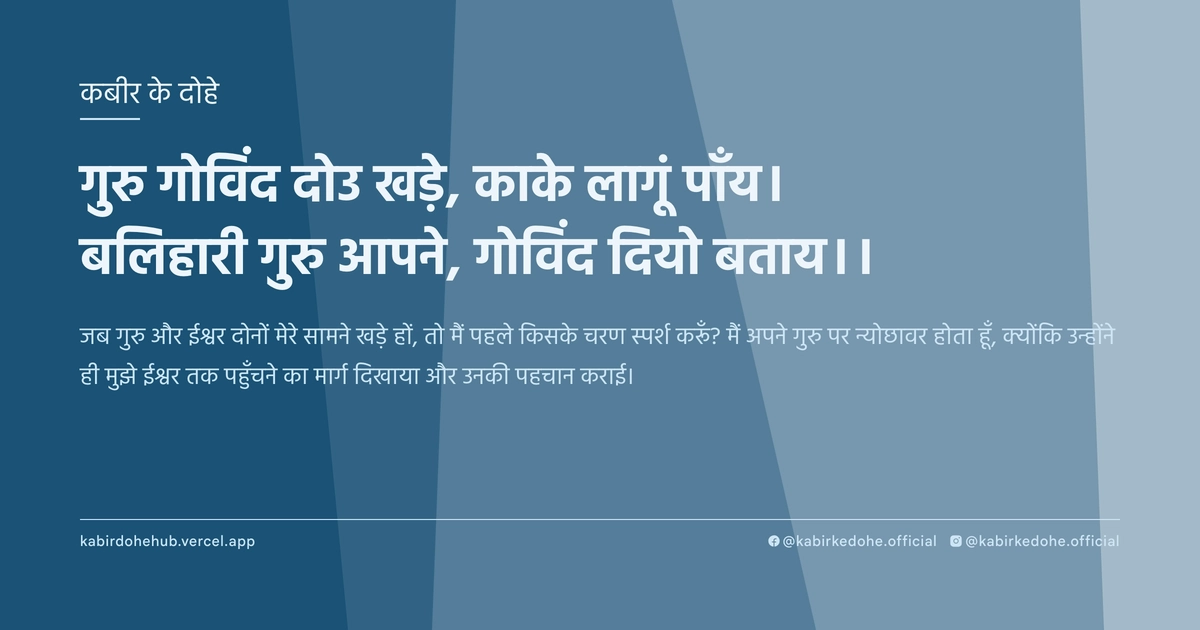
गुरु गोविंद दोउ खड़े, काके लागूं पाँय।
बलिहारी गुरु आपने, गोविंद दियो बताय।।
Guru Govind dou khade, kaake laagun paany. Balihari guru aapne, Govind diyo batay.
इस पृष्ठ पर इस कबीर दोहे का अर्थ (meaning), हिंदी व्याख्या और अंग्रेज़ी अनुवाद, दार्शनिक विश्लेषण और व्यावहारिक जीवन सीख दी गई है। यह दोहा गुरु महत्व (The Guru's Importance) विषय से जुड़ा है — Kabir doha meaning and explanation in Hindi and English.
अर्थ (Meaning):
जब गुरु और ईश्वर दोनों मेरे सामने खड़े हों, तो मैं पहले किसके चरण स्पर्श करूँ? मैं अपने गुरु पर न्योछावर होता हूँ, क्योंकि उन्होंने ही मुझे ईश्वर तक पहुँचने का मार्ग दिखाया और उनकी पहचान कराई।
When both the spiritual teacher and the Divine stand before me, whose feet should I bow to first? I offer myself entirely to the Guru, for it is through the Guru's grace and guidance that I was able to recognize and reach the Divine.
व्याख्या (Interpretation):
यह दोहा एक आध्यात्मिक विरोधाभास प्रस्तुत करता है जहाँ शिष्य को दो सर्वोच्च सत्ताओं के बीच चयन करना है। शाब्दिक अर्थ में यह गुरु की श्रेष्ठता को दर्शाता है, लेकिन सूक्ष्म स्तर पर यह 'साधन' और 'साध्य' के संबंध को स्पष्ट करता है। गुरु वह माध्यम (साधन) है जिसके बिना साध्य (ईश्वर) की प्राप्ति असंभव है। निर्गुण भक्ति के संदर्भ में, गुरु केवल एक व्यक्ति नहीं बल्कि वह 'ज्ञान-प्रकाश' है जो माया के पर्दे को हटाता है। यह अद्वैत वेदांत के उस सिद्धांत को पुष्ट करता है कि जब तक अहंकार और अज्ञान का अंधकार है, तब तक ब्रह्म की अनुभूति नहीं हो सकती। गुरु उस अंधकार को मिटाकर आत्मा और परमात्मा की एकता का बोध कराते हैं।
This couplet presents a spiritual paradox where the disciple must choose between two supreme entities. While literally emphasizing the Guru's superiority, it metaphorically explores the relationship between the 'Means' (Sadhana) and the 'End' (Sadhya). The Guru is the catalyst; without the bridge, the destination remains unreachable. In the context of Nirgun Bhakti, the Guru is not merely a physical person but the 'Illuminating Consciousness' that pierces the veil of Maya. This aligns with Advaita Vedanta, suggesting that as long as the darkness of ego and ignorance persists, the realization of Brahman is impossible. The Guru annihilates this ignorance, revealing the non-duality of the Atman and the Universal Soul.
दार्शनिक विश्लेषण (Philosophical Analysis):
कबीर का यह दोहा मध्यकालीन भारत के उस सामाजिक-धार्मिक परिवेश में रचा गया जहाँ कर्मकांड और बाहरी आडंबर चरम पर थे। कबीर ने मंदिर, मस्जिद और जातिगत श्रेष्ठता के बजाय 'अनुभव' और 'मार्गदर्शन' को प्राथमिकता दी। यहाँ गुरु की महत्ता इस बात में नहीं है कि वह कोई चमत्कार करता है, बल्कि इस बात में है कि वह शिष्य की दृष्टि बदल देता है।
दार्शनिक रूप से, यह सूफीवाद के 'मुर्शिद' (मार्गदर्शक) की अवधारणा से मेल खाता है, जहाँ बिना एक आध्यात्मिक गुरु के, सत्य की खोज में भटकने की संभावना अधिक होती है। कबीर यहाँ यह स्पष्ट करते हैं कि ईश्वर (गोविंद) सर्वव्यापी है, लेकिन उस सर्वव्यापकता को पहचानने की क्षमता केवल गुरु के ज्ञान से आती है।
अद्वैत वेदांत के अनुसार, हम पहले से ही ईश्वर हैं, लेकिन हम इसे भूल चुके हैं। गुरु वह दर्पण है जो हमें हमारा असली चेहरा दिखाता है। यदि गोविंद वह गंतव्य है, तो गुरु वह मानचित्र है। बिना मानचित्र के, गंतव्य का अस्तित्व होने के बावजूद यात्री वहां नहीं पहुँच सकता।
यह दोहा ritualism (कर्मकांड) पर एक गहरा प्रहार है। यह बताता है कि ईश्वर की पूजा से अधिक महत्वपूर्ण उस ज्ञान की प्राप्ति है जो पूजा के वास्तविक अर्थ को समझा सके। यह 'अहं' के विसर्जन की प्रक्रिया है, जहाँ शिष्य अपनी पूरी सत्ता गुरु के चरणों में समर्पित कर देता है ताकि वह स्वयं को मिटाकर ईश्वर में विलीन हो सके।
अंततः, कबीर यह संदेश देते हैं कि ज्ञान का स्रोत मानवीय है, लेकिन उसका लक्ष्य दैवीय है। गुरु और गोविंद के बीच का यह चुनाव वास्तव में 'अज्ञान' और 'बोध' के बीच का चुनाव है। जब बोध प्राप्त होता है, तब यह समझ आता है कि गुरु और गोविंद वास्तव में एक ही चेतना के दो अलग-अलग रूप हैं।
Kabir composed this verse during a medieval Indian era dominated by rigid ritualism and caste hierarchies. He prioritized direct experience and guidance over the sterile performance of religious rites. The Guru's significance here is not rooted in miraculous powers, but in the ability to shift the disciple's perception of reality.
Philosophically, this mirrors the Sufi concept of the 'Murshid' (spiritual guide), asserting that without a guide, the seeker is likely to wander aimlessly in the labyrinth of the mind. Kabir clarifies that while Govind (the Divine) is omnipresent, the capacity to perceive this omnipresence is unlocked only through the Guru's wisdom.
According to Advaita Vedanta, we are already the Divine, yet we suffer from spiritual amnesia. The Guru serves as the mirror reflecting our true nature. If Govind is the destination, the Guru is the map. Despite the destination's existence, the traveler remains lost without the map.
This couplet is a subtle critique of ritualism. It suggests that the pursuit of knowledge regarding the nature of the Divine is more vital than the mechanical act of worship. It describes the process of 'ego-annihilation,' where the disciple surrenders their identity to the Guru to eventually merge with the Absolute.
Ultimately, Kabir teaches that while the source of knowledge is human, its objective is divine. The choice between Guru and Govind is actually a choice between ignorance and awakening. Once awakened, the seeker realizes that the Guru and the Divine are merely two manifestations of the same singular Consciousness.
मूल संदेश (Core Message):
- अहंकार वह पर्दा है जो ईश्वर और मनुष्य के बीच खड़ा है।
- सही मार्गदर्शन के बिना आध्यात्मिक प्रयास दिशाहीन भटकन मात्र हैं।
- गुरु केवल व्यक्ति नहीं, बल्कि सत्य की ओर ले जाने वाली एक ऊर्जा है।
- साध्य (ईश्वर) की प्राप्ति के लिए साधन (गुरु) का सम्मान अनिवार्य है।
- वास्तविक भक्ति कर्मकांडों में नहीं, बल्कि आंतरिक रूपांतरण में है।
- The ego is the only veil separating the human from the Divine.
- Spiritual efforts without proper guidance are merely directionless wanderings.
- The Guru is not just a person, but an energy leading toward Truth.
- Respect for the Means (Guru) is essential to reach the End (Divine).
- True devotion lies not in rituals, but in internal transformation.
व्यावहारिक उदाहरण (Practical Example):
एक समय की बात है, वाराणसी के घाटों पर माधव नाम का एक वृद्ध बुनकर रहता था। माधव जीवन भर ईमानदारी से कपड़े बुनता रहा, लेकिन उसके मन में हमेशा एक बेचैनी रहती थी कि वह ईश्वर को कैसे पा सकता है। वह घंटों मंदिर की सीढ़ियों पर बैठा रहता, मंत्र पढ़ता और उपवास करता, पर उसे शांति नहीं मिलती थी।
एक दिन उसकी मुलाकात एक फकीर से हुई, जो शहर के किनारे एक छोटी सी कुटिया में रहता था। फकीर ने माधव के माथे पर छाई चिंता को देखा और उससे पूछा, "तुम क्या खोज रहे हो?"
माधव ने कहा, "मैं गोविंद को खोजना चाहता हूँ, पर मुझे रास्ता नहीं पता। मैंने सारे शास्त्र पढ़े, सारे व्रत किए, फिर भी वह मुझसे दूर हैं।"
फकीर मुस्कुराया और बोला, "तुम बाहर देख रहे हो, जबकि वह तुम्हारे भीतर ही है। तुम जिस चाबी को पूरी दुनिया में ढूंढ रहे हो, वह तुम्हारे अपने ही हाथ में है, बस तुमने उसे पकड़ना नहीं सीखा।"
अगले कुछ महीनों तक, फकीर ने माधव को कोई मंत्र नहीं दिया, बल्कि उसे सिखाया कि कैसे अपने काम (बुनाई) के दौरान अपनी सांसों और विचारों का अवलोकन किया जाए। फकीर ने उसे बताया कि हर धागा जो वह बुनता है, वह ईश्वर की ही एक अभिव्यक्ति है।
धीरे-धीरे माधव का नजरिया बदलने लगा। अब वह मंदिर जाने के लिए नहीं तड़पता था, बल्कि अपनी करघे की आवाज़ में ही ईश्वर का संगीत सुनने लगा। उसे समझ आया कि ईश्वर कहीं बाहर नहीं, बल्कि वर्तमान क्षण की पूर्ण जागरूकता में है।
एक दिन माधव ने महसूस किया कि वह फकीर के बिना कभी इस सत्य तक नहीं पहुँच पाता। उसने सोचा कि यदि वह केवल मंदिर जाता रहता, तो वह केवल एक मूर्ति को पूजता, लेकिन फकीर ने उसे उस 'चेतना' से मिलवाया जो मूर्ति और मूर्तिकार दोनों में है।
माधव की आँखों में आँसू आ गए। उसने महसूस किया कि फकीर (गुरु) ने उसे वह दृष्टि दी जिससे वह गोविंद (ईश्वर) को देख सका।
अब माधव केवल कपड़े नहीं बुनता था, वह प्रेम और शांति बुनता था। उसके व्यवहार में एक ऐसी विनम्रता आ गई कि पूरा गाँव उसकी ओर आकर्षित होने लगा।
उसने जान लिया कि गुरु वह पुल है जो हमें इस पार (अज्ञान) से उस पार (मोक्ष) ले जाता है, और उस पुल का सम्मान करना ही वास्तव में ईश्वर का सम्मान करना है।
Once, in the ghats of Varanasi, lived an elderly weaver named Madhav. Madhav had spent his life weaving cloth with honesty, yet a persistent restlessness plagued him regarding how to find God. He spent hours on temple steps, chanting mantras and fasting, but peace remained elusive.
One day, he encountered a Fakir living in a small hut on the outskirts of the city. The Fakir noticed the anxiety etched on Madhav's brow and asked, "What is it that you seek?"
Madhav replied, "I wish to find Govind, but I do not know the way. I have read the scriptures and kept the fasts, yet He remains distant."
The Fakir smiled and said, "You are looking outward, while He resides within. The key you seek in the world is already in your hand; you simply haven't learned how to turn it."
For the next few months, the Fakir gave Madhav no mantras. Instead, he taught him to observe his breath and thoughts while weaving. He explained that every thread Madhav wove was an expression of the Divine.
Slowly, Madhav's perspective shifted. He no longer craved the temple; instead, he began to hear the music of God in the rhythmic clatter of his loom. He realized that God was not in a distant heaven, but in the absolute awareness of the present moment.
One day, Madhav realized that without the Fakir, he would never have reached this truth. He reflected that had he continued only with temple visits, he would have worshipped a stone, but the Fakir introduced him to the Consciousness that exists in both the stone and the sculptor.
Tears welled in Madhav's eyes. He understood that the Fakir (the Guru) provided the vision through which he could perceive Govind (the Divine).
From then on, Madhav did not just weave cloth; he wove love and peace. A profound humility entered his demeanor, drawing the entire village toward him.
He learned that the Guru is the bridge leading from this shore of ignorance to the shore of liberation, and honoring that bridge is the truest way of honoring the Divine.
अभ्यास मार्गदर्शन (Practice Guidance):
- प्रतिदिन 15 मिनट मौन बैठें और विचार करें कि आपके जीवन में वह कौन सा व्यक्ति या अनुभव था जिसने आपकी चेतना को जगाया।
- एक 'कृतज्ञता पत्रिका' (Gratitude Journal) बनाएँ, जिसमें केवल उन सीखों को लिखें जिन्होंने आपको आपके अहंकार से ऊपर उठने में मदद की।
- व्यवहार परिवर्तन: जब भी आप किसी से बहस करें, रुककर सोचें कि क्या आपका 'अहं' बोल रहा है या आपका 'बोध'।
- डायग्नोस्टिक चेकलिस्ट: क्या आप अभी भी बाहरी प्रतीकों (कपड़े, पद, अनुष्ठान) में शांति ढूंढ रहे हैं? यदि हाँ, तो आप अभी भी 'साधन' और 'साध्य' के भ्रम में हैं।
- Sit in silence for 15 minutes daily and contemplate the person or experience that first awakened your consciousness.
- Maintain a 'Gratitude Journal' specifically for the lessons that helped you transcend your ego and see a higher truth.
- Behavioral Shift: During conflicts, pause and ask yourself: "Is it my ego speaking, or is it my awareness?"
- Diagnostic Checklist: Are you still seeking peace in external symbols (status, attire, rituals)? If yes, you are still trapped in the illusion of the 'Means' rather than the 'End'.
चिंतन प्रश्न (Reflection Questions):
- क्या मैं अपने गुरु या मार्गदर्शक को केवल एक व्यक्ति के रूप में देखता हूँ, या उस ज्ञान के रूप में जो मेरे भीतर है?
- मेरे जीवन में 'गोविंद' (लक्ष्य) क्या है, और क्या मैं उस लक्ष्य के पीछे भागने में इतने अंधे हो गया हूँ कि मैंने मार्गदर्शक को अनदेखा कर दिया?
- मैं अपनी डिजिटल पहचान (सोशल मीडिया ईगो) को कितना महत्व देता हूँ, और यह मेरी वास्तविक आध्यात्मिक खोज में कैसे बाधा डाल रहा है?
- यदि आज मेरे पास कोई बाहरी धार्मिक पहचान न हो, तो क्या मैं स्वयं को ईश्वर के करीब महसूस करूँगा?
- क्या मैं सत्य को स्वीकार करने के लिए तैयार हूँ, भले ही वह मेरी स्थापित मान्यताओं को पूरी तरह नष्ट कर दे?
- Do I perceive my guide as a mere human, or as the embodiment of the knowledge residing within me?
- What is the 'Govind' (ultimate goal) in my life, and have I become so obsessed with the destination that I ignore the guide?
- How much weight do I give to my digital identity (social media ego), and how does this obstruct my authentic spiritual quest?
- If I were stripped of all external religious identities, would I still feel a connection to the Divine?
- Am I truly prepared to accept a truth that completely annihilates my long-held beliefs?