
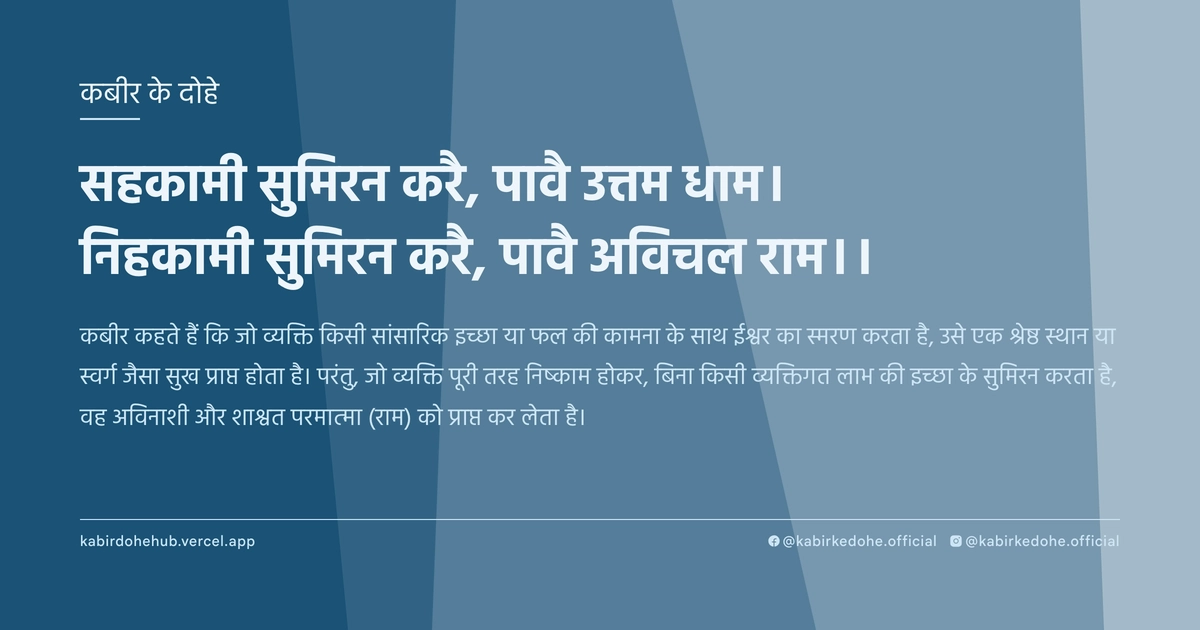
सहकामी सुमिरन करै, पावै उत्तम धाम।
निहकामी सुमिरन करै, पावै अविचल राम।।
Sahkami sumiran karai, pavai uttam dhaam. Nihkami sumiran karai, pavai avichal ram.
इस पृष्ठ पर इस कबीर दोहे का अर्थ (meaning), हिंदी व्याख्या और अंग्रेज़ी अनुवाद, दार्शनिक विश्लेषण और व्यावहारिक जीवन सीख दी गई है। यह दोहा भक्ति (Bhakti) विषय से जुड़ा है — Kabir doha meaning and explanation in Hindi and English.
अर्थ (Meaning):
कबीर कहते हैं कि जो व्यक्ति किसी सांसारिक इच्छा या फल की कामना के साथ ईश्वर का स्मरण करता है, उसे एक श्रेष्ठ स्थान या स्वर्ग जैसा सुख प्राप्त होता है। परंतु, जो व्यक्ति पूरी तरह निष्काम होकर, बिना किसी व्यक्तिगत लाभ की इच्छा के सुमिरन करता है, वह अविनाशी और शाश्वत परमात्मा (राम) को प्राप्त कर लेता है।
Kabir explains that one who remembers the Divine with a desire for specific rewards or worldly gains attains a superior realm or heavenly pleasure. However, the one who practices remembrance without any desire, devoid of all selfish expectations, attains the Eternal and Unchanging Divine Reality, the timeless Ram.
व्याख्या (Interpretation):
इस दोहे का शाब्दिक अर्थ है कि कामनापूर्ण भक्ति और निष्काम भक्ति के परिणाम अलग होते हैं। यहाँ 'सहकामी' वह है जिसकी भक्ति के पीछे कोई गुप्त एजेंडा या भौतिक लाभ है, जबकि 'निष्कामी' वह है जिसने अपनी अहंकारपूर्ण इच्छाओं का विसर्जन कर दिया है। यह निरगुण भक्ति का सार है, जहाँ ईश्वर कोई बाहरी व्यक्ति नहीं बल्कि अंतरात्मा का सत्य है। माया हमें यह विश्वास दिलाती है कि हम ईश्वर को 'लेन-देन' के माध्यम से पा सकते हैं, लेकिन अद्वैत वेदांत के अनुसार, जब तक 'मैं' (अहंकार) मौजूद है, तब तक पूर्ण मिलन संभव नहीं है। यह विरोधाभास है कि हम ईश्वर को पाने की इच्छा रखते हैं, जबकि ईश्वर को पाने की एकमात्र शर्त इच्छा का अभाव है। अंततः, अविचल राम वह अवस्था है जहाँ साधक और साध्य एक हो जाते हैं।
The literal meaning distinguishes between devotion driven by desire and devotion devoid of it. 'Sahkaami' refers to the seeker whose spirituality is a means to an end—be it heaven, power, or peace—whereas 'Nishkaami' is the one who has dissolved the ego's demands. This is the essence of Nirgun Bhakti, where the Divine is not an external entity to be bargained with, but the immanent Truth within. Maya tricks the mind into believing that the Divine can be acquired through a transactional relationship. According to Advaita Vedanta, as long as the 'I' (the ego) persists, total union is impossible. The central paradox lies in the fact that the desire to attain God is itself an obstacle; only when the desire for attainment vanishes does the Eternal Ram reveal Himself. Ultimately, 'Avichal Ram' represents the state of non-duality where the seeker and the sought merge into one.
दार्शनिक विश्लेषण (Philosophical Analysis):
कबीर का यह दोहा मध्यकालीन भारत के उस सामाजिक-धार्मिक परिवेश में रचा गया था जहाँ कर्मकांड और बाहरी आडंबरों का बोलबाला था। उस समय लोग मोक्ष या स्वर्ग पाने के लिए विशिष्ट अनुष्ठानों का सहारा लेते थे, जिसे कबीर ने 'व्यापारिक भक्ति' माना। उन्होंने स्पष्ट किया कि यदि भक्ति का उद्देश्य कोई पुरस्कार है, तो वह केवल मानसिक संतुष्टि या अस्थायी सुख (उत्तम धाम) तक सीमित रहेगी।
दार्शनिक स्तर पर, यह विचार निष्काम कर्मयोग के सिद्धांत से मेल खाता है, जैसा कि भगवद गीता में वर्णित है। कबीर यहाँ सूफी मत के 'फना' (अहंकार का विनाश) की अवधारणा को भी जोड़ते हैं। जब तक साधक के भीतर 'पाने' की तृष्णा है, वह द्वैत में जीता है। निष्कामता का अर्थ निष्क्रियता नहीं, बल्कि कर्म करते हुए फल से विरक्ति है।
अद्वैत वेदांत के परिप्रेक्ष्य में, 'अविचल राम' वह शुद्ध चेतना (Brahman) है जो समय और स्थान से परे है। सहकामी व्यक्ति माया के प्रभाव में होता है, जो उसे यह विश्वास दिलाता है कि वह अपनी इच्छाओं के माध्यम से ईश्वर को नियंत्रित कर सकता है। यह एक मनोवैज्ञानिक भ्रम है जहाँ व्यक्ति ईश्वर की पूजा नहीं, बल्कि अपनी इच्छाओं की पूजा करता है।
कबीर जाति और धर्म के बंधनों को तोड़ते हुए यह संदेश देते हैं कि परमात्मा की प्राप्ति किसी विशेष कुल या विधि से नहीं, बल्कि हृदय की शुद्धि और इच्छाओं के त्याग से होती है। यह एक क्रांतिकारी विचार था जिसने भक्ति आंदोलन को लोकतांत्रिक बनाया और इसे महलों से निकालकर झोपड़ियों तक पहुँचाया।
अंततः, यह विश्लेषण हमें सिखाता है कि आध्यात्मिक प्रगति का पैमाना यह नहीं है कि हमने कितनी मालाएँ जपीं, बल्कि यह है कि हमारे भीतर से 'स्वार्थ' कितना कम हुआ। जब 'मैं' मिटता है, तभी 'वह' प्रकट होता है। यही वह बिंदु है जहाँ व्यक्तिगत आत्मा (Atman) सार्वभौमिक आत्मा (Brahman) में विलीन हो जाती है।
This couplet was composed during a medieval Indian era dominated by rigid ritualism and external displays of piety. People often engaged in specific rituals to secure a place in heaven or attain salvation, a practice Kabir viewed as 'transactional devotion.' He asserts that if the motive behind devotion is a reward, the result will be limited to temporary psychological satisfaction or a celestial realm (Uttam Dhaam), rather than ultimate liberation.
Philosophically, this aligns with the principle of Nishkama Karma (desireless action) as detailed in the Bhagavad Gita. Kabir also integrates the Sufi concept of 'Fana'—the annihilation of the ego. As long as the seeker harbors a thirst for 'attainment,' they remain trapped in duality. Desirelessness does not imply inaction, but rather action performed without attachment to the fruit.
From the lens of Advaita Vedanta, 'Avichal Ram' is the Pure Consciousness (Brahman) that transcends time and space. The 'Sahkaami' seeker is under the spell of Maya, believing they can manipulate the Divine through their desires. This is a psychological delusion where the individual is not actually worshipping God, but is instead worshipping their own desires projected onto a deity.
By rejecting caste and sectarian boundaries, Kabir emphasizes that the realization of the Divine is not achieved through lineage or specific methods, but through the purification of the heart and the surrender of desire. This was a revolutionary shift that democratized the Bhakti movement, moving spirituality from the ivory towers of the priesthood to the humble huts of the common folk.
Ultimately, this analysis teaches us that the metric of spiritual progress is not the number of beads counted on a rosary, but the extent to which 'selfishness' has diminished. When the 'I' vanishes, the 'All' appears. This is the precise moment where the individual soul (Atman) merges into the Universal Soul (Brahman).
मूल संदेश (Core Message):
- इच्छाओं के साथ की गई भक्ति केवल अस्थायी सुख देती है।
- निस्वार्थ समर्पण ही परमात्मा से मिलन का एकमात्र द्वार है।
- अहंकार का विसर्जन ही वास्तविक आध्यात्मिक उपलब्धि है।
- ईश्वर कोई वस्तु नहीं जिसे माँगकर पाया जाए, वह एक अनुभव है।
- जब 'मैं' मिटता है, तब 'अविचल राम' का साक्षात्कार होता है।
- Devotion coupled with desire yields only temporary rewards.
- Selfless surrender is the only gateway to the Divine.
- The dissolution of the ego is the ultimate spiritual achievement.
- God is not an object to be acquired, but an experience to be realized.
- When the 'I' vanishes, the 'Unchanging Ram' is revealed.
व्यावहारिक उदाहरण (Practical Example):
वाराणसी के एक पुराने घाट पर माधव नाम का एक वृद्ध नाविक रहता था। माधव का जीवन केवल नाव चलाने और यात्रियों को पार लगाने तक सीमित था। वह हर दिन गंगा किनारे एक छोटे से मंदिर में जाता और भगवान से प्रार्थना करता कि उसे अधिक ग्राहक मिलें और उसका जीवन आरामदायक हो जाए। वह घंटों पूजा करता, उपवास रखता और दान देता, लेकिन उसका मन हमेशा इस बात में लगा रहता कि उसे बदले में क्या मिलेगा। वह एक 'सहकामी' था, जो भक्ति को एक सौदे की तरह देख रहा था।
समय बीता, और एक बार भीषण बाढ़ आई। माधव की नाव बह गई और उसका छोटा सा घर ढह गया। वह सड़क पर आ गया। पहले तो वह बहुत विलाप किया और ईश्वर पर क्रोधित हुआ कि उसकी इतनी पूजा के बाद भी ऐसा क्यों हुआ। लेकिन इस संकट ने उसके भीतर के अहंकार को तोड़ दिया। उसने महसूस किया कि उसकी अब तक की सारी प्रार्थनाएँ केवल उसकी अपनी इच्छाओं की पूर्ति के लिए थीं।
एक दिन, भूख और थकान से चूर, वह घाट की सीढ़ियों पर बैठा था। उसने देखा कि एक अन्य नाविक, जो उससे भी अधिक गरीब था, अपनी आखिरी रोटी एक भूखे कुत्ते को खिला रहा था। उस क्षण माधव के भीतर कुछ बदल गया। उसने महसूस किया कि असली शांति माँगने में नहीं, बल्कि समर्पित होने में है। उसने अपनी सारी शिकायतें छोड़ दीं और बस मौन रहकर उस अनंत चेतना का स्मरण करने लगा।
अब माधव की प्रार्थना बदल गई थी। वह अब यह नहीं माँगता था कि उसे अधिक पैसे मिलें या उसकी नाव वापस आ जाए। वह बस यह कहता, "हे राम, मैं जो भी हूँ, जैसा भी हूँ, आपका हूँ। मेरी इच्छाएँ मुझे आपसे दूर करती हैं, इसलिए मैं अपनी इच्छाओं को ही आपको समर्पित करता हूँ।"
उसने फिर से एक छोटी सी नाव किराए पर ली और काम करना शुरू किया। लेकिन अब उसके काम करने का तरीका बदल गया था। वह यात्रियों को केवल पैसे के लिए नहीं, बल्कि सेवा भाव से ले जाता। वह अक्सर अपनी कमाई का एक हिस्सा चुपचाप दूसरों की मदद में लगा देता, बिना यह सोचे कि लोग उसकी तारीफ करेंगे या नहीं।
शहर के लोग हैरान थे कि सब कुछ खोने के बाद भी माधव के चेहरे पर एक ऐसी शांति और चमक थी जो पहले कभी नहीं देखी गई थी। वह अब तनावमुक्त था क्योंकि उसने 'परिणाम' की चिंता छोड़ दी थी। वह अब एक 'निष्कामी' बन चुका था।
एक बार एक धनी व्यापारी ने उससे पूछा, "तुम्हारे पास अब कुछ नहीं है, फिर भी तुम इतने खुश कैसे हो?"
माधव ने मुस्कुराकर जवाब दिया, "पहले मैं भगवान से अपनी इच्छाएँ पूरी करने की माँग करता था, तब मैं उनके गुलाम था। अब मैं अपनी इच्छाओं को भगवान में विलीन कर चुका हूँ, अब मैं वास्तव में स्वतंत्र हूँ।"
माधव की यह यात्रा दिखाती है कि जब हम ईश्वर को एक 'साधन' के रूप में देखना बंद कर देते हैं और उन्हें ही 'साध्य' मान लेते हैं, तब हम उस अविचल राम को प्राप्त करते हैं जो बाहरी परिस्थितियों से अप्रभावित रहता है।
On an ancient ghat in Varanasi lived an elderly boatman named Madhav. Madhav's life revolved around rowing his boat and ferrying pilgrims across the river. Every day, he visited a small temple by the Ganges and prayed for more customers and a more comfortable life. He spent hours in prayer, fasted, and gave alms, but his mind was always preoccupied with what he would receive in return. He was a 'Sahkaami,' viewing devotion as a business transaction.
Time passed, and a devastating flood struck the city. Madhav's boat was swept away, and his modest hut collapsed. He found himself destitute. Initially, he wailed in grief and raged against the Divine, questioning why this happened despite his rigorous piety. However, this crisis shattered his ego.
He realized that all his previous prayers were merely attempts to satisfy his own desires. One day, exhausted and hungry, he sat on the stone steps of the ghat. He noticed another boatman, even poorer than himself, sharing his last piece of bread with a stray dog. In that moment, something shifted within Madhav. He understood that true peace lay not in asking, but in surrendering.
Madhav ceased all complaints and began to remember the Infinite Consciousness in absolute silence. His prayers transformed. He no longer asked for more money or the return of his boat. Instead, he whispered, "O Ram, whatever I am, however I am, I belong to You. My desires separate me from You; therefore, I surrender my desires to You."
He eventually rented a small boat and resumed his work, but his approach had changed. He no longer ferried passengers merely for money, but as an act of service. He began secretly donating a portion of his earnings to those in need, without any desire for recognition or praise.
People in the city were amazed. Despite having lost everything, Madhav's face radiated a serenity and glow that had never been there before. He was free from stress because he had ceased worrying about the 'outcome.' He had become a 'Nishkaami.'
Once, a wealthy merchant asked him, "You have nothing left to your name, yet you are so happy. How is this possible?"
Madhav smiled and replied, "Previously, I asked God to fulfill my desires, and thus I was a slave to them. Now, I have dissolved my desires into God, and for the first time, I am truly free."
Madhav's journey illustrates that when we stop viewing the Divine as a 'means' to an end and recognize the Divine as the 'end' itself, we attain that Unchanging Ram who remains unaffected by external circumstances.
अभ्यास मार्गदर्शन (Practice Guidance):
- प्रतिदिन 20 मिनट मौन बैठें और अपने भीतर उठने वाली हर इच्छा (चाहे वह छोटी हो या बड़ी) को केवल एक साक्षी की तरह देखें, बिना उसे पूरा करने की कोशिश किए।
- एक 'इच्छा-डायरी' बनाएँ। दिन भर में जब भी आप किसी चीज़ की माँग करें, उसे लिखें और फिर खुद से पूछें: "क्या यह माँग मेरी आत्मा की ज़रूरत है या मेरे अहंकार की तृष्णा?"
- सप्ताह में एक बार ऐसा कार्य करें जिसका कोई व्यक्तिगत लाभ न हो और जिसके बारे में किसी को पता न चले। यह 'गुप्त सेवा' निष्कामता का अभ्यास कराती है।
- निदान चेकलिस्ट: यदि आप प्रार्थना के बाद बेचैनी महसूस करते हैं कि 'मेरी माँग पूरी क्यों नहीं हुई', तो आप 'सहकामी' अवस्था में हैं। यदि आप प्रार्थना के बाद केवल एक गहरा सुकून और समर्पण महसूस करते हैं, तो आप 'निष्कामी' मार्ग पर हैं।
- Sit in silence for 20 minutes daily. Observe every desire that arises within you—no matter how small—as a witness, without attempting to fulfill or suppress it.
- Maintain a 'Desire Journal.' Whenever you find yourself asking for something throughout the day, write it down and ask yourself: "Is this a need of my soul or a craving of my ego?"
- Once a week, perform an act of kindness that offers no personal gain and remains completely anonymous. This 'secret service' cultivates the state of Nishkaam (desirelessness).
- Diagnostic Checklist: If you feel restlessness after prayer, wondering 'why my request wasn't granted,' you are in the 'Sahkaami' state. If you feel only a deep sense of peace and surrender, you are on the 'Nishkaami' path.
चिंतन प्रश्न (Reflection Questions):
- मेरी प्रार्थनाएँ वास्तव में ईश्वर के लिए हैं, या वे केवल मेरी अपनी इच्छाओं का एक परिष्कृत रूप हैं?
- यदि मुझे पता चले कि मेरी कोई भी आध्यात्मिक साधना मुझे स्वर्ग या सुख नहीं दिलाएगी, तो क्या मैं फिर भी उस मार्ग पर चलूँगा?
- मेरे जीवन में ऐसा कौन सा 'गुप्त लाभ' है जिसे मैं धर्म या सेवा के नाम पर प्राप्त करने की कोशिश कर रहा हूँ?
- क्या मैं वास्तव में सत्य को खोज रहा हूँ, या मैं केवल अपनी वर्तमान पहचान को और अधिक शक्तिशाली बनाना चाहता हूँ?
- मेरे भीतर का 'सहकामी' मुझे कैसे धोखा देता है कि मैं आध्यात्मिक हूँ, जबकि मैं केवल अपनी तृष्णाओं को संतुष्ट कर रहा हूँ?
- Are my prayers truly for the Divine, or are they merely a refined form of my own desires?
- If I knew that none of my spiritual practices would lead to heaven or personal happiness, would I still walk this path?
- What 'hidden gain' am I attempting to secure under the guise of religion or service?
- Am I truly seeking the Truth, or am I simply trying to make my current identity more powerful?
- How does the 'Sahkaami' within me deceive me into believing I am spiritual, while I am merely satisfying my cravings?