
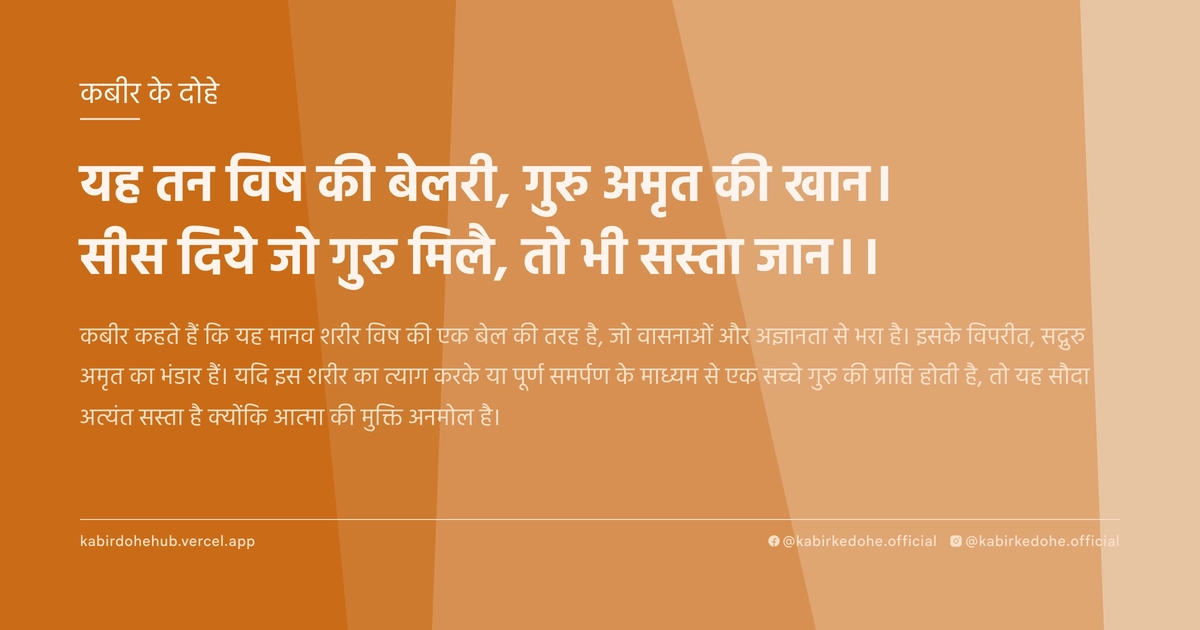
यह तन विष की बेलरी, गुरु अमृत की खान।
सीस दिये जो गुरु मिलै, तो भी सस्ता जान।।
Yeh tan vish ki belri, guru amrit ki khan. Sees diye jo guru milai, to bhi sasta jaan.
इस पृष्ठ पर इस कबीर दोहे का अर्थ (meaning), हिंदी व्याख्या और अंग्रेज़ी अनुवाद, दार्शनिक विश्लेषण और व्यावहारिक जीवन सीख दी गई है। यह दोहा गुरु महत्व (The Guru's Importance) विषय से जुड़ा है — Kabir doha meaning and explanation in Hindi and English.
अर्थ (Meaning):
कबीर कहते हैं कि यह मानव शरीर विष की एक बेल की तरह है, जो वासनाओं और अज्ञानता से भरा है। इसके विपरीत, सद्गुरु अमृत का भंडार हैं। यदि इस शरीर का त्याग करके या पूर्ण समर्पण के माध्यम से एक सच्चे गुरु की प्राप्ति होती है, तो यह सौदा अत्यंत सस्ता है क्योंकि आत्मा की मुक्ति अनमोल है।
Kabir asserts that the human body is like a vine of poison, saturated with worldly desires and ignorance. In contrast, the true Guru is a reservoir of divine nectar. If one can find a genuine spiritual guide, even at the cost of sacrificing one's own head—symbolizing the total annihilation of the ego—the price is negligible compared to the eternal liberation gained.
व्याख्या (Interpretation):
यहाँ 'विष की बेलरी' शरीर की नश्वरता और उसमें व्याप्त काम, क्रोध, और लोभ का प्रतीक है। गुरु को 'अमृत की खान' कहा गया है क्योंकि वे अज्ञान के अंधकार को मिटाकर आत्म-साक्षात्कार का मार्ग दिखाते हैं। 'सीस देना' शारीरिक मृत्यु नहीं, बल्कि अहंकार का पूर्ण विसर्जन है। यह दोहा निर्गुण भक्ति के उस सिद्धांत पर आधारित है जहाँ साधक को अपनी सीमित पहचान (माया) को मिटाना पड़ता है ताकि वह ब्रह्म के साथ एकाकार हो सके। यह द्वैत से अद्वैत की यात्रा है, जहाँ 'मैं' का अंत ही 'परमात्मा' का आरंभ है।
The 'vine of poison' symbolizes the physical body and the psychological entanglement in Maya, where every desire acts as a toxin. The Guru is described as the 'mine of nectar' because they possess the alchemy to transform base instincts into spiritual gold. 'Giving the head' is a potent metaphor for the total surrender of the ego (Ahamkara). In the context of Nirgun Bhakti, this represents the transition from the perceived separate self to the realization of the formless Absolute. The paradox lies in the fact that one must 'lose' their identity to 'find' their true essence, mirroring the Advaita Vedanta concept of Atman-Brahman non-duality.
दार्शनिक विश्लेषण (Philosophical Analysis):
कबीर का यह दोहा मध्यकालीन भारत के उस सामाजिक परिवेश में रचा गया जहाँ कर्मकांड और बाहरी आडंबरों का बोलबाला था। कबीर ने स्पष्ट किया कि मोक्ष किसी मंदिर, मस्जिद या केवल मंत्रोच्चार से नहीं, बल्कि आंतरिक रूपांतरण से मिलता है। वे यहाँ शरीर को एक बाधा के रूप में देखते हैं, जो इंद्रियों के सुखों में उलझा हुआ है।
दार्शनिक स्तर पर, यह अद्वैत वेदांत के उस सत्य को पुष्ट करता है कि शरीर और मन केवल एक आवरण हैं। जब तक यह आवरण (माया) बना रहता है, मनुष्य स्वयं को ईश्वर से अलग मानता है। गुरु वह उत्प्रेरक है जो इस भ्रम को तोड़ता है।
सूफी मत के 'फना' (अहंकार का विनाश) के सिद्धांत से इसकी गहरी समानता है। जैसे सूफी संत खुदा में विलीन होने के लिए अपनी हस्ती मिटाते हैं, कबीर भी 'सीस देने' की बात करते हैं। यह आत्म-विनाश नहीं, बल्कि आत्म-विस्तार है।
कबीर जाति और धर्म की सीमाओं को नकारते हुए केवल 'ज्ञान' और 'अनुभव' को महत्व देते हैं। उनके लिए गुरु कोई व्यक्ति नहीं, बल्कि वह चेतना है जो शिष्य को उसके अपने भीतर के ईश्वर से परिचित कराए।
अंतिम विश्लेषण में, यह दोहा मनोवैज्ञानिक रूपांतरण की बात करता है। जब तक मनुष्य अपनी पुरानी पहचान और पूर्वाग्रहों को नहीं छोड़ता, वह नई आध्यात्मिक ऊंचाई प्राप्त नहीं कर सकता। यह 'मृत्यु पूर्व मृत्यु' का आह्वान है, ताकि पुनर्जन्म केवल भौतिक न होकर आध्यात्मिक हो।
This couplet emerges from the socio-religious turbulence of medieval India, where Kabir challenged the hegemony of ritualism and the caste hierarchy. He posits that liberation is not found in the external performance of rites but in the internal alchemy of the soul. The body is viewed as a vessel of 'poison'—not because matter is evil, but because the attachment to it creates a veil of ignorance.
Philosophically, this aligns with Advaita Vedanta's teaching that the perceived separation between the individual soul (Jiva) and the Universal Consciousness (Brahman) is an illusion (Maya). The Guru acts as the catalyst who dissolves this illusion, revealing the inherent divinity within the seeker.
There is a profound resonance here with the Sufi concept of 'Fana'—the annihilation of the self in the Divine. Just as the Sufi seeks to extinguish the 'I' to find the 'He', Kabir suggests that the sacrifice of the ego is the only prerequisite for spiritual awakening.
Kabir’s rejection of institutionalized religion is evident here. He elevates the Guru above all scriptures, suggesting that a living embodiment of truth is more valuable than a thousand dead texts. The Guru is not merely a teacher but a mirror reflecting the seeker's true nature.
Psychologically, the 'sacrifice of the head' represents the breaking of the cognitive patterns and biases that define our limited personality. It is a call for a radical shift in consciousness, moving from the ego-centric mode of existence to a God-centric or Truth-centric existence, where the boundary between the observer and the observed vanishes.
मूल संदेश (Core Message):
- शरीर और मन की वासनाएँ आध्यात्मिक प्रगति में सबसे बड़ी बाधा हैं।
- सच्चा गुरु वह है जो हमें हमारे अपने अहंकार के भ्रम से मुक्त करे।
- अहंकार का पूर्ण त्याग ही वास्तविक मोक्ष का एकमात्र द्वार है।
- बाहरी अनुष्ठानों से अधिक महत्वपूर्ण आंतरिक रूपांतरण और समर्पण है।
- जब 'मैं' मिटता है, तभी अनंत सत्य का अनुभव संभव होता है।
- Worldly desires and bodily attachments are the primary obstacles to spiritual evolution.
- A true Guru is one who liberates the seeker from the illusion of the separate self.
- The total annihilation of the ego is the only gateway to genuine liberation.
- Internal transformation and surrender outweigh all external religious rituals.
- Only when the 'I' vanishes can the experience of the Infinite Truth begin.
व्यावहारिक उदाहरण (Practical Example):
वाराणसी के घाटों पर रहने वाले एक वृद्ध विधवा, जानकी, का जीवन अत्यंत कठिन था। समाज ने उन्हें उपेक्षित कर दिया था और वे अपने अकेलेपन और कड़वाहट के विष में डूबी रहती थीं। वे मानती थीं कि उनका दुख ही उनकी नियति है और वे हर आने जाने वाले व्यक्ति में दोष ढूँढती थीं।
एक दिन उनकी मुलाकात एक शांत स्वभाव के संन्यासी से हुई, जो घाट की सीढ़ियों पर चुपचाप बैठे रहते थे। जानकी ने पहले तो उन्हें अपनी शिकायतों का पुलिंदा सुनाया, लेकिन संन्यासी ने केवल एक मुस्कान दी और कहा, 'तुम अपनी कड़वाहट को ढो रही हो, जबकि तुम्हारे भीतर शांति का सागर है।'
जानकी को पहले यह बात अजीब लगी। उन्होंने सोचा कि एक अजनबी उनकी पीड़ा को कैसे समझ सकता है। लेकिन संन्यासी की स्थिरता ने उन्हें सोचने पर मजबूर कर दिया। वे हर दिन उनके पास जाने लगीं और धीरे-धीरे उन्होंने महसूस किया कि उनकी शिकायतें वास्तव में उनके अपने अहंकार का हिस्सा थीं जो उन्हें दुनिया से अलग कर रही थीं।
संन्यासी ने उनसे कहा, 'यदि तुम अपनी इस 'मैं पीड़ित हूँ' वाली पहचान को त्याग सको, तो तुम मुक्त हो जाओगी।' यह जानकी के लिए 'सीस देने' जैसा था—अपनी उस पहचान को मारना जिसे उन्होंने दशकों से संजोया था।
शुरुआत में यह संघर्ष कठिन था। उन्हें अपनी पुरानी आदतों और क्रोध के आवेगों से लड़ना पड़ा। लेकिन जैसे-जैसे उन्होंने संन्यासी के मौन और प्रेम को आत्मसात किया, उनके भीतर का विष अमृत में बदलने लगा।
उन्होंने देखा कि जब वे दूसरों की मदद करने लगीं, तो उनका अपना दुख गायब हो गया। उन्होंने अपने घर के पास रहने वाले अन्य बेसहारा लोगों के लिए भोजन बनाना शुरू किया।
एक दिन, एक युवती ने उनसे पूछा कि वे इतनी खुश कैसे हैं। जानकी ने मुस्कुराकर कहा, 'मैंने अपनी उस पहचान को मार दिया जो मुझे दुखी रखती थी।'
यह रूपांतरण केवल बाहरी नहीं था; जानकी ने महसूस किया कि संन्यासी ने उन्हें वह रास्ता दिखाया जहाँ 'मैं' का अंत और 'हम' का आरंभ होता है।
अंततः, जानकी का जीवन एक उदाहरण बन गया कि कैसे सही मार्गदर्शन और अहंकार के विसर्जन से सबसे विषैला जीवन भी अमृतमय हो सकता है।
अब वे घाट की सबसे प्रिय सदस्य थीं, न कि सबसे उपेक्षित, क्योंकि उन्होंने अपने भीतर के 'विष' को 'अमृत' में बदल लिया था।
Janaki, an elderly widow living on the ghats of Varanasi, led a life steeped in bitterness. Ostracized by society and consumed by loneliness, she viewed her suffering as her sole identity, projecting her inner poison onto everyone she encountered.
One day, she encountered a serene monk who sat in profound silence on the stone steps of the river. Janaki initially approached him with a torrent of grievances, but the monk responded only with a gentle smile and a single observation: 'You are carrying the weight of your bitterness, unaware that a sea of peace resides within you.'
Janaki was initially skeptical. How could a stranger understand her lifelong agony? However, the monk's unwavering stillness intrigued her. She began visiting him daily, and through his silence, she started realizing that her identity as a 'victim' was actually a shield for her ego, keeping her isolated from the world.
The monk challenged her: 'If you can sacrifice the identity of the one who suffers, you will find the one who is free.' For Janaki, this was the 'sacrifice of the head'—the willingness to kill the persona she had nurtured for decades.
The process was grueling. She had to confront her ingrained patterns of anger and resentment. But as she absorbed the monk's compassion, the poison of her past began to transmute into the nectar of presence.
She began to channel her energy into serving other displaced souls on the ghats, cooking simple meals for those more destitute than herself. She discovered that in the act of selfless giving, her own pain vanished.
One afternoon, a young traveler asked her the secret of her radiance. Janaki replied, 'I simply killed the version of myself that insisted on being miserable.'
This transformation was not a change in circumstances, but a change in consciousness. The monk had served as the catalyst, the 'mine of nectar,' guiding her to dissolve the ego that separated her from the rest of humanity.
Janaki's life became a living testament to the fact that the most toxic existence can be redeemed through the guidance of a true master and the courage to let go of the self.
She was no longer the outcast of the ghats but its most beloved soul, having traded the poison of her ego for the nectar of universal love.
अभ्यास मार्गदर्शन (Practice Guidance):
- दैनिक आत्म-निरीक्षण: प्रतिदिन 20 मिनट मौन बैठें और उन विचारों को पहचानें जो आपके भीतर 'विष' (क्रोध, ईर्ष्या, अहंकार) पैदा करते हैं।
- समर्पण का अभ्यास: किसी ऐसे व्यक्ति या आदर्श को खोजें जो आपसे अधिक जागरूक हो, और उनके प्रति पूर्ण मानसिक समर्पण का अभ्यास करें, बिना किसी शर्त के।
- अहंकार विसर्जन जर्नल: हर रात लिखें कि आज आपने किस परिस्थिति में अपने 'अहं' को जीत लिया और कहाँ आप अभी भी अपनी पहचान से चिपके हुए हैं।
- डायग्नोस्टिक चेकलिस्ट: क्या आप दूसरों की आलोचना करते हैं? क्या आप अपनी उपलब्धियों का श्रेय केवल स्वयं को देते हैं? यदि हाँ, तो आप अभी भी 'विष की बेलरी' में उलझे हैं।
- Daily Self-Observation: Spend 20 minutes in silence daily, identifying the specific thoughts that generate 'poison' (anger, jealousy, pride) within you.
- Practice of Surrender: Identify a mentor, a spiritual ideal, or a higher consciousness and practice unconditional mental surrender, letting go of the need to be 'right'.
- Ego-Dissolution Journaling: Each night, record instances where you successfully transcended your ego and moments where you clung stubbornly to your identity.
- Diagnostic Checklist: Do you find yourself judging others to feel superior? Do you feel a need for constant validation? If yes, you are still entangled in the 'vine of poison'.
चिंतन प्रश्न (Reflection Questions):
- वह कौन सी पहचान है जिसे आप इतनी मजबूती से पकड़े हुए हैं कि उसे छोड़ने का विचार ही आपको डरा देता है?
- क्या आपका 'आध्यात्मिक मार्ग' वास्तव में अहंकार को मिटा रहा है, या यह आपके अहंकार को एक 'धार्मिक' रूप दे रहा है?
- यदि आज आपकी सारी सामाजिक प्रतिष्ठा और उपलब्धियाँ छीन ली जाएँ, तो आपके भीतर क्या बचेगा?
- आपकी डिजिटल पहचान (सोशल मीडिया) आपके वास्तविक स्वरूप को कितना ढक रही है?
- क्या आप वास्तव में किसी के मार्गदर्शन के लिए तैयार हैं, या आप केवल अपनी मान्यताओं की पुष्टि चाहते हैं?
- What specific identity are you clinging to so tightly that the thought of losing it terrifies you?
- Is your spiritual journey actually dissolving your ego, or is it merely giving your ego a 'spiritual' mask?
- If all your social status and achievements were stripped away today, what would remain of you?
- To what extent does your digital persona obscure your authentic, raw existence?
- Are you truly open to guidance, or are you merely seeking a mirror that confirms your existing biases?