
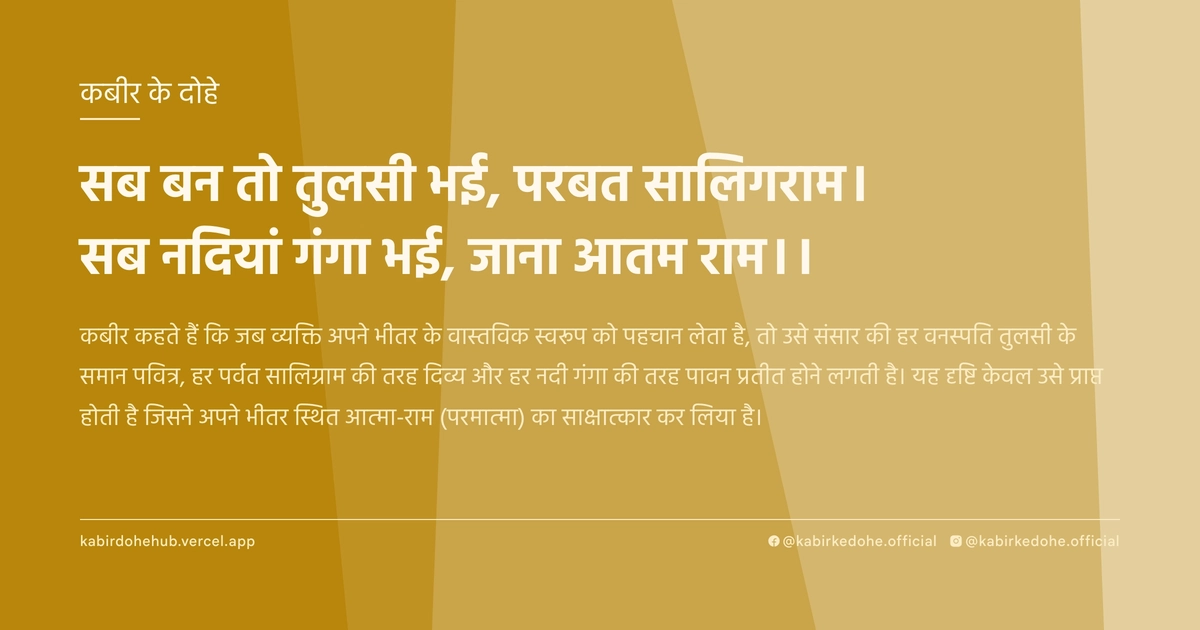
सब बन तो तुलसी भई, परबत सालिगराम।
सब नदियां गंगा भई, जाना आतम राम।।
Sab ban to tulsi bhayi, parbat saligram. Sab nadiyaan ganga bhayi, jaana aatam ram.
इस पृष्ठ पर इस कबीर दोहे का अर्थ (meaning), हिंदी व्याख्या और अंग्रेज़ी अनुवाद, दार्शनिक विश्लेषण और व्यावहारिक जीवन सीख दी गई है। यह दोहा निर्गुण ब्रह्म (Nirguna Brahman) विषय से जुड़ा है — Kabir doha meaning and explanation in Hindi and English.
अर्थ (Meaning):
कबीर कहते हैं कि जब व्यक्ति अपने भीतर के वास्तविक स्वरूप को पहचान लेता है, तो उसे संसार की हर वनस्पति तुलसी के समान पवित्र, हर पर्वत सालिग्राम की तरह दिव्य और हर नदी गंगा की तरह पावन प्रतीत होने लगती है। यह दृष्टि केवल उसे प्राप्त होती है जिसने अपने भीतर स्थित आत्मा-राम (परमात्मा) का साक्षात्कार कर लिया है।
Kabir asserts that once an individual realizes their true inner essence, the entire world is transformed in their eyes: every plant becomes as sacred as the holy Tulsi, every mountain as divine as the Saligram stone, and every river as purifying as the Ganges. This transcendental vision is accessible only to those who have recognized the indwelling Spirit—the Atman-Ram—within themselves.
व्याख्या (Interpretation):
शाब्दिक अर्थ यह है कि बाहरी पवित्रता आंतरिक बोध पर निर्भर करती है। यहाँ 'तुलसी', 'सालिग्राम' और 'गंगा' केवल धार्मिक प्रतीक नहीं हैं, बल्कि वे उस परम पवित्रता के प्रतिनिधि हैं जिसे मनुष्य बाहर खोजता है। कबीर एक गहरे विरोधाभास को उजागर करते हैं: हम पवित्रता को भूगोल या वस्तुओं में खोजते हैं, जबकि वह एक मानसिक और आध्यात्मिक अवस्था है। जब साधक 'अद्वैत' की स्थिति में पहुँचता है, तो वह देखता है कि माया का पर्दा हट गया है और अब वह भेद नहीं करता। निर्गुण भक्ति का सार यही है कि ईश्वर किसी विशेष स्थान या वस्तु में नहीं, बल्कि सर्वव्यापी चेतना में है। अंततः, यह दोहा यह समझाता है कि जब 'मैं' (अहंकार) मिट जाता है, तो पूरी सृष्टि ही मंदिर बन जाती है और हर कण परमात्मा का प्रतिबिंब बन जाता है।
Literally, the verse suggests that external sanctity is a reflection of internal realization. The symbols of 'Tulsi', 'Saligram', and 'Ganga' are not merely religious icons but representations of the absolute purity that humanity seeks externally. Kabir highlights a central paradox: we search for holiness in geography and objects, whereas it is actually a state of consciousness. When the seeker attains the state of 'Advaita' (non-duality), the veil of Maya is lifted, and the distinction between the sacred and the profane vanishes. The essence of Nirgun Bhakti is that the Divine does not reside in a specific location or idol but is the omnipresent consciousness itself. Ultimately, the doha teaches that once the ego is annihilated, the entire universe transforms into a temple, and every atom becomes a mirror reflecting the Divine.
दार्शनिक विश्लेषण (Philosophical Analysis):
कबीर का यह दोहा मध्यकालीन भारत के उस दौर का है जब धार्मिक कट्टरता और कर्मकांड अपने चरम पर थे। उन्होंने बाहरी आडंबरों, जैसे तीर्थयात्रा और मूर्ति पूजा, का कड़ा विरोध किया। उनका दर्शन 'सहज मार्ग' पर आधारित है, जो यह मानता है कि सत्य कहीं बाहर नहीं, बल्कि हृदय के भीतर है। यह विचार सीधे तौर पर अद्वैत वेदांत से जुड़ता है, जहाँ आत्मा और ब्रह्म को एक माना गया है। कबीर कहते हैं कि यदि आप स्वयं को नहीं जानते, तो गंगा में स्नान करना केवल शरीर को धोना है, आत्मा को नहीं।
सूफी मत के 'वहदत-अल-वजूद' (अस्तित्व की एकता) के समान, कबीर यहाँ एक ऐसी दृष्टि की बात कर रहे हैं जहाँ सृष्टा और सृष्टि का भेद समाप्त हो जाता है। उनके लिए 'राम' दशरथ के पुत्र नहीं, बल्कि वह निराकार तत्व है जो हर सांस में मौजूद है। यह विश्लेषण हमें बताता है कि पवित्रता कोई वस्तु नहीं जिसे प्राप्त किया जाए, बल्कि एक बोध है जिसे जगाया जाए।
सामाजिक स्तर पर, यह संदेश जातिवाद और ऊंच-नीच के भेदभाव पर प्रहार करता है। यदि हर नदी गंगा है, तो कोई भी स्थान या व्यक्ति अछूत नहीं हो सकता। यह एक क्रांतिकारी विचार था जिसने समाज को यह सिखाया कि ईश्वर की प्राप्ति के लिए किसी पुरोहित या मध्यस्थ की आवश्यकता नहीं है।
मनोवैज्ञानिक रूप से, यह दोहा 'परसेप्शन' या धारणा के परिवर्तन की बात करता है। जब हमारा आंतरिक द्वेष और अहंकार समाप्त होता है, तो हमारा मस्तिष्क बाहरी दुनिया को प्रेम और करुणा के चश्मे से देखने लगता है। यह एक मानसिक रूपांतरण है जहाँ भय, घृणा और अलगाव की जगह एकात्मता ले लेती है।
अंततः, कबीर हमें चेतावनी देते हैं कि बाहरी प्रतीकों की पूजा तब तक व्यर्थ है जब तक कि आंतरिक रूपांतरण न हो। वास्तविक तीर्थयात्रा स्वयं के भीतर की यात्रा है। जब 'आतम राम' का ज्ञान होता है, तब संसार का हर साधारण तत्व असाधारण और दिव्य हो जाता है, क्योंकि अब देखने वाली आँखें दिव्य हो चुकी हैं।
This doha emerges from a medieval Indian era characterized by rigid religious orthodoxy and ritualism. Kabir vehemently opposed external displays of piety, such as pilgrimages and idol worship, advocating instead for the 'Sahaj Marg' (the Natural Path), which posits that Truth resides within the heart. This philosophy aligns closely with Advaita Vedanta, which asserts the fundamental identity of the Atman (individual soul) and Brahman (universal consciousness). Kabir suggests that without self-realization, bathing in the Ganges is merely a physical act, leaving the soul untouched.
Parallel to the Sufi concept of 'Wahdat-al-Wujud' (the Unity of Existence), Kabir describes a vision where the distinction between the Creator and the Creation dissolves. For him, 'Ram' is not the historical son of Dasharatha, but the formless, omnipresent element residing in every breath. This analysis reveals that holiness is not an object to be acquired but a realization to be awakened.
Socially, this message strikes a blow against casteism and social hierarchy. If every river is the Ganges, then no place or person can be deemed 'untouchable' or impure. This was a revolutionary assertion, teaching that the realization of the Divine requires no priestly intermediary or ritualistic gateway.
Psychologically, the doha addresses the transformation of perception. When internal malice and ego are eradicated, the mind begins to perceive the external world through the lens of love and compassion. It is a cognitive shift where fear, hatred, and alienation are replaced by a sense of oneness and cosmic intimacy.
Ultimately, Kabir warns that the worship of external symbols is futile without internal transmutation. The true pilgrimage is the journey inward. Once the knowledge of 'Atman-Ram' is attained, every mundane element of the world becomes extraordinary and divine, for the eyes that behold them have themselves become divine.
मूल संदेश (Core Message):
- बाहरी तीर्थयात्रा केवल एक भ्रम है; वास्तविक यात्रा अंतर्मन की है।
- पवित्रता किसी वस्तु में नहीं, बल्कि उसे देखने वाली चेतना में होती है।
- अहंकार का विसर्जन ही संसार को दिव्य बनाने की एकमात्र कुंजी है।
- ईश्वर किसी विशेष धर्म या स्थान का नहीं, बल्कि समस्त अस्तित्व का है।
- जब आप स्वयं को जान लेते हैं, तो पूरा ब्रह्मांड आपका मंदिर बन जाता है।
- External pilgrimages are mere illusions; the true journey is inward.
- Holiness resides not in the object, but in the consciousness that perceives it.
- The dissolution of the ego is the only key to seeing the world as divine.
- The Divine belongs to no specific religion or place, but to all existence.
- Once you know yourself, the entire universe transforms into your temple.
व्यावहारिक उदाहरण (Practical Example):
वाराणसी के एक पुराने मोहल्ले में माधव नाम का एक वृद्ध कुम्हार रहता था। माधव का जीवन केवल मिट्टी के बर्तन बनाने और उन्हें बेचने तक सीमित था, लेकिन उसका मन हमेशा इस बात से परेशान रहता था कि वह एक 'निम्न' जाति से आता है और कभी भी उन बड़े मंदिरों के गर्भगृह में प्रवेश नहीं कर पाया जहाँ अमीर लोग जाते थे। वह अक्सर सोचता था कि पवित्रता केवल उन पत्थरों और मूर्तियों में है जिन्हें लोग पूजते हैं।
एक दिन माधव की मुलाकात एक घुमंतू फकीर से हुई। फकीर ने माधव को देखा और मुस्कुराते हुए पूछा, "तुम उस ईश्वर को कहाँ खोज रहे हो जो तुम्हारे अपने हाथों की मिट्टी में बसा है?"
माधव हैरान था। उसने कहा, "महाराज, मैं तो केवल मिट्टी गूँथता हूँ, पवित्रता तो गंगा के जल और मंदिर के विग्रहों में होती है।"
फकीर ने माधव को एक साधारण मिट्टी का दीया दिखाया और कहा, "यदि तुम इस दीये के भीतर की ज्योति को देख सको, तो तुम्हें हर मिट्टी का ढेर सालिग्राम जैसा लगेगा। पवित्रता स्थान में नहीं, देखने वाले की दृष्टि में होती है।"
माधव ने इस बात पर गहराई से विचार करना शुरू किया। उसने महसूस किया कि वह अब तक अपनी पहचान अपनी जाति और अपनी सामाजिक स्थिति से जोड़ रहा था, जिसने उसके भीतर एक हीन भावना पैदा कर दी थी। उसने बाहरी मंदिरों की खोज छोड़ दी और अपने भीतर के मौन में उतरने का प्रयास किया।
धीरे-धीरे, माधव का नजरिया बदलने लगा। अब जब वह सड़क किनारे की धूल देखता, तो उसे उसमें भी वही तत्व दिखता जो मंदिर के सोने के कलश में था। जब वह किसी गरीब या बीमार व्यक्ति की सेवा करता, तो उसे लगता कि वह साक्षात ईश्वर की सेवा कर रहा है।
एक दिन, शहर में एक बड़ा धार्मिक उत्सव था। लोग गंगा में डुबकी लगाने के लिए उमड़ रहे थे। माधव वहीं खड़ा था, लेकिन वह भीड़ का हिस्सा नहीं था। वह शांत था। उसने देखा कि लोग पवित्रता की तलाश में पानी में कूद रहे हैं, जबकि वह स्वयं के भीतर उस शांति और पवित्रता को महसूस कर रहा था।
उसने महसूस किया कि अब उसे किसी विशेष नदी की आवश्यकता नहीं है, क्योंकि उसके भीतर की करुणा ही गंगा बन गई थी। उसके द्वारा बनाए गए मिट्टी के बर्तनों में अब एक अजीब सी चमक थी, क्योंकि वे अब केवल व्यापार के लिए नहीं, बल्कि प्रेम और समर्पण से बनाए जा रहे थे।
माधव का जीवन बदल गया। वह अब एक कुम्हार नहीं रहा, बल्कि एक ऐसा इंसान बन गया जिसने यह जान लिया था कि ईश्वर किसी मंदिर की कैद में नहीं, बल्कि हर जीवित प्राणी की धड़कन में है। उसका घर ही उसका मंदिर बन गया और उसकी कला ही उसकी प्रार्थना।
In an ancient neighborhood of Varanasi lived an elderly potter named Madhav. Madhav's life revolved around shaping clay and selling pots, but his heart was perpetually heavy with the belief that he belonged to a 'lower' caste and could never enter the inner sanctums of the great temples where the wealthy prayed. He believed that holiness resided only in the stones and idols worshipped by the elite.
One day, Madhav encountered a wandering fakir. The fakir looked at Madhav and asked with a smile, "Where are you searching for the God who dwells within the very clay of your hands?"
Madhav was bewildered. He replied, "Master, I only knead mud. Purity exists only in the waters of the Ganges and the idols of the temples."
The fakir showed Madhav a simple clay lamp and said, "If you can see the light within this lamp, every mound of earth will seem to you as sacred as the Saligram. Holiness is not in the place, but in the vision of the beholder."
Madhav began to contemplate these words deeply. He realized he had tied his identity to his caste and social standing, which had bred a sense of inferiority within him. He ceased his search for external temples and attempted to descend into the silence of his own being.
Gradually, Madhav's perception shifted. Now, when he looked at the dust on the roadside, he saw the same essence that resided in the golden spires of the temples. When he served a poor or sick person, he felt he was serving the Divine in human form.
One day, a grand religious festival took place in the city. Crowds were surging into the Ganges to bathe. Madhav stood by, but he was not part of the frantic crowd. He was serene. He observed people diving into the water in search of purity, while he felt that very purity and peace vibrating within himself.
He realized he no longer needed a specific river, for the compassion within him had become his Ganges. The clay pots he crafted now possessed a strange, ethereal glow, for they were no longer made for commerce, but with love and surrender.
Madhav's life was transformed. He was no longer just a potter, but a man who understood that God is not imprisoned in a temple, but lives in the heartbeat of every living creature. His home became his temple, and his art became his prayer.
अभ्यास मार्गदर्शन (Practice Guidance):
- दैनिक ध्यान: प्रतिदिन 20 मिनट मौन बैठें और यह विचार करें कि आपके शरीर का हर परमाणु उसी ब्रह्मांडीय ऊर्जा से बना है जिससे तारे और नदियां बनी हैं।
- आत्म-पूछताछ जर्नल: प्रतिदिन एक ऐसी घटना लिखें जहाँ आपने किसी व्यक्ति या वस्तु को 'अपवित्र' या 'निम्न' माना, और फिर विश्लेषण करें कि वह निर्णय आपके किस पूर्वाग्रह से उपजा था।
- व्यवहार परिवर्तन: दिन में कम से कम एक बार किसी ऐसे व्यक्ति की निस्वार्थ मदद करें जिसे समाज 'अवांछनीय' मानता है, यह महसूस करते हुए कि आप स्वयं ईश्वर की सेवा कर रहे हैं।
- निदान चेकलिस्ट: यदि आप अभी भी पवित्रता के लिए बाहरी स्थानों पर निर्भर हैं, या दूसरों को उनके धर्म/जाति के आधार पर आंक रहे हैं, तो इसका अर्थ है कि 'आतम राम' का बोध अभी अधूरा है।
- Daily Meditation: Spend 20 minutes in silence, contemplating that every atom of your body is composed of the same cosmic energy that forms the stars and the rivers.
- Self-Inquiry Journal: Daily, record one instance where you perceived a person or object as 'impure' or 'inferior,' and analyze which internal bias triggered that judgment.
- Behavioral Shift: At least once a day, render selfless service to someone whom society deems 'undesirable,' consciously feeling that you are serving the Divine within them.
- Diagnostic Checklist: If you still rely on external locations for sanctity, or judge others based on religion or caste, it is a sign that the realization of 'Atman-Ram' remains incomplete.
चिंतन प्रश्न (Reflection Questions):
- क्या मेरी पवित्रता की परिभाषा केवल उन चीजों तक सीमित है जो समाज द्वारा स्वीकृत हैं?
- यदि मैं अपने जीवन से सभी धार्मिक प्रतीकों को हटा दूँ, तो क्या मेरे भीतर की शांति बनी रहेगी?
- मैं किन लोगों को 'अपवित्र' मानता हूँ, और यह धारणा मेरे किस आंतरिक डर या अहंकार से जुड़ी है?
- क्या मैं वास्तव में दूसरों में ईश्वर को देखता हूँ, या मैं केवल अपनी छवि का प्रतिबिंब खोज रहा हूँ?
- मेरे जीवन का वह कौन सा हिस्सा है जहाँ मैं अभी भी 'मैं' और 'वह' का भेद करता हूँ?
- क्या मेरी भक्ति मुझे दूसरों के प्रति अधिक विनम्र बनाती है, या यह मुझे एक आध्यात्मिक श्रेष्ठता का अहसास कराती है?
- Is my definition of purity limited only to those things approved by social convention?
- If I were to remove all religious symbols from my life, would my inner peace remain intact?
- Whom do I perceive as 'impure,' and which internal fear or ego is this perception linked to?
- Do I truly see the Divine in others, or am I merely searching for a reflection of my own image?
- In which areas of my life do I still maintain the duality of 'I' and 'the other'?
- Does my devotion make me more humble toward others, or does it grant me a sense of spiritual superiority?