
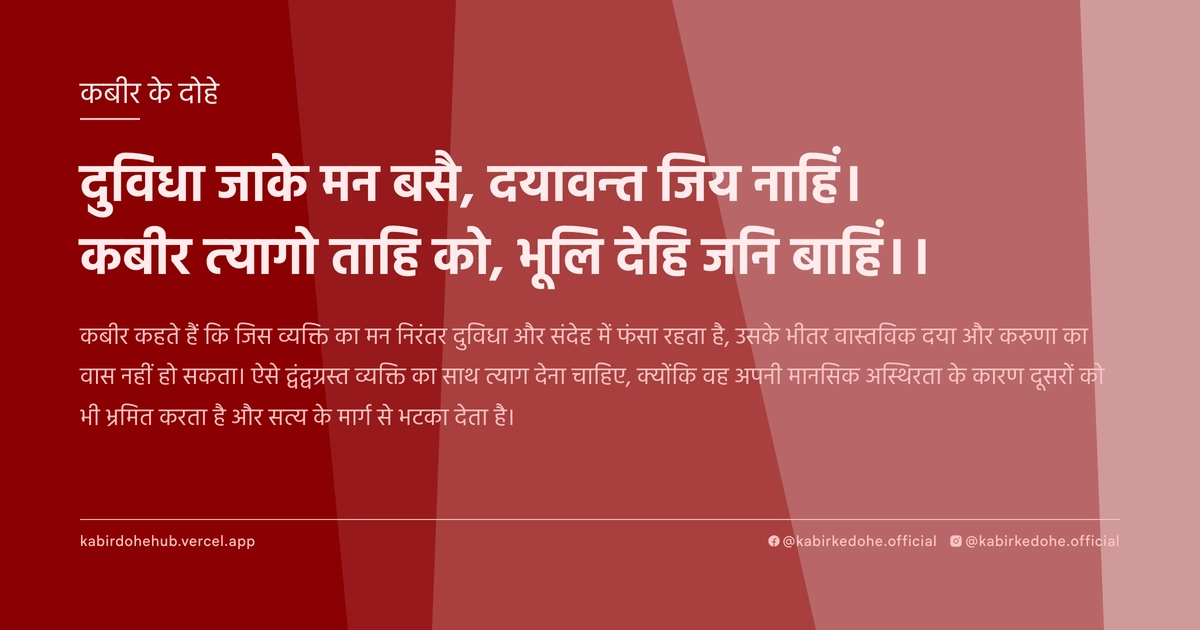
दुविधा जाके मन बसै, दयावन्त जिय नाहिं।
कबीर त्यागो ताहि को, भूलि देहि जनि बाहिं।।
Duvidha jaake man basai, dayavant jiy naahin. Kabir tyago taahi ko, bhuli dehi jani baahin.
इस पृष्ठ पर इस कबीर दोहे का अर्थ (meaning), हिंदी व्याख्या और अंग्रेज़ी अनुवाद, दार्शनिक विश्लेषण और व्यावहारिक जीवन सीख दी गई है। यह दोहा मन नियंत्रण (Mind Control) विषय से जुड़ा है — Kabir doha meaning and explanation in Hindi and English.
अर्थ (Meaning):
कबीर कहते हैं कि जिस व्यक्ति का मन निरंतर दुविधा और संदेह में फंसा रहता है, उसके भीतर वास्तविक दया और करुणा का वास नहीं हो सकता। ऐसे द्वंद्वग्रस्त व्यक्ति का साथ त्याग देना चाहिए, क्योंकि वह अपनी मानसिक अस्थिरता के कारण दूसरों को भी भ्रमित करता है और सत्य के मार्ग से भटका देता है।
Kabir asserts that an individual whose mind is perpetually inhabited by doubt and indecision lacks true compassion and spiritual empathy. He advises distancing oneself from such a person, as their internal conflict creates a ripple of confusion, preventing both themselves and others from attaining spiritual clarity and peace.
व्याख्या (Interpretation):
यह दोहा मानसिक द्वंद्व और आध्यात्मिक शून्यता के बीच के संबंध को दर्शाता है। शाब्दिक अर्थ यह है कि दुविधाग्रस्त व्यक्ति दयालु नहीं होता। गहरे स्तर पर, 'दुविधा' यहाँ केवल निर्णय लेने की असमर्थता नहीं, बल्कि 'माया' का वह प्रभाव है जो आत्मा को विभाजित करता है। जब मन दो विपरीत दिशाओं में खिंचता है, तो वह 'अद्वैत' (non-duality) की स्थिति से दूर हो जाता है। निर्गुण भक्ति में, ईश्वर का अनुभव पूर्ण समर्पण और एकाग्रता से होता है; जहाँ संदेह है, वहाँ भक्ति नहीं हो सकती। यह विरोधाभास है कि मनुष्य सत्य की खोज तो करता है, लेकिन अपने भीतर के अंतर्विरोधों को पकड़े रहता है, जिससे करुणा का स्रोत सूख जाता है।
This couplet illuminates the intrinsic link between mental oscillation and spiritual void. Literally, it suggests that a conflicted mind cannot be compassionate. Metaphorically, 'duvidha' (doubt) represents the influence of Maya, which fragments the consciousness. When the mind is split between opposing desires or beliefs, it deviates from the state of Advaita, or non-duality. In Nirgun Bhakti, the experience of the Formless Divine requires absolute surrender and singular focus; where doubt resides, devotion cannot flourish. This highlights the central human paradox: the yearning for Truth while clinging to the internal contradictions that obscure it, effectively drying up the wellspring of genuine compassion.
दार्शनिक विश्लेषण (Philosophical Analysis):
कबीर का यह विचार उनके युग के धार्मिक पाखंड और कर्मकांडीय जटिलताओं के विरुद्ध एक प्रहार है। उस समय समाज बाहरी आडंबरों और विपरीत धार्मिक नियमों में उलझा था, जिससे मानसिक द्वंद्व पैदा होता था। कबीर का तर्क है कि जो व्यक्ति केवल शास्त्रों की बहस में उलझा है और जिसका मन 'हाँ' और 'ना' के बीच झूल रहा है, वह कभी भी उस 'दया' को प्राप्त नहीं कर सकता जो आत्मा का मूल स्वभाव है।
अद्वैत वेदांत के परिप्रेक्ष्य में, दुविधा 'अविद्या' (अज्ञान) का रूप है। जब तक साधक यह मानता है कि वह और परमात्मा अलग हैं, या वह संसार और सत्य के बीच चुनाव कर रहा है, वह द्वैत में फंसा रहता है। यह द्वैत ही अहंकार को जन्म देता है और करुणा को बाधित करता है, क्योंकि दया केवल तभी संभव है जब व्यक्ति दूसरे में स्वयं को देखे।
सूफीवाद के साथ इसका गहरा संबंध है, जहाँ 'नफ्स' (अहंकार) को मिटाना अनिवार्य है। एक विभाजित मन वास्तव में अहंकार का एक खेल है, जो सत्य को पाने के बजाय अपनी ही उलझनों में आनंद खोजता है। कबीर यहाँ चेतावनी दे रहे हैं कि ऐसी मानसिक स्थिति संक्रामक होती है।
ritualism (कर्मकांड) का विरोध करते हुए कबीर यह स्पष्ट करते हैं कि मंदिर या मस्जिद जाने से अधिक महत्वपूर्ण है मन की स्थिरता। यदि मन में संदेह है, तो हज़ारों प्रार्थनाएँ भी व्यर्थ हैं। वास्तविक धर्म वह है जो मन को एकनिष्ठ करे और उसे प्रेम में परिवर्तित करे।
अंततः, यह विश्लेषण हमें मनोवैज्ञानिक रूपांतरण की ओर ले जाता है। अहंकार का विलोपन तब होता है जब हम 'दुविधा' को त्याग कर 'पूर्णता' को स्वीकार करते हैं। जो व्यक्ति स्वयं के साथ युद्ध कर रहा है, वह जगत के प्रति दयालु नहीं हो सकता, क्योंकि उसकी पूरी ऊर्जा आंतरिक संघर्ष में नष्ट हो रही है।
Kabir’s insight serves as a critique of the religious hypocrisy and ritualistic complexities of his era. Society was entangled in external displays and contradictory dogmas, which bred profound mental instability. Kabir argues that one who is lost in scholarly debates or trapped between opposing religious mandates cannot access the 'daya' (compassion) that is the primordial nature of the soul.
From the lens of Advaita Vedanta, this 'duvidha' is a manifestation of Avidya (ignorance). As long as the seeker perceives a separation between the self and the Divine, or struggles to choose between the world and the Truth, they remain imprisoned in duality. This duality fuels the ego and obstructs compassion, for true empathy only arises when one recognizes oneself in the other.
This aligns closely with Sufism, where the annihilation of the 'Nafs' (ego) is paramount. A divided mind is essentially a game of the ego, finding a perverse satisfaction in its own confusion rather than seeking the Absolute. Kabir warns that this state of mental fragmentation is contagious, potentially leading others astray.
By rejecting ritualism, Kabir clarifies that mental stability is far more vital than the act of visiting temples or mosques. If the mind is riddled with doubt, a thousand prayers remain futile. True religion is that which unifies the mind and transmutes that unity into universal love.
Ultimately, this analysis points toward a psychological transformation. The dissolution of the ego occurs when we abandon hesitation in favor of wholeness. A person at war with themselves cannot be compassionate toward the world, as their entire spiritual energy is consumed by internal friction.
मूल संदेश (Core Message):
- मानसिक द्वंद्व करुणा का सबसे बड़ा शत्रु है।
- संदेह आत्मा की एकाग्रता को नष्ट कर देता है।
- पूर्ण समर्पण ही दुविधा से मुक्ति का एकमात्र मार्ग है।
- दया केवल विचार नहीं, बल्कि एक त्वरित क्रिया है।
- अद्वैत की अनुभूति के लिए मन का एकनिष्ठ होना आवश्यक है।
- Mental oscillation is the greatest enemy of genuine compassion.
- Doubt erodes the singular focus of the soul.
- Absolute surrender is the only path to liberation from indecision.
- Compassion is not a conceptual thought, but an immediate action.
- Unity of mind is essential to experience the non-dual Truth.
व्यावहारिक उदाहरण (Practical Example):
वाराणसी के एक पुराने घाट पर माधव नाम का एक वृद्ध बुनकर रहता था। वह अपनी कला में निपुण था, लेकिन उसका मन हमेशा इस दुविधा में रहता था कि क्या उसे केवल धन के लिए काम करना चाहिए या उन गरीबों के लिए मुफ्त कपड़े बुनने चाहिए जो उसकी मदद चाहते थे।
वह अक्सर कहता, 'यदि मैं मुफ्त में देता हूँ, तो मेरा परिवार भूखा रहेगा; यदि मैं नहीं देता हूँ, तो मेरा धर्म मुझे दोषी ठहराएगा।' यह द्वंद्व उसके चेहरे पर झलकता था और उसकी करुणा केवल शब्दों तक सीमित थी।
एक दिन उसने देखा कि एक छोटा बच्चा ठंड से कांप रहा था। माधव ने उसे कपड़े देने की सोची, लेकिन फिर अपने लाभ के बारे में सोचने लगा। वह घंटों इसी कशमकश में रहा, जबकि बच्चा वहीं बैठा रहा।
तभी उसने पास बैठे एक फकीर को देखा, जिसने बिना किसी सोच-विचार के अपनी एकमात्र चादर उस बच्चे को ओढ़ा दी। फकीर के चेहरे पर एक असीम शांति थी, जबकि माधव के चेहरे पर तनाव था।
माधव को अहसास हुआ कि उसकी 'दया' केवल एक विचार थी, जबकि फकीर की दया एक 'अवस्था' थी। उसकी दुविधा ने उसकी करुणा को मार दिया था।
उसने महसूस किया कि जब तक वह लाभ और हानि के तराजू पर धर्म को तौलेगा, वह कभी भी उस परम शांति को प्राप्त नहीं कर पाएगा जिसे कबीर ने बताया है।
उस रात माधव ने अपनी दुविधा को त्यागने का निर्णय लिया। उसने तय किया कि वह अपनी आय का एक निश्चित हिस्सा निस्वार्थ सेवा के लिए समर्पित करेगा, बिना किसी मानसिक संघर्ष के।
जैसे ही उसने यह निर्णय लिया, उसके मन का बोझ हल्का हो गया। अब वह जब किसी की मदद करता, तो उसके मन में कोई 'लेकिन' या 'किंतु' नहीं होता था।
उसकी बुनाई में अब एक नई चमक थी, क्योंकि उसका मन अब विभाजित नहीं था। वह अब केवल एक बुनकर नहीं, बल्कि एक दयालु आत्मा बन गया था।
माधव की कहानी यह सिखाती है कि निर्णय की स्पष्टता ही करुणा का द्वार खोलती है, और दुविधा वह ताला है जो हृदय को बंद रखता है।
On an ancient ghat in Varanasi lived an elderly weaver named Madhav. He was a master of his craft, yet his mind was perpetually haunted by a dilemma: should he weave solely for profit, or provide free garments to the destitute who sought his help?
He would often lament, 'If I give for free, my family will starve; if I do not, my faith will condemn me.' This conflict was etched upon his face, and his compassion remained merely verbal.
One day, he noticed a small child shivering from the cold. Madhav considered giving him a cloth, but immediately began calculating his losses. He remained trapped in this mental tug-of-war for hours, while the child continued to tremble.
Suddenly, he observed a wandering fakir nearby. Without a moment's hesitation or a single thought of loss, the fakir wrapped his only shawl around the child. The fakir’s face radiated an infinite peace, while Madhav’s face was clouded with tension.
Madhav realized that his 'compassion' was merely a conceptual thought, whereas the fakir’s compassion was a state of being. His internal duality had effectively murdered his capacity for genuine kindness.
He understood that as long as he weighed spirituality on the scales of profit and loss, he would never attain the supreme peace spoken of by Kabir.
That night, Madhav decided to surrender his dilemma. He committed to dedicating a specific portion of his income to selfless service, without any further mental negotiation.
As soon as he made this firm resolve, the burden on his heart lifted. Now, when he helped someone, there were no 'buts' or 'ifs' lingering in his mind.
His weaving acquired a new brilliance, for his mind was no longer fragmented. He ceased to be just a weaver and became a compassionate soul.
Madhav’s story teaches us that clarity of decision is the key that unlocks the door to compassion, and doubt is the lock that keeps the heart closed.
अभ्यास मार्गदर्शन (Practice Guidance):
- प्रतिदिन 20 मिनट मौन ध्यान करें, जहाँ आप अपने मन में उठने वाले द्वंद्वों को बिना किसी निर्णय के केवल देखें।
- एक 'द्वंद्व पत्रिका' (Doubt Journal) बनाएँ। लिखें कि कौन से निर्णय आपको मानसिक रूप से विभाजित कर रहे हैं और पूछें: 'क्या यह डर है या वास्तव में नैतिक दुविधा?'
- व्यवहार परिवर्तन: दिन में कम से कम एक ऐसा कार्य करें जिसमें आप बिना किसी लाभ-हानि के विचार के तुरंत सहायता करें।
- निदान चेकलिस्ट: क्या आप अक्सर 'काश' या 'शायद' शब्दों का प्रयोग करते हैं? क्या आपकी मदद करने की इच्छा आपके संदेहों से दब जाती है? यदि हाँ, तो आप दुविधा के प्रभाव में हैं।
- Practice 20 minutes of silent meditation daily, observing the conflicts arising in your mind without judgment or attachment.
- Maintain a 'Doubt Journal.' Document the decisions that leave you mentally fragmented and ask: 'Is this rooted in fear, or is it a genuine ethical dilemma?'
- Behavioral Shift: Perform at least one act of kindness daily where you help someone immediately, bypassing all calculations of profit or loss.
- Diagnostic Checklist: Do you frequently use words like 'perhaps' or 'I wish' regarding your values? Does your urge to help get suppressed by hesitation? If so, you are under the influence of 'duvidha'.
चिंतन प्रश्न (Reflection Questions):
- मेरे जीवन के वे कौन से क्षेत्र हैं जहाँ मैं सत्य को जानते हुए भी संदेह के कारण कार्य नहीं कर पाता?
- क्या मेरी 'दया' वास्तव में दूसरों के लिए है, या यह मेरी अपनी छवि को बेहतर बनाने का एक तरीका है?
- जब मैं किसी की मदद करने में दुविधा करता हूँ, तो वह डर किसका होता है—मेरी सामाजिक प्रतिष्ठा का या मेरे संसाधनों का?
- क्या मेरा डिजिटल व्यक्तित्व (सोशल मीडिया) मेरे वास्तविक आंतरिक संघर्षों को छिपाने का एक मुखौटा है?
- यदि आज मेरा अहंकार पूरी तरह समाप्त हो जाए, तो मेरे जीवन का कौन सा सबसे बड़ा द्वंद्व स्वतः समाप्त हो जाएगा?
- In which areas of my life do I fail to act upon the Truth because I am paralyzed by doubt?
- Is my 'compassion' truly for others, or is it a tool to polish my own self-image?
- When I hesitate to help, what is the root of that fear—my social status or my material resources?
- Is my digital persona a mask designed to hide the fragmented nature of my internal conflicts?
- If my ego were to vanish completely today, which of my greatest life dilemmas would spontaneously resolve?