
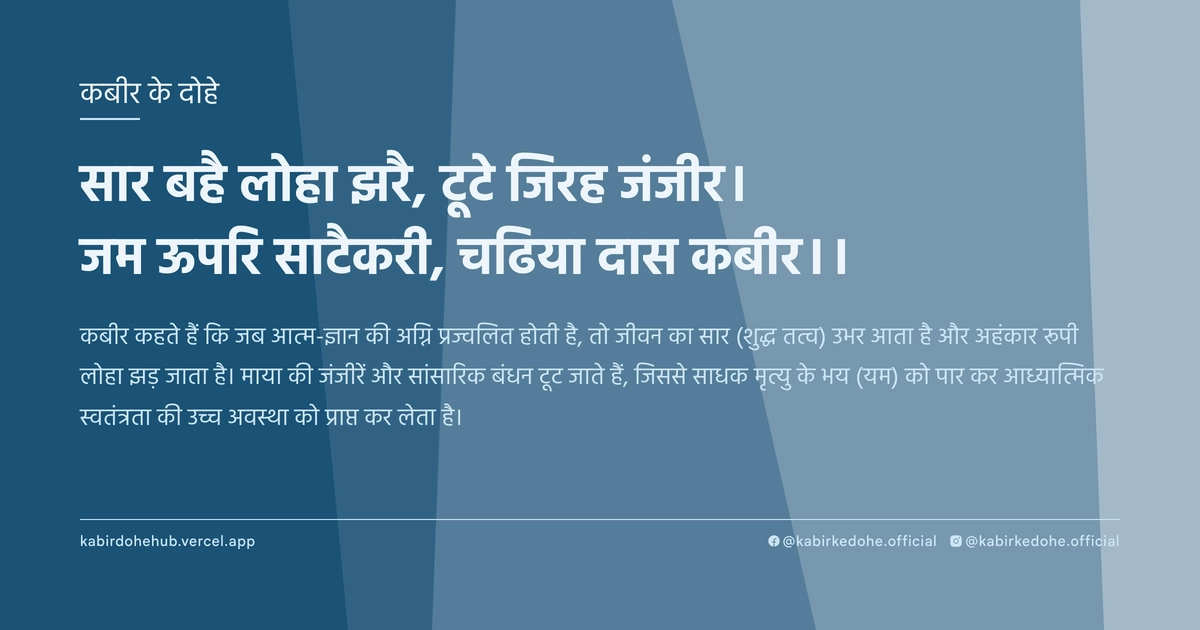
सार बहै लोहा झरै, टूटे जिरह जंजीर।
जम ऊपरि साटैकरी, चढिया दास कबीर।।
Saar bahai loha jharai, toote jirah janjeer. Jam upari sataikari, chadhiya daas Kabir.
इस पृष्ठ पर इस कबीर दोहे का अर्थ (meaning), हिंदी व्याख्या और अंग्रेज़ी अनुवाद, दार्शनिक विश्लेषण और व्यावहारिक जीवन सीख दी गई है। यह दोहा मुक्ति (Liberation) विषय से जुड़ा है — Kabir doha meaning and explanation in Hindi and English.
अर्थ (Meaning):
कबीर कहते हैं कि जब आत्म-ज्ञान की अग्नि प्रज्वलित होती है, तो जीवन का सार (शुद्ध तत्व) उभर आता है और अहंकार रूपी लोहा झड़ जाता है। माया की जंजीरें और सांसारिक बंधन टूट जाते हैं, जिससे साधक मृत्यु के भय (यम) को पार कर आध्यात्मिक स्वतंत्रता की उच्च अवस्था को प्राप्त कर लेता है।
Kabir proclaims that when the fire of self-realization ignites, the essential essence of being emerges while the iron of ego disintegrates. The chains of Maya and worldly attachments are shattered, allowing the seeker to transcend the fear of death (Yama) and ascend to the pinnacle of spiritual liberation.
व्याख्या (Interpretation):
इस दोहे में कबीर एक शक्तिशाली धातु-शोधन की प्रक्रिया का रूपक उपयोग करते हैं। 'सार' वह शुद्ध आत्मा है जो अशुद्धियों के हटने पर शेष रहती है। 'लोहा' और 'जंजीर' अज्ञान, अहंकार और सामाजिक रूढ़ियों के प्रतीक हैं जो आत्मा को जकड़े हुए हैं। यहाँ 'जम' (यम) केवल मृत्यु के देवता नहीं, बल्कि उस भय और मोह का प्रतीक हैं जो मनुष्य को जन्म-मृत्यु के चक्र में बांधे रखते हैं। 'साटैकरी' या उच्च स्थान पर चढ़ना इस बात का संकेत है कि जब अहंकार का विसर्जन होता है, तो व्यक्ति द्वैत से अद्वैत की ओर बढ़ता है। यह निर्गुण भक्ति का चरम है जहाँ साधक स्वयं को ब्रह्म में विलीन पाता है। अंततः, यह दोहा इस विरोधाभास को दर्शाता है कि सच्ची स्वतंत्रता केवल पूर्ण आत्म-समर्पण और अहंकार के विनाश के बाद ही संभव है।
In this couplet, Kabir employs a powerful metaphor of metallurgical refinement. 'Saar' represents the pure essence of the soul that remains once impurities are purged. 'Iron' and 'chains' symbolize ignorance, ego, and social dogmas that shackle the spirit. Here, 'Jam' (Yama) is not merely the deity of death, but a symbol of the fear and attachment that keep humans bound to the cycle of birth and rebirth. Ascending to the 'saatakari' or a higher vantage point signifies the transition from duality to non-duality (Advaita) upon the dissolution of the ego. This is the zenith of Nirgun Bhakti, where the seeker realizes their identity as the formless Brahman. Ultimately, the verse highlights the paradox that true liberation is achieved only through the total annihilation of the self-concept.
दार्शनिक विश्लेषण (Philosophical Analysis):
कबीर का यह दृष्टिकोण उनके युग के कट्टरपंथी धार्मिक अनुष्ठानों के विरुद्ध एक विद्रोह था। उन्होंने स्पष्ट किया कि मोक्ष किसी बाहरी तीर्थ या कर्मकांड से नहीं, बल्कि आंतरिक रूपांतरण से मिलता है। यह विचार अद्वैत वेदांत के करीब है, जहाँ 'अहं ब्रह्मास्मि' का अनुभव केवल तब होता है जब माया का पर्दा हटता है। कबीर के लिए, 'लोहा झड़ना' मानसिक और भावनात्मक स्तर पर उन सभी पहचानों को त्यागना है जो हमने समाज द्वारा थोपी गई हैं।
सूफी मत के 'फना' (अहंकार का विनाश) के सिद्धांत के साथ इसका गहरा संबंध है। जिस तरह एक धातु को शुद्ध करने के लिए उसे आग में तपाना पड़ता है, उसी तरह आत्मा को शुद्ध करने के लिए विरह और तप की अग्नि आवश्यक है। कबीर यहाँ यह तर्क देते हैं कि जब तक हम अपनी 'पहचान' (जाति, धर्म, पद) को पकड़े रहते हैं, हम जंजीरों में जकड़े रहते हैं।
ऐतिहासिक रूप से, कबीर ने उस समय के ब्राह्मणवादी और मौलवी वर्चस्व को चुनौती दी, जो मोक्ष को केवल कुछ विशेष वर्गों तक सीमित मानते थे। उन्होंने घोषणा की कि ईश्वर (निर्गुण ब्रह्म) हर उस व्यक्ति के भीतर है जो अपने अहंकार को गलाने का साहस रखता है। यह एक लोकतांत्रिक आध्यात्मिकता थी जिसने व्यक्ति को स्वयं के अनुभव का केंद्र बनाया।
मनोवैज्ञानिक स्तर पर, यह दोहा संज्ञानात्मक पुनर्गठन की बात करता है। 'जिरह जंजीर' हमारे अवचेतन में बैठे डर और पूर्वग्रह हैं। जब एक व्यक्ति यह महसूस करता है कि वह शरीर नहीं बल्कि अनंत चेतना है, तो मृत्यु का भय समाप्त हो जाता है। यही वह बिंदु है जहाँ 'यम' पर विजय प्राप्त होती है।
निष्कर्षतः, कबीर का दर्शन यह है कि मुक्ति कोई भविष्य की घटना नहीं है, बल्कि वर्तमान में अहंकार के विसर्जन की एक प्रक्रिया है। जब 'मैं' मरता है, तभी 'वह' (परमात्मा) प्रकट होता है। यह पूर्ण शून्यता से पूर्णता की ओर की यात्रा है।
Kabir's perspective here is a direct rebellion against the rigid religious rituals of his era. He asserts that liberation is not attained through external pilgrimages or rites, but through internal transmutation. This aligns closely with Advaita Vedanta, where the realization of 'Aham Brahmasmi' (I am Brahman) occurs only when the veil of Maya is lifted. For Kabir, the 'shedding of iron' represents the psychological shedding of all socially imposed identities.
There is a profound connection to the Sufi concept of 'Fana' (annihilation of the self). Just as metal must be heated in a furnace to be purified, the soul requires the fire of longing and austerity to be cleansed. Kabir argues that as long as we cling to our 'identities'—be they caste, religion, or status—we remain shackled by invisible chains.
Historically, Kabir challenged the hegemony of the priestly classes who claimed that salvation was reserved for a privileged few. He proclaimed that the Formless Divine (Nirgun Brahman) resides within anyone courageous enough to melt away their ego. This was a democratic spirituality that centered the individual's direct experience over scriptural authority.
Psychologically, this verse speaks to cognitive restructuring. The 'chains' are the fears and prejudices embedded in the subconscious. When a person realizes they are not the limited body but the infinite consciousness, the fear of death vanishes. This is the precise moment where victory over 'Yama' is achieved.
In conclusion, Kabir's philosophy posits that liberation is not a future event but a present process of ego-dissolution. When the 'I' dies, the 'Universal One' manifests. It is a journey from the void of the ego to the fullness of the Absolute.
मूल संदेश (Core Message):
- अहंकार ही वह लोहा है जो आत्मा को कैद करता है।
- शुद्धता बाहरी कर्मों से नहीं, आंतरिक विसर्जन से आती है।
- मृत्यु का भय केवल तब तक है जब तक 'मैं' जीवित है।
- सच्ची स्वतंत्रता अपनी पहचान को मिटाने में निहित है।
- ब्रह्म का अनुभव अद्वैत की स्थिति में ही संभव है।
- Ego is the very iron that imprisons the soul.
- Purity comes not from external rites, but from internal dissolution.
- The fear of death exists only as long as the 'I' persists.
- True freedom lies in the erasure of the separate identity.
- Experience of the Divine is possible only in the state of non-duality.
व्यावहारिक उदाहरण (Practical Example):
एक समय की बात है, वाराणसी के घाटों पर माधव नाम का एक वृद्ध बुनकर रहता था। माधव अपने काम में निपुण था, लेकिन उसका हृदय क्रोध और अहंकार से भरा था। वह मानता था कि उसकी बुनाई की कला उसे शहर के अन्य सभी बुनकरों से श्रेष्ठ बनाती है। वह अक्सर दूसरों को नीचा दिखाता और अपनी श्रेष्ठता का ढोंग करता।
एक दिन उसकी मुलाकात एक फकीर से हुई, जिसने माधव के अहंकार को पहचान लिया। फकीर ने उससे कहा, "माधव, तुम्हारी रेशमी साड़ियाँ सुंदर हैं, लेकिन तुम्हारा मन लोहे की जंजीरों में जकड़ा हुआ है। तुम अपनी कला के गुलाम हो, कलाकार नहीं।"
माधव को पहले तो यह बात चुभी, लेकिन फकीर की आँखों की गहराई ने उसे सोचने पर मजबूर कर दिया। उसने महसूस किया कि उसकी 'श्रेष्ठता' वास्तव में उसे दूसरों से अलग कर रही थी और वह भीतर से अकेला और अशांत था।
अगले कुछ महीनों तक, माधव ने फकीर के मार्गदर्शन में मौन और आत्म-निरीक्षण का अभ्यास किया। उसने अपनी कला को 'अहंकार' के बजाय 'सेवा' के रूप में देखना शुरू किया। उसने अपनी श्रेष्ठता का गर्व त्याग दिया और गरीब बच्चों को मुफ्त में बुनाई सिखाने लगा।
जैसे-जैसे उसका अहंकार कम हुआ, उसे एक अजीब सी शांति महसूस होने लगी। वह अब अपनी कला के परिणामों से नहीं जुड़ा था; वह केवल प्रक्रिया में आनंद लेने लगा। उसके भीतर का 'लोहा' यानी अहंकार धीरे-धीरे झड़ने लगा।
एक दिन, जब उसे गंभीर बीमारी ने घेरा और मृत्यु निकट आने लगी, तो उसके चेहरे पर कोई डर नहीं था। जहाँ अन्य लोग मृत्यु के भय से कांपते थे, माधव एक गहरी मुस्कान के साथ लेटा था।
उसके परिवार ने देखा कि वह अब किसी भी सांसारिक मोह या पछतावे से मुक्त था। वह मानसिक रूप से उन सभी जंजीरों को तोड़ चुका था जिन्होंने उसे जीवन भर बांधे रखा था।
उसने अनुभव किया कि जिस 'सार' की बात कबीर ने की थी, वह उसकी अपनी आत्मा की शुद्धता थी, जो अब पूरी तरह से प्रकट हो चुकी थी।
माधव ने मृत्यु को एक शत्रु के रूप में नहीं, बल्कि एक पुराने वस्त्र को बदलने की तरह स्वीकार किया। वह 'यम' के भय से ऊपर उठ चुका था।
उसकी यह रूपांतरण यात्रा यह सिद्ध करती है कि जब हम अपनी पहचान के झूठे गर्व को त्याग देते हैं, तभी हम वास्तव में स्वतंत्र होते हैं।
Once, on the ghats of Varanasi, lived an elderly weaver named Madhav. Madhav was masterly in his craft, but his heart was filled with anger and pride. He believed his weaving skills made him superior to all other weavers in the city, and he often belittled others to maintain his image of superiority.
One day, he encountered a wandering fakir who saw through Madhav's ego. The fakir told him, "Madhav, your silk sarees are beautiful, but your mind is shackled in iron chains. You are a slave to your craft, not its master."
Initially, Madhav felt insulted, but the depth in the fakir's eyes forced him to reflect. He realized that his 'superiority' was actually isolating him, leaving him internally lonely and restless.
Over the next few months, under the fakir's guidance, Madhav practiced silence and self-inquiry. He began to view his art not as a tool for ego, but as a medium of service. He abandoned his pride and started teaching weaving to poor children for free.
As his ego diminished, a strange peace descended upon him. He was no longer attached to the results of his work; he found joy simply in the process. The 'iron' of his ego began to flake away.
One day, when a severe illness struck and death drew near, there was no fear on his face. While others trembled at the thought of the end, Madhav lay with a profound smile.
His family noticed that he was free from all worldly attachments and regrets. He had mentally broken all the chains that had bound him throughout his life.
He experienced that the 'essence' Kabir spoke of was the purity of his own soul, which had now fully manifested.
Madhav accepted death not as an enemy, but as the simple act of changing an old garment. He had risen above the fear of 'Yama'.
His journey of transformation proves that only when we relinquish the false pride of our identity do we become truly free.
अभ्यास मार्गदर्शन (Practice Guidance):
- प्रतिदिन 20 मिनट 'साक्षी भाव' का अभ्यास करें: अपने विचारों को बिना किसी निर्णय के देखें, जैसे वे बादलों की तरह गुजर रहे हों।
- आत्म-पूछताछ जर्नल: प्रतिदिन लिखें कि आज किस क्षण में आपका अहंकार (Ego) सक्रिय हुआ और उसने आपको दूसरों से अलग किया।
- सेवा का अभ्यास: सप्ताह में एक बार ऐसा कार्य करें जिसमें आपको कोई श्रेय (Credit) न मिले और आपकी पहचान गुप्त रहे।
- निदान चेकलिस्ट: क्या मैं अभी भी अपनी उपलब्धियों या पद के आधार पर दूसरों को आंक रहा हूँ? क्या मृत्यु का विचार मुझे बेचैन करता है? यदि हाँ, तो जंजीरें अभी भी मौजूद हैं।
- Practice 'Witness Consciousness' for 20 minutes daily: Observe your thoughts without judgment, as if they are passing clouds.
- Self-Inquiry Journaling: Record moments each day where your ego was triggered and how it created a sense of separation from others.
- Anonymous Service: Once a week, perform an act of kindness where you receive no credit and your identity remains hidden.
- Diagnostic Checklist: Am I still judging others based on achievements or status? Does the thought of death make me anxious? If yes, the chains are still present.
चिंतन प्रश्न (Reflection Questions):
- मेरी वह कौन सी 'पहचान' है जिसे खोने के विचार मात्र से मुझे डर लगता है?
- क्या मेरा धर्म या मेरी नैतिकता वास्तव में मेरी अपनी है, या यह केवल एक सामाजिक जंजीर है जिसे मैं ढो रहा हूँ?
- यदि आज मेरी सारी उपलब्धियाँ और पद छीन लिए जाएँ, तो मेरे भीतर क्या बचेगा?
- मैं अपनी डिजिटल छवि (Social Media Ego) को बनाए रखने के लिए कितनी मानसिक ऊर्जा व्यर्थ करता हूँ?
- क्या मैं वास्तव में स्वतंत्र हूँ, या मैं केवल अपनी पसंद की जंजीरों का आनंद ले रहा हूँ?
- Which part of my 'identity' do I fear losing the most?
- Is my religion or morality truly my own, or is it merely a social chain I am carrying?
- If all my achievements and titles were stripped away today, what would remain within me?
- How much mental energy do I waste maintaining my digital image (Social Media Ego)?
- Am I truly free, or am I simply enjoying the chains of my own choosing?