
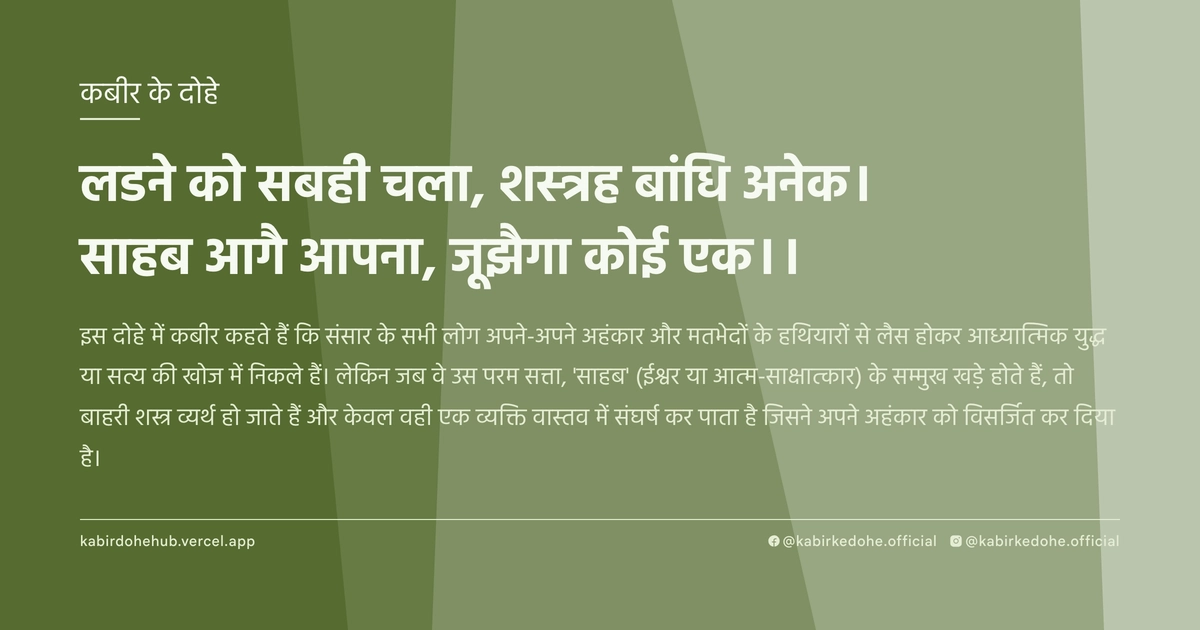
लडने को सबही चला, शस्त्रह बांधि अनेक।
साहब आगै आपना, जूझैगा कोई एक।।
Ladne ko sabhi chala, shastrah baandhi anek. Sahab aage aapna, joojhaiga koi ek.
इस पृष्ठ पर इस कबीर दोहे का अर्थ (meaning), हिंदी व्याख्या और अंग्रेज़ी अनुवाद, दार्शनिक विश्लेषण और व्यावहारिक जीवन सीख दी गई है। यह दोहा अहंकार (The Ego) विषय से जुड़ा है — Kabir doha meaning and explanation in Hindi and English.
अर्थ (Meaning):
इस दोहे में कबीर कहते हैं कि संसार के सभी लोग अपने-अपने अहंकार और मतभेदों के हथियारों से लैस होकर आध्यात्मिक युद्ध या सत्य की खोज में निकले हैं। लेकिन जब वे उस परम सत्ता, 'साहब' (ईश्वर या आत्म-साक्षात्कार) के सम्मुख खड़े होते हैं, तो बाहरी शस्त्र व्यर्थ हो जाते हैं और केवल वही एक व्यक्ति वास्तव में संघर्ष कर पाता है जिसने अपने अहंकार को विसर्जित कर दिया है।
In this couplet, Kabir observes that everyone sets out for the spiritual battle of truth, armed with various weapons of ego, dogma, and intellectual pride. However, when they finally stand before the 'Sahab' (the Divine or the Absolute Truth), these external armaments prove useless. Only the one who has transcended the ego is capable of truly engaging with the Divine essence.
व्याख्या (Interpretation):
कबीर यहाँ 'लड़ने' और 'शस्त्र' का प्रयोग रूपक के रूप में कर रहे हैं। शस्त्र केवल भौतिक तलवारें नहीं, बल्कि हमारी धार्मिक कट्टरता, सामाजिक प्रतिष्ठा और बौद्धिक अहंकार हैं। जब साधक कहता है कि वह सत्य को जानता है, तो वह वास्तव में अपने अहंकार के शस्त्र से लड़ रहा होता है। निर्गुण भक्ति के अनुसार, ईश्वर किसी बाहरी आडंबर या शास्त्र ज्ञान से नहीं, बल्कि हृदय की सरलता से मिलता है। 'साहब' का अर्थ यहाँ उस निराकार ब्रह्म से है जो द्वैत से परे है। जब व्यक्ति इस अद्वैत अवस्था में पहुँचता है, तो वह पाता है कि लड़ने वाला और जिससे लड़ा जा रहा था, दोनों एक ही हैं। यह विरोधाभास ही मानव स्थिति का केंद्र है: हम जिसे खोजने बाहर निकलते हैं, वह हमारे भीतर ही छिपा है, लेकिन हमारा अहंकार ही सबसे बड़ी बाधा है।
Kabir employs 'fighting' and 'weapons' as metaphors for the human struggle with the ego. These weapons are not physical blades but represent religious bigotry, social status, and intellectual arrogance. When a seeker claims to possess the truth, they are merely wielding the weapon of their own pride. In the tradition of Nirgun Bhakti, the Divine is not accessed through ritualistic armor or scriptural mastery, but through the simplicity of the heart. 'Sahab' refers to the formless Brahman, existing beyond all dualities. Upon reaching this state of Advaita (non-duality), the seeker realizes that the fighter and the fought are one and the same. This paradox defines the human condition: the very tools we use to seek the Truth are the obstacles that keep us separated from it.
दार्शनिक विश्लेषण (Philosophical Analysis):
कबीर का यह दोहा उस सामाजिक और धार्मिक परिवेश की प्रतिक्रिया है जहाँ मध्यकालीन भारत में विभिन्न संप्रदायों के बीच शास्त्रार्थ और कट्टरता चरम पर थी। कबीर ने देखा कि लोग धर्म के नाम पर शस्त्र उठाते थे, चाहे वे भौतिक हों या वैचारिक। उनका प्रहार उन लोगों पर है जो मानते हैं कि केवल विशिष्ट ग्रंथों के ज्ञान या कठिन तपस्या से मोक्ष मिल सकता है। यह दृष्टिकोण अद्वैत वेदांत के करीब है, जहाँ माया को वह पर्दा माना गया है जो आत्मा को ब्रह्म से अलग करता है।
सूफी मत के 'फना' (अहंकार का विनाश) के सिद्धांत के साथ इसका गहरा संबंध है। जब तक 'मैं' जीवित है, तब तक 'वह' (ईश्वर) प्रकट नहीं हो सकता। कबीर तर्क देते हैं कि आध्यात्मिक मार्ग पर चलने वाले अधिकांश लोग वास्तव में अपनी श्रेष्ठता सिद्ध करने की होड़ में होते हैं, जो कि एक प्रकार का मानसिक युद्ध है। यह युद्ध बाहरी नहीं, आंतरिक है।
ritualism या कर्मकांडों का विरोध करते हुए कबीर यह स्पष्ट करते हैं कि बाहरी दिखावा केवल एक ढाल है जो हमें वास्तविक आत्म-साक्षात्कार से बचाती है। वे कहते हैं कि जब आप उस परम सत्य के सामने खड़े होंगे, तो आपकी जाति, आपका पद और आपकी विद्वत्ता कोई मायने नहीं रखेगी। केवल वह 'एक' बचेगा जिसने स्वयं को शून्य कर लिया है।
मनोवैज्ञानिक स्तर पर, यह दोहा संज्ञानात्मक विसंगति (cognitive dissonance) को दर्शाता है। हम सत्य की खोज का दावा तो करते हैं, लेकिन हम अपनी पूर्व-स्थापित धारणाओं (weapons) को छोड़ने को तैयार नहीं होते। वास्तविक परिवर्तन तब होता है जब व्यक्ति अपनी बौद्धिक श्रेष्ठता के हथियार डाल देता है।
अंततः, कबीर यह संदेश देते हैं कि सत्य कोई ऐसी वस्तु नहीं है जिसे जीता जा सके या जिसके लिए लड़ा जाए। सत्य वह है जिसमें विलीन हो जाया जाए। जो 'जूझने' की बात कर रहा है, वह वास्तव में अपने ही भीतर के अंधकार से लड़ रहा है, और जीत केवल उसी की होती है जो हारना सीख जाता है।
This couplet is a poignant reaction to the socio-religious climate of medieval India, where sectarian conflicts and dogmatic debates were rampant. Kabir observed that people wielded weapons in the name of religion—whether physical blades or ideological rigidity. He attacks the notion that salvation is a trophy won through scriptural mastery or rigorous asceticism, aligning his thought with Advaita Vedanta, where Maya is the veil separating the Atman from Brahman.
There is a profound connection here to the Sufi concept of 'Fana' (the annihilation of the self). As long as the 'I' persists, the Divine cannot manifest. Kabir argues that most spiritual seekers are actually engaged in a psychological war to prove their superiority over others, mistaking this ego-driven competition for a spiritual quest.
By rejecting ritualism, Kabir clarifies that external observances are merely shields that protect the ego from the terrifying vulnerability of true self-realization. He asserts that when one stands before the Absolute Truth, caste, rank, and scholarship become irrelevant. Only the 'one' who has become a void remains.
Psychologically, this reflects the struggle with cognitive dissonance. We claim to seek Truth, yet we refuse to surrender our preconceived notions—our intellectual weapons. True transformation occurs only when the individual lays down the armor of perceived superiority.
Ultimately, Kabir suggests that Truth is not an object to be conquered or a prize to be won. Truth is that in which one must dissolve. The 'struggle' mentioned is actually an internal battle against one's own darkness, and victory belongs only to the one who learns the art of surrender.
मूल संदेश (Core Message):
- बौद्धिक अहंकार सत्य के मार्ग में सबसे बड़ा अवरोध है।
- सच्ची आध्यात्मिक जीत स्वयं के अहंकार के विसर्जन में है।
- बाहरी शस्त्र और कर्मकांड आत्मा की खोज में व्यर्थ हैं।
- जब 'मैं' मिटता है, तभी 'परम' का साक्षात्कार होता है।
- मौन और विनम्रता ही ईश्वर तक पहुँचने के वास्तविक सेतु हैं।
- Intellectual arrogance is the greatest obstacle on the path to Truth.
- True spiritual victory lies in the dissolution of the individual ego.
- External rituals and dogmas are useless in the quest for the Soul.
- Only when the 'I' vanishes does the 'Absolute' manifest.
- Silence and humility are the only authentic bridges to the Divine.
व्यावहारिक उदाहरण (Practical Example):
वाराणसी के एक पुराने घाट पर माधव नाम का एक वृद्ध विद्वान रहता था। उसने जीवन भर वेदों और शास्त्रों का अध्ययन किया था और उसे विश्वास था कि उसका ज्ञान ही उसे मोक्ष दिलाएगा। वह अक्सर अन्य साधकों के साथ शास्त्रार्थ करता और अपनी तर्कों की तलवार से उन्हें पराजित करता। वह मानता था कि वह आध्यात्मिक युद्ध का सबसे बड़ा योद्धा है।
एक दिन, उसी घाट पर एक साधारण सा बुनकर आया, जो चुपचाप बैठा रहता था और केवल अपनी माला जपता था। माधव ने उसे नीचा दिखाने के लिए कठिन दार्शनिक प्रश्न पूछे। बुनकर ने केवल मुस्कुराकर कहा, "बाबा, आप शब्दों से लड़ रहे हैं, मैं मौन से मिल रहा हूँ।"
माधव को यह बात चुभी। उसने और अधिक आक्रामक होकर अपने ज्ञान के शस्त्र चलाए। लेकिन बुनकर की शांति ने माधव के भीतर एक हलचल पैदा कर दी। उसे महसूस हुआ कि उसकी सारी विद्वत्ता केवल एक अहंकार थी, एक ऐसा शस्त्र जिसे वह दूसरों को दबाने के लिए उपयोग कर रहा था, न कि स्वयं को जानने के लिए।
उस रात माधव को नींद नहीं आई। उसने सोचा कि वह जिस 'साहब' को खोजने का दावा करता है, वह वास्तव में उसके अहंकार के नीचे दबा हुआ है। उसने महसूस किया कि वह अब तक केवल एक मानसिक युद्ध लड़ रहा था, जबकि वास्तविक यात्रा तो समर्पण की थी।
अगली सुबह, माधव ने अपने सभी ग्रंथों को एक तरफ रखा और उस बुनकर के पास गया। उसने अपनी विद्वत्ता का अहंकार त्याग दिया और पहली बार विनम्रता से पूछा, "मुझे वह मौन सिखाओ।"
बुनकर ने कहा, "जब तक आप यह सोचेंगे कि आप कुछ सीख रहे हैं, तब तक आप लड़ रहे होंगे। जिस दिन आप यह मान लेंगे कि आप कुछ भी नहीं हैं, उसी दिन आप साहब से मिल जाएंगे।"
माधव की आँखों से आँसू बहने लगे। उसे समझ आया कि उसके शास्त्रों के शस्त्र उसे सत्य से दूर ले जा रहे थे। उसने अपनी पहचान एक 'विद्वान' के रूप में मिटा दी और एक साधारण जिज्ञासु बन गया।
धीरे-धीरे, माधव का व्यवहार बदल गया। वह अब दूसरों को सही साबित करने की कोशिश नहीं करता था। उसने पाया कि जब उसने लड़ना बंद किया, तो उसके भीतर एक असीम शांति का जन्म हुआ।
उसने जाना कि असली युद्ध बाहरी दुनिया या अन्य लोगों से नहीं, बल्कि अपने भीतर के उस 'मैं' से था जो खुद को श्रेष्ठ समझता था।
अंत में, माधव ने महसूस किया कि वह 'एक' व्यक्ति जो वास्तव में जूझ पाया, वह वह था जिसने अपने शस्त्र डाल दिए थे। उसकी जीत उसकी हार में छिपी थी।
On an ancient ghat in Varanasi lived an elderly scholar named Madhav. He had spent his life studying the Vedas and Shastras, convinced that his intellectual prowess was the sole key to liberation. He frequently engaged in debates with other seekers, using his logical arguments like swords to defeat them. He believed himself to be the greatest warrior in the spiritual battle.
One day, a simple weaver arrived at the ghat. He remained silent, quietly chanting his beads. Seeking to humble the man, Madhav approached him with complex philosophical questions. The weaver merely smiled and replied, "Baba, you are fighting with words; I am meeting the Divine through silence."
This response stung Madhav. He became more aggressive, wielding his knowledge as a weapon to prove the weaver's ignorance. However, the weaver's unwavering peace triggered a turmoil within Madhav. He realized that his entire scholarship was merely a facade for his ego—a weapon used to suppress others rather than to discover himself.
That night, Madhav could not sleep. He contemplated how the 'Sahab' he claimed to seek was actually buried beneath layers of his own pride. He realized he had been fighting a mental war, while the true journey required total surrender.
The next morning, Madhav set aside his texts and approached the weaver. Casting away his intellectual arrogance, he asked with genuine humility, "Teach me that silence."
The weaver replied, "As long as you think you are learning, you are still fighting. The day you accept that you are nothing, you will find the Sahab."
Tears streamed down Madhav's face. He understood that his scriptural weapons were actually barriers separating him from the Truth. He erased his identity as a 'scholar' and became a simple seeker.
Gradually, Madhav's behavior transformed. He stopped trying to prove others wrong. He discovered that when he stopped fighting, an infinite peace blossomed within him.
He learned that the real battle was not against the world or other people, but against the 'I' within him that insisted on being superior.
Finally, Madhav realized that the 'one' person who truly succeeded in the struggle was the one who had the courage to lay down his weapons. His victory lay in his surrender.
अभ्यास मार्गदर्शन (Practice Guidance):
- दैनिक मौन अभ्यास: प्रतिदिन 30 मिनट पूर्ण मौन में बैठें। जब भी मन में किसी को सही साबित करने या बहस करने की इच्छा जागे, तो उसे एक 'शस्त्र' के रूप में पहचानें और उसे मानसिक रूप से त्याग दें।
- अहंकार की डायरी: दिन भर में उन क्षणों को लिखें जब आपने अपनी श्रेष्ठता प्रदर्शित करने की कोशिश की। विश्लेषण करें कि उस समय आप किस 'शस्त्र' (ज्ञान, पद, धन) का उपयोग कर रहे थे।
- समर्पण का अभ्यास: किसी ऐसे व्यक्ति की बात सुनें जिससे आप असहमत हैं, बिना किसी प्रतिक्रिया या तर्क के। केवल सुनने का प्रयास करें, जीतने का नहीं।
- निदान चेकलिस्ट: क्या मैं बातचीत में समाधान खोज रहा हूँ या जीत? क्या मेरी शांति दूसरों की सहमति पर निर्भर है? क्या मैं अपनी पहचान को अपने ज्ञान या उपलब्धियों से जोड़कर देख रहा हूँ?
- Daily Silence Practice: Sit in complete silence for 30 minutes daily. Whenever the urge to prove someone wrong or win an argument arises, identify it as a 'weapon' and consciously release it.
- Ego Journaling: Record moments throughout the day when you attempted to demonstrate your superiority. Analyze which 'weapon' (knowledge, status, wealth) you were wielding at that moment.
- Practice of Surrender: Listen to someone you fundamentally disagree with without reacting or arguing. Focus entirely on listening, not on winning the exchange.
- Diagnostic Checklist: Am I seeking a resolution or a victory in my conversations? Is my inner peace dependent on others' agreement? Am I tying my identity to my knowledge or achievements?
चिंतन प्रश्न (Reflection Questions):
- मेरे जीवन में वे कौन से 'शस्त्र' हैं जिन्हें मैं अपनी पहचान मान बैठा हूँ?
- क्या मेरी आध्यात्मिक खोज वास्तव में सत्य के लिए है, या केवल मेरी श्रेष्ठता सिद्ध करने के लिए?
- जब मैं किसी से बहस करता हूँ, तो मैं सत्य को खोज रहा होता हूँ या अपनी जीत को?
- यदि मेरी सारी डिग्रियाँ, पद और ज्ञान छीन लिए जाएँ, तो मेरे भीतर क्या बचेगा?
- क्या मैं उस सत्य को स्वीकार करने के लिए तैयार हूँ जो मेरे वर्तमान विश्वासों को पूरी तरह नष्ट कर दे?
- मेरी डिजिटल पहचान (सोशल मीडिया) किस प्रकार मेरे अहंकार के शस्त्रों को धार दे रही है?
- What are the 'weapons' in my life that I have mistaken for my identity?
- Is my spiritual quest truly for the Truth, or merely to validate my own superiority?
- When I argue, am I searching for the Truth or for my own victory?
- If all my degrees, titles, and knowledge were stripped away, what would remain within me?
- Am I prepared to accept a Truth that completely annihilates my current beliefs?
- How is my digital identity (social media) sharpening the weapons of my ego?