
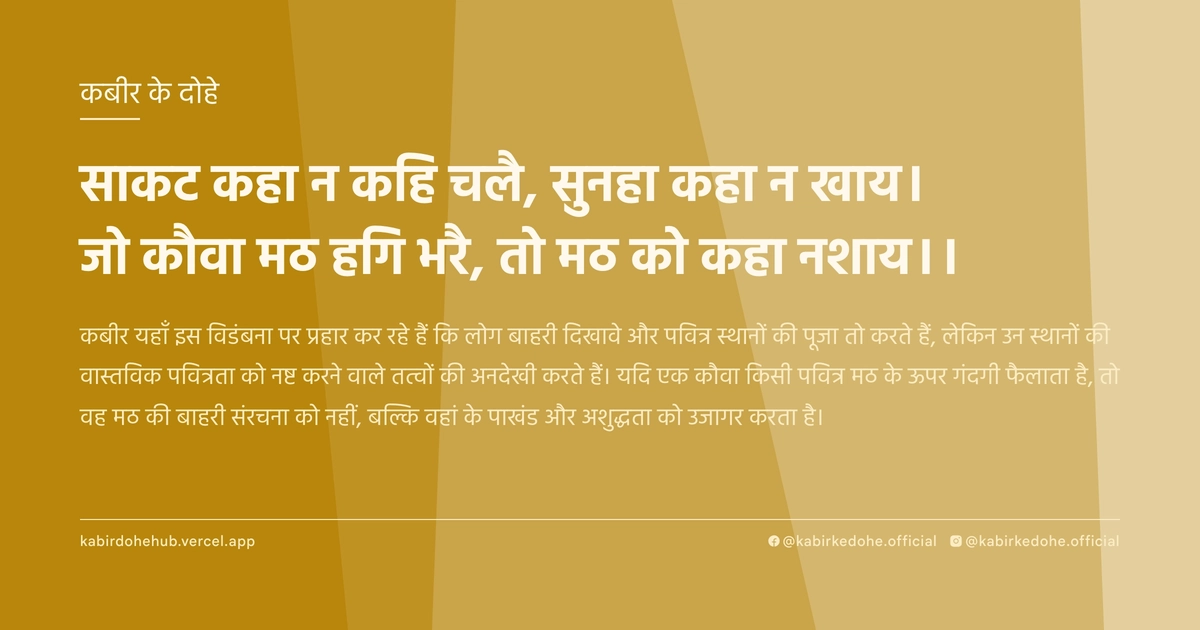
साकट कहा न कहि चलै, सुनहा कहा न खाय।
जो कौवा मठ हगि भरै, तो मठ को कहा नशाय।।
Saakat kaha na kahi chalai, sunha kaha na khaaye. Jo kauwa math hagi bharai, to math ko kaha nashaye.
इस पृष्ठ पर इस कबीर दोहे का अर्थ (meaning), हिंदी व्याख्या और अंग्रेज़ी अनुवाद, दार्शनिक विश्लेषण और व्यावहारिक जीवन सीख दी गई है। यह दोहा धार्मिक पाखंड (Religious Hypocrisy) विषय से जुड़ा है — Kabir doha meaning and explanation in Hindi and English.
अर्थ (Meaning):
कबीर यहाँ इस विडंबना पर प्रहार कर रहे हैं कि लोग बाहरी दिखावे और पवित्र स्थानों की पूजा तो करते हैं, लेकिन उन स्थानों की वास्तविक पवित्रता को नष्ट करने वाले तत्वों की अनदेखी करते हैं। यदि एक कौवा किसी पवित्र मठ के ऊपर गंदगी फैलाता है, तो वह मठ की बाहरी संरचना को नहीं, बल्कि वहां के पाखंड और अशुद्धता को उजागर करता है।
Kabir critiques the irony of people venerating external symbols of holiness while ignoring the internal decay. He suggests that if a crow defiles a monastery with its droppings, it does not destroy the sanctuary's essence, but rather exposes the superficiality of those who believe holiness resides in bricks and mortar rather than in the purity of the soul.
व्याख्या (Interpretation):
शाब्दिक अर्थ में, यह दोहा एक कौवे द्वारा मठ को गंदा करने की बात करता है, लेकिन रूपकात्मक रूप से 'कौवा' उस कड़वे सत्य या उस आलोचक का प्रतीक है जो धार्मिक पाखंड को उजागर करता है। 'मठ' यहाँ संगठित धर्म और अहंकार से भरे संस्थानों का प्रतिनिधित्व करता है। निर्गुण भक्ति के परिप्रेक्ष्य में, कबीर यह समझा रहे हैं कि ईश्वर किसी विशेष इमारत में नहीं, बल्कि अंतरात्मा में बसता है। माया हमें बाहरी कर्मकांडों में उलझाती है, जिससे हम यह भूल जाते हैं कि वास्तविक पवित्रता मन की शुद्धि में है। यह दोहा द्वैतवाद के भ्रम को तोड़ता है और यह दर्शाता है कि जिसे हम 'अपवित्र' मानकर तिरस्कृत करते हैं, वह वास्तव में हमारी अपनी मानसिक सीमाओं का दर्पण होता है।
Literally, the verse speaks of a crow defiling a monastery, but metaphorically, the 'crow' represents the harsh truth or the critic who exposes religious hypocrisy. The 'monastery' symbolizes organized religion and institutions bloated by ego. Within the framework of Nirgun Bhakti, Kabir asserts that the Divine does not reside in specific structures but within the inner self. Maya entangles us in external rituals, blinding us to the fact that true sanctity lies in the purification of the mind. This doha shatters the illusion of duality, suggesting that what we perceive as 'impure' or 'defiling' is actually a mirror reflecting our own mental limitations and attachments to form.
दार्शनिक विश्लेषण (Philosophical Analysis):
कबीर का यह दोहा उनके युग के गहरे सामाजिक और धार्मिक संघर्षों को दर्शाता है, जहाँ धर्म केवल बाहरी प्रतीकों, जैसे कि मंदिरों और मठों, तक सीमित हो गया था। वे जाति व्यवस्था और कर्मकांडीय शुद्धता के विचार को पूरी तरह नकारते हैं। उनके लिए, एक पवित्र स्थान की 'अपवित्रता' केवल एक भौतिक घटना है, जबकि वास्तविक अपवित्रता मनुष्य के भीतर का अहंकार और घृणा है।
अद्वैत वेदांत के दृष्टिकोण से, कबीर यह तर्क दे रहे हैं कि यदि सब कुछ ब्रह्म है, तो कोई भी वस्तु या जीव वास्तव में 'अपवित्र' नहीं हो सकता। कौवे की गंदगी और मठ की पवित्रता का भेद केवल मानवीय धारणाओं (माया) में है। जब साधक इस भेद को मिटा देता है, तब वह देखता है कि संपूर्ण अस्तित्व एक ही चेतना का विस्तार है।
सूफीवाद के प्रभाव में, यहाँ 'फना' या अहंकार के विनाश की बात है। मठ का 'नष्ट' होना वास्तव में उस झूठे अहंकार का नष्ट होना है जो खुद को दूसरों से श्रेष्ठ मानता है। कबीर यह संदेश देते हैं कि सत्य को खोजने के लिए हमें उन दीवारों को गिराना होगा जो हमने 'पवित्र' और 'अपवित्र' के बीच खड़ी की हैं।
मनोवैज्ञानिक रूप से, यह दोहा हमारे 'कन्फर्मेशन बायस' पर प्रहार करता है। हम केवल वही देखना चाहते हैं जो हमारी मान्यताओं के अनुकूल हो। जब कोई अप्रिय सत्य (कौवा) हमारी मान्यताओं (मठ) पर प्रहार करता है, तो हम उसे गंदगी मानते हैं, जबकि वह वास्तव में हमारी चेतना को जगाने वाला एक झटका होता है।
अंततः, कबीर यह स्पष्ट करते हैं कि धर्म का उद्देश्य बाहरी संरचनाओं का संरक्षण नहीं, बल्कि आंतरिक रूपांतरण है। यदि कोई संस्थान सत्य की कसौटी पर खरा नहीं उतरता, तो उसकी बाहरी भव्यता निरर्थक है। वास्तविक भक्ति वह है जो बिना किसी भेदभाव के हर जीव में उसी एक निराकार तत्व को देखे।
This doha reflects the profound social and religious tensions of Kabir's era, where spirituality had been reduced to external symbols like temples and monasteries. He vehemently rejects the notions of caste-based purity and ritualistic sanctity. For Kabir, the 'defilement' of a holy site is merely a physical event, whereas true impurity resides in human ego and hatred.
From the lens of Advaita Vedanta, Kabir argues that if everything is Brahman, then no object or being can be inherently 'impure.' The distinction between the crow's droppings and the monastery's sanctity exists only within human perceptions (Maya). Once the seeker transcends this duality, they realize that the entire existence is an extension of a single consciousness.
Influenced by Sufism, there is an implicit call for 'Fana' or the annihilation of the ego. The 'destruction' of the monastery is actually the dismantling of the false ego that deems itself superior to others. Kabir suggests that to find the Truth, one must tear down the walls constructed between the 'sacred' and the 'profane.'
Psychologically, this verse attacks our confirmation bias. We tend to see only what aligns with our preconceived notions. When an unpleasant truth (the crow) strikes our beliefs (the monastery), we perceive it as filth, whereas it is actually a catalyst for awakening our dormant consciousness.
Ultimately, Kabir clarifies that the purpose of religion is not the preservation of external structures but internal transformation. If an institution fails the test of truth, its outward grandeur is meaningless. True devotion is that which perceives the same formless element in every living being without discrimination.
मूल संदेश (Core Message):
- बाहरी पवित्रता एक भ्रम है; वास्तविक शुद्धि अंतरात्मा में होती है।
- अहंकार वह गंदगी है जिसे कोई भी बाहरी अनुष्ठान नहीं धो सकता।
- सत्य अक्सर उन रूपों में आता है जिन्हें हम 'अपवित्र' मानकर नकार देते हैं।
- संस्थानों की भव्यता उनकी आध्यात्मिक गहराई की गारंटी नहीं होती।
- जब हम भेद मिटाते हैं, तब हम वास्तव में ईश्वर से मिलते हैं।
- External purity is an illusion; true sanctity resides within the soul.
- Ego is the filth that no external ritual can ever cleanse.
- Truth often arrives in forms that we reject as 'impure.'
- The grandeur of institutions does not guarantee spiritual depth.
- When we erase distinctions, we truly encounter the Divine.
व्यावहारिक उदाहरण (Practical Example):
वाराणसी के एक पुराने मोहल्ले में रामदीन नाम का एक वृद्ध बुनकर रहता था। वह अपनी ईमानदारी और सादगी के लिए जाना जाता था, लेकिन मोहल्ले के कुछ प्रभावशाली लोग उसे 'अछूत' मानकर अपने सामाजिक दायरे से बाहर रखते थे।
उसी मोहल्ले में एक भव्य मंदिर था, जिसे शहर के सबसे अमीर सेठ ने बनवाया था। सेठ खुद को बहुत धार्मिक मानता था और मंदिर की बाहरी चमक-धमक पर बहुत गर्व करता था।
एक दिन, मंदिर के मुख्य शिखर पर एक कौवे ने गंदगी कर दी। सेठ यह देखकर क्रोधित हो उठा और उसने इसे एक 'अपशकुन' माना। उसने पूरे मंदिर को शुद्ध करने के लिए हज़ारों रुपये खर्च किए और बड़े-बड़े पंडितों को बुलाया।
रामदीन यह सब देख रहा था। उसने विनम्रता से कहा, 'सेठ जी, कौवे ने तो केवल पत्थर को गंदा किया है, जिसे पानी से धोया जा सकता है। लेकिन आपके मन में जो इस गरीब के प्रति घृणा है, उसे किस पानी से धोएंगे?'
सेठ को पहले तो बहुत गुस्सा आया, लेकिन रामदीन की बातों ने उसे सोचने पर मजबूर कर दिया। उसने महसूस किया कि वह मंदिर की दीवारों को तो चमका रहा था, लेकिन उसका हृदय ईर्ष्या और अहंकार की गंदगी से भरा था।
रामदीन ने उसे समझाया कि असली मंदिर वह है जहाँ मनुष्य की सेवा हो, न कि वह जहाँ केवल सोने की परतें चढ़ी हों।
सेठ ने पहली बार रामदीन के सामने सिर झुकाया और अपनी गलती मानी। उसने महसूस किया कि जिस व्यक्ति को वह 'अपवित्र' समझता था, वही वास्तव में सबसे पवित्र था क्योंकि उसका मन निर्मल था।
उस दिन के बाद, सेठ ने मंदिर के बाहरी दिखावे के बजाय मोहल्ले के गरीबों की शिक्षा और स्वास्थ्य पर ध्यान देना शुरू किया।
रामदीन और सेठ के बीच का यह संवाद पूरे मोहल्ले के लिए एक मिसाल बन गया, जहाँ लोगों ने बाहरी शुद्धता के बजाय आंतरिक करुणा को महत्व देना शुरू किया।
यह 'कबीर ट्विस्ट' था—एक कौवे की गंदगी ने उस अहंकार को नष्ट कर दिया जिसने खुद को धर्म का रक्षक मान लिया था।
In an old neighborhood of Varanasi lived an elderly weaver named Ramdeen. He was known for his honesty and simplicity, yet some influential locals shunned him, labeling him 'untouchable' and keeping him outside their social circles.
In the same neighborhood stood a magnificent temple, built by the city's wealthiest merchant. The merchant considered himself deeply religious and took immense pride in the temple's external opulence.
One day, a crow defiled the main spire of the temple. Seeing this, the merchant became enraged, viewing it as an 'ill omen.' He spent thousands of rupees to purify the temple and summoned high priests for elaborate rituals.
Ramdeen witnessed this. He humbly remarked, 'Seth ji, the crow has only soiled the stone, which can be washed with water. But the hatred in your heart for this poor man—with what water will you wash that?'
Initially, the merchant was furious, but Ramdeen's words forced him into deep contemplation. He realized that while he was polishing the temple walls, his heart was caked with the filth of envy and arrogance.
Ramdeen explained that the true temple is where humanity is served, not where gold leaf is applied to walls.
For the first time, the merchant bowed his head before Ramdeen and admitted his fault. He realized that the man he deemed 'impure' was actually the purest of all because his mind was serene.
From that day forward, the merchant shifted his focus from the temple's outward display to the education and health of the neighborhood's poor.
The dialogue between Ramdeen and the merchant became a legend in the locality, prompting people to value internal compassion over external purity.
This was the 'Kabir Twist'—the droppings of a crow destroyed the ego of a man who believed himself to be the guardian of faith.
अभ्यास मार्गदर्शन (Practice Guidance):
- दैनिक चिंतन: प्रतिदिन 15 मिनट यह विचार करें कि आप किन बाहरी प्रतीकों (पद, प्रतिष्ठा, धर्म) को अपनी पहचान मान रहे हैं और क्या वे आपकी आंतरिक शांति में बाधा डाल रहे हैं।
- आत्म-पूछताछ जर्नल: लिखें कि हाल ही में आपने किसे 'अपवित्र' या 'गलत' माना। विश्लेषण करें कि क्या यह निर्णय आपके पूर्वाग्रहों पर आधारित था या वास्तविक सत्य पर।
- व्यवहारिक परिवर्तन: जानबूझकर उन लोगों के साथ समय बिताएं जिन्हें समाज 'निम्न' मानता है, और उनमें उस एक निराकार चेतना को खोजने का प्रयास करें।
- डायग्नोस्टिक चेकलिस्ट: यदि आप किसी की गलती पर तुरंत क्रोधित होते हैं या खुद को दूसरों से नैतिक रूप से श्रेष्ठ महसूस करते हैं, तो समझ लें कि आपका 'मठ' (अहंकार) अभी भी कायम है।
- Daily Contemplation: Spend 15 minutes reflecting on the external symbols (status, prestige, religion) you identify with and whether they hinder your inner peace.
- Self-Inquiry Journal: Document instances where you recently labeled someone as 'impure' or 'wrong.' Analyze if this judgment was based on prejudice or objective truth.
- Behavioral Shift: Consciously spend time with those marginalized by society, attempting to recognize the single formless consciousness within them.
- Diagnostic Checklist: If you react with immediate anger to others' flaws or feel morally superior, recognize that your 'monastery' (ego) is still intact.
चिंतन प्रश्न (Reflection Questions):
- मेरे जीवन का वह 'मठ' क्या है जिसे मैं दुनिया की नजरों में पवित्र बनाए रखने की कोशिश कर रहा हूँ?
- क्या मेरी धार्मिक या नैतिक मान्यताएं मुझे दूसरों के प्रति अधिक दयालु बनाती हैं, या अधिक निर्णयात्मक?
- यदि मेरा सामाजिक सम्मान और पद अचानक छिन जाए, तो मेरे भीतर क्या बचेगा?
- मैं अपनी डिजिटल पहचान (सोशल मीडिया) को कितना 'पवित्र' और 'आदर्श' दिखाने की कोशिश करता हूँ, और मेरा वास्तविक स्वरूप उससे कितना अलग है?
- क्या मैं सत्य को स्वीकार करने के लिए तैयार हूँ, भले ही वह मेरी सबसे प्रिय मान्यताओं को 'गंदा' कर दे?
- What is the 'monastery' in my life that I strive to keep sacred in the eyes of the world?
- Do my religious or moral beliefs make me more compassionate toward others, or more judgmental?
- If my social status and titles were suddenly stripped away, what would remain of me?
- How much do I curate my digital identity to appear 'pure' and 'ideal,' and how far does it deviate from my actual self?
- Am I ready to accept the truth, even if it 'defiles' my most cherished beliefs?