
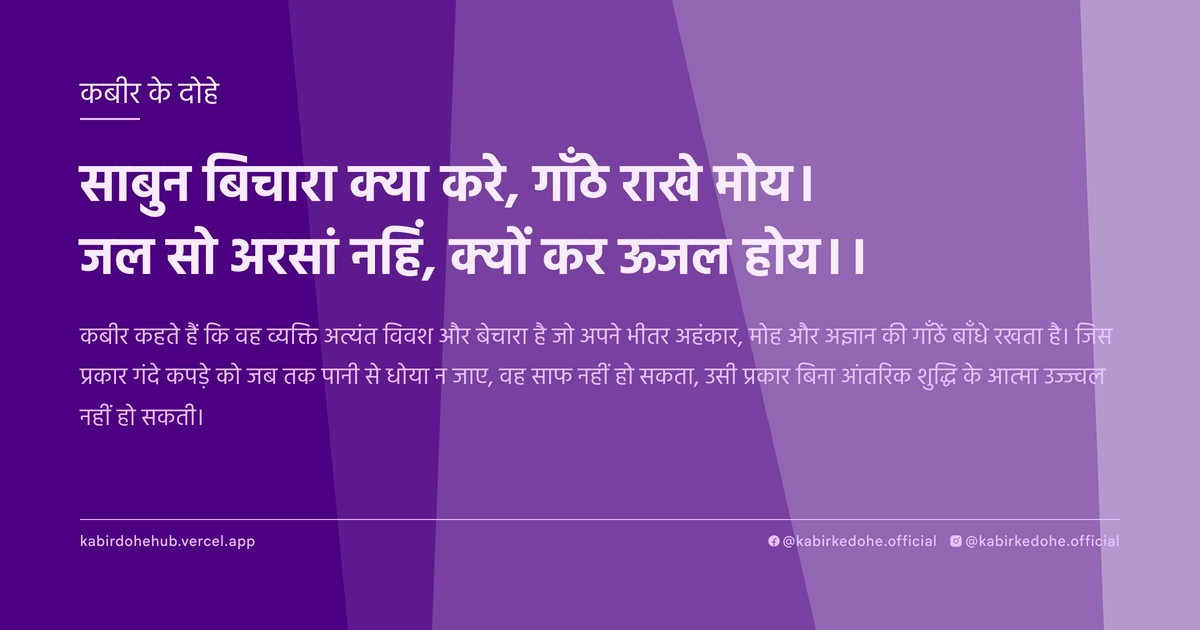
साबुन बिचारा क्या करे, गाँठे राखे मोय।
जल सो अरसां नहिं, क्यों कर ऊजल होय।।
Saabun bichaara kya kare, gaanthe raakhe moy. Jal so arsaan nahin, kyun kar ujal hoye.
इस पृष्ठ पर इस कबीर दोहे का अर्थ (meaning), हिंदी व्याख्या और अंग्रेज़ी अनुवाद, दार्शनिक विश्लेषण और व्यावहारिक जीवन सीख दी गई है। यह दोहा आत्मनिरीक्षण (Self-introspection) विषय से जुड़ा है — Kabir doha meaning and explanation in Hindi and English.
अर्थ (Meaning):
कबीर कहते हैं कि वह व्यक्ति अत्यंत विवश और बेचारा है जो अपने भीतर अहंकार, मोह और अज्ञान की गाँठें बाँधे रखता है। जिस प्रकार गंदे कपड़े को जब तक पानी से धोया न जाए, वह साफ नहीं हो सकता, उसी प्रकार बिना आंतरिक शुद्धि के आत्मा उज्ज्वल नहीं हो सकती।
Kabir laments the plight of the soul that clings to the knots of ego, attachment, and ignorance. Just as a soiled cloth cannot become clean without the purifying touch of water, the human spirit cannot attain luminosity and purity as long as it harbors internal contradictions and spiritual obstructions.
व्याख्या (Interpretation):
यहाँ 'गाँठ' मानसिक और आध्यात्मिक अवरोधों का प्रतीक है—जैसे क्रोध, लोभ और जातिगत श्रेष्ठता का भ्रम। कबीर का तर्क है कि हम बाहरी अनुष्ठानों से पवित्र होने का प्रयास करते हैं, लेकिन असली गंदगी भीतर है। 'जल' यहाँ केवल भौतिक पानी नहीं, बल्कि 'ज्ञान' और 'भक्ति' का प्रतीक है। जब तक साधक अपने अहंकार की गाँठों को नहीं खोलता, वह ब्रह्म के साथ एकाकार नहीं हो सकता। यह निरगुण भक्ति का सार है, जहाँ ईश्वर किसी मूर्ति में नहीं, बल्कि शुद्ध अंतःकरण में निवास करता है। माया हमें यह विश्वास दिलाती है कि हम इन गाँठों के बिना अधूरे हैं, जबकि सत्य यह है कि ये गाँठें ही हमें सत्य से दूर रखती हैं।
The 'knots' mentioned here symbolize psychological and spiritual blockages—specifically ego, greed, and the illusion of social superiority. Kabir argues that while humans strive for purity through external rituals, the actual impurity resides within the psyche. The 'water' is not literal H2O, but a metaphor for 'Gyan' (divine knowledge) and 'Bhakti' (devotion). Until the seeker unties the knots of the 'I-consciousness,' union with the Brahman is impossible. This aligns with Nirgun Bhakti, where the Divine is formless and accessible only through a purified heart. Maya creates the illusion that these attachments define us, whereas in reality, they are the very veils preventing the realization of the Atman's non-duality with the Universal Truth.
दार्शनिक विश्लेषण (Philosophical Analysis):
कबीर का यह दोहा मध्यकालीन भारत के सामाजिक और धार्मिक पाखंड पर एक गहरा प्रहार है। उस समय धर्म केवल कर्मकांडों और बाहरी दिखावे तक सीमित था। कबीर ने 'अद्वैत वेदांत' के इस सिद्धांत को अपनाया कि आत्मा और परमात्मा एक ही हैं, लेकिन उनके बीच 'अविद्या' (अज्ञान) की दीवार है। वे कहते हैं कि जब तक आप स्वयं को एक अलग इकाई (अहंकार) मानते हैं, आप उस 'गाँठ' को पकड़े हुए हैं जो आपको परमात्मा से अलग करती है।
सूफीवाद के प्रभाव में, कबीर 'फना' (अहंकार का विनाश) की बात करते हैं। जिस तरह सूफी संत खुदा में विलीन होने के लिए अपनी हस्ती को मिटाते हैं, कबीर भी उसी आंतरिक विलोपन की मांग करते हैं। उनके लिए पवित्रता का अर्थ गंगा स्नान नहीं, बल्कि मन का निर्मल होना है।
यह विश्लेषण हमें बताता है कि मनोवैज्ञानिक स्तर पर 'गाँठ' हमारे मानसिक आघात, पूर्वाग्रह और कंडीशनिंग हैं। हम अक्सर अपनी पहचान अपनी शिकायतों और अपनी उपलब्धियों से जोड़ लेते हैं, जो वास्तव में आध्यात्मिक बंधन हैं।
कबीर का विरोध केवल ब्राह्मणवाद या कट्टरपंथ से नहीं था, बल्कि उस हर मानसिक स्थिति से था जो मनुष्य को उसकी वास्तविक प्रकृति (शुद्ध चैतन्य) से दूर करती है। वे तर्क देते हैं कि ज्ञान केवल पुस्तकों से नहीं, बल्कि अनुभव से आता है।
अंततः, यह दोहा इस सत्य को स्थापित करता है कि मुक्ति बाहरी सहायता से नहीं, बल्कि आंतरिक समर्पण और आत्म-निरीक्षण से प्राप्त होती है। जब 'मैं' मिटता है, तभी 'वह' प्रकट होता है।
This couplet is a profound critique of the social and religious hypocrisy prevalent in medieval India, where spirituality was reduced to rote rituals and outward displays of piety. Kabir integrates the core tenet of Advaita Vedanta: that the Atman (individual soul) and Brahman (universal soul) are identical, yet separated by the veil of 'Avidya' (ignorance). The 'knot' represents the false identification of the self with the ego, creating a perceived duality where none exists.
Influenced by Sufism, Kabir advocates for a process akin to 'Fana'—the annihilation of the self. Just as Sufi mystics seek to dissolve their existence into the Divine, Kabir demands the dissolution of the ego-structure. For him, purity is not found in the waters of the Ganges but in the clarity of the consciousness.
Psychologically, these 'knots' are the cognitive biases, traumas, and social conditioning that we mistake for our identity. We anchor our existence in grievances and achievements, which are essentially spiritual shackles that bind us to the cycle of suffering.
Kabir's rebellion was not merely against casteism or orthodoxy, but against any mental construct that obscures the innate nature of the human spirit as pure consciousness. He posits that true knowledge is experiential ('Anubhava'), not scriptural.
Ultimately, the Doha establishes that liberation is not an external acquisition but an internal subtraction. It is the process of removing what is false to reveal what has always been true. When the 'I' vanishes, the 'All' emerges.
मूल संदेश (Core Message):
- बाहरी शुद्धि एक भ्रम है; वास्तविक पवित्रता आंतरिक विलोपन में है।
- अहंकार की गाँठें ही आत्मा और परमात्मा के बीच की एकमात्र बाधा हैं।
- ज्ञान वह जल है जो अज्ञान की सघनतम गाँठों को भी गला देता है।
- जब 'मैं' का बोध समाप्त होता है, तब सत्य का प्रकाश स्वतः प्रकट होता है।
- प्रेम और करुणा ही वे उपकरण हैं जिनसे अहंकार की गाँठें खुलती हैं।
- External purity is an illusion; true sanctity lies in internal dissolution.
- The knots of ego are the sole barriers between the soul and the Divine.
- Knowledge is the water that dissolves even the densest knots of ignorance.
- When the perception of 'I' ceases, the light of Truth manifests spontaneously.
- Love and compassion are the only tools capable of untying the knots of ego.
व्यावहारिक उदाहरण (Practical Example):
एक समय की बात है, बनारस के घाटों पर रामदीन नाम का एक वृद्ध बुनकर रहता था। रामदीन अपने काम में निपुण था, लेकिन उसका स्वभाव अत्यंत कठोर था। वह अपनी जाति और अपने पुराने ज्ञान के अहंकार में इतना डूबा था कि वह अपने ही पड़ोसियों को तुच्छ समझता था। वह मानता था कि उसकी शुद्धता उसके जन्म और उसके कठोर नियमों के पालन में है।
एक दिन, उसके घर में एक युवा साधु आया, जिसने कोई बाहरी चोला नहीं पहना था और न ही किसी विशेष संप्रदाय का दावा किया। साधु ने देखा कि रामदीन अपने कपड़ों को तो बहुत सावधानी से धोता है, लेकिन उसकी वाणी में कड़वाहट और मन में घृणा भरी है।
साधु ने रामदीन को एक गंदा, गाँठदार कपड़ा दिया और कहा, 'इसे साफ करो।' रामदीन ने उसे पानी में भिगोया, रगड़ा, लेकिन कपड़ा साफ नहीं हुआ क्योंकि उसमें कई सख्त गाँठें बंधी थीं, जिनके भीतर गंदगी फंसी हुई थी।
रामदीन झुंझलाकर बोला, 'यह कैसे संभव है? जब तक ये गाँठें नहीं खुलेंगी, पानी अंदर नहीं जा पाएगा और गंदगी बाहर नहीं आएगी!'
साधु मुस्कुराया और धीरे से कहा, 'रामदीन, तुम्हारा जीवन भी इसी कपड़े जैसा है। तुमने अपने भीतर क्रोध, श्रेष्ठता और नफरत की इतनी गाँठें बाँध रखी हैं कि ईश्वर की कृपा का जल तुम्हारे भीतर प्रवेश ही नहीं कर पा रहा। तुम बाहर से खुद को शुद्ध दिखाते हो, लेकिन भीतर की गाँठें तुम्हें काला बनाए हुए हैं।'
यह बात रामदीन के हृदय पर बिजली की तरह गिरी। उसे अहसास हुआ कि उसकी 'शुद्धता' का दावा वास्तव में उसका सबसे बड़ा बंधन था। उसने पहली बार महसूस किया कि वह जिसे अपनी मर्यादा समझ रहा था, वह वास्तव में उसका अहंकार था।
अगले कुछ महीनों में, रामदीन ने धीरे-धीरे अपने व्यवहार को बदलना शुरू किया। उसने उन लोगों की मदद करना शुरू किया जिन्हें वह पहले तुच्छ समझता था। उसने अपनी वाणी की कठोरता को करुणा में बदला।
जैसे-जैसे उसके मन की गाँठें खुलती गईं, उसे एक अजीब सी शांति और हल्कापन महसूस होने लगा। अब उसे मंदिर जाने या कठिन व्रत रखने की आवश्यकता नहीं थी; उसका हर कार्य ही एक प्रार्थना बन गया था।
अंत में, रामदीन ने पाया कि जब उसने 'मैं श्रेष्ठ हूँ' की गाँठ को खोल दिया, तो वह वास्तव में सबके साथ एक हो गया। उसकी आत्मा अब उस सफेद कपड़े की तरह उज्ज्वल हो गई थी जिसे वह जीवन भर बाहर से साफ करने की कोशिश कर रहा था।
Once, on the ghats of Varanasi, lived an elderly weaver named Ramdeen. Ramdeen was masterful in his craft, but his temperament was harsh. He was so consumed by the ego of his caste and his ancestral knowledge that he viewed his neighbors with contempt. He believed his purity lay in his birth and his strict adherence to ritualistic rules.
One day, a young wandering monk visited him. This monk wore no ornate robes and claimed no specific sect. He observed that while Ramdeen meticulously washed his physical clothes, his speech was laced with bitterness and his heart filled with disdain.
The monk handed Ramdeen a filthy piece of cloth tied into several tight, complex knots and asked him to clean it. Ramdeen soaked it in water and scrubbed it vigorously, but the cloth remained dirty because the grime was trapped deep within the knots.
Frustrated, Ramdeen exclaimed, 'This is impossible! Until these knots are untied, the water cannot penetrate the core, and the dirt cannot be washed away!'
The monk smiled and softly replied, 'Ramdeen, your life is exactly like this cloth. You have tied so many knots of anger, superiority, and hatred within yourself that the water of divine grace cannot enter. You present a facade of purity, but the internal knots keep you stained.'
These words struck Ramdeen like a bolt of lightning. He realized that his claim to purity was actually his greatest bondage. He understood that what he had mistaken for 'dignity' was merely his ego.
Over the following months, Ramdeen began to consciously alter his behavior. He started helping those he had previously dismissed as inferior. He transformed the harshness of his tongue into the softness of compassion.
As the knots of his mind loosened, he experienced an unprecedented sense of peace and lightness. He no longer felt the need for elaborate temple visits or grueling fasts; every act of service became a prayer.
Eventually, Ramdeen discovered that by untying the knot of 'I am superior,' he had finally become one with everyone. His soul became as luminous as the white cloth he had spent his entire life trying to clean from the outside.
अभ्यास मार्गदर्शन (Practice Guidance):
- प्रतिदिन 20 मिनट मौन ध्यान करें, जहाँ आप अपने भीतर उठने वाले क्रोध या ईर्ष्या के विचारों को केवल एक 'गाँठ' के रूप में देखें, बिना उनसे जुड़े।
- आत्म-पूछताछ जर्नल: हर रात लिखें—'आज मैंने किस बात पर अपनी श्रेष्ठता सिद्ध करने की कोशिश की?' और विश्लेषण करें कि वह कौन सी मानसिक गाँठ थी।
- व्यवहार परिवर्तन: दिन में कम से कम एक बार ऐसे व्यक्ति की निस्वार्थ मदद करें जिसे आप सामान्यतः पसंद नहीं करते या जिसे आप अपने से छोटा समझते हैं।
- निदान चेकलिस्ट: यदि आप किसी की आलोचना करते समय संतुष्टि महसूस करते हैं, या अपनी पहचान को अपनी उपलब्धियों से जोड़ते हैं, तो समझें कि आपकी 'गाँठें' अभी भी मौजूद हैं।
- Practice 20 minutes of silent meditation daily, observing arising thoughts of anger or jealousy simply as 'knots' without identifying with them.
- Self-Inquiry Journaling: Every night, record—'In what moment did I try to prove my superiority today?' and analyze which mental knot was triggered.
- Behavioral Shift: At least once a day, perform a selfless act of service for someone you typically dislike or perceive as inferior to you.
- Diagnostic Checklist: If you feel a sense of satisfaction while criticizing others, or if your self-worth is tied strictly to your achievements, recognize that your 'knots' are still intact.
चिंतन प्रश्न (Reflection Questions):
- मेरे व्यक्तित्व का वह कौन सा हिस्सा है जिसे मैं 'पवित्र' कहता हूँ, लेकिन वास्तव में वह केवल मेरा सामाजिक मुखौटा है?
- यदि मेरी सभी उपाधियाँ, संपत्ति और पारिवारिक प्रतिष्ठा छीन ली जाए, तो मेरे भीतर क्या बचेगा?
- मैं किन लोगों को अपने से 'नीचा' मानता हूँ, और यह धारणा मेरे भीतर किस प्रकार की गाँठ पैदा कर रही है?
- क्या मेरी धार्मिक आस्था मुझे विनम्र बना रही है, या यह मेरे अहंकार को एक नया आध्यात्मिक आधार दे रही है?
- मेरे जीवन की वह कौन सी पुरानी शिकायत है जिसे मैं एक गाँठ की तरह पकड़े हुए हूँ और छोड़ने से इनकार कर रहा हूँ?
- Which part of my personality do I label as 'pure,' while it is actually just a socially constructed mask?
- If all my titles, assets, and family prestige were stripped away, what would remain of my essence?
- Who are the people I perceive as 'inferior,' and what kind of internal knot does this prejudice create within me?
- Is my religious faith making me humble, or is it providing a new, spiritual foundation for my ego?
- What old grievance am I clutching like a knot, and why am I refusing to let it go?