
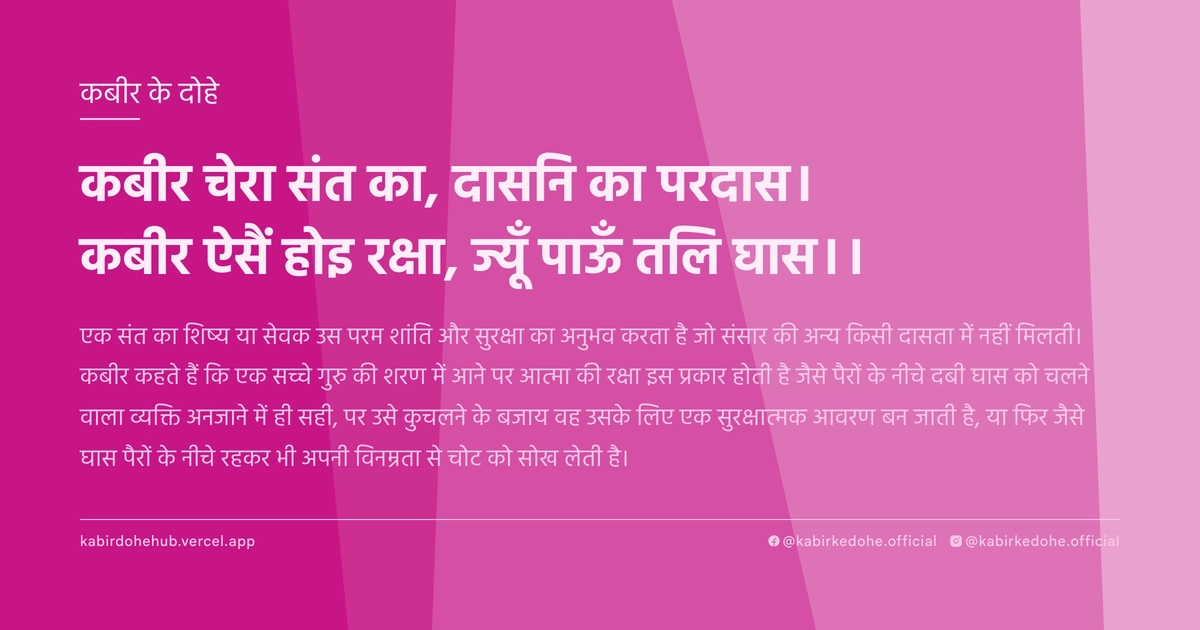
कबीर चेरा संत का, दासनि का परदास।
कबीर ऐसैं होइ रक्षा, ज्यूँ पाऊँ तलि घास।।
Kabir chera sant ka, dasani ka pardas. Kabir aisain hoye raksha, jyun paaun tali ghaas.
इस पृष्ठ पर इस कबीर दोहे का अर्थ (meaning), हिंदी व्याख्या और अंग्रेज़ी अनुवाद, दार्शनिक विश्लेषण और व्यावहारिक जीवन सीख दी गई है। यह दोहा गुरु महत्व (The Guru's Importance) विषय से जुड़ा है — Kabir doha meaning and explanation in Hindi and English.
अर्थ (Meaning):
एक संत का शिष्य या सेवक उस परम शांति और सुरक्षा का अनुभव करता है जो संसार की अन्य किसी दासता में नहीं मिलती। कबीर कहते हैं कि एक सच्चे गुरु की शरण में आने पर आत्मा की रक्षा इस प्रकार होती है जैसे पैरों के नीचे दबी घास को चलने वाला व्यक्ति अनजाने में ही सही, पर उसे कुचलने के बजाय वह उसके लिए एक सुरक्षात्मक आवरण बन जाती है, या फिर जैसे घास पैरों के नीचे रहकर भी अपनी विनम्रता से चोट को सोख लेती है।
A disciple of a saint finds a sanctuary and a form of servitude that is actually a liberation, unlike any worldly bondage. Kabir suggests that the protection provided by a true spiritual master is so absolute and subtle that the seeker is shielded from the harshness of existence, much like how grass beneath the feet absorbs the impact of a step, transforming a potential collision into a soft, protective cushion.
व्याख्या (Interpretation):
यह दोहा विनम्रता और पूर्ण समर्पण (Prapatti) के आध्यात्मिक विज्ञान को दर्शाता है। 'चेरा' या सेवक होने का अर्थ यहाँ सामाजिक गुलामी नहीं, बल्कि अहंकार का विसर्जन है। जब साधक अपने 'मैं' को गुरु के चरणों में समर्पित कर देता है, तो वह द्वैत से अद्वैत की ओर बढ़ता है। घास का उदाहरण एक गहरे विरोधाभास को उजागर करता है: जो सबसे नीचे है, वही सबसे अधिक सुरक्षित है। निरगुण भक्ति में, जब व्यक्ति अपनी पहचान को शून्य कर लेता है, तो वह माया के प्रहारों से बच जाता है क्योंकि प्रहार करने के लिए कोई 'अहंकार' शेष नहीं रहता। यह आत्मा और ब्रह्म की एकता का मार्ग है जहाँ समर्पण ही सर्वोच्च स्वतंत्रता बन जाता है।
This couplet illustrates the spiritual science of humility and total surrender (Prapatti). Being a 'servant' here does not imply social bondage, but the dissolution of the ego. When a seeker surrenders their 'I' at the feet of the Guru, they transition from duality to non-duality. The metaphor of the grass reveals a profound paradox: that which is lowest is the most protected. In Nirgun Bhakti, when an individual nullifies their identity, they become immune to the strikes of Maya because there is no longer an 'ego' to be targeted. It is the path of Atman-Brahman unity where surrender becomes the ultimate liberation.
दार्शनिक विश्लेषण (Philosophical Analysis):
कबीर का यह विचार तत्कालीन सामाजिक संरचना और धार्मिक कर्मकांडों के विरुद्ध एक सशक्त प्रहार है। उन्होंने जाति और वर्ण के आधार पर तय की गई श्रेष्ठता को नकारते हुए 'सेवा' को आध्यात्मिक उत्थान का साधन माना। यह दृष्टिकोण सूफी मत के 'फना' (Fana) के सिद्धांत से मेल खाता है, जहाँ साधक ईश्वर की इच्छा में स्वयं को मिटा देता है।
अद्वैत वेदांत के परिप्रेक्ष्य में, यह दोहा अविद्या (ignorance) के विनाश की बात करता है। जब तक मनुष्य स्वयं को कर्ता मानता है, वह संसार के दुखों से घिरा रहता है। जैसे ही वह स्वयं को एक 'सेवक' या निमित्त मानता है, वह कर्म बंधन से मुक्त हो जाता है। कबीर यहाँ यह समझा रहे हैं कि सुरक्षा बाहरी दीवारों में नहीं, बल्कि आंतरिक शून्यता में है।
ऐतिहासिक रूप से, कबीर ने देखा कि लोग धर्म के नाम पर ऊँचे पदों और सम्मान की खोज में थे, जिससे अहंकार बढ़ रहा था। उन्होंने इसके विपरीत 'निम्नता' या विनम्रता को चुना। उनके लिए, संत की शरण में जाना वास्तव में स्वयं के भीतर के उस परमात्मा को खोजना है जो अहंकार के शोर के नीचे दबा हुआ है।
मनोवैज्ञानिक स्तर पर, यह 'ईगो-डेथ' की प्रक्रिया है। जब हम स्वयं को सबसे महत्वपूर्ण मानना छोड़ देते हैं, तो तनाव और भय समाप्त हो जाते हैं। यह मानसिक रूपांतरण व्यक्ति को बाहरी परिस्थितियों से अप्रभावित कर देता है, जिससे वह जीवन के झटकों को घास की तरह सोखने लगता है।
अंततः, यह दोहा यह स्पष्ट करता है कि वास्तविक सुरक्षा किसी संस्था या व्यक्ति में नहीं, बल्कि उस चेतना में है जो सर्वव्यापी है। गुरु केवल एक माध्यम है जो साधक को उस स्थिति तक पहुँचाता है जहाँ वह स्वयं ही अपनी रक्षा करने में सक्षम हो जाता है क्योंकि वह अब पृथक इकाई नहीं, बल्कि संपूर्ण ब्रह्मांड का हिस्सा है।
Kabir's thought is a powerful strike against the social hierarchies and religious rituals of his era. By rejecting superiority based on caste or varna, he posits 'service' as the primary vehicle for spiritual ascension. This perspective aligns with the Sufi concept of 'Fana' (annihilation), where the seeker dissolves their existence into the Divine Will.
From the lens of Advaita Vedanta, this doha speaks of the destruction of Avidya (ignorance). As long as a human perceives themselves as the 'doer' (Karta), they remain entangled in worldly suffering. The moment they perceive themselves as a mere instrument or servant, they are liberated from the bondage of Karma. Kabir explains that true security is not found in external walls, but in internal emptiness.
Historically, Kabir observed people chasing high status and honor in the name of religion, which only inflated the ego. In contrast, he advocated for 'lowliness' or profound humility. For him, seeking refuge in a saint is actually the process of discovering the inner Divinity buried beneath the noise of the ego.
On a psychological level, this is the process of 'ego-death.' When we cease to view ourselves as the center of the universe, stress and fear vanish. This mental transformation renders the individual unaffected by external circumstances, allowing them to absorb life's shocks just as grass absorbs a footstep.
Ultimately, the doha clarifies that real protection does not reside in an institution or a person, but in the consciousness that is omnipresent. The Guru is merely a catalyst who leads the seeker to a state where they become their own sanctuary, no longer a separate entity but an integral part of the universal whole.
मूल संदेश (Core Message):
- अहंकार ही वह एकमात्र दीवार है जो हमें सुरक्षा से दूर रखती है।
- सच्ची शक्ति प्रभुत्व में नहीं, बल्कि पूर्ण समर्पण में निहित है।
- जब आप स्वयं को मिटा देते हैं, तो आप अविनाशी हो जाते हैं।
- विनम्रता कोई कमजोरी नहीं, बल्कि आत्मा का सबसे मजबूत कवच है।
- गुरु की शरण में आना वास्तव में स्वयं के वास्तविक स्वरूप से मिलना है।
- The ego is the only wall that keeps us separated from true security.
- Real power lies not in dominance, but in absolute surrender.
- When you annihilate the 'I', you become indestructible.
- Humility is not a weakness, but the soul's strongest armor.
- Seeking refuge in the Guru is actually meeting one's own true nature.
व्यावहारिक उदाहरण (Practical Example):
वाराणसी के एक पुराने घाट पर माधव नाम का एक वृद्ध नाविक रहता था। वह स्वभाव से अत्यंत क्रोधी था और हर छोटी बात पर दूसरों से झगड़ता था। उसे लगता था कि उसकी नाव और उसका अनुभव उसे शहर का सबसे शक्तिशाली व्यक्ति बनाते हैं। वह अन्य नाविकों को तुच्छ समझता था और स्वयं को श्रेष्ठ मानता था।
एक दिन उसकी भेंट एक मौन साधु से हुई, जो घाट की सीढ़ियों पर शांत बैठे थे। माधव ने अपने अहंकार में साधु का उपहास किया, लेकिन साधु की आँखों में एक ऐसी करुणा थी जिसने माधव को भीतर तक झकझोर दिया। साधु ने केवल एक शब्द कहा—'समर्पण'।
माधव ने उस साधु की सेवा करना शुरू किया। उसने अपनी नाव की कमाई का एक हिस्सा गरीबों में बाँटना शुरू किया और धीरे-धीरे उसने महसूस किया कि जब वह स्वयं को 'बड़ा' समझता था, तो वह हर अपमान से डरता था और हर आलोचना पर क्रोधित होता था।
जैसे-जैसे वह साधु के प्रति समर्पित हुआ, उसका अहंकार घटने लगा। उसने पाया कि अब जब लोग उसे ताना मारते हैं या उसके साथ बुरा व्यवहार करते हैं, तो उसे दुख नहीं होता। वह अब उस घास की तरह हो गया था जो पैरों के नीचे दबकर भी शांत रहती है।
एक बार शहर में भीषण बाढ़ आई। माधव की नाव और उसका घर सब बह गए। अन्य नाविक जो अपनी संपत्ति पर गर्व करते थे, वे गहरे शोक और अवसाद में डूब गए। लेकिन माधव शांत था।
उसने महसूस किया कि उसकी वास्तविक सुरक्षा उसकी नाव में नहीं, बल्कि उस आंतरिक शांति में थी जो उसने समर्पण से अर्जित की थी। उसने अन्य पीड़ितों की मदद करना शुरू किया, और उसकी विनम्रता ने उसे सबका प्रिय बना दिया।
उसका क्रोध अब करुणा में बदल चुका था। उसने सीखा कि जब आप स्वयं को शून्य कर लेते हैं, तो दुनिया की कोई भी विपरीत परिस्थिति आपको तोड़ नहीं सकती।
माधव अब केवल एक नाविक नहीं था, बल्कि वह एक जीवित उदाहरण बन गया था कि कैसे अहंकार का त्याग व्यक्ति को अजेय बना देता है। उसकी जीवन यात्रा अब संघर्ष से शांति की ओर मुड़ चुकी थी।
On an ancient ghat in Varanasi lived an elderly boatman named Madhav. He was temperamental by nature, frequently clashing with others over trivial matters. He believed his boat and his years of experience made him the most powerful man in the city, viewing other boatmen as inferior.
One day, he encountered a silent monk sitting peacefully on the steps of the ghat. In his arrogance, Madhav mocked the monk, but the compassion in the monk's eyes shook Madhav to his core. The monk uttered only one word: 'Surrender.'
Madhav began to serve the monk. He started distributing a portion of his earnings to the poor and gradually realized that when he viewed himself as 'great,' he lived in constant fear of insult and reacted with rage to every criticism.
As he became more devoted to the monk, his ego began to shrink. He discovered that when people taunted him or treated him poorly, he no longer felt pain. He had become like the grass that remains peaceful even when stepped upon.
Once, a devastating flood hit the city. Madhav's boat and home were swept away. Other boatmen, who took pride in their possessions, sank into deep grief and depression.
Madhav, however, remained calm. He realized that his true security did not lie in his boat, but in the inner peace he had earned through surrender.
He began helping other victims, and his humility made him beloved by all. His anger had now transformed into compassion.
He learned that when you nullify yourself, no adverse circumstance in the world can break you. Madhav was no longer just a boatman; he became a living testament to how the abandonment of ego makes a person invincible. His life's journey had shifted from conflict to profound serenity.
अभ्यास मार्गदर्शन (Practice Guidance):
- प्रतिदिन 20 मिनट 'शून्य ध्यान' का अभ्यास करें, जहाँ आप कल्पना करें कि आपका अहंकार एक पुराने वस्त्र की तरह उतर रहा है।
- एक 'विनम्रता डायरी' लिखें: दिन भर में उन क्षणों को दर्ज करें जब आपका अहंकार चोटिल हुआ और आपने प्रतिक्रिया देने के बजाय उसे स्वीकार किया।
- सचेत सेवा (Conscious Service): सप्ताह में एक बार किसी ऐसे व्यक्ति की निस्वार्थ सेवा करें जिससे आपका कोई व्यक्तिगत लाभ न जुड़ा हो।
- निदान चेकलिस्ट: क्या मैं अभी भी अपनी उपलब्धियों का श्रेय स्वयं ले रहा हूँ? क्या मैं दूसरों की आलोचना पर विचलित होता हूँ? यदि हाँ, तो समर्पण का अभ्यास बढ़ाएँ।
- Practice 'Zero Meditation' for 20 minutes daily, visualizing your ego shedding away like an old garment.
- Maintain a 'Humility Journal': Record moments throughout the day when your ego was bruised and you chose acceptance over reaction.
- Conscious Service: Once a week, perform selfless service for someone from whom you have nothing to gain personally.
- Diagnostic Checklist: Am I still taking sole credit for my achievements? Do I feel disturbed by others' criticism? If yes, increase the practice of surrender.
चिंतन प्रश्न (Reflection Questions):
- मेरे जीवन में वह कौन सा 'पद' या 'पहचान' है जिसे खोने के डर से मैं सबसे अधिक चिंतित रहता हूँ?
- क्या मेरी विनम्रता वास्तविक है, या यह केवल दूसरों से प्रशंसा पाने का एक सामाजिक मुखौटा है?
- जब कोई मेरी मान्यताओं का उपहास करता है, तो मेरे भीतर उठने वाला क्रोध वास्तव में किसकी रक्षा कर रहा है?
- यदि मैं आज अपनी सभी उपलब्धियों और उपाधियों को त्याग दूँ, तो मेरे भीतर क्या शेष बचेगा?
- क्या मैं वास्तव में समर्पित हूँ, या मैं केवल अपनी इच्छाओं की पूर्ति के लिए समर्पण का ढोंग कर रहा हूँ?
- What is the specific 'status' or 'identity' in my life that I fear losing the most?
- Is my humility genuine, or is it merely a social mask used to gain admiration from others?
- When someone mocks my beliefs, whose protection is the resulting anger actually serving?
- If I were to renounce all my achievements and titles today, what would remain within me?
- Am I truly surrendered, or am I merely pretending to surrender to fulfill my own desires?