
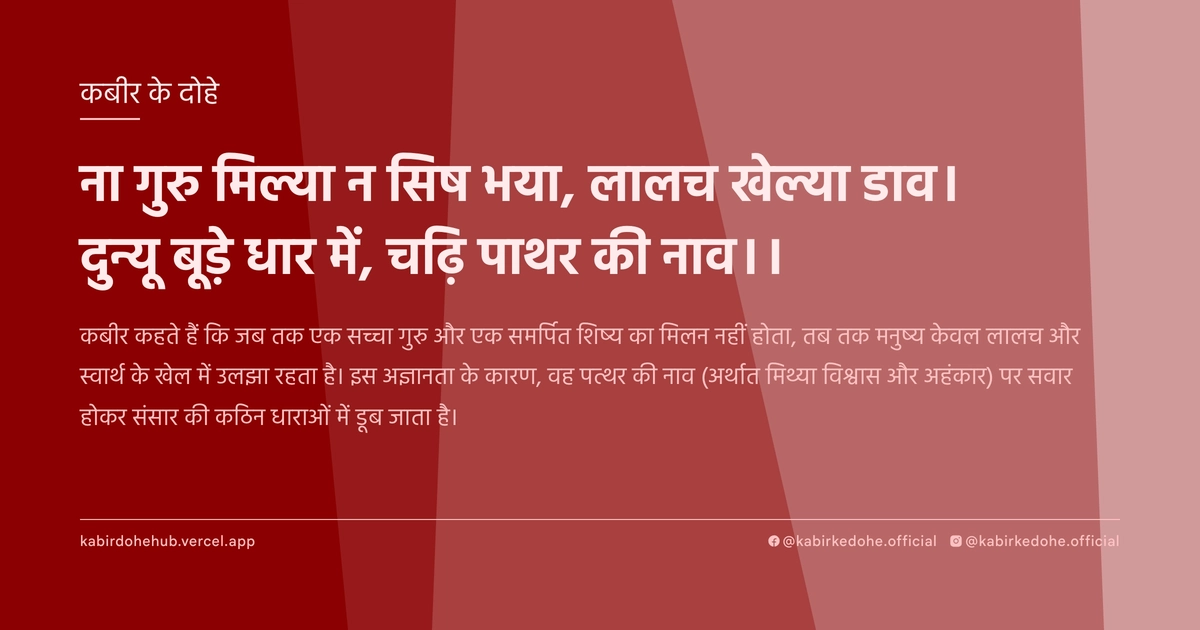
ना गुरु मिल्या न सिष भया, लालच खेल्या डाव।
दुन्यू बूड़े धार में, चढ़ि पाथर की नाव।।
Na guru milya na sish bhaya, lalach khellya daav. Dunyu boode dhaar mein, chadhi paathar ki naav.
इस पृष्ठ पर इस कबीर दोहे का अर्थ (meaning), हिंदी व्याख्या और अंग्रेज़ी अनुवाद, दार्शनिक विश्लेषण और व्यावहारिक जीवन सीख दी गई है। यह दोहा गुरु महत्व (The Guru's Importance) विषय से जुड़ा है — Kabir doha meaning and explanation in Hindi and English.
अर्थ (Meaning):
कबीर कहते हैं कि जब तक एक सच्चा गुरु और एक समर्पित शिष्य का मिलन नहीं होता, तब तक मनुष्य केवल लालच और स्वार्थ के खेल में उलझा रहता है। इस अज्ञानता के कारण, वह पत्थर की नाव (अर्थात मिथ्या विश्वास और अहंकार) पर सवार होकर संसार की कठिन धाराओं में डूब जाता है।
Kabir asserts that without the authentic union of a realized Guru and a devoted disciple, a human remains trapped in the game of greed and self-interest. In this state of spiritual blindness, the individual attempts to cross the turbulent currents of worldly existence using a 'boat of stone'—symbolizing false beliefs and the heavy burden of the ego—which inevitably leads to spiritual drowning.
व्याख्या (Interpretation):
इस दोहे का शाब्दिक अर्थ है कि गुरु और शिष्य के अभाव में मनुष्य लालच के जुए में लगा रहता है। रूपकात्मक रूप से, 'पत्थर की नाव' उस कठोर अहंकार और रूढ़िवादी कर्मकांडों का प्रतीक है जो हमें लगता है कि हमें पार लगाएंगे, लेकिन वास्तव में वे हमें नीचे खींचते हैं। यह निर्गुण भक्ति का सार है जहाँ बाहरी आडंबरों को त्यागकर अंतरात्मा की खोज की जाती है। माया यहाँ उस 'लालच' के रूप में है जो सत्य को ढक लेती है। जब तक जीव अद्वैत (एकता) का अनुभव नहीं करता, वह स्वयं को शरीर और पद से जोड़कर रखता है, जो पत्थर की तरह भारी और जड़ है। यह विरोधाभास है कि जिसे हम अपनी सुरक्षा का साधन (नाव) समझते हैं, वही हमारे विनाश का कारण बनता है।
Literally, the verse speaks of the absence of a guide and the presence of greed. Metaphorically, the 'boat of stone' represents the rigid ego and the dead weight of ritualistic orthodoxy which the seeker mistakenly believes will provide salvation. This aligns with Nirgun Bhakti, where the formless Divine is sought beyond external idols. Maya is depicted here as the 'game of greed' that obscures the realization of the Atman. In the framework of Advaita Vedanta, the stone boat is the illusion of duality—the belief that the self is separate from the Brahman. The central paradox is that the very structures we build for spiritual security (dogmas, titles, rituals) are the heaviest weights that ensure our sinking in the ocean of Samsara.
दार्शनिक विश्लेषण (Philosophical Analysis):
कबीर का यह दोहा उनके समय के सामाजिक और धार्मिक पाखंड पर एक तीखा प्रहार है। 15वीं शताब्दी में, धर्म केवल बाहरी दिखावे और जातिगत श्रेष्ठता का साधन बन गया था। कबीर ने इस बात पर जोर दिया कि बिना आंतरिक रूपांतरण के, कोई भी धार्मिक पहचान व्यर्थ है। वे यहाँ 'गुरु' को केवल एक व्यक्ति नहीं, बल्कि उस 'ज्ञान' के रूप में देखते हैं जो अज्ञानता के पर्दे को हटा दे।
अद्वैत वेदांत के परिप्रेक्ष्य में, यह दोहा अविद्या (ignorance) की चर्चा करता है। जब तक साधक यह नहीं समझता कि वह स्वयं ब्रह्म है, वह बाहरी सहारे खोजता है। यह 'पत्थर की नाव' उस बौद्धिक अहंकार का प्रतीक है जो तर्क तो करता है लेकिन अनुभव से शून्य है। सूफीवाद के 'फना' (अहंकार का विनाश) के सिद्धांत की तरह, कबीर भी कहते हैं कि जब तक 'मैं' (लालच और अहंकार) जीवित है, तब तक सत्य का साक्षात्कार असंभव है।
कबीर ने जाति और धर्म के भेदभाव को पूरी तरह नकारा। उनके लिए, एक सच्चा शिष्य वह है जो अपनी पहचान को मिटाने के लिए तैयार हो। जो व्यक्ति केवल फल की इच्छा से साधना करता है, वह वास्तव में लालच का खेल खेल रहा है। यह मनोवैज्ञानिक विश्लेषण बताता है कि हमारी इच्छाएं ही हमारे बंधन हैं।
यहाँ 'धार' (current) संसार की अनिश्चितताओं और मोह-माया का प्रतीक है। जो व्यक्ति केवल भौतिक सुखों या शास्त्रगत ज्ञान पर भरोसा करता है, वह पत्थर की नाव पर है। वास्तविक नाव 'प्रेम' और 'समर्पण' है, जो हल्की और पारदर्शी होती है।
अंततः, यह दोहा हमें चेतावनी देता है कि आध्यात्मिक यात्रा में शॉर्टकट या दिखावा घातक होता है। बिना मार्गदर्शन के, व्यक्ति अपने ही भ्रम के जाल में फंसकर डूब जाता है। यह केवल धार्मिक चेतावनी नहीं, बल्कि एक मनोवैज्ञानिक सत्य है कि बिना आत्म-जागरूकता के किया गया कोई भी प्रयास व्यर्थ है।
This Doha is a scathing critique of the social and religious hypocrisy of Kabir's 15th-century era. During this time, spirituality had been reduced to external displays and caste superiority. Kabir emphasizes that without internal transformation, any religious identity is a hollow shell. He views the 'Guru' not merely as a person, but as the illuminating knowledge that dissolves the veil of ignorance.
From the lens of Advaita Vedanta, the verse addresses 'Avidya' (primordial ignorance). Until the seeker realizes their identity as Brahman, they cling to external crutches. The 'boat of stone' symbolizes intellectual arrogance—the kind of knowledge that is theoretical and rigid but devoid of experiential realization. Similarly, echoing the Sufi concept of 'Fana' (annihilation of the self), Kabir suggests that as long as the 'I' (the ego driven by greed) exists, the realization of Truth is impossible.
Kabir radically rejected the caste system and ritualism. To him, a true disciple is one willing to dissolve their identity. Those who practice spirituality solely for rewards are merely playing the 'game of greed.' This psychological insight reveals that our desires are the very chains that bind us to suffering.
The 'current' (dhaar) represents the volatility of worldly existence and the pull of Maya. One who relies solely on material accumulation or rote scriptural learning is sailing on a stone boat. The true vessel for crossing is 'Prem' (Divine Love) and 'Samarpan' (Surrender), which are weightless and transparent.
Ultimately, the Doha warns that shortcuts or performative piety in the spiritual journey are fatal. Without authentic guidance and self-honesty, the seeker drowns in their own delusions. This is not merely a religious warning but a psychological truth: any effort devoid of self-awareness is destined for failure.
मूल संदेश (Core Message):
- अहंकार और लालच आध्यात्मिक प्रगति के सबसे बड़े अवरोध हैं।
- बिना सही मार्गदर्शन के धार्मिक प्रयास केवल भ्रम पैदा करते हैं।
- बाहरी आडंबर और पद पत्थर की तरह भारी होते हैं, जो आत्मा को डुबो देते हैं।
- सच्ची मुक्ति केवल विनम्रता और समर्पण के माध्यम से संभव है।
- आंतरिक रूपांतरण ही एकमात्र वास्तविक 'नाव' है जो संसार से पार ले जाती है।
- Ego and greed are the primary obstacles to spiritual evolution.
- Religious efforts without authentic guidance create only deeper delusions.
- External rituals and titles are heavy as stone, sinking the soul.
- True liberation is possible only through humility and total surrender.
- Inner transformation is the only real 'boat' that crosses the ocean of existence.
व्यावहारिक उदाहरण (Practical Example):
वाराणसी के एक पुराने घाट पर रहने वाले एक वृद्ध बुनकर, माधव, की कहानी है। माधव अपनी कला में निपुण था, लेकिन उसका मन हमेशा और अधिक धन और प्रसिद्धि की लालसा में रहता था। वह खुद को शहर का सबसे बड़ा कलाकार मानता था और अन्य बुनकरों को तुच्छ समझता था।
उसने अपनी पूरी जिंदगी एक ऐसी 'नाव' बनाई थी जो उसकी प्रतिष्ठा और अहंकार से बनी थी। वह मानता था कि उसकी श्रेष्ठता ही उसे जीवन के दुखों से बचाएगी। वह धर्म के नाम पर बड़े-बड़े दान देता था, लेकिन उसके मन में अपने सहायकों के प्रति घृणा थी।
एक दिन, एक साधारण सा फकीर उसके पास आया, जिसने कोई वस्त्र नहीं पहने थे और कोई पद नहीं था। फकीर ने माधव के रेशमी कपड़ों को देखा और मुस्कुराते हुए कहा, 'माधव, तुम रेशम बुन रहे हो, लेकिन तुम्हारा मन पत्थर का हो गया है। तुम जिस नाव पर सवार हो, वह तुम्हें पार नहीं ले जाएगी, बल्कि तुम्हें डुबो देगी।'
माधव को पहले तो यह बात चुभी, लेकिन फकीर ने उसे एक चुनौती दी। उसने कहा, 'एक सप्ताह तक अपने सबसे निचले स्तर के मजदूर के साथ बैठकर भोजन करो और उससे उसकी पीड़ा सुनो, बिना उसे उपदेश दिए।'
शुरुआत में माधव का अहंकार उसे रोकता रहा। उसे लगा कि यह समय की बर्बादी है। लेकिन जिज्ञासावश उसने ऐसा किया। जब उसने अपने मजदूर, रामू, की कहानी सुनी—कि कैसे रामू ने अपनी बेटी की बीमारी के लिए अपनी पूरी जमापूंजी लगा दी और फिर भी वह कर्ज में डूबा रहा—तो माधव का हृदय पहली बार पिघला।
उसे एहसास हुआ कि उसकी 'प्रतिष्ठा की नाव' वास्तव में पत्थर की तरह भारी थी, जिसने उसे मानवीय संवेदनाओं से काट दिया था। उसका लालच केवल धन के लिए नहीं था, बल्कि 'श्रेष्ठ' दिखने के लालच के लिए था।
उसने महसूस किया कि वह अब तक केवल एक खेल खेल रहा था, जहाँ वह खुद को विजेता समझता था, जबकि वास्तव में वह अकेला और रिक्त था। उसने फकीर के चरणों में गिरकर अपनी गलती स्वीकार की।
माधव ने अपनी कार्यशाला को एक सहकारी समिति में बदल दिया, जहाँ लाभ का समान वितरण था। उसने अपनी प्रतिष्ठा का मोह त्याग दिया और सेवा को अपना नया मार्ग बनाया।
उसका जीवन अब बोझिल नहीं था। वह अब उस 'पत्थर की नाव' से उतरकर प्रेम की सरिता में बहने लगा था। उसकी कला में अब एक नई गहराई थी, क्योंकि वह अब केवल कपड़ों में नहीं, बल्कि आत्माओं में रंग भर रहा था।
इस प्रकार, एक सच्चे मार्गदर्शन (फकीर) और शिष्य भाव (विनम्रता) के मिलन ने माधव को उस डूबते हुए जीवन से बचा लिया जिसे वह अब तक सफलता समझ रहा था।
This is the story of Madhav, an elderly weaver living on the ancient ghats of Varanasi. Madhav was a master of his craft, but his mind was perpetually consumed by a craving for more wealth and fame. He considered himself the greatest artist in the city and looked down upon other weavers.
He had spent his entire life constructing a 'boat' made of prestige and ego. He believed that his perceived superiority would protect him from the hardships of life. In the name of religion, he made grand donations, yet his heart harbored contempt for his assistants.
One day, a simple Fakir arrived, wearing no fine clothes and claiming no title. The Fakir looked at Madhav's exquisite silks and smiled, saying, 'Madhav, you weave silk, but your heart has become stone. The boat you sail upon will not carry you across; it will pull you under.'
Initially, Madhav felt insulted, but the Fakir gave him a challenge: 'For one week, sit and eat with your lowest-ranking laborer and listen to his sorrows without offering a single piece of advice.'
At first, Madhav's ego resisted. He felt this was a waste of time. However, driven by curiosity, he complied. As he listened to the story of his laborer, Ramu—who had spent every penny on his daughter's illness and remained drowned in debt—Madhav's heart melted for the first time.
He realized that his 'boat of prestige' was indeed as heavy as stone, severing him from human empathy. His greed was not just for money, but for the greed of appearing 'superior.'
He understood that he had been playing a game where he thought he was the winner, while in reality, he was profoundly alone and empty.
He fell at the Fakir's feet and confessed his blindness. Madhav transformed his workshop into a cooperative where profits were shared equally. He abandoned the pursuit of fame and adopted service as his new path.
His life was no longer burdensome. He stepped off the 'stone boat' and began to flow with the current of love. A new depth entered his art, for he was no longer just coloring fabric, but coloring souls.
Thus, the union of authentic guidance (the Fakir) and the spirit of a disciple (humility) saved Madhav from the drowning life he had previously mistaken for success.
अभ्यास मार्गदर्शन (Practice Guidance):
- दैनिक आत्म-निरीक्षण: प्रतिदिन 15 मिनट मौन बैठें और विचार करें कि आज आपने कितनी बार 'मैं' या 'मेरा' (अहंकार) का उपयोग किया।
- सेवा का अभ्यास: सप्ताह में एक बार किसी ऐसे व्यक्ति की निस्वार्थ मदद करें जिससे आपको कोई लाभ न मिले और जिसे आप सामाजिक रूप से अपने से 'नीचे' समझते हों।
- जर्नलिंग प्रॉम्प्ट: 'मेरी वह कौन सी उपलब्धि या पहचान है जिसे मैं पत्थर की नाव की तरह ढो रहा हूँ और जो मुझे वास्तव में स्वतंत्र होने से रोक रही है?'
- डायग्नोस्टिक चेकलिस्ट: क्या आप दूसरों की सलाह सुनने में कठिनाई महसूस करते हैं? क्या आपकी खुशी दूसरों की तुलनात्मक विफलता पर टिकी है? यदि हाँ, तो आप 'पत्थर की नाव' पर हैं।
- Daily Self-Inquiry: Spend 15 minutes in silence daily, observing how many times you operated from the 'I' or 'Mine' (the ego) during the day.
- Practice of Service: Once a week, perform a selfless act of service for someone from whom you gain nothing and whom you perceive as socially 'inferior.'
- Journaling Prompt: 'Which achievement or identity am I carrying like a stone boat, and how is it preventing me from being truly free?'
- Diagnostic Checklist: Do you find it difficult to accept guidance from others? Is your happiness dependent on the comparative failure of others? If yes, you are sailing on a 'stone boat.'
चिंतन प्रश्न (Reflection Questions):
- आपकी वह कौन सी 'धार्मिक' या 'नैतिक' पहचान है जिसका उपयोग आप अनजाने में दूसरों को नीचा दिखाने के लिए करते हैं?
- यदि आपकी सारी उपाधियाँ और सामाजिक प्रतिष्ठा आज छीन ली जाए, तो आपके भीतर क्या बचेगा?
- क्या आप वास्तव में एक गुरु की तलाश में हैं, या आप केवल ऐसे व्यक्ति की तलाश में हैं जो आपके मौजूदा विश्वासों की पुष्टि करे?
- आपके जीवन में 'लालच' किस सूक्ष्म रूप में मौजूद है—धन, प्रशंसा, या सही होने की जिद?
- आपकी 'पत्थर की नाव' (अहंकार) आपको सुरक्षा का अहसास दिलाती है, लेकिन क्या यह आपको वास्तव में शांत कर पा रही है?
- Which 'religious' or 'moral' identity do you unconsciously use to feel superior to others?
- If all your titles and social prestige were stripped away today, what would remain of you?
- Are you truly seeking a Guru, or are you merely seeking someone who validates your existing beliefs?
- In what subtle form does 'greed' exist in your life—as a desire for wealth, praise, or the need to be right?
- Your 'stone boat' (ego) gives you a sense of security, but is it actually bringing you peace?