
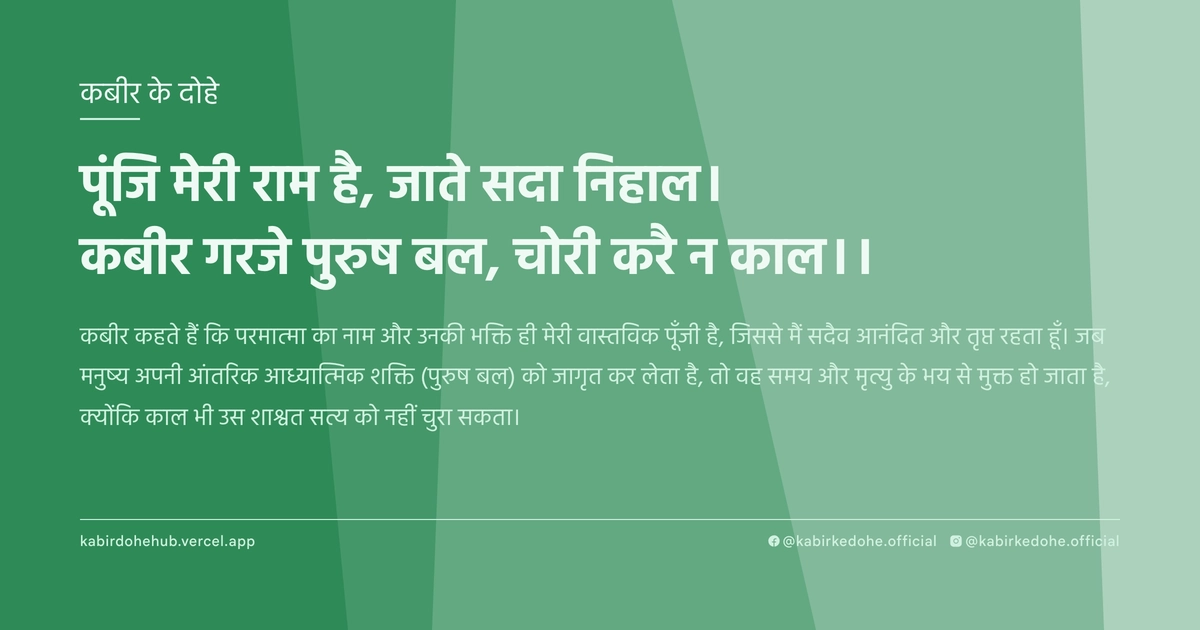
पूंजि मेरी राम है, जाते सदा निहाल।
कबीर गरजे पुरुष बल, चोरी करै न काल।।
Punji meri Ram hai, jaate sada nihaal. Kabir garje purush bal, chori karai na kaal.
इस पृष्ठ पर इस कबीर दोहे का अर्थ (meaning), हिंदी व्याख्या और अंग्रेज़ी अनुवाद, दार्शनिक विश्लेषण और व्यावहारिक जीवन सीख दी गई है। यह दोहा मुक्ति (Liberation) विषय से जुड़ा है — Kabir doha meaning and explanation in Hindi and English.
अर्थ (Meaning):
कबीर कहते हैं कि परमात्मा का नाम और उनकी भक्ति ही मेरी वास्तविक पूँजी है, जिससे मैं सदैव आनंदित और तृप्त रहता हूँ। जब मनुष्य अपनी आंतरिक आध्यात्मिक शक्ति (पुरुष बल) को जागृत कर लेता है, तो वह समय और मृत्यु के भय से मुक्त हो जाता है, क्योंकि काल भी उस शाश्वत सत्य को नहीं चुरा सकता।
Kabir declares that the Divine Presence is his only true wealth, leaving him eternally blissful and fulfilled. He asserts that once a seeker awakens their inner spiritual potency (Purush Bal), they transcend the fear of time and death, for the inevitable 'Kaal' cannot steal that which is eternal and non-material.
व्याख्या (Interpretation):
यहाँ 'पूंजि' का अर्थ भौतिक धन नहीं, बल्कि वह आध्यात्मिक संचय है जो साधना से प्राप्त होता है। 'राम' यहाँ दशरथ पुत्र नहीं, बल्कि निर्गुण निराकार ब्रह्म हैं जो कण-कण में व्याप्त हैं। कबीर इस विरोधाभास को दर्शाते हैं कि संसार में सब कुछ नश्वर है, लेकिन जो आत्मा को जान लेता है, वह 'निहाल' यानी पूर्ण हो जाता है। 'पुरुष बल' का तात्पर्य शारीरिक शक्ति से नहीं, बल्कि आत्म-साक्षात्कार की उस शक्ति से है जो माया के पर्दे को हटा देती है। जब साधक अद्वैत की स्थिति में पहुँचता है, तो वह समय (काल) के चक्र से ऊपर उठ जाता है। यह स्थिति मृत्यु पर विजय नहीं, बल्कि मृत्यु के भ्रम का अंत है। इस प्रकार, यह दोहा जीव की सीमित पहचान से मुक्त होकर सार्वभौमिक चेतना में विलीन होने की प्रक्रिया का वर्णन करता है।
The term 'Punji' (capital/wealth) here does not refer to material assets but to the spiritual accumulation gained through intense discipline. 'Ram' represents not the mythological king, but the Nirgun (formless) Absolute that permeates every atom. Kabir highlights the paradox that while everything in the phenomenal world is transient, the one who realizes the Self becomes 'Nihaal'—utterly fulfilled. 'Purush Bal' refers not to physical strength, but to the spiritual potency of self-realization that pierces through the veil of Maya. When the seeker attains the state of Advaita (non-duality), they transcend the linear constraints of time (Kaal). This is not a claim of physical immortality, but the dissolution of the illusion of death. Thus, the couplet describes the transition from a limited ego-identity to a universal consciousness.
दार्शनिक विश्लेषण (Philosophical Analysis):
कबीर का यह दर्शन निर्गुण भक्ति और सूफी मत के संगम पर स्थित है। उन्होंने उस समय के समाज में व्याप्त बाहरी कर्मकांडों और संचय की प्रवृत्ति का कड़ा विरोध किया। जहाँ लोग स्वर्ण और भूमि को पूँजी मानते थे, कबीर ने 'नाम' को एकमात्र स्थायी संपत्ति बताया। यह विचार अद्वैत वेदांत के इस सिद्धांत से मेल खाता है कि आत्मा और ब्रह्म एक ही हैं; जब यह बोध होता है, तो भय समाप्त हो जाता है।
ऐतिहासिक संदर्भ में, कबीर एक जुलाहे थे, जिन्होंने समाज के सबसे निचले पायदान से सत्य को देखा। उन्होंने देखा कि जाति और धर्म के नाम पर लोग विभाजित हैं, जबकि सत्य एक है। उनका 'पुरुष बल' का आह्वान वास्तव में अहंकार के विसर्जन का आह्वान है। जब 'मैं' मिटता है, तब केवल वह 'राम' बचता है जो कालजयी है।
सूफीवाद के 'फना' (अहंकार का विनाश) के समान, कबीर यहाँ स्वयं को परमात्मा में विलीन करने की बात कर रहे हैं। वे तर्क देते हैं कि मृत्यु केवल शरीर की होती है, चेतना की नहीं। जो व्यक्ति अपनी चेतना को ब्रह्म के साथ जोड़ लेता है, उसके लिए काल एक चोर की तरह नहीं, बल्कि एक माध्यम की तरह बन जाता है।
यह दोहा मनोवैज्ञानिक स्तर पर असुरक्षा की भावना पर प्रहार करता है। मनुष्य जीवन भर वस्तुओं को इकट्ठा करता है क्योंकि वह मृत्यु से डरता है। कबीर इस डर का समाधान 'आंतरिक संपदा' में खोजते हैं। वे सिखाते हैं कि वास्तविक सुरक्षा बाहरी दीवारों में नहीं, बल्कि आंतरिक स्थिरता में है।
अंततः, कबीर का संदेश यह है कि मोक्ष किसी बाहरी तीर्थ या अनुष्ठान से नहीं, बल्कि स्वयं के भीतर छिपे उस 'पुरुष' या चैतन्य को जगाने से मिलता है। यह एक क्रांतिकारी विचार था जिसने मध्यकालीन भारत में भक्ति आंदोलन को एक नई दिशा दी और धर्म को मंदिर-मस्जिद से निकालकर हृदय में स्थापित किया।
Kabir's philosophy stands at the intersection of Nirgun Bhakti and Sufism. He vehemently opposed the ritualism and the obsession with accumulation prevalent in his era. While the masses viewed gold and land as capital, Kabir redefined 'Punji' as the spiritual resonance of the Divine Name. This aligns with Advaita Vedanta's core tenet: the identity of Atman and Brahman; once realized, all existential fear vanishes.
Historically, as a weaver, Kabir observed truth from the margins of society. He witnessed how caste and creed divided humanity while the Truth remained singular. His call for 'Purush Bal' is not a call for power, but for the annihilation of the ego. When the 'I' dissolves, only the timeless 'Ram' remains.
Similar to the Sufi concept of 'Fana' (annihilation of the self), Kabir speaks of merging into the Absolute. He argues that death is merely a bodily event, not a conscious one. One who anchors their consciousness in the Eternal ceases to view Time (Kaal) as a thief and instead sees it as a medium of transition.
Psychologically, this couplet attacks the root of human insecurity. Humans spend lifetimes hoarding material goods to hedge against the fear of death. Kabir proposes 'inner wealth' as the only viable solution. He teaches that true security is found not in external fortifications, but in internal stillness.
Ultimately, Kabir asserts that liberation is not achieved through external pilgrimages or rituals, but by awakening the dormant consciousness within. This was a revolutionary stance in medieval India, shifting the locus of religion from the temple and mosque to the human heart, fueling the Bhakti movement's democratic spirit.
मूल संदेश (Core Message):
- भौतिक संचय केवल एक भ्रम है, आध्यात्मिक जागृति ही वास्तविक पूँजी है।
- अहंकार का विसर्जन ही वह 'पुरुष बल' है जो हमें भयमुक्त करता है।
- मृत्यु शरीर का अंत है, उस शाश्वत चेतना का नहीं जो राम स्वरूप है।
- सच्ची तृप्ति बाहरी वस्तुओं में नहीं, बल्कि आंतरिक पूर्णता में निहित है।
- जब साधक अद्वैत को पा लेता है, तो समय की सीमाएँ समाप्त हो जाती हैं।
- Material accumulation is a mirage; spiritual awakening is the only true capital.
- The dissolution of ego is the 'spiritual potency' that liberates us from fear.
- Death is the end of the vessel, not the Eternal Consciousness that is Ram.
- True fulfillment lies not in external acquisitions, but in internal wholeness.
- When the seeker realizes non-duality, the constraints of time cease to exist.
व्यावहारिक उदाहरण (Practical Example):
वाराणसी के घाटों पर रहने वाला एक वृद्ध विधवा, जिसे लोग 'माई' कहते थे, अपना पूरा जीवन दूसरों की सेवा और भिक्षा में बिता चुकी थी। उसके पास न तो रहने के लिए अपना घर था और न ही कोई संतान। शहर के अमीर लोग उसे दया की दृष्टि से देखते थे, क्योंकि उसके पास पहनने के लिए केवल एक फटी हुई सूती साड़ी थी।
माई हर दिन गंगा किनारे बैठकर घंटों मौन रहती और केवल एक ही शब्द का जाप करती। उसके चेहरे पर एक ऐसी शांति थी जो बड़े-बड़े महलों के स्वामियों के पास भी नहीं थी। लोग उसे पागल समझते थे क्योंकि वह अक्सर अकेले में मुस्कुराती और कहती, 'मेरी तिजोरी तो भर चुकी है'।
एक दिन शहर का एक धनी व्यापारी, जो अपनी संपत्ति खोने के डर से रातों को सो नहीं पाता था, माई के पास आया। उसने पूछा, 'माई, तुम्हारे पास कुछ नहीं है, फिर भी तुम इतनी निश्चिंत कैसे हो? मुझे देखो, मेरे पास सब कुछ है, फिर भी मैं डर में जीता हूँ।'
माई ने मुस्कुराकर जवाब दिया, 'बेटा, तूने वह जमा किया है जिसे चोर चुरा सकते हैं और समय नष्ट कर सकता है। मैंने वह पूँजी जमा की है जिसे न कोई छीन सकता है, न काल मिटा सकता है। मेरी पूँजी मेरा राम है।'
व्यापारी को पहले तो यह बात साधारण लगी, लेकिन उसने गौर किया कि माई की आँखों में एक ऐसी चमक थी जो किसी भौतिक सुख से नहीं आ सकती थी। उसने देखा कि माई को मृत्यु का कोई भय नहीं था, जबकि वह स्वयं अपनी लंबी उम्र की दुआएँ माँगता था ताकि अपनी संपत्ति का आनंद ले सके।
धीरे-धीरे व्यापारी ने माई के सानिध्य में समय बिताना शुरू किया। उसने महसूस किया कि उसकी सारी चिंताएँ उसकी 'पहचान' और 'स्वामित्व' से जुड़ी थीं। उसने सीखा कि जब तक वह खुद को अपनी संपत्ति का मालिक मानता रहेगा, वह डरता रहेगा।
एक दिन माई का देहांत हुआ। उसके अंतिम संस्कार के लिए कोई रिश्तेदार नहीं था, लेकिन पूरा घाट उमड़ पड़ा। उसकी मृत्यु में कोई शोक नहीं था, बल्कि एक उत्सव था। व्यापारी ने देखा कि माई ने अपनी अंतिम सांस तक उस 'पुरुष बल' को बनाए रखा, जिससे वह मृत्यु को भी एक पुराने वस्त्र बदलने जैसा मान रही थी।
उस दिन व्यापारी ने अपनी आधी संपत्ति गरीबों में बाँट दी। उसने महसूस किया कि असली पूँजी वह नहीं जो बैंक में है, बल्कि वह है जो आत्मा के भीतर है। उसने अपनी जीवनशैली बदली और बाहरी प्रदर्शन के बजाय आंतरिक शांति की खोज शुरू की।
अब वह व्यापारी रात को चैन से सोता था। उसने जान लिया था कि जब हम स्वयं को उस अनंत राम के साथ जोड़ लेते हैं, तो समय का भय समाप्त हो जाता है। उसने अपनी 'पूंजी' को भौतिकता से हटाकर आध्यात्मिकता में निवेश किया।
यह परिवर्तन केवल उसके व्यवहार में नहीं, बल्कि उसकी चेतना में था। वह अब एक 'मालिक' नहीं, बल्कि एक 'साधक' बन गया था, जिसने कबीर की उस पूँजी को पा लिया था जिसे काल कभी नहीं चुरा सकता।
In the ghats of Varanasi lived an elderly widow, known to all as 'Mai'. She had spent her entire life in service and sustenance through alms. She owned neither a home nor had any children. The wealthy citizens of the city looked upon her with pity, for she possessed nothing but a single, worn-out cotton saree.
Mai would spend hours in silence by the Ganges, chanting a single name. There was a serenity on her face that the owners of the grandest mansions lacked. People considered her eccentric, as she would often smile to herself and whisper, 'My treasury is already full.'
One day, a wealthy merchant, plagued by insomnia due to the fear of losing his fortune, approached Mai. He asked, 'Mai, you have nothing, yet you are so carefree. Look at me; I have everything, yet I live in constant fear.'
Mai smiled and replied, 'Son, you have accumulated that which thieves can steal and time can erode. I have gathered a wealth that no one can snatch, and no passage of time can erase. My capital is my Ram.'
The merchant initially found this answer simplistic, but he noticed a luminosity in Mai's eyes that no material luxury could produce. He realized that Mai had no fear of death, while he spent his days praying for a long life simply to enjoy his possessions.
Gradually, the merchant began spending more time in Mai's presence. He realized that all his anxieties were tied to his 'identity' and 'ownership'. He learned that as long as he viewed himself as the owner of his wealth, he would remain a prisoner of fear.
One day, Mai passed away. There were no relatives for her last rites, yet the entire ghat gathered. Her passing was not a moment of grief, but a celebration. The merchant saw that Mai had maintained that 'Purush Bal' (spiritual strength) until her last breath, treating death as merely changing an old garment.
That day, the merchant donated half of his wealth to the poor. He understood that true capital is not what resides in a bank, but what resides within the soul. He shifted his lifestyle from external display to internal exploration.
Now, the merchant slept peacefully. He had realized that when one aligns themselves with the infinite Ram, the fear of time vanishes. He invested his 'capital' not in materiality, but in spirituality.
This transformation was not just behavioral, but conscious. He was no longer a 'possessor' but a 'seeker', having found the wealth Kabir spoke of—the one that Time can never steal.
अभ्यास मार्गदर्शन (Practice Guidance):
- प्रतिदिन 20 मिनट 'नाम जप' या मौन ध्यान करें, जहाँ आप स्वयं को एक शरीर नहीं, बल्कि एक अनंत चेतना के रूप में अनुभव करें।
- स्व-पूछताछ जर्नल: प्रतिदिन लिखें कि आज आपने किन भौतिक चीजों के प्रति मोह महसूस किया और वह मोह आपकी आंतरिक शांति को कैसे बाधित कर रहा था।
- व्यवहार परिवर्तन: सप्ताह में एक बार अपनी किसी प्रिय वस्तु का त्याग करें या उसे किसी जरूरतमंद को दें, ताकि 'स्वामित्व' का भ्रम टूटे।
- डायग्नोस्टिक चेकलिस्ट: क्या आप भविष्य की चिंता में वर्तमान को खो रहे हैं? क्या आप अपनी पहचान अपनी उपलब्धियों से जोड़ते हैं? यदि हाँ, तो आप 'काल' के डर में हैं।
- Engage in 20 minutes of 'Naam Japa' or silent meditation daily, perceiving yourself not as a physical body, but as infinite consciousness.
- Self-Inquiry Journaling: Record daily instances where you felt attachment to material objects and analyze how that attachment disrupted your inner peace.
- Behavioral Shift: Once a week, consciously let go of a prized possession or donate it to someone in need to break the illusion of 'ownership'.
- Diagnostic Checklist: Are you losing the present moment to anxieties about the future? Do you tie your identity to your achievements? If yes, you are still operating under the fear of 'Kaal'.
चिंतन प्रश्न (Reflection Questions):
- यदि आज आपकी सारी भौतिक उपलब्धियाँ छीन ली जाएँ, तो आपकी पहचान का क्या बचेगा?
- आपकी 'डिजिटल ईगो' (सोशल मीडिया इमेज) आपको वास्तविक सत्य से कितना दूर ले जा रही है?
- क्या आप वास्तव में स्वतंत्र हैं, या आप उन चीजों के गुलाम हैं जिन्हें आप अपना 'कब्जा' कहते हैं?
- मृत्यु का विचार आपको भयभीत करता है या यह आपको जीवन की वास्तविकता के प्रति अधिक जागरूक बनाता है?
- आपके भीतर का वह कौन सा हिस्सा है जो समय और उम्र से परे है?
- If all your material achievements were stripped away today, what would remain of your identity?
- To what extent is your 'digital ego' (social media image) distancing you from your authentic truth?
- Are you truly free, or are you a slave to the things you claim to 'own'?
- Does the thought of death terrify you, or does it make you more conscious of the reality of existence?
- Which part of your being exists beyond the reach of time and aging?