
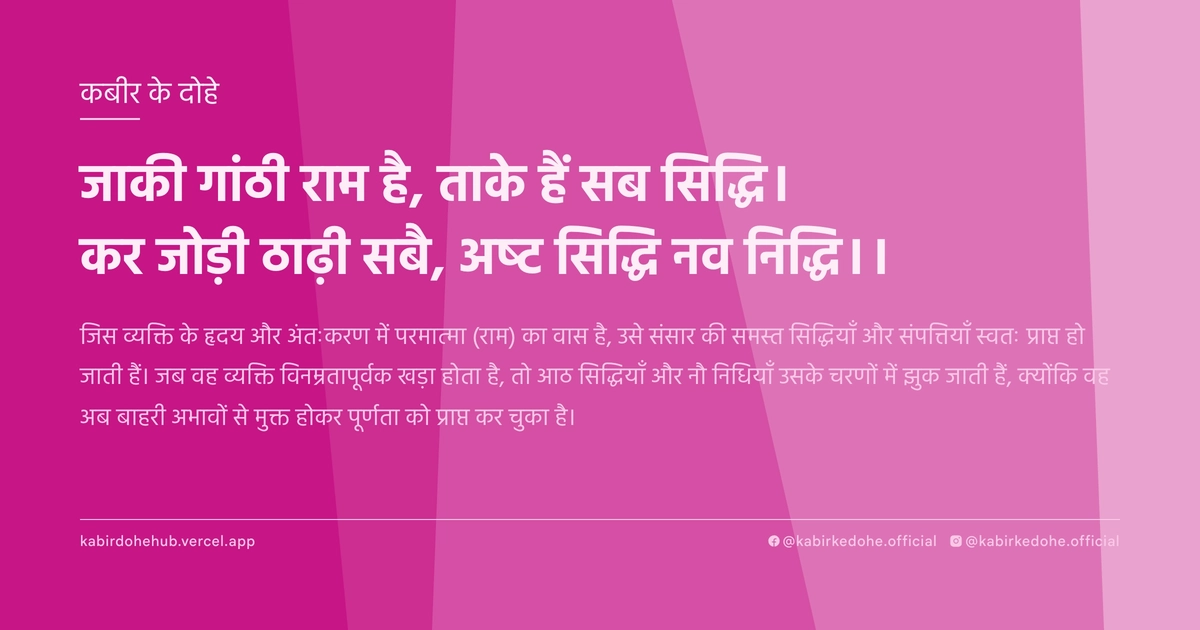
जाकी गांठी राम है, ताके हैं सब सिद्धि।
कर जोड़ी ठाढ़ी सबै, अष्ट सिद्धि नव निद्धि।।
Jaki gaanthi Ram hai, taake hain sab siddhi. Kar jodi thadhi sabai, asht siddhi nav niddhi.
इस पृष्ठ पर इस कबीर दोहे का अर्थ (meaning), हिंदी व्याख्या और अंग्रेज़ी अनुवाद, दार्शनिक विश्लेषण और व्यावहारिक जीवन सीख दी गई है। यह दोहा भक्ति (Bhakti) विषय से जुड़ा है — Kabir doha meaning and explanation in Hindi and English.
अर्थ (Meaning):
जिस व्यक्ति के हृदय और अंतःकरण में परमात्मा (राम) का वास है, उसे संसार की समस्त सिद्धियाँ और संपत्तियाँ स्वतः प्राप्त हो जाती हैं। जब वह व्यक्ति विनम्रतापूर्वक खड़ा होता है, तो आठ सिद्धियाँ और नौ निधियाँ उसके चरणों में झुक जाती हैं, क्योंकि वह अब बाहरी अभावों से मुक्त होकर पूर्णता को प्राप्त कर चुका है।
He whose inner core is anchored in the Divine (Ram) possesses all possible accomplishments. When such a person stands in humble presence, the eight supernatural powers (Siddhis) and nine treasures (Nidhis) bow before them, for they have transcended external lack by realizing the infinite abundance within.
व्याख्या (Interpretation):
यहाँ 'राम' किसी व्यक्ति या मूर्ति नहीं, बल्कि उस निर्गुण निराकार ब्रह्म का प्रतीक है जो सर्वव्यापी है। 'गांठी' का अर्थ है अंतरात्मा या वह सूक्ष्म केंद्र जहाँ मनुष्य अपने अहंकार को विसर्जित करता है। शाब्दिक अर्थ में यह सिद्धियों की प्राप्ति की बात करता है, परंतु आध्यात्मिक स्तर पर यह 'अद्वैत' की स्थिति है। जब साधक यह जान लेता है कि वह स्वयं ब्रह्म है, तो संसार की भौतिक और मानसिक शक्तियाँ उसके लिए गौण हो जाती हैं। यह विरोधाभास है कि जो बाहरी शक्तियों की खोज छोड़ देता है, वही वास्तव में सर्वशक्तिमान हो जाता है। माया का पर्दा हटते ही आत्मा और परमात्मा का मिलन होता है, जिससे आंतरिक पूर्णता का उदय होता है।
Here, 'Ram' does not refer to a deity in human form, but to the Nirgun (formless) Absolute that permeates existence. The 'ganthi' (knot/pocket) symbolizes the innermost core of consciousness where the ego is dissolved. While the literal meaning suggests the acquisition of supernatural powers, the metaphorical essence is the realization of Advaita (non-duality). When the seeker recognizes their identity as Brahman, external acquisitions become irrelevant. It is a divine paradox: by relinquishing the pursuit of power, one attains true sovereignty. As the veil of Maya lifts, the union of Atman and Brahman occurs, transforming the seeker from a fragment into the Whole.
दार्शनिक विश्लेषण (Philosophical Analysis):
कबीर का यह दोहा मध्यकालीन भारत के उस दौर का है जब धर्म कर्मकांडों और बाहरी आडंबरों में जकड़ा हुआ था। कबीर ने 'राम' शब्द का प्रयोग करके हिंदू और मुस्लिम दोनों परंपराओं को एक सूत्र में पिरोने का प्रयास किया, लेकिन उनके राम 'दशरथ पुत्र' नहीं बल्कि 'अकाल पुरुष' हैं। यह दृष्टिकोण सूफी मत के 'वहदत-अल-वजूद' (अस्तित्व की एकता) और वेदांत के 'अहं ब्रह्मास्मि' के अत्यंत निकट है।
कबीर यहाँ स्पष्ट करते हैं कि सिद्धि और निधि बाहरी साधनाओं या कठिन तपस्या से नहीं, बल्कि आंतरिक समर्पण और आत्म-साक्षात्कार से मिलती हैं। वे जाति और वर्ण व्यवस्था को नकारते हुए यह संदेश देते हैं कि ईश्वर का वास किसी मंदिर या मस्जिद में नहीं, बल्कि मनुष्य की अपनी चेतना में है। यह एक मनोवैज्ञानिक क्रांति है जहाँ व्यक्ति अपनी निर्भरता बाहरी दुनिया से हटाकर अपने भीतर के केंद्र पर केंद्रित करता है।
दार्शनिक रूप से, यह दोहा 'साधन' और 'साध्य' के अंतर को मिटाता है। आमतौर पर लोग सिद्धियों को साध्य मानते हैं, लेकिन कबीर के लिए सिद्धि केवल एक उप-उत्पाद (by-product) है। मुख्य लक्ष्य तो केवल उस निराकार राम का अनुभव करना है। जब अहंकार का विसर्जन होता है, तो व्यक्ति 'शून्य' हो जाता है, और शून्य में ही अनंत की संभावना निहित है।
यह शिक्षण हमें सिखाता है कि वास्तविक समृद्धि भौतिक संचय नहीं, बल्कि मानसिक शांति और आध्यात्मिक स्थिरता है। जो व्यक्ति स्वयं में संतुष्ट है, उसे दुनिया की किसी भी वस्तु की लालसा नहीं रहती, और यही वह स्थिति है जहाँ संसार स्वयं उसके सामने झुक जाता है।
अंततः, कबीर यह स्थापित करते हैं कि भक्ति का मार्ग केवल प्रेम का मार्ग नहीं, बल्कि विवेक और ज्ञान का मार्ग भी है। बिना आत्म-ज्ञान के की गई पूजा केवल एक मानसिक व्यायाम है। जब ज्ञान और प्रेम का मिलन होता है, तब साधक उस अवस्था में पहुँचता है जहाँ वह स्वयं सिद्धि बन जाता है।
This couplet emerges from the socio-religious turbulence of medieval India, a time when spirituality was stifled by rigid rituals and caste hierarchies. Kabir employs the term 'Ram' as a bridge between Hindu and Islamic traditions, yet his Ram is not the historical prince of Ayodhya, but the 'Akal Purush'—the Timeless Being. This perspective aligns seamlessly with the Sufi concept of 'Wahdat-al-Wujud' (Unity of Existence) and the Vedantic proclamation 'Aham Brahmasmi' (I am Brahman).
Kabir asserts that spiritual accomplishments (Siddhis) and treasures (Nidhis) are not the results of grueling asceticism or external rituals, but the natural outcome of inner surrender and self-realization. By rejecting the caste system, he democratizes divinity, suggesting that the Divine resides not in temples or mosques, but within the human consciousness. This represents a psychological shift from external dependency to internal sovereignty.
Philosophically, the verse collapses the distinction between the means (Sadhana) and the end (Sadhya). While most seekers pursue supernatural powers as the goal, Kabir treats them as mere by-products. The primary objective is the experience of the Formless. When the ego is annihilated, the seeker becomes 'Shunya' (Void), and it is within this void that the Infinite manifests.
The teaching emphasizes that true prosperity is not material accumulation but spiritual equilibrium. A person who is centered in the Divine ceases to crave external validation or wealth; consequently, the world no longer holds power over them, and they appear to possess everything.
Ultimately, Kabir establishes that the path of Bhakti is not merely emotional but is deeply rooted in Viveka (discernment) and Jnana (knowledge). Rituals without realization are empty. When love and knowledge merge, the seeker does not just find the Truth—they become the Truth.
मूल संदेश (Core Message):
- बाहरी उपलब्धियाँ केवल भ्रम हैं, आंतरिक शांति ही वास्तविक सिद्धि है।
- अहंकार का विसर्जन ही परमात्मा के साथ मिलन का एकमात्र मार्ग है।
- जब आप स्वयं को शून्य करते हैं, तब आप अनंत को प्राप्त करते हैं।
- सच्ची समृद्धि वह है जहाँ इच्छाएँ समाप्त हो जाती हैं और संतोष जन्म लेता है।
- परमात्मा कहीं बाहर नहीं, बल्कि आपकी अपनी चेतना के केंद्र में स्थित है।
- External achievements are illusions; inner peace is the only true siddhi.
- The dissolution of ego is the sole path to union with the Divine.
- When you become zero, you encompass the infinite.
- True prosperity is the state where cravings end and contentment is born.
- The Divine is not elsewhere, but resides at the center of your own consciousness.
व्यावहारिक उदाहरण (Practical Example):
वाराणसी के एक पुराने घाट पर माधव नाम का एक वृद्ध बुनकर रहता था। माधव के पास न तो कोई बड़ी दुकान थी और न ही कोई सामाजिक प्रतिष्ठा। वह दिन भर सूत कातता और रात को कबीर के भजनों में लीन रहता। शहर के बड़े सेठ और पंडित उसकी सादगी का मज़ाक उड़ाते थे, क्योंकि माधव कभी किसी से कुछ नहीं माँगता था और न ही किसी पद की लालसा करता था।
एक समय शहर में भीषण अकाल पड़ा। अनाज की कीमतें आसमान छूने लगीं। बड़े-बड़े सेठ जो कभी अपनी तिजोरियों पर गर्व करते थे, अब डर के मारे अपनी संपत्तियों को बचाने में लगे थे। वे चिंतित थे, तनावग्रस्त थे और अपनी समृद्धि के बावजूद दुखी थे।
उसी दौरान, एक विदेशी विद्वान वाराणसी आया। उसने देखा कि जहाँ पूरा शहर घबराहट में है, माधव अपनी छोटी सी कुटिया में अत्यंत शांत और आनंदित है। वह विद्वान माधव के पास गया और पूछा, "तुम्हारे पास न धन है, न अनाज का भंडार, फिर भी तुम्हारी आँखों में ऐसी शांति कैसे है जो इन महलों के स्वामियों के पास भी नहीं है?"
माधव मुस्कुराया और बोला, "साहब, मेरी पोटली में वह राम है जो कभी खत्म नहीं होता। जब आप भीतर के अभाव को मिटा देते हैं, तो बाहर की कमी आपको छू नहीं पाती।"
विद्वान ने देखा कि माधव के पास केवल एक पुराना करघा और कुछ सूती कपड़े थे, लेकिन उसकी उपस्थिति इतनी प्रभावशाली थी कि लोग उसकी सलाह लेने आने लगे। वह बिना किसी प्रयास के लोगों के विवाद सुलझाता और उन्हें मानसिक शांति देता।
धीरे-धीरे, शहर के वे अमीर लोग जो माधव को तुच्छ समझते थे, उसके पास आने लगे। उन्होंने महसूस किया कि उनकी 'निधियाँ' उन्हें सुरक्षा नहीं दे रही थीं, जबकि माधव की 'राम-गाँठ' उसे अभय बना रही थी।
एक दिन, शहर के सबसे अमीर सेठ ने माधव से पूछा, "हमें वह सिद्धि कैसे मिलेगी जिससे हम भी तुम्हारी तरह शांत रह सकें?"
माधव ने उत्तर दिया, "अपनी तिजोरियों की चाबियाँ नहीं, बल्कि अपने अहंकार की चाबी बदलिए। जब तक आप 'मैं' और 'मेरा' में कैद हैं, आप दरिद्र हैं। जिस दिन आप स्वयं को उस परमात्मा में विलीन कर देंगे, आप पाएंगे कि सब कुछ आपका ही है।"
सेठ ने उस दिन पहली बार महसूस किया कि वह सब कुछ पाकर भी खाली था। उसने अपनी संपत्ति का एक बड़ा हिस्सा गरीबों के लिए खोल दिया। जैसे ही उसने त्याग करना शुरू किया, उसे वह मानसिक शांति मिली जिसकी वह तलाश कर रहा था।
यह 'कबीर ट्विस्ट' था—संपत्ति का संचय नहीं, बल्कि उसका वितरण और अहंकार का विसर्जन ही वास्तविक सिद्धि थी। माधव की सादगी ने सेठ के जीवन को बदल दिया, और वह समझ गया कि असली निधि हृदय की पवित्रता में है।
In the ancient alleys of Varanasi lived an elderly weaver named Madhav. Madhav possessed neither a grand shop nor any social prestige. He spent his days spinning yarn and his nights immersed in the mystical verses of Kabir. The wealthy merchants and high priests of the city often mocked his simplicity, as Madhav never asked for anything nor craved any position of power.
One year, a severe famine struck the region. Grain prices skyrocketed. The great merchants, who once prided themselves on their overflowing vaults, were now consumed by fear, desperately trying to protect their hoardings. Despite their wealth, they were anxious, stressed, and profoundly unhappy.
During this crisis, a foreign scholar visited Varanasi. He noticed that while the entire city was gripped by panic, Madhav remained profoundly calm and joyful in his tiny hut. The scholar approached him and asked, "You have no wealth, no store of grain, yet there is a peace in your eyes that the owners of these palaces lack. How is this possible?"
Madhav smiled and replied, "Sir, in my pocket, I carry the Ram that never diminishes. When you erase the void within, the lack outside cannot touch you."
The scholar observed that although Madhav owned nothing but an old loom and a few cotton cloths, his presence was so magnetic that people began seeking his counsel. Without effort, he resolved disputes and provided mental solace to the distressed.
Gradually, the wealthy elite who had once looked down upon Madhav began to visit him. They realized that their 'Nidhis' (treasures) provided no security, whereas Madhav's 'Ram-Ganthi' (inner connection) made him fearless.
One day, the richest merchant in the city asked, "How can we attain the siddhi that allows us to be as peaceful as you?"
Madhav answered, "Do not change the keys to your vaults, but change the key to your ego. As long as you are imprisoned in 'I' and 'Mine,' you are a pauper. The day you dissolve yourself into the Divine, you will find that everything already belongs to you."
For the first time, the merchant realized that despite his possessions, he was empty. He began distributing a large portion of his wealth to the poor. As he started the act of letting go, he experienced the mental serenity he had been chasing for decades.
This was the 'Kabir Twist'—true siddhi was not in the accumulation of wealth, but in its distribution and the annihilation of the ego. Madhav's simplicity transformed the merchant's life, proving that the ultimate treasure is the purity of the heart.
अभ्यास मार्गदर्शन (Practice Guidance):
- प्रतिदिन 20 मिनट मौन अभ्यास करें, जहाँ आप बाहरी दुनिया की सभी इच्छाओं को त्यागकर केवल अपने भीतर की श्वास और उस 'राम' (चेतना) पर ध्यान केंद्रित करें।
- स्व-पूछताछ जर्नल: प्रतिदिन लिखें कि आज किस क्षण में मेरा 'अहंकार' (Ego) हावी हुआ और मैंने बाहरी वस्तुओं में अपनी खुशी ढूँढने की कोशिश की।
- व्यवहार परिवर्तन: सप्ताह में एक बार अपनी किसी प्रिय वस्तु का त्याग करें या किसी की निस्वार्थ मदद करें, यह महसूस करते हुए कि देने वाला और लेने वाला एक ही है।
- डायग्नोस्टिक चेकलिस्ट: क्या मैं तनाव में हूँ? क्या मैं दूसरों से अपनी तुलना कर रहा हूँ? क्या मुझे लगता है कि कुछ और मिल जाने पर मैं खुश हो जाऊँगा? यदि हाँ, तो इसका अर्थ है कि मेरी 'गाँठ' अभी भी बाहरी दुनिया से बंधी है।
- Practice 20 minutes of daily silence, relinquishing all external desires and focusing solely on the breath and the 'Ram' (Universal Consciousness) within.
- Self-Inquiry Journaling: Record daily instances where the ego dominated your thoughts or where you sought happiness through external acquisitions.
- Behavioral Shift: Once a week, give away something you cherish or help someone selflessly, consciously realizing that the giver and receiver are one.
- Diagnostic Checklist: Am I feeling anxious? Am I comparing myself to others? Do I believe that acquiring 'something more' will bring happiness? If yes, your 'knot' is still tied to the external world.
चिंतन प्रश्न (Reflection Questions):
- मेरी वह कौन सी 'निधि' या उपलब्धि है जिसे मैं अपनी पहचान मानता हूँ, और यदि वह मुझसे छीन ली जाए, तो मेरा अस्तित्व क्या बचेगा?
- क्या मैं वास्तव में आध्यात्मिक शांति चाहता हूँ, या मैं केवल 'सिद्धियों' और 'चमत्कारों' के लालच में धर्म का सहारा ले रहा हूँ?
- मेरे जीवन का वह कौन सा क्षेत्र है जहाँ मैं अभी भी 'कमी' महसूस करता हूँ? क्या यह कमी वास्तव में बाहरी है या मेरे भीतर के खालीपन का प्रतिबिंब है?
- यदि मैं आज अपनी सभी सामाजिक उपाधियों को त्याग दूँ, तो क्या मैं स्वयं के साथ सहज रह पाऊँगा?
- क्या मेरी भक्ति मुझे दूसरों के प्रति अधिक विनम्र बना रही है, या यह मेरे भीतर एक 'आध्यात्मिक अहंकार' पैदा कर रही है?
- Which 'treasure' or achievement do I mistake for my identity, and what would remain of me if it were stripped away?
- Do I truly seek spiritual peace, or am I using religion as a tool to acquire 'Siddhis' and miracles?
- In which area of my life do I still feel a sense of 'lack'? Is this lack truly external, or is it a reflection of an inner void?
- If I were to renounce all my social titles today, would I be comfortable in my own presence?
- Is my spiritual practice making me more humble toward others, or is it fueling a hidden 'spiritual ego'?