
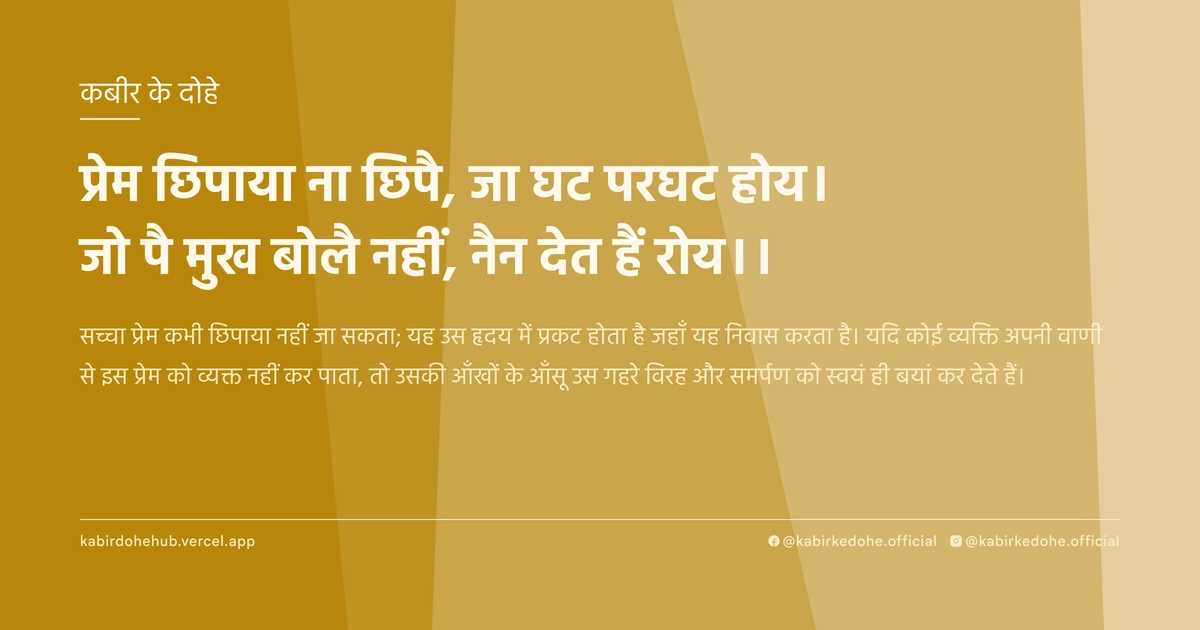
प्रेम छिपाया ना छिपै, जा घट परघट होय।
जो पै मुख बोलै नहीं, नैन देत हैं रोय।।
Prem chipaya na chipai, ja ghat parghat hoye. Jo pai mukh bolai nahi, nain det hain roy.
इस पृष्ठ पर इस कबीर दोहे का अर्थ (meaning), हिंदी व्याख्या और अंग्रेज़ी अनुवाद, दार्शनिक विश्लेषण और व्यावहारिक जीवन सीख दी गई है। यह दोहा भक्ति (Bhakti) विषय से जुड़ा है — Kabir doha meaning and explanation in Hindi and English.
अर्थ (Meaning):
सच्चा प्रेम कभी छिपाया नहीं जा सकता; यह उस हृदय में प्रकट होता है जहाँ यह निवास करता है। यदि कोई व्यक्ति अपनी वाणी से इस प्रेम को व्यक्त नहीं कर पाता, तो उसकी आँखों के आँसू उस गहरे विरह और समर्पण को स्वयं ही बयां कर देते हैं।
True divine love cannot be concealed; it inevitably manifests within the heart where it resides. Even if a person remains silent and cannot articulate this love through words, their eyes betray the secret, weeping in the profound longing and surrender of the soul.
व्याख्या (Interpretation):
शाब्दिक रूप से, यह दोहा प्रेम की अपरिहार्यता को दर्शाता है। आध्यात्मिक स्तर पर, यह 'प्रेम' केवल मानवीय अनुराग नहीं, बल्कि आत्मा का परमात्मा के प्रति तीव्र विरह है। यह निर्गुण भक्ति की उस अवस्था को इंगित करता है जहाँ साधक और साध्य के बीच का द्वैत समाप्त होने लगता है। माया के पर्दे के पीछे छिपा सत्य अंततः प्रकट होता है, क्योंकि आत्मा का स्वभाव ही प्रकाश और प्रेम है। जब अहंकार का मुख मौन हो जाता है, तब भी अंतरात्मा की तड़प अश्रुओं के रूप में बहती है, जो इस बात का प्रमाण है कि ब्रह्म का अनुभव शब्दों की सीमा से परे है। यह विरोधाभास है कि जो सबसे गहरा सत्य है, वह सबसे कम बोला जाता है, फिर भी सबसे अधिक दिखाई देता है।
Literally, this couplet depicts the inevitability of love. On a spiritual plane, this 'love' is not mere human affection but the soul's intense longing for the Divine. It points to a state in Nirgun Bhakti where the duality between the seeker and the sought begins to dissolve. Truth, hidden behind the veil of Maya, eventually manifests because the inherent nature of the Atman is light and love. When the mouth of the ego falls silent, the yearning of the inner soul flows as tears, proving that the experience of Brahman transcends the boundaries of language. It is a paradox that the deepest truth is the least spoken, yet the most visible through the transparency of a broken heart.
दार्शनिक विश्लेषण (Philosophical Analysis):
कबीर का यह दोहा मध्यकालीन भारत के उस सामाजिक परिवेश से उपजा है जहाँ धर्म को बाहरी कर्मकांडों और कठोर नियमों में बांध दिया गया था। कबीर ने इन कृत्रिम ढाँचों को नकारते हुए 'प्रेम' को ही एकमात्र वास्तविक मार्ग बताया। यहाँ प्रेम का अर्थ कामुकता नहीं, बल्कि सूफीवाद के 'इश्क-ए-हकीकी' (ईश्वरीय प्रेम) और अद्वैत वेदांत के 'आत्म-साक्षात्कार' का संगम है।
दार्शनिक रूप से, कबीर यह तर्क दे रहे हैं कि ईश्वर किसी मंदिर या मस्जिद में नहीं, बल्कि हृदय की गहराई में है। जब व्यक्ति अपनी पहचान (अहंकार) को मिटा देता है, तो जो शेष बचता है वह केवल प्रेम है। यह 'अहं ब्रह्मास्मि' की उस स्थिति की ओर ले जाता है जहाँ प्रेमी और प्रिय एक हो जाते हैं।
कबीर ने जाति और वर्ण के भेदभाव को पूरी तरह खारिज किया क्योंकि प्रेम की भाषा सार्वभौमिक है। उनके लिए, एक ब्राह्मण का ज्ञान व्यर्थ है यदि उसके हृदय में करुणा और प्रेम नहीं है। यह विश्लेषण दर्शाता है कि आध्यात्मिक प्रगति बौद्धिक विमर्श से नहीं, बल्कि भावनात्मक विसर्जन से होती है।
मनोवैज्ञानिक स्तर पर, यह दोहा दमित भावनाओं और उनके प्रकटीकरण की प्रक्रिया को समझाता है। जब सत्य इतना शक्तिशाली हो जाता है कि वह शब्दों में नहीं समाता, तो वह शरीर के माध्यम से (आँसुओं के रूप में) बाहर निकलता है। यह 'कैथार्सिस' या भावनात्मक विरेचन की वह स्थिति है जहाँ साधक पूरी तरह से समर्पित हो जाता है।
अंततः, कबीर यह संदेश देते हैं कि ईश्वर की प्राप्ति के लिए किसी विशेष विधि की आवश्यकता नहीं है, बल्कि केवल एक शुद्ध और तड़पते हुए हृदय की आवश्यकता है। यह मार्ग कठिन है क्योंकि इसमें स्वयं को पूरी तरह मिटाना पड़ता है, लेकिन यही एकमात्र मार्ग है जो माया के भ्रम को तोड़कर शाश्वत सत्य तक पहुँचाता है।
Kabir's couplet emerges from the socio-religious landscape of medieval India, where spirituality had been confined to rigid rituals and external dogmas. Rejecting these artificial structures, Kabir posits 'Love' as the only authentic path to the Divine. Here, love is not romantic or erotic, but a synthesis of the Sufi concept of 'Ishq-e-Haqiqi' (Divine Love) and the Advaita Vedanta pursuit of self-realization.
Philosophically, Kabir argues that the Divine resides not in temples or mosques, but in the depths of the human heart. When an individual annihilates their identity (the ego), what remains is pure love. This leads toward the state of 'Aham Brahmasmi,' where the lover and the Beloved merge into one seamless reality.
Kabir completely dismissed caste and creed because the language of love is universal. For him, the scholarship of a priest is futile if the heart lacks compassion. This analysis underscores that spiritual evolution occurs not through intellectual discourse, but through emotional immersion and surrender.
Psychologically, the verse explains the process of suppressed emotions and their inevitable manifestation. When a truth becomes too powerful to be contained in words, it escapes through the body—in the form of tears. This is a state of spiritual catharsis where the seeker is completely stripped of pretension.
Ultimately, Kabir suggests that reaching God requires no specific methodology, only a pure and yearning heart. This path is arduous because it demands the total annihilation of the self, yet it is the only way to shatter the illusions of Maya and attain the eternal Truth.
मूल संदेश (Core Message):
- शब्द सीमित हैं, लेकिन प्रेम असीम और सार्वभौमिक है।
- अहंकार की भाषा मौन हो जाती है जब आत्मा जागती है।
- सच्ची भक्ति बाहरी प्रदर्शन में नहीं, आंतरिक विरह में है।
- आँसू आत्मा की वह भाषा हैं जिसे ईश्वर तुरंत पहचान लेता है।
- प्रेम का प्रकटीकरण अनिवार्य है; इसे दबाया नहीं जा सकता।
- मौन ही वह सेतु है जो व्यक्ति को परमात्मा से जोड़ता है।
- Words are limited, but love is infinite and universal.
- The language of ego falls silent when the soul awakens.
- True devotion lies not in external display, but in internal longing.
- Tears are the language of the soul that the Divine recognizes instantly.
- The manifestation of love is inevitable; it cannot be suppressed.
- Silence is the bridge that connects the individual to the Universal.
व्यावहारिक उदाहरण (Practical Example):
वाराणसी के घाटों पर रहने वाली एक वृद्ध विधवा, जानकी, का जीवन अत्यंत एकाकी था। समाज ने उन्हें 'अशुभ' मानकर किनारे कर दिया था। वह दिन भर चुपचाप गंगा के किनारे बैठती और लोगों को आते-जाते देखती।
जानकी ने कभी किसी से अपनी पीड़ा नहीं कही, न ही वह किसी से सहानुभूति माँगती थी। वह बस मौन रहती, लेकिन उसकी आँखों में एक ऐसी गहराई थी जो किसी भी देखने वाले को झकझोर देती थी।
एक दिन एक युवा विद्वान पंडित उनके पास आया और उन्हें धर्म और मोक्ष के कठिन श्लोकों के बारे में बताने लगा। वह पंडित अपनी विद्वत्ता का प्रदर्शन कर रहा था और जानकी को 'अज्ञानी' मानकर उपदेश दे रहा था।
जानकी चुपचाप सुनती रही। पंडित ने जब पूछा कि क्या उन्हें समझ आ रहा है, तो जानकी ने कोई उत्तर नहीं दिया। लेकिन जैसे ही पंडित ने ईश्वर की सर्वव्यापकता की बात की, जानकी की आँखों से अनायास ही आँसू बहने लगे।
उन आँसुओं में कोई दुख नहीं था, बल्कि एक ऐसा असीम प्रेम और समर्पण था जिसे पंडित ने अपनी सारी किताबों में नहीं पढ़ा था। पंडित अचानक चुप हो गया। उसे महसूस हुआ कि वह जिसे 'अज्ञानी' समझ रहा था, वह वास्तव में उस सत्य को जी रही थी जिसे वह केवल शब्दों में खोज रहा था।
पंडित को समझ आया कि ज्ञान केवल मस्तिष्क का खेल है, लेकिन प्रेम आत्मा का अनुभव है। उसने अपनी पोथियाँ किनारे रखीं और पहली बार जानकी के मौन को सुनने की कोशिश की।
उस क्षण पंडित का अहंकार टूट गया। उसने महसूस किया कि वास्तविक भक्ति मंदिर की घंटियों में नहीं, बल्कि उस हृदय की तड़प में है जो बिना बोले भी सब कुछ कह देता है।
जानकी के उन आँसुओं ने पंडित के जीवन की दिशा बदल दी। उसने बाहरी आडंबरों को त्यागकर अंतर्मुखी होने का निर्णय लिया और प्रेम को ही अपना एकमात्र धर्म मान लिया।
Janaki, an elderly widow living on the ghats of Varanasi, led a life of profound isolation. Society had marginalized her, labeling her as 'inauspicious.' She spent her days sitting silently by the Ganges, watching the world pass by.
Janaki never spoke of her pain, nor did she seek sympathy from anyone. She remained in a state of perpetual silence, yet her eyes possessed a depth that could unsettle anyone who looked into them.
One day, a young scholar-priest approached her and began explaining complex shlokas about Dharma and Moksha. The priest was flaunting his erudition, treating Janaki as 'ignorant' and delivering a lecture on salvation.
Janaki listened in silence. When the priest asked if she understood, she gave no verbal answer. However, the moment the priest spoke of the omnipresence of God, tears spontaneously flowed from Janaki's eyes.
There was no grief in those tears, but rather an infinite love and surrender that the priest had never encountered in all his scriptures. The priest suddenly fell silent. He realized that the woman he deemed 'ignorant' was actually living the truth he was merely searching for in words.
He understood that knowledge is often a game of the intellect, but love is an experience of the soul. He set aside his manuscripts and, for the first time, tried to listen to Janaki's silence.
In that moment, the priest's ego shattered. He felt that true devotion does not lie in the ringing of temple bells, but in the yearning of a heart that speaks everything without uttering a word.
Janaki's tears changed the trajectory of the priest's life. He decided to abandon external rituals and turn inward, accepting love as his only true religion.
अभ्यास मार्गदर्शन (Practice Guidance):
- प्रतिदिन 20 मिनट 'मौन साधना' करें, जहाँ आप शब्दों को छोड़कर केवल अपने हृदय की धड़कन और भावनाओं को महसूस करें।
- एक 'भावनात्मक जर्नल' लिखें: उन क्षणों को दर्ज करें जब आप किसी के प्रति गहरा प्रेम या करुणा महसूस करते हैं, लेकिन उसे शब्दों में व्यक्त नहीं कर पाते।
- स्वयं से पूछें: 'मेरा अहंकार मुझे सत्य बोलने से कैसे रोकता है?' और देखें कि क्या आपकी भावनाएँ आपके शब्दों के विपरीत हैं।
- डायग्नोस्टिक चेकलिस्ट: क्या मैं केवल शब्दों से प्रेम व्यक्त कर रहा हूँ? क्या मेरी आँखों में दूसरों के लिए करुणा है? क्या मेरा मौन शांतिपूर्ण है या तनावपूर्ण?
- Practice 20 minutes of 'Silent Contemplation' daily, letting go of words to simply feel the heartbeat and emotions of your inner self.
- Maintain an 'Emotional Journal': Record moments when you feel profound love or compassion for another, yet find yourself unable to articulate it in words.
- Self-Inquiry Prompt: 'How does my ego prevent me from speaking the truth?' Observe if your emotional state contradicts your spoken words.
- Diagnostic Checklist: Am I expressing love only through words? Is there genuine compassion in my eyes for others? Is my silence peaceful or tense?
चिंतन प्रश्न (Reflection Questions):
- क्या मेरा सार्वजनिक व्यक्तित्व मेरे आंतरिक प्रेम और करुणा के साथ मेल खाता है, या मैं एक मुखौटा पहनकर जी रहा हूँ?
- जब मैं किसी के लिए रोता हूँ, तो क्या वह मेरी अपनी हानि का दुख है या दूसरे के प्रति निस्वार्थ प्रेम?
- मेरे जीवन में ऐसा कौन सा सत्य है जिसे मैं शब्दों में व्यक्त करने से डरता हूँ, लेकिन मेरी आत्मा उसे चिल्लाकर कहना चाहती है?
- क्या मेरी डिजिटल पहचान (सोशल मीडिया) मेरे वास्तविक आध्यात्मिक संघर्षों को छिपाने का एक साधन बन गई है?
- यदि आज मेरी वाणी छीन ली जाए, तो क्या मेरा व्यवहार और मेरी आँखें अभी भी प्रेम का संदेश दे पाएँगी?
- मैं अपनी 'पवित्रता' के दावों में कितना सच्चा हूँ, और मेरे भीतर का 'अंधेरा' मुझसे क्या कहना चाहता है?
- Does my public persona align with my internal love and compassion, or am I living behind a carefully constructed mask?
- When I weep for another, is it the grief of my own loss, or a selfless love for the other's existence?
- What is the truth in my life that I fear articulating in words, but which my soul is screaming to release?
- Has my digital identity (social media) become a tool to conceal my actual spiritual struggles?
- If my voice were taken away today, would my behavior and my eyes still be able to convey a message of love?
- How honest am I in my claims of 'purity,' and what is the darkness within me trying to tell me?