
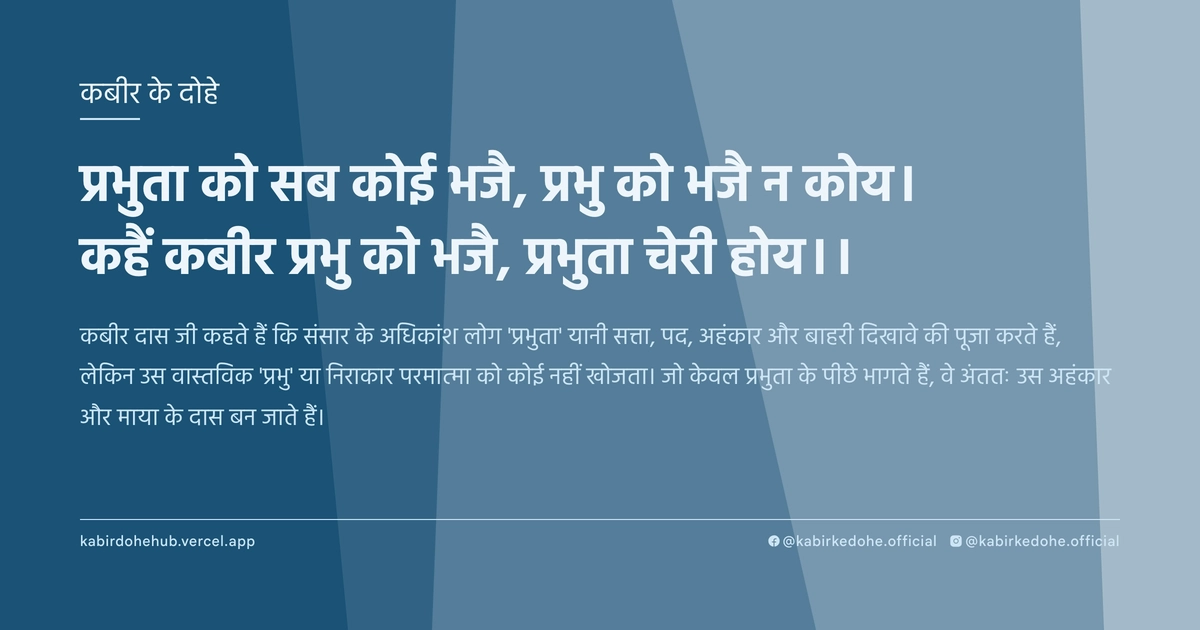
प्रभुता को सब कोई भजै, प्रभु को भजै न कोय।
कहैं कबीर प्रभु को भजै, प्रभुता चेरी होय।।
Prabhuta ko sab koi bhajai, prabhu ko bhajai na koy. Kahain kabir prabhu ko bhajai, prabhuta cheri hoye.
इस पृष्ठ पर इस कबीर दोहे का अर्थ (meaning), हिंदी व्याख्या और अंग्रेज़ी अनुवाद, दार्शनिक विश्लेषण और व्यावहारिक जीवन सीख दी गई है। यह दोहा भक्ति (Bhakti) विषय से जुड़ा है — Kabir doha meaning and explanation in Hindi and English.
अर्थ (Meaning):
कबीर दास जी कहते हैं कि संसार के अधिकांश लोग 'प्रभुता' यानी सत्ता, पद, अहंकार और बाहरी दिखावे की पूजा करते हैं, लेकिन उस वास्तविक 'प्रभु' या निराकार परमात्मा को कोई नहीं खोजता। जो केवल प्रभुता के पीछे भागते हैं, वे अंततः उस अहंकार और माया के दास बन जाते हैं।
Kabir observes that most people worship 'Prabhuta'—the attributes of power, status, ego, and outward grandeur—while ignoring the actual 'Prabhu,' the formless Divine. Those who chase the illusion of power eventually become slaves to their own ego and the deceptive nature of Maya.
व्याख्या (Interpretation):
इस दोहे का शाब्दिक अर्थ है कि लोग ईश्वर के गुणों के बजाय उसकी सत्ता के प्रदर्शन से आकर्षित होते हैं। रूपक के स्तर पर, 'प्रभुता' वह सामाजिक और मानसिक मुखौटा है जिसे हम अपनी पहचान मानते हैं। यह निर्गुण भक्ति का मूल है जहाँ कबीर चेतावनी देते हैं कि जब तक हम पद और प्रतिष्ठा (माया) को ईश्वर मानते हैं, हम सत्य से दूर रहते हैं। यह आत्मा और ब्रह्म के अद्वैत संबंध में एक बड़ी बाधा है, क्योंकि अहंकार (Ego) स्वयं को कर्ता मान लेता है। यहाँ विरोधाभास यह है कि जो व्यक्ति स्वयं को शक्तिशाली समझकर प्रभुता की खोज करता है, वह वास्तव में अपनी इच्छाओं और सामाजिक अपेक्षाओं का सबसे बड़ा गुलाम बन जाता है।
Literally, the verse suggests people are drawn to the display of power rather than the essence of the Divine. Metaphorically, 'Prabhuta' represents the social and psychological masks we wear to define our identity. This aligns with Nirgun Bhakti, where Kabir warns that as long as we mistake status and prestige (Maya) for God, we remain distant from the Truth. In the context of Advaita Vedanta, this ego-driven pursuit creates a veil over the non-duality of Atman and Brahman. The central paradox is that the individual seeking power and dominance through 'Prabhuta' inadvertently becomes a slave to their own desires and the crushing weight of societal expectations.
दार्शनिक विश्लेषण (Philosophical Analysis):
कबीर का यह दोहा उनके युग के धार्मिक पाखंड और सामाजिक स्तरीकरण पर एक तीखा प्रहार है। उस समय, धर्म अक्सर बाहरी कर्मकांडों और उच्च पदों के प्रदर्शन में सिमट गया था। कबीर ने इस 'प्रभुता' को खारिज करते हुए यह तर्क दिया कि ईश्वर किसी मंदिर, मस्जिद या ऊँचे पद में नहीं, बल्कि मनुष्य के भीतर की शुद्ध चेतना में निवास करता है। यह दृष्टिकोण सूफी मत के 'फना' (अहंकार का विनाश) और अद्वैत वेदांत के 'अहं ब्रह्मास्मि' के करीब है।
दार्शनिक रूप से, कबीर यहाँ 'सत्ता' और 'सत्य' के बीच अंतर स्पष्ट कर रहे हैं। सत्ता (Power) अस्थायी है और द्वैत पैदा करती है, जबकि सत्य (Truth) शाश्वत है और एकता लाता है। जब मनुष्य पद या प्रतिष्ठा को पूजता है, तो वह वास्तव में अपनी ही सूक्ष्म वासनाओं की पूजा कर रहा होता है। यह मनोवैज्ञानिक बंधन उसे वास्तविकता से काट देता है।
कबीर का विरोध केवल बाहरी संस्थाओं से नहीं, बल्कि आंतरिक अहंकार से है। वे समझाते हैं कि 'प्रभुता' का मोह मनुष्य को एक ऐसे चक्र में फँसा देता है जहाँ वह दूसरों पर नियंत्रण पाना चाहता है, लेकिन स्वयं अपनी इंद्रियों का दास बना रहता है। यह दासता सूक्ष्म है लेकिन अत्यंत शक्तिशाली है।
भक्ति आंदोलन के संदर्भ में, यह दोहा 'सहज मार्ग' की वकालत करता है। सहजता का अर्थ है बिना किसी दिखावे या जटिल अनुष्ठान के, केवल प्रेम और समर्पण के साथ उस निराकार तत्व से जुड़ना। जब 'मैं' (अहंकार) मिटता है, तभी 'वह' (प्रभु) प्रकट होता है।
अंततः, कबीर यह संदेश देते हैं कि आध्यात्मिक मुक्ति केवल तभी संभव है जब हम बाहरी प्रभुता के मोह को त्यागकर आंतरिक मौन और शून्यता को अपनाएं। यह परिवर्तन केवल बौद्धिक नहीं, बल्कि अनुभवजन्य होना चाहिए, जहाँ साधक यह महसूस करे कि वह जिसे बाहर खोज रहा था, वह वास्तव में उसके अपने शुद्ध स्वरूप में विद्यमान है।
This couplet is a sharp critique of the religious hypocrisy and social stratification prevalent during Kabir's era. At the time, spirituality had largely devolved into outward rituals and the pursuit of high ecclesiastical status. Kabir rejects this 'Prabhuta' (grandeur), arguing that the Divine does not reside in temples, mosques, or titles, but within the pure consciousness of the human being. This perspective mirrors the Sufi concept of 'Fana' (annihilation of the ego) and the Advaita Vedanta realization of 'Aham Brahmasmi' (I am Brahman).
Philosophically, Kabir distinguishes between 'Power' (Satta) and 'Truth' (Satya). Power is transient and fosters duality, whereas Truth is eternal and promotes unity. When a person worshipes status or prestige, they are unconsciously worshipping their own subtle desires. This psychological bondage severs their connection with ultimate reality.
Kabir's opposition is not merely directed at external institutions but at the internal ego. He explains that the obsession with 'Prabhuta' traps the individual in a cycle where they seek control over others while remaining slaves to their own senses. This servitude is subtle yet profoundly restrictive.
Within the Bhakti movement, this verse advocates for the 'Sahaj Marg' (the Natural Path). Sahaj implies connecting with the formless element through love and surrender, devoid of ostentation or complex rituals. Only when the 'I' (ego) is extinguished does the 'He' (Divine) manifest.
Ultimately, Kabir asserts that spiritual liberation is possible only when one abandons the lure of external grandeur in favor of internal silence and emptiness. This transformation must be experiential rather than intellectual, leading the seeker to realize that the Divine they sought externally is actually their own innermost essence.
मूल संदेश (Core Message):
- बाहरी सम्मान एक सुनहरा पिंजरा है जो आत्मा को कैद करता है।
- सच्ची भक्ति पद की प्राप्ति में नहीं, बल्कि पद के मोह के त्याग में है।
- अहंकार की पूजा वास्तव में स्वयं की दासता है।
- निराकार सत्य तक पहुँचने के लिए सामाजिक मुखौटों को उतारना अनिवार्य है।
- जब 'मैं' मिटता है, तभी अनंत 'वह' प्रकट होता है।
- शक्ति का प्रदर्शन कमजोरी है; आंतरिक शांति ही वास्तविक शक्ति है।
- External honor is a golden cage that imprisons the soul.
- True devotion lies not in attaining status, but in relinquishing the attachment to it.
- Worshipping the ego is, in reality, a form of self-enslavement.
- Shedding social masks is essential to reach the formless Truth.
- Only when the 'I' vanishes does the infinite 'He' manifest.
- The display of power is a weakness; internal peace is the only true power.
व्यावहारिक उदाहरण (Practical Example):
वाराणसी के घाटों पर रहने वाले एक वृद्ध विधवा, जानकी, का जीवन अत्यंत साधारण था। वह दिन भर अन्य तीर्थयात्रियों की सेवा करती और शाम को गंगा किनारे बैठकर मौन रहती। उसी शहर में एक प्रतिष्ठित पंडित थे, जिन्हें उनकी विद्वत्ता और समाज में ऊँचे पद के कारण 'प्रभुता' प्राप्त थी। पंडित जी हमेशा अपने ज्ञान का प्रदर्शन करते और चाहते थे कि हर कोई उनके सामने झुके।
एक दिन, पंडित जी ने देखा कि जानकी के चेहरे पर एक ऐसा असीम संतोष और शांति थी जो उनके पास, तमाम सम्मान और पद होने के बावजूद, नहीं थी। पंडित जी ने अहंकारवश उनसे पूछा, 'तुम तो एक साधारण विधवा हो, तुम्हारे पास न ज्ञान है, न धन, न सम्मान। फिर तुम्हारे चेहरे पर यह दिव्य शांति कैसे?'
जानकी ने विनम्रता से उत्तर दिया, 'महाराज, आप उस प्रभु की पूजा कर रहे हैं जिसे दुनिया पूजती है—आपकी अपनी छवि, आपका पद और आपकी प्रतिष्ठा। आप अपनी 'प्रभुता' के दास हैं। मैं तो बस उस निराकार प्रभु की शरण में हूँ जिसने मुझे शून्य कर दिया है। जब खोने के लिए कुछ नहीं बचता, तब केवल शांति बचती है।'
पंडित जी को पहले तो यह बात चुभी, लेकिन धीरे-धीरे उन्हें एहसास हुआ कि वे वास्तव में अपने सम्मान की रक्षा करने के बोझ तले दबे हुए थे। वे हर समय इस चिंता में रहते थे कि लोग उनके बारे में क्या सोचेंगे। उनकी 'प्रभुता' वास्तव में उनकी सबसे बड़ी बेड़ी बन गई थी।
अगले कुछ महीनों में, पंडित जी ने धीरे-धीरे अपने बाहरी दिखावे को कम करना शुरू किया। उन्होंने दूसरों को नीचा दिखाना बंद कर दिया और अपनी विद्वत्ता को अहंकार के बजाय सेवा का माध्यम बनाया। उन्होंने महसूस किया कि जब उन्होंने 'पंडित' होने के अहंकार को छोड़ा, तब उन्हें वास्तविक आंतरिक शांति का अनुभव हुआ।
उन्होंने जानकी से सीखा कि असली प्रभुता वह नहीं है जो दूसरों पर शासन करे, बल्कि वह है जो स्वयं के अहंकार पर विजय प्राप्त करे। उन्होंने अपने शास्त्रों के ज्ञान को केवल शब्दों तक सीमित न रखकर उसे अपने आचरण में उतारा।
पंडित जी अब केवल पूजा-पाठ के लिए नहीं, बल्कि आत्म-साक्षात्कार के लिए ध्यान लगाने लगे। उन्होंने पाया कि जब वे अपनी सामाजिक पहचान को भूलकर केवल एक साधारण मनुष्य बन जाते हैं, तब वे ईश्वर के अधिक करीब महसूस करते हैं।
यह 'कबीर ट्विस्ट' उनके जीवन में एक क्रांतिकारी बदलाव लाया। अब वे समाज में पूजे जाने के बजाय, समाज के सबसे निचले तबके के लोगों के साथ प्रेम से घुल-मिल गए। उनकी असली मुक्ति उनके पद के त्याग में नहीं, बल्कि पद के प्रति उनके मोह के त्याग में थी।
In the ghats of Varanasi lived an elderly widow named Janaki, whose life was profoundly simple. She spent her days serving other pilgrims and her evenings in silent contemplation by the Ganges. In the same city lived a prestigious priest, revered for his scholarship and high social standing, possessing immense 'Prabhuta' (grandeur).
The priest constantly displayed his knowledge and expected everyone to bow before him. One day, he noticed an infinite contentment and peace on Janaki's face—a peace that he, despite all his honors and titles, lacked.
Driven by ego, the priest asked her, 'You are a mere widow with no knowledge, no wealth, and no status. How is it that your face glows with such divine peace?'
Janaki replied humbly, 'Maharaj, you worship the God that the world worships—your own image, your position, and your prestige. You are a slave to your 'Prabhuta.' I, however, have surrendered to the formless Divine who has reduced me to zero. When there is nothing left to lose, only peace remains.'
Initially, the priest felt insulted, but gradually he realized that he was indeed crushed under the burden of maintaining his reputation. He lived in constant anxiety about how others perceived him. His 'Prabhuta' had become his heaviest chain.
Over the following months, the priest began to shed his outward ostentation. He stopped belittling others and transformed his scholarship from a tool of ego into a medium of service.
He learned from Janaki that true mastery is not about ruling others, but about conquering one's own ego. He stopped treating his scriptural knowledge as a badge of superiority and started integrating it into his conduct.
The priest now meditated not for ritualistic merit, but for self-realization. He discovered that when he forgot his social identity and became a simple human being, he felt closer to the Divine.
This 'Kabir Twist' brought a revolutionary change in his life. Instead of seeking adoration from society, he began to blend lovingly with the most marginalized sections of the community.
His true liberation lay not in the abandonment of his position, but in the abandonment of his attachment to that position.
अभ्यास मार्गदर्शन (Practice Guidance):
- दैनिक आत्म-निरीक्षण: दिन के अंत में यह विश्लेषण करें कि कितनी बार आपने अपनी प्रशंसा की इच्छा की या अपने पद का उपयोग दूसरों को प्रभावित करने के लिए किया।
- मौन साधना: प्रतिदिन 30 मिनट पूर्ण मौन में बैठें, जहाँ आप अपनी सभी सामाजिक पहचानों (नाम, पेशा, रिश्ता) को मानसिक रूप से त्याग दें और केवल एक 'साक्षी' बनें।
- सेवा अभ्यास: किसी ऐसे व्यक्ति की निस्वार्थ सेवा करें जिससे आपको कोई सामाजिक लाभ न मिले और जिसके सामने आपकी 'प्रभुता' का कोई मूल्य न हो।
- डायरी लेखन: 'मैं कौन हूँ?' इस प्रश्न पर लिखें, लेकिन अपनी उपलब्धियों और उपाधियों को छोड़कर। केवल अपनी आंतरिक भावनाओं और कमजोरियों को दर्ज करें।
- डायग्नोस्टिक चेकलिस्ट: यदि आप दूसरों की आलोचना करते समय श्रेष्ठता महसूस करते हैं, या अपनी उपलब्धियों की चर्चा करते समय उत्तेजना महसूस करते हैं, तो समझें कि आप 'प्रभुता' के दास हैं।
- Daily Self-Audit: At the end of each day, analyze how many times you sought validation or used your status to influence or intimidate others.
- Silence Practice: Spend 30 minutes daily in absolute silence, mentally stripping away all social identities (name, profession, relationships) and remaining only as a 'Witness'.
- Service Exercise: Perform selfless service for someone from whom you gain no social advantage and before whom your 'Prabhuta' holds no value.
- Journaling: Write on the question 'Who am I?', excluding all achievements and titles. Record only your internal emotions and vulnerabilities.
- Diagnostic Checklist: If you feel a sense of superiority while criticizing others, or an adrenaline rush while discussing your achievements, recognize that you are a slave to 'Prabhuta'.
चिंतन प्रश्न (Reflection Questions):
- यदि आपसे आपकी सारी उपाधियाँ, धन और सामाजिक प्रतिष्ठा छीन ली जाए, तो आपके भीतर क्या बचेगा?
- क्या आप वास्तव में स्वतंत्र हैं, या आप अपनी छवि (Image) को बनाए रखने के लिए दुनिया के गुलाम हैं?
- वह कौन सा डर है जो आपको अपनी 'प्रभुता' को छोड़ने से रोकता है?
- क्या आपकी आध्यात्मिक साधना आपको विनम्र बना रही है, या यह आपके भीतर एक 'आध्यात्मिक अहंकार' पैदा कर रही है?
- आपकी डिजिटल पहचान (Social Media) आपकी वास्तविक आत्मा का प्रतिबिंब है या केवल एक निर्मित 'प्रभुता'?
- क्या आप किसी ऐसे व्यक्ति को प्रेम कर सकते हैं जो आपको समाज में कोई सम्मान नहीं देता?
- If all your titles, wealth, and social prestige were stripped away, what would remain within you?
- Are you truly free, or are you a slave to the world in your effort to maintain your image?
- What is the specific fear that prevents you from letting go of your 'Prabhuta'?
- Is your spiritual practice making you humble, or is it creating a 'spiritual ego' within you?
- Is your digital identity (Social Media) a reflection of your true soul or merely a constructed 'Prabhuta'?
- Can you genuinely love someone who grants you no social recognition or respect?