
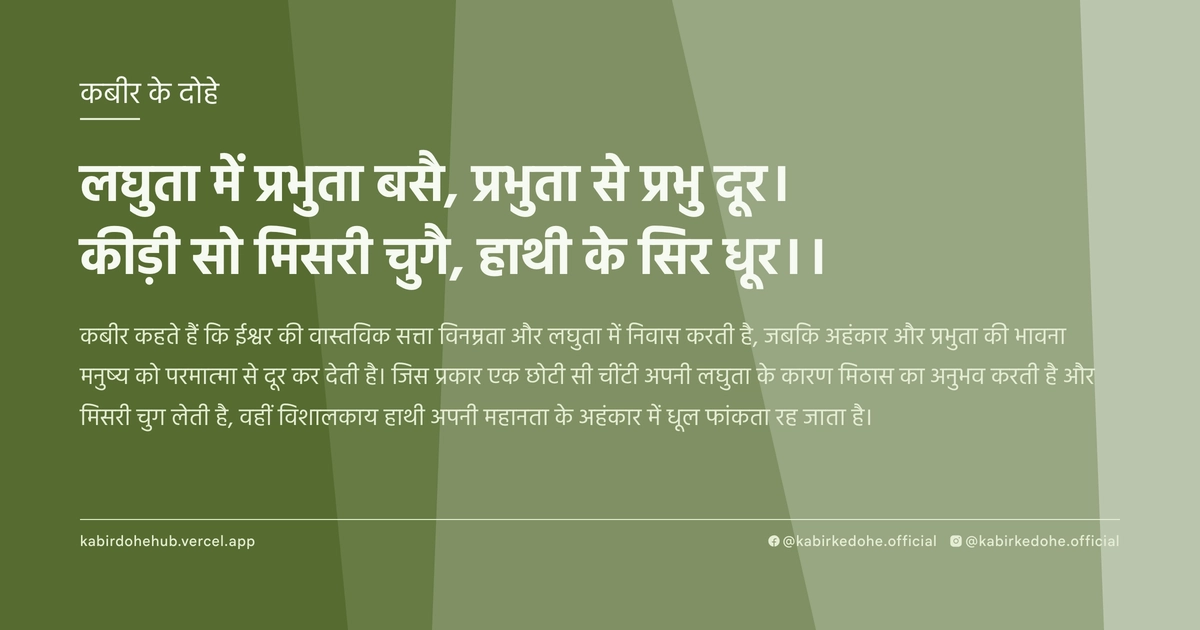
लघुता में प्रभुता बसै, प्रभुता से प्रभु दूर।
कीड़ी सो मिसरी चुगै, हाथी के सिर धूर।।
Laghuta mein prabhuta basai, prabhuta se prabhu door. Keedi so misri chugai, haathi ke sir dhoor.
इस पृष्ठ पर इस कबीर दोहे का अर्थ (meaning), हिंदी व्याख्या और अंग्रेज़ी अनुवाद, दार्शनिक विश्लेषण और व्यावहारिक जीवन सीख दी गई है। यह दोहा विनम्रता (Humility) विषय से जुड़ा है — Kabir doha meaning and explanation in Hindi and English.
अर्थ (Meaning):
कबीर कहते हैं कि ईश्वर की वास्तविक सत्ता विनम्रता और लघुता में निवास करती है, जबकि अहंकार और प्रभुता की भावना मनुष्य को परमात्मा से दूर कर देती है। जिस प्रकार एक छोटी सी चींटी अपनी लघुता के कारण मिठास का अनुभव करती है और मिसरी चुग लेती है, वहीं विशालकाय हाथी अपनी महानता के अहंकार में धूल फांकता रह जाता है।
Kabir asserts that the Divine resides within humility and smallness, whereas the illusion of superiority and dominance alienates a person from God. Just as a tiny ant, in its insignificance, is able to taste and consume the sweetness of sugar, the mighty elephant, burdened by its own perceived greatness, ends up with nothing but dust upon its head.
व्याख्या (Interpretation):
इस दोहे का शाब्दिक अर्थ है कि विनम्र व्यक्ति ईश्वर के करीब होता है और अहंकारी दूर। रूपकात्मक स्तर पर, 'लघुता' केवल शारीरिक आकार नहीं, बल्कि 'अहंकार का विसर्जन' है। निर्गुण भक्ति के अनुसार, जब तक 'मैं' (अहंकार) मौजूद है, तब तक 'वह' (परमात्मा) प्रकट नहीं हो सकता। माया हमें यह विश्वास दिलाती है कि शक्ति, पद और प्रतिष्ठा हमें सत्य के करीब ले जाएगी, जबकि वास्तव में ये बाधाएं हैं। यह अद्वैत वेदांत के उस सिद्धांत को पुष्ट करता है जहाँ आत्मा और ब्रह्म की एकता केवल तब अनुभव होती है जब व्यक्तिगत पहचान का भ्रम टूट जाता है। यहाँ विरोधाभास यह है कि जो स्वयं को शून्य करता है, वही पूर्णता को प्राप्त करता है।
Literally, the verse suggests that the humble are close to God while the proud are distant. Metaphorically, 'smallness' does not refer to physical size but to the 'dissolution of the ego.' In the tradition of Nirgun Bhakti, as long as the 'I' (ego) exists, the 'He' (Divine) cannot be realized. Maya deceives us into believing that power, status, and prestige bring us closer to Truth, when in reality, they are the primary obstacles. This aligns with Advaita Vedanta, where the non-duality of Atman and Brahman is experienced only when the illusion of a separate individual identity is shattered. The central paradox presented is that only by becoming 'nothing' can one encompass 'everything.'
दार्शनिक विश्लेषण (Philosophical Analysis):
कबीर का यह विचार उनके समय के सामाजिक और धार्मिक पाखंड पर एक गहरा प्रहार था। मध्यकालीन भारत में, जाति और वर्ण व्यवस्था ने लोगों को 'उच्च' और 'निम्न' के कृत्रिम खानों में विभाजित कर दिया था। कबीर ने इस पदानुक्रम को चुनौती देते हुए यह स्थापित किया कि आध्यात्मिक पात्रता का संबंध जन्म या सामाजिक स्थिति से नहीं, बल्कि आंतरिक विनम्रता से है।
दार्शनिक रूप से, यह सूफी मत के 'फना' (अहंकार का विनाश) के सिद्धांत से मेल खाता है। जब एक साधक अपनी हस्ती को मिटा देता है, तभी वह ईश्वर के नूर में विलीन हो पाता है। कबीर यहाँ यह समझा रहे हैं कि 'प्रभुता' या श्रेष्ठता का दावा करना वास्तव में एक मानसिक कारागार है जो व्यक्ति को उसकी अपनी वास्तविकता से काट देता है।
अद्वैत वेदांत के परिप्रेक्ष्य में, अहंकार वह पर्दा है जो जीव को यह भुला देता है कि वह वास्तव में ब्रह्म है। जब व्यक्ति स्वयं को 'लघु' या तुच्छ मानता है, तो वह वास्तव में उस झूठे अहंकार को त्याग रहा होता है जो उसे सीमित करता है। यह मनोवैज्ञानिक रूपांतरण है जहाँ 'अहं' का 'विघटन' ही 'मोक्ष' का द्वार है।
कबीर ritualism (कर्मकांड) का विरोध करते हैं क्योंकि कर्मकांड अक्सर बाहरी प्रदर्शन और श्रेष्ठता की भावना को बढ़ावा देते हैं। मंदिर, मस्जिद या तीर्थयात्राएं यदि केवल अहंकार की तुष्टि के लिए हैं, तो वे 'हाथी के सिर की धूल' के समान व्यर्थ हैं। वास्तविक पूजा हृदय की सरलता और समर्पण में है।
अंततः, यह दोहा हमें सिखाता है कि सत्य का अनुभव करने के लिए हमें अपनी महानता के बोझ को उतारना होगा। जो व्यक्ति स्वयं को सबसे छोटा मानता है, उसके लिए ब्रह्मांड की सारी मिठास (ईश्वरीय आनंद) उपलब्ध हो जाती है, क्योंकि उसके भीतर अब कोई अवरोध नहीं बचा है।
Kabir's insight serves as a profound critique of the social and religious hypocrisies of his era. In medieval India, the caste and varna systems had compartmentalized humanity into artificial hierarchies of 'high' and 'low.' Kabir challenged this structure, establishing that spiritual eligibility is not a product of birth or social standing, but of inner humility.
Philosophically, this resonates with the Sufi concept of 'Fana' (the annihilation of the self). Only when a seeker erases their own perceived existence can they merge into the Divine Light. Kabir explains that claiming 'superiority' or 'dominance' is actually a psychological prison that severs the individual's connection to their ultimate reality.
From the lens of Advaita Vedanta, the ego is the veil that blinds the Jiva (individual soul) to the fact that it is, in essence, Brahman. When a person embraces 'smallness' or humility, they are effectively shedding the false ego that limits them. This is a psychological transformation where the dissolution of the 'I' becomes the gateway to liberation.
Kabir rejects ritualism because outward ceremonies often fuel a sense of performance and spiritual superiority. Temples, mosques, or pilgrimages, if undertaken merely to satisfy the ego, are as futile as the 'dust on the elephant's head.' True worship resides in the simplicity and surrender of the heart.
Ultimately, this Doha teaches us that to experience Truth, we must shed the burden of our perceived greatness. The person who considers themselves the smallest in the room finds the entire sweetness of the universe (Divine Bliss) available to them, for there is no longer any barrier between the self and the Infinite.
मूल संदेश (Core Message):
- अहंकार वह पर्दा है जो ईश्वर को ओझल करता है।
- विनम्रता ही वह कुंजी है जो सत्य के द्वार खोलती है।
- श्रेष्ठता का दावा करना आध्यात्मिक पतन का लक्षण है।
- शून्यता में ही पूर्णता का वास होता है।
- सरलता ही सबसे कठिन और उच्चतम साधना है।
- Ego is the veil that obscures the Divine presence.
- Humility is the only key that unlocks the doors of Truth.
- Claiming superiority is a symptom of spiritual decline.
- In the state of emptiness, fullness resides.
- Simplicity is the most difficult yet highest spiritual practice.
व्यावहारिक उदाहरण (Practical Example):
वाराणसी के एक पुराने घाट पर माधव नाम का एक वृद्ध नाविक रहता था। वह शहर के सबसे अनुभवी नाविकों में से एक था, लेकिन उसकी विनम्रता प्रसिद्ध थी। उसके विपरीत, शहर में एक बड़ा जहाज मालिक था जिसका नाम धनराज था। धनराज के पास सबसे आधुनिक नावें थीं और वह खुद को गंगा का स्वामी समझता था। वह अक्सर माधव का मजाक उड़ाता कि वह अभी भी एक छोटी सी लकड़ी की नाव चलाता है।
एक दिन गंगा में भीषण बाढ़ आई। पानी का स्तर इतनी तेजी से बढ़ा कि धनराज के बड़े और भारी जहाज संतुलन खोने लगे। धनराज का अहंकार उसे यह मानने नहीं दे रहा था कि उसकी तकनीक विफल हो रही है। वह अपनी बड़ी नाव के साथ लहरों से लड़ने की कोशिश करता रहा, लेकिन उसकी विशालता ही उसकी कमजोरी बन गई; वह लहरों के प्रहार को झेल नहीं पाया और उसका जहाज किनारे की चट्टानों से टकराकर डूबने लगा।
उसी समय, माधव अपनी छोटी सी नाव के साथ पानी की लहरों के साथ बह रहा था। उसने लहरों से लड़ने की कोशिश नहीं की, बल्कि खुद को पानी के हवाले कर दिया। उसकी नाव इतनी छोटी और हल्की थी कि वह उथले पानी और संकरी गलियों से आसानी से निकल गया, जहाँ बड़े जहाज कभी नहीं पहुँच सकते थे।
जब धनराज डूबने लगा, तो माधव ने अपनी छोटी नाव से उसे बचा लिया। पानी से बाहर आने के बाद, धनराज ने देखा कि जिस 'लघुता' का वह मजाक उड़ाता था, उसी ने माधव को सुरक्षित रखा और अंततः उसकी जान बचाई।
माधव ने मुस्कुराते हुए कहा, 'सेठ जी, जब हम खुद को बहुत बड़ा मान लेते हैं, तो हम लहरों के सामने खड़े हो जाते हैं और टूट जाते हैं। लेकिन जब हम खुद को छोटा मानकर लहरों के साथ बहते हैं, तो हम सुरक्षित किनारे तक पहुँच जाते हैं।'
धनराज को पहली बार समझ आया कि उसकी 'प्रभुता' (श्रेष्ठता का भ्रम) ही उसकी सबसे बड़ी बाधा थी। उसने महसूस किया कि वह अपनी संपत्ति और शक्ति के अहंकार में इतना अंधा हो गया था कि वह जीवन की सहजता और सरलता को भूल चुका था।
उस दिन के बाद धनराज ने अपनी जीवनशैली बदल दी। उसने अपनी संपत्ति का उपयोग दूसरों की सेवा के लिए करना शुरू किया और अपनी श्रेष्ठता के मुखौटे को उतार फेंका।
वह अब माधव के साथ घाट पर बैठता और यह सीखता कि कैसे एक छोटी सी चींटी की तरह जीवन की छोटी-छोटी खुशियों और ईश्वर की उपस्थिति को महसूस किया जाए। उसने पाया कि अहंकार के बिना जीवन पहले से कहीं अधिक मीठा और शांतिपूर्ण हो गया था।
On an ancient ghat in Varanasi lived an elderly boatman named Madhav. He was one of the most experienced sailors in the city, yet his humility was legendary. In contrast, there was a wealthy ship owner named Dhanraj. Dhanraj owned the most modern vessels and considered himself the master of the Ganges. He often mocked Madhav for still rowing a tiny, weathered wooden boat.
One day, a fierce flood struck the Ganges. The water levels rose so rapidly that Dhanraj's large, heavy ships began to lose their balance. Dhanraj's ego prevented him from admitting that his technology was failing. He continued to fight the currents with his massive vessel, but its very size became its weakness; it could not withstand the sheer force of the waves and eventually crashed into the riverbank rocks, beginning to sink.
At that same moment, Madhav was navigating the flood in his small boat. He did not attempt to fight the currents; instead, he surrendered himself to the flow of the water. His boat was so small and light that it glided effortlessly through shallow waters and narrow channels where the great ships could never venture.
As Dhanraj began to drown, Madhav used his small boat to rescue him. Once safe on shore, Dhanraj realized that the 'smallness' he had ridiculed was exactly what had kept Madhav safe and had ultimately saved his own life.
Madhav smiled and said, 'Seth ji, when we believe ourselves to be too great, we stand against the waves and are broken. But when we consider ourselves small and flow with the current, we reach the safe shore.'
For the first time, Dhanraj understood that his 'prabhuta' (the illusion of superiority) had been his greatest obstacle. He realized he had been so blinded by his wealth and power that he had forgotten the innate simplicity and grace of life.
From that day forward, Dhanraj transformed his life. He began using his wealth to serve others and cast aside the mask of superiority.
He would now sit with Madhav on the ghat, learning how to feel the small joys of life and the presence of the Divine, much like a tiny ant tasting sugar. He discovered that without the burden of ego, life had become sweeter and more peaceful than ever before.
अभ्यास मार्गदर्शन (Practice Guidance):
- दैनिक चिंतन: प्रतिदिन 10 मिनट मौन बैठें और विचार करें कि आपके जीवन में कौन सी 'श्रेष्ठता' की भावना आपको दूसरों से अलग कर रही है।
- आत्म-पूछताछ जर्नल: लिखें कि पिछले एक सप्ताह में आपने कब अपनी बुद्धिमत्ता या पद का उपयोग दूसरों को नीचा दिखाने के लिए किया।
- व्यवहारिक परिवर्तन: दिन में कम से कम एक बार किसी ऐसे व्यक्ति की मदद करें या उनसे कुछ सीखें जिन्हें समाज 'निम्न' मानता है।
- निदान चेकलिस्ट: क्या आप दूसरों की आलोचना करते समय खुद को श्रेष्ठ महसूस करते हैं? क्या आप अनचाहे सुझावों पर क्रोधित होते हैं? यदि हाँ, तो आप 'हाथी' की स्थिति में हैं।
- Daily Contemplation: Sit in silence for 10 minutes daily and reflect on which feelings of 'superiority' are creating a barrier between you and others.
- Self-Inquiry Journal: Document instances from the past week where you used your intelligence or status to subtly belittle someone else.
- Behavioral Shift: At least once a day, seek a lesson or offer genuine help to someone whom society deems 'insignificant' or 'lower.'
- Diagnostic Checklist: Do you feel a sense of superiority while criticizing others? Do you react with anger to unsolicited suggestions? If yes, you are currently in the state of the 'elephant'.
चिंतन प्रश्न (Reflection Questions):
- आपकी कौन सी उपलब्धियां वास्तव में आपकी अपनी हैं, और कौन सी केवल सामाजिक मुखौटे हैं?
- यदि आपसे आपकी सारी पदवियां और प्रतिष्ठा छीन ली जाए, तो आपके भीतर क्या बचेगा?
- क्या आपकी डिजिटल पहचान (सोशल मीडिया) आपके वास्तविक स्वरूप को छिपाने का एक साधन बन गई है?
- आप उन लोगों के प्रति कैसा व्यवहार करते हैं जो आपके लिए कुछ भी नहीं कर सकते?
- क्या आप वास्तव में विनम्र हैं, या आप केवल 'विनम्र दिखने' का अभिनय कर रहे हैं?
- Which of your achievements are truly your own, and which are merely social masks?
- If all your titles and prestige were stripped away, what would remain of your inner self?
- Has your digital identity (social media) become a tool to hide your authentic, flawed self?
- How do you treat those who can offer you absolutely nothing in return?
- Are you truly humble, or are you merely performing the act of 'appearing humble'?