
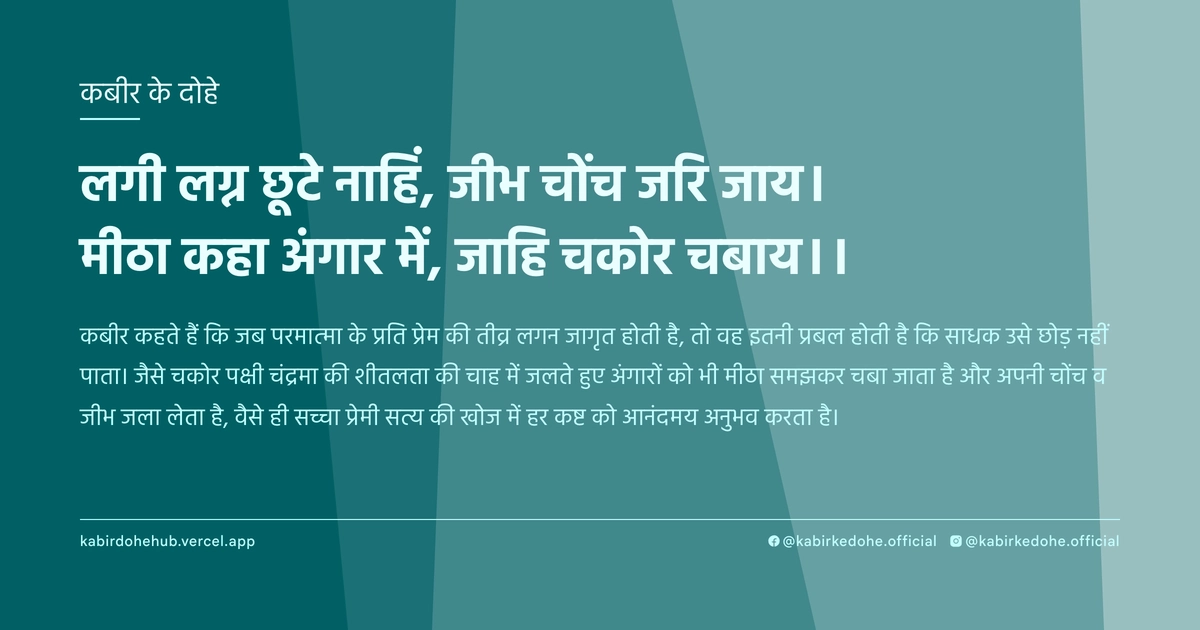
लगी लग्न छूटे नाहिं, जीभ चोंच जरि जाय।
मीठा कहा अंगार में, जाहि चकोर चबाय।।
Lagi lagan chhoote naahin, jeebh chonch jari jaaye. Meetha kaha angaar mein, jaahi chakor chabay.
इस पृष्ठ पर इस कबीर दोहे का अर्थ (meaning), हिंदी व्याख्या और अंग्रेज़ी अनुवाद, दार्शनिक विश्लेषण और व्यावहारिक जीवन सीख दी गई है। यह दोहा भक्ति (Bhakti) विषय से जुड़ा है — Kabir doha meaning and explanation in Hindi and English.
अर्थ (Meaning):
कबीर कहते हैं कि जब परमात्मा के प्रति प्रेम की तीव्र लगन जागृत होती है, तो वह इतनी प्रबल होती है कि साधक उसे छोड़ नहीं पाता। जैसे चकोर पक्षी चंद्रमा की शीतलता की चाह में जलते हुए अंगारों को भी मीठा समझकर चबा जाता है और अपनी चोंच व जीभ जला लेता है, वैसे ही सच्चा प्रेमी सत्य की खोज में हर कष्ट को आनंदमय अनुभव करता है।
Kabir describes a state of intense spiritual longing where the devotion to the Divine becomes an unbreakable bond. He uses the metaphor of the Chakor bird, which is so obsessed with the moon that it mistakes burning embers for the moon's coolness, consuming them and burning its own beak and tongue. Similarly, a true seeker finds a strange sweetness in the fires of longing and sacrifice, unable to detach from the pursuit of Truth.
व्याख्या (Interpretation):
यह दोहा 'विरह' और 'तड़प' की पराकाष्ठा को दर्शाता है। शाब्दिक अर्थ में यह एक पक्षी की मूर्खता लग सकती है, लेकिन आध्यात्मिक स्तर पर यह 'अद्वैत' की उस स्थिति का वर्णन है जहाँ द्वैत समाप्त हो जाता है। यहाँ 'अंगार' संसार के दुखों और तपस्या की कठिनाइयों का प्रतीक हैं, जबकि 'मीठा' उस आंतरिक आनंद का है जो केवल पूर्ण समर्पण से मिलता है। निर्गुण भक्ति में, जब आत्मा (जीवात्मा) परमात्मा (ब्रह्म) से मिलने के लिए व्याकुल होती है, तो वह बाहरी सुख-दुख से ऊपर उठ जाती है। यह विरोधाभास है कि विनाशकारी अग्नि ही साधक के लिए अमृत बन जाती है क्योंकि उसका लक्ष्य भौतिक अस्तित्व नहीं, बल्कि शून्य में विलीन होना है। माया का पर्दा तब हटता है जब साधक अपनी 'अहं' की चोंच को सत्य की अग्नि में जला देता है।
This couplet depicts the pinnacle of 'Viraha' (longing) and spiritual yearning. While literally describing a bird's folly, metaphorically it illustrates the state of Non-duality (Advaita) where the distinction between pain and pleasure dissolves. The 'embers' symbolize the hardships of asceticism and the agonies of worldly existence, while the 'sweetness' represents the transcendental bliss found only through absolute surrender. In Nirgun Bhakti, when the individual soul (Atman) yearns for the Formless Divine (Brahman), it transcends the binary of suffering and joy. It is a profound paradox: the destructive fire becomes a nectar because the seeker's goal is not physical survival, but the annihilation of the ego. The veil of Maya is lifted only when the seeker allows the 'beak' of their identity to be consumed by the fire of Truth.
दार्शनिक विश्लेषण (Philosophical Analysis):
कबीर का यह दृष्टिकोण सूफीवाद के 'इश्क-ए-हकीकी' (ईश्वरीय प्रेम) और भारतीय वेदांत के मिलन बिंदु पर स्थित है। कबीर के युग में, धर्म केवल कर्मकांडों और बाहरी दिखावे तक सीमित था। उन्होंने इस विचार को चुनौती दी कि ईश्वर केवल मंदिर या मस्जिद में मिलता है; उन्होंने तर्क दिया कि ईश्वर उस हृदय में है जो पूरी तरह जल चुका है। यहाँ 'जलने' का अर्थ है अहंकार का विनाश। जब तक 'मैं' जीवित है, तब तक 'वह' नहीं मिल सकता।
अद्वैत वेदांत के अनुसार, आत्मा और परमात्मा एक ही हैं, लेकिन अज्ञान (माया) के कारण हम अलग महसूस करते हैं। यह 'लगन' वह अग्नि है जो अज्ञान की परतों को जलाती है। सूफी मत में इसे 'फना' कहा गया है—अपनी पहचान को ईश्वर की इच्छा में पूरी तरह मिटा देना। कबीर यहाँ यह समझा रहे हैं कि आध्यात्मिक मार्ग सरल नहीं है; इसमें वह पीड़ा निहित है जो एक प्रेमी अपनी प्रेमिका के लिए सहता है।
ritualism (कर्मकांड) का विरोध करते हुए कबीर बताते हैं कि माला फेरना या व्रत रखना तब तक व्यर्थ है जब तक कि भीतर वह तड़प न हो जो चकोर में है। वास्तविक भक्ति वह नहीं है जो शांति दे, बल्कि वह है जो आपको भीतर से झकझोर दे और आपकी पुरानी पहचान को नष्ट कर दे।
मनोवैज्ञानिक स्तर पर, यह 'cognitive dissonance' की स्थिति है जहाँ साधक अपनी भौतिक सुख-सुविधाओं को त्याग कर एक उच्चतर सत्य की ओर बढ़ता है। यह एक प्रकार का 'सकारात्मक विनाश' है। जब व्यक्ति अपनी इच्छाओं की चोंच को जला देता है, तो वह वास्तव में मुक्त हो जाता है क्योंकि अब उसके पास खोने के लिए कुछ नहीं बचता।
अंततः, यह दोहा हमें सिखाता है कि सत्य की प्राप्ति के लिए 'तप' अनिवार्य है। बिना जले, कुंदन नहीं बनता। कबीर का संदेश स्पष्ट है: यदि आप उस परम आनंद को पाना चाहते हैं, तो पहले उस अग्नि से गुजरना होगा जो आपके अहंकार को भस्म कर दे।
Kabir's perspective sits at the intersection of the Sufi concept of 'Ishq-e-Haqiqi' (Divine Love) and Indian Advaita Vedanta. In Kabir's era, religion was largely reduced to rituals and outward displays. He challenged the notion that the Divine resides only in temples or mosques, arguing instead that God is found in the heart that has been completely consumed by longing. Here, 'burning' signifies the annihilation of the ego. As long as the 'I' exists, the 'Thou' cannot be realized.
According to Advaita Vedanta, the Atman and Brahman are one, separated only by the illusion of Maya. This 'lagan' (intense longing) is the fire that incinerates the layers of ignorance. In Sufism, this is termed 'Fana'—the dissolution of the self into the Will of the Divine. Kabir illustrates that the spiritual path is not a gentle stroll but a rigorous journey involving a pain akin to that of a lover separated from the beloved.
Rejecting ritualism, Kabir asserts that chanting beads or fasting is futile unless there is an internal yearning similar to that of the Chakor bird. True devotion is not that which provides immediate comfort, but that which shakes the core of one's being and destroys the old identity.
Psychologically, this represents a state of transcendence where the seeker moves beyond the binary of pleasure and pain. It is a 'positive destruction.' When one burns the 'beak' of their desires, they achieve true liberation because there is nothing left to cling to or fear losing.
Ultimately, this doha teaches that 'Tapas' (spiritual heat/discipline) is essential for realization. Just as gold must be purified in fire, the soul must be purified through longing. Kabir's message is clear: to attain the supreme bliss, one must first pass through the fire that consumes the ego.
मूल संदेश (Core Message):
- अहंकार की चोंच जब जलती है, तभी सत्य का स्वाद मिलता है।
- सच्ची भक्ति सुख की खोज नहीं, बल्कि पूर्ण समर्पण की अग्नि है।
- बाहरी कष्ट आंतरिक रूपांतरण के सबसे शक्तिशाली उपकरण हैं।
- जब 'मैं' मिट जाता है, तब केवल 'वह' शेष रहता है।
- प्रेम की पराकाष्ठा वह है जहाँ दर्द और आनंद एक हो जाते हैं।
- The taste of Truth is found only when the beak of ego is incinerated.
- True devotion is not a quest for comfort, but a fire of total surrender.
- External hardships are the most powerful tools for internal transformation.
- When the 'I' is extinguished, only the 'Divine' remains.
- The pinnacle of love is where pain and bliss merge into one.
व्यावहारिक उदाहरण (Practical Example):
वाराणसी के एक पुराने घाट पर रहने वाली एक वृद्ध विधवा, जानकी, का जीवन अत्यंत कठिन था। समाज ने उन्हें हाशिए पर धकेल दिया था और उनके पास केवल एक छोटा सा कमरा और दूसरों की सेवा करने का काम था। जानकी ने वर्षों तक बाहरी दुनिया से कटकर केवल राम नाम का जाप किया, लेकिन उनका जाप केवल शब्दों का दोहराव नहीं था, बल्कि एक गहरी तड़प थी।
एक समय आया जब उनके जीवन में अत्यधिक अभाव आया। उनके पास भोजन के लिए पैसे नहीं थे और स्वास्थ्य गिर रहा था। लोग उन्हें दया की दृष्टि से देखते थे, लेकिन जानकी के चेहरे पर एक अजीब सी शांति और मुस्कान थी। उनके पड़ोस में रहने वाला एक युवा विद्वान, जो शास्त्रों का ज्ञाता था, उनसे अक्सर पूछता, 'माता, आप इस दुख और दरिद्रता में भी कैसे मुस्कुरा सकती हैं? क्या आपको दर्द नहीं होता?'
जानकी ने उत्तर दिया, 'बेटा, जिसे तुम दुख कह रहे हो, वह मेरे लिए उस अग्नि की तरह है जो मेरे भीतर की सारी गंदगी को जला रही है। मुझे अब इस शरीर या समाज की चिंता नहीं है, क्योंकि मेरी लगन उस परमात्मा से लग गई है।'
उस विद्वान को लगा कि जानकी पागल हो गई हैं, लेकिन जब उसने गौर से देखा, तो पाया कि जानकी की आँखों में वह चमक थी जो उसने बड़े-बड़े पंडितों की आँखों में नहीं देखी थी। जानकी ने अपनी भूख और अकेलेपन को अपनी साधना का ईंधन बना लिया था।
एक दिन, उस विद्वान ने देखा कि जानकी एक घायल कुत्ते की सेवा कर रही थीं, जबकि उनके अपने हाथ कांप रहे थे। उन्होंने अपनी अंतिम रोटी उस कुत्ते को खिला दी। जब विद्वान ने उन्हें रोका, तो जानकी ने कहा, 'जब मैं स्वयं उस परमात्मा की अग्नि में जल रही हूँ, तो मुझे इस छोटी सी भूख का क्या भय?'
यह 'कबीर ट्विस्ट' था। विद्वान को समझ आया कि वह केवल किताबों में 'वैराग्य' पढ़ रहा था, जबकि जानकी उसे जी रही थीं। जानकी के लिए, गरीबी और उपेक्षा वह 'अंगार' थे जिन्हें उन्होंने प्रेम के कारण 'मीठा' बना लिया था।
विद्वान का अहंकार टूट गया। उसने महसूस किया कि उसकी सारी विद्वत्ता व्यर्थ है क्योंकि उसमें वह 'तड़प' नहीं थी। उसने अपनी सुख-सुविधाओं का त्याग नहीं किया, लेकिन उसने जानकी के चरणों में बैठकर यह सीखा कि कैसे दुख को भक्ति में बदला जाता है।
जानकी का जीवन एक प्रमाण बन गया कि जब लगन सच्ची होती है, तो बाहरी परिस्थितियाँ मायने नहीं रखतीं। उन्होंने अपनी सामाजिक पहचान (एक विधवा, एक गरीब) को पूरी तरह जला दिया था और केवल एक शुद्ध आत्मा के रूप में जीवित थीं।
अंततः, उस विद्वान ने अपना जीवन सेवा और सादगी में लगा दिया, यह समझते हुए कि सत्य केवल जानने की चीज़ नहीं, बल्कि जलकर अनुभव करने की चीज़ है।
इस प्रकार, जानकी ने अपनी पीड़ा को अपनी शक्ति में बदल दिया, ठीक उसी तरह जैसे चकोर पक्षी अंगारों में भी अपना सुख खोज लेता है।
In the ancient ghats of Varanasi lived an elderly widow named Janaki. Her life was fraught with hardship; society had pushed her to the margins, and she possessed nothing but a tiny room and a life spent serving others. For years, Janaki practiced the remembrance of the Divine, but her chanting was not a mere repetition of words—it was a profound, aching longing.
There came a time when her poverty became extreme. She lacked money for food, and her health was failing. People looked at her with pity, yet a strange peace and a persistent smile radiated from her face. A young scholar living nearby, well-versed in the scriptures, often asked her, 'Mother, how can you smile in the midst of such misery and deprivation? Does it not hurt?'
Janaki replied, 'Son, what you call suffering is, for me, like a fire that is burning away all the impurities within. I no longer care for this body or the judgments of society, for my heart is anchored in the Divine.'
The scholar initially thought Janaki had lost her mind. However, he noticed a brilliance in her eyes that he had never seen in the most learned pundits. Janaki had turned her hunger and loneliness into the fuel for her spiritual practice.
One day, the scholar saw Janaki tending to a wounded dog, despite her own hands trembling with weakness. She fed her last piece of bread to the animal. When the scholar tried to stop her, Janaki said, 'When I am already burning in the fire of Divine love, why should I fear a little hunger?'
This was the 'Kabir Twist.' The scholar realized that while he had only read about 'Vairagya' (detachment) in books, Janaki was embodying it. For her, poverty and neglect were the 'embers' which she had transformed into 'sweetness' through love.
The scholar's ego shattered. He realized his entire academic achievement was hollow because he lacked that visceral yearning. He did not abandon his life, but he began sitting at Janaki's feet to learn how to transmute pain into devotion.
Janaki's life became a testament that when longing is authentic, external circumstances become irrelevant. She had completely incinerated her social identity—that of a widow, a pauper—and existed only as a pure soul.
Eventually, the scholar dedicated his life to service and simplicity, understanding that Truth is not something to be known intellectually, but something to be experienced by burning through the ego.
Thus, Janaki transformed her agony into power, just as the Chakor bird finds its solace even within the glowing embers.
अभ्यास मार्गदर्शन (Practice Guidance):
- दैनिक चिंतन: प्रतिदिन 20 मिनट मौन बैठें और अपने भीतर की उस 'तड़प' को महसूस करें जो आपको पूर्णता की ओर ले जाती है। यह पूछें, 'मैं वास्तव में क्या खोज रहा हूँ?'
- आत्म-पूछताछ जर्नल: उन क्षेत्रों को लिखें जहाँ आप जीवन में संघर्ष कर रहे हैं। फिर यह विश्लेषण करें कि कैसे यह संघर्ष आपके अहंकार को मिटाने का एक अवसर हो सकता है।
- व्यवहार परिवर्तन: जब भी आपको मानसिक या शारीरिक कष्ट हो, तो उसे 'प्रतिरोध' करने के बजाय, उसे एक 'शुद्धिकरण प्रक्रिया' के रूप में स्वीकार करें।
- निदान चेकलिस्ट: क्या मैं अभी भी बाहरी प्रशंसा और आलोचना से विचलित होता हूँ? (यदि हाँ, तो अहंकार अभी जीवित है)। क्या मैं अपने दुखों को ईश्वर की इच्छा मानकर उनमें शांति खोज पा रहा हूँ? (यदि हाँ, तो लगन जागृत हो रही है)।
- Daily Contemplation: Spend 20 minutes in silence daily, feeling the 'yearning' within that pulls you toward wholeness. Ask yourself, 'What am I truly searching for?'
- Self-Inquiry Journaling: List the areas of your life where you are currently struggling. Analyze how these struggles can serve as opportunities to incinerate your ego.
- Behavioral Shift: Whenever you encounter mental or physical distress, instead of resisting it, consciously accept it as a 'purification process' designed to strip away the false self.
- Diagnostic Checklist: Do I still react strongly to external praise or criticism? (If yes, the ego is still intact). Am I able to find peace within my suffering by viewing it as a Divine catalyst? (If yes, the spiritual longing is awakening).
चिंतन प्रश्न (Reflection Questions):
- मेरे जीवन का वह कौन सा 'अंगार' (दुख) है जिसे मैं अब तक कड़वा मान रहा हूँ, लेकिन वह वास्तव में मुझे बदल रहा है?
- क्या मेरी आध्यात्मिक खोज केवल मानसिक शांति के लिए है, या मैं अपनी पहचान को पूरी तरह मिटाने के लिए तैयार हूँ?
- मैं अपनी डिजिटल पहचान (सोशल मीडिया) के माध्यम से किस 'छवि' को बचाए रखने की कोशिश कर रहा हूँ, और वह छवि मेरे वास्तविक सत्य में कैसे बाधा है?
- यदि मेरा सारा सामाजिक सम्मान और पद छीन लिया जाए, तो क्या मेरे भीतर कुछ ऐसा बचेगा जो अभी भी 'मीठा' और आनंदमय हो?
- क्या मैं वास्तव में सत्य का प्रेमी हूँ, या मैं केवल सत्य के 'लाभों' का प्रेमी हूँ?
- What is the 'ember' (suffering) in my life that I have viewed as bitter, but which is actually transforming me?
- Is my spiritual quest merely for mental peace, or am I truly prepared to annihilate my identity?
- What 'image' am I trying to preserve through my digital identity, and how does that image obstruct my realization of Truth?
- If all my social status and honors were stripped away, would there be something within me that remains 'sweet' and blissful?
- Am I truly a lover of Truth, or am I merely a lover of the 'benefits' that come with being spiritual?