
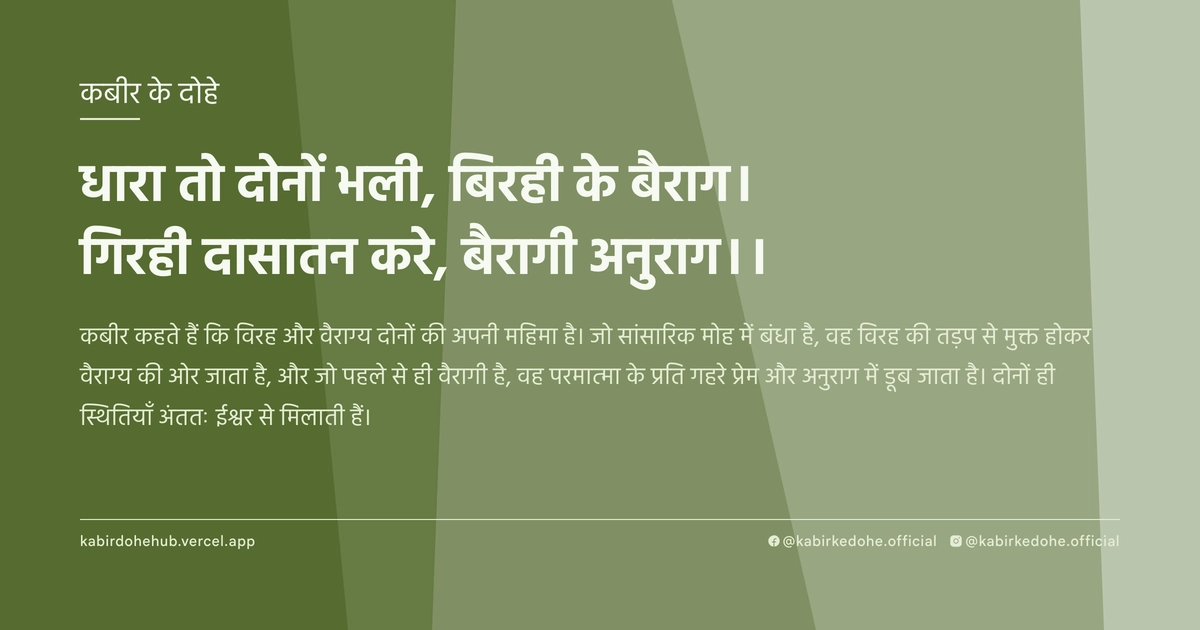
धारा तो दोनों भली, बिरही के बैराग।
गिरही दासातन करे, बैरागी अनुराग।।
Dhara to donon bhali, birhi ke bairag. Girhi dasatan kare, bairagi anurag.
इस पृष्ठ पर इस कबीर दोहे का अर्थ (meaning), हिंदी व्याख्या और अंग्रेज़ी अनुवाद, दार्शनिक विश्लेषण और व्यावहारिक जीवन सीख दी गई है। यह दोहा वैराग्य (Detachment) विषय से जुड़ा है — Kabir doha meaning and explanation in Hindi and English.
अर्थ (Meaning):
कबीर कहते हैं कि विरह और वैराग्य दोनों की अपनी महिमा है। जो सांसारिक मोह में बंधा है, वह विरह की तड़प से मुक्त होकर वैराग्य की ओर जाता है, और जो पहले से ही वैरागी है, वह परमात्मा के प्रति गहरे प्रेम और अनुराग में डूब जाता है। दोनों ही स्थितियाँ अंततः ईश्वर से मिलाती हैं।
Kabir asserts that both longing (viraha) and detachment (vairagya) are auspicious paths. The householder, bound by worldly attachments, is purified through the agony of separation to reach detachment, while the ascetic, already detached, evolves into a state of divine passion and intense love for the Formless One. Both trajectories converge at the ultimate truth.
व्याख्या (Interpretation):
इस दोहे का शाब्दिक अर्थ है कि विरही और वैरागी दोनों की स्थिति कल्याणकारी है। यहाँ 'गिरही' का अर्थ गृहस्थ से है और 'बैरागी' का अर्थ संन्यासी से। रूपक के स्तर पर, कबीर यह समझा रहे हैं कि आध्यात्मिक यात्रा दो दिशाओं से शुरू हो सकती है: या तो संसार की निस्सारता का अनुभव कर वैराग्य प्राप्त करना, या वैराग्य के बाद उस शून्य में प्रेम को खोजना। यह निर्गुण भक्ति का सार है जहाँ आत्मा (Atman) अपनी विस्मृति को तोड़कर ब्रह्म (Brahman) की ओर बढ़ती है। माया का पर्दा तब हटता है जब या तो दुख चरम पर हो या शांति पूर्ण हो। यह विरोधाभास दर्शाता है कि चाहे आप मोह में तड़प रहे हों या शांति में लीन हों, यदि वह दिशा परमात्मा की ओर है, तो दोनों मार्ग समान रूप से पवित्र हैं।
Literally, the verse suggests that both the longing soul and the detached seeker are blessed. 'Girahi' refers to the householder entangled in Maya, while 'Bairagi' refers to the renunciant. Metaphorically, Kabir illustrates that the spiritual trajectory can begin from two poles: the agony of worldly disillusionment leading to detachment, or the stillness of detachment evolving into divine ecstasy. This aligns with Nirgun Bhakti, where the soul (Atman) awakens from the slumber of ignorance to realize its non-duality with the Formless Brahman. The veil of Maya is pierced either by the fire of separation or the coolness of surrender. This paradox highlights that whether one is driven by the pain of loss or the peace of renunciation, both paths are valid if they lead toward the Eternal.
दार्शनिक विश्लेषण (Philosophical Analysis):
कबीर का यह विचार उनके युग के कट्टरपंथ और बाहरी आडंबरों पर एक गहरा प्रहार है। उस समय समाज दो हिस्सों में बंटा था: एक वे जो कर्मकांडों में फंसे थे और दूसरे वे जो जंगलों में जाकर तपस्या कर रहे थे। कबीर ने इन दोनों के बीच के कृत्रिम भेद को मिटा दिया। वे कहते हैं कि बाहरी वस्त्र या सामाजिक स्थिति मायने नहीं रखती, बल्कि आंतरिक रूपांतरण महत्वपूर्ण है।
अद्वैत वेदांत के परिप्रेक्ष्य में, यह दोहा 'विवेक' और 'वैराग्य' की प्रक्रिया को दर्शाता है। जब एक गृहस्थ को यह अहसास होता है कि संसार नश्वर है, तो वह 'दासातन' यानी विरही बन जाता है। यह विरह वास्तव में परमात्मा के प्रति एक पुकार है। यह मानसिक अवस्था अहंकार के विसर्जन की पहली सीढ़ी है, जहाँ व्यक्ति अपनी सीमित पहचान को छोड़कर अनंत की खोज करता है।
सूफी मत के 'इश्क-ए-मिजाजी' (सांसारिक प्रेम) से 'इश्क-ए-हकीकी' (दिव्य प्रेम) के संक्रमण के साथ इसका गहरा संबंध है। सूफीवाद में भी माना जाता है कि सांसारिक प्रेम की तड़प ही अंततः ईश्वर के प्रति प्रेम में बदलती है। कबीर यहाँ इसी मनोवैज्ञानिक बदलाव की बात कर रहे हैं, जहाँ विरह की अग्नि अशुद्धियों को जलाकर आत्मा को कुंदन बना देती है।
कबीर ritualism (कर्मकांड) का विरोध करते हैं क्योंकि वे जानते हैं कि केवल जटाएं बढ़ा लेने या घर छोड़ देने से वैराग्य नहीं आता। सच्चा वैराग्य मन की वह स्थिति है जहाँ इच्छाएं समाप्त हो जाती हैं। यदि एक गृहस्थ अपने कर्तव्यों का पालन करते हुए भी भीतर से विरक्त है, तो वह उस संन्यासी से श्रेष्ठ है जो जंगल में रहकर भी वासनाओं से घिरा है।
अंततः, यह विश्लेषण हमें इस निष्कर्ष पर ले जाता है कि आध्यात्मिक प्रगति रैखिक नहीं है। यह एक चक्र है जहाँ विरह, वैराग्य और फिर अनुराग (प्रेम) का क्रम चलता है। अहंकार का विनाश तभी संभव है जब व्यक्ति यह समझ ले कि वह न तो केवल एक शरीर है और न ही केवल एक विचार, बल्कि वह उस विराट चेतना का हिस्सा है जो प्रेम और शांति का पर्याय है।
Kabir’s insight serves as a profound critique of the rigid dichotomies and outward rituals of his era. At a time when society was split between the ritualistic householder and the forest-dwelling ascetic, Kabir dismantled the artificial wall between them. He posits that external attire or social status is irrelevant; what matters is the internal alchemy of the soul.
From the lens of Advaita Vedanta, this verse encapsulates the process of 'Viveka' (discernment) and 'Vairagya' (dispassion). When a householder realizes the ephemeral nature of the world, they enter a state of 'dasatan' or longing. This longing is not a mere emotional void but a spiritual catalyst—a call from the Infinite. It is the first step in the annihilation of the ego, where the individual transcends the limited 'I' to seek the universal 'Self'.
There is a striking parallel here with the Sufi transition from 'Ishq-e-Majazi' (metaphorical/earthly love) to 'Ishq-e-Haqiqi' (divine love). Sufism teaches that the intensity of human longing is a training ground for the soul's yearning for the Beloved. Kabir mirrors this psychological shift, suggesting that the fire of separation burns away the dross of the ego, leaving behind the pure gold of consciousness.
Kabir vehemently rejects ritualism because he understands that wearing saffron robes or retreating to a cave does not guarantee detachment. True Vairagya is a state of mind where craving ceases. A householder who performs their duties while remaining internally detached is spiritually superior to a monk who dwells in a forest but remains imprisoned by hidden desires.
Ultimately, this analysis reveals that spiritual evolution is not linear but cyclical. The movement from longing to detachment, and finally to divine love (Anurag), is a refining process. The ego is extinguished only when one realizes they are neither the body nor the mind, but a fragment of the Vast Consciousness, where the paradox of separation and union finally dissolves into a singular, eternal presence.
मूल संदेश (Core Message):
- दुख केवल पीड़ा नहीं, बल्कि जागृति का संकेत है।
- मोह का टूटना ही वास्तविक स्वतंत्रता की शुरुआत है।
- वैराग्य शून्य नहीं, बल्कि पूर्णता की ओर पहला कदम है।
- प्रेम जब व्यक्तिगत से वैश्विक हो जाता है, तब वह अनुराग बनता है।
- परमात्मा तक पहुँचने के दो मार्ग हैं: तड़प और शांति।
- Suffering is not merely pain, but a signal for awakening.
- The breaking of attachment is the true dawn of freedom.
- Detachment is not a void, but the first step toward wholeness.
- Love becomes 'Anurag' when it shifts from the personal to the universal.
- There are two portals to the Divine: the fire of longing and the stillness of peace.
व्यावहारिक उदाहरण (Practical Example):
वाराणसी के घाटों पर रहने वाले एक वृद्ध बुनकर, माधव, की कहानी है। माधव ने अपना पूरा जीवन रेशमी साड़ियाँ बुनने में बिता दिया। वह अपने काम में माहिर था, लेकिन उसका मन हमेशा इस बात से परेशान रहता था कि उसकी कला की सराहना केवल धनवान लोग करते हैं, जबकि वह स्वयं अभावों में जीता था।
एक समय आया जब माधव के जीवन में गहरा दुख आया। उसकी इकलौती बेटी, जो उसका एकमात्र सहारा थी, एक लंबी बीमारी के बाद दुनिया छोड़ गई। इस क्षति ने माधव को तोड़ दिया। वह गहरे विरह में डूब गया। उसे लगा कि यह संसार एक छलावा है और जिस प्रेम को वह अपनी बेटी में खोज रहा था, वह यहाँ स्थायी नहीं है।
शुरुआत में, माधव ने सब कुछ त्याग दिया। उसने बुनना छोड़ दिया और घाट की सीढ़ियों पर चुपचाप बैठने लगा। लोग उसे 'पागल' कहने लगे, लेकिन माधव के भीतर एक गहरा वैराग्य जन्म ले रहा था। वह अब धन या प्रसिद्धि की इच्छा नहीं करता था। उसके लिए अब केवल एक ही प्रश्न था—'वह कौन सी शक्ति है जो जीवन और मृत्यु का खेल खेलती है?'
इस वैराग्य की अवस्था में, माधव ने पाया कि उसकी तड़प अब उसकी बेटी के लिए नहीं, बल्कि उस परम सत्य के लिए थी जिसने उसे यह सब दिखाया। वह विरह अब एक दर्द नहीं, बल्कि एक मार्ग बन गया था। उसने महसूस किया कि जिस शून्य को वह अपनी बेटी के जाने से महसूस कर रहा था, वही शून्य वास्तव में परमात्मा का निवास स्थान है।
धीरे-धीरे, माधव का वैराग्य 'अनुराग' में बदलने लगा। उसने फिर से करघा चलाया, लेकिन अब वह साड़ियाँ बेचने के लिए नहीं, बल्कि ईश्वर की स्तुति के रूप में बुनने लगा। हर धागा अब उसके लिए एक प्रार्थना था। वह अब अपनी कला को एक माध्यम मानता था जिससे वह दुनिया को शांति का संदेश दे सके।
एक दिन एक अहंकारी व्यापारी उसके पास आया और उसने माधव की साड़ी की बहुत ऊंची कीमत लगाई। माधव ने मुस्कुराकर साड़ी उसे मुफ्त में दे दी। व्यापारी हैरान था। माधव ने कहा, 'जब मैं इस धागे में खुद को नहीं देखता, तो यह साड़ी मेरी नहीं, उस परमात्मा की है। मैं केवल एक माध्यम हूँ।'
व्यापारी ने देखा कि माधव के चेहरे पर एक ऐसी शांति थी जो उसने बड़े-बड़े महलों में नहीं देखी थी। माधव का विरह उसे वैराग्य तक ले गया था, और वैराग्य ने उसे उस असीम प्रेम (अनुराग) से जोड़ दिया था जहाँ न कुछ खोने का डर था और न कुछ पाने की लालसा।
माधव की कहानी हमें सिखाती है कि जीवन के सबसे गहरे दुख ही अक्सर आध्यात्मिक जागृति के द्वार होते हैं। जिसे हम 'नुकसान' समझते हैं, वह वास्तव में माया के बंधन टूटने की प्रक्रिया हो सकती है, जो हमें अंततः उस प्रेम तक ले जाती है जो कभी समाप्त नहीं होता।
Consider the story of Madhav, an elderly weaver living on the ghats of Varanasi. Madhav spent his entire life weaving exquisite silk sarees. He was a master of his craft, yet he lived in a state of perpetual unrest, feeling that his art was only appreciated by the wealthy while he remained in poverty.
Life took a devastating turn when Madhav's only daughter, his sole emotional anchor, passed away after a prolonged illness. This loss shattered him. He plummeted into a state of profound longing (viraha). He began to perceive the world as a deceptive mirage, realizing that the love he sought in human forms was transient.
Initially, Madhav abandoned everything. He stopped weaving and spent his days sitting silently on the stone steps of the Ganges. People labeled him 'mad,' but within Madhav, a deep detachment (vairagya) was taking root. He no longer craved wealth or recognition. A single question consumed him: 'What is the power that orchestrates this dance of life and death?'
In this state of detachment, Madhav discovered that his longing had shifted. He was no longer yearning for his daughter, but for the Ultimate Truth that had revealed this cycle to him. His grief had transformed into a spiritual compass. He realized that the void left by his daughter was not an empty space, but the very dwelling place of the Divine.
Gradually, Madhav's detachment evolved into 'Anurag'—a divine passion. He returned to his loom, but no longer to earn a living. He began weaving as a form of meditation and praise. Every thread became a prayer, and every pattern a hymn. His art became a medium to radiate peace to everyone who encountered him.
One day, an arrogant merchant approached him and offered a lavish sum for one of his sarees. Madhav smiled and gave the saree away for free. The merchant was bewildered. Madhav replied, 'When I no longer see myself in these threads, the saree does not belong to me; it belongs to the Divine. I am merely the instrument.'
The merchant noticed a serenity on Madhav's face that he had never seen in the most opulent palaces. Madhav's longing had led him to detachment, and that detachment had blossomed into an unconditional love that feared no loss and desired no gain.
Madhav's journey teaches us that the deepest sorrows of life are often the gateways to spiritual awakening. What we perceive as a 'loss' is often the process of Maya's bonds snapping, eventually leading us to a love that is eternal and unchanging.
अभ्यास मार्गदर्शन (Practice Guidance):
- दैनिक चिंतन: प्रतिदिन 20 मिनट मौन बैठें और अपने जीवन के उन क्षेत्रों की पहचान करें जहाँ आप अत्यधिक मोह (attachment) महसूस करते हैं। विचार करें कि यदि वह वस्तु या व्यक्ति चला जाए, तो क्या आप उस शून्य को परमात्मा से भर पाएंगे?
- स्व-पूछताछ जर्नल: एक डायरी लिखें जिसमें आप अपने 'दुखों' को 'दिव्य विरह' के रूप में देखने का प्रयास करें। लिखें: 'यह दर्द मुझे किस सत्य की ओर ले जा रहा है?'
- व्यवहार परिवर्तन: सप्ताह में एक बार अपनी किसी प्रिय वस्तु या विचार का त्याग करें (जैसे सोशल मीडिया का मोह या किसी के प्रति ईर्ष्या) और देखें कि क्या यह त्याग आपको अधिक हल्का और शांत महसूस कराता है।
- डायग्नोस्टिक चेकलिस्ट: यदि आप छोटी बातों पर विचलित होते हैं, तो आप 'गिरही' (मोह) में हैं। यदि आप दुनिया से कटे हुए लेकिन उदास हैं, तो आप 'वैराग्य' की शुरुआती अवस्था में हैं। यदि आप दुनिया में रहते हुए भी सबके प्रति प्रेम महसूस करते हैं, तो आप 'अनुराग' की स्थिति में हैं।
- Daily Contemplation: Spend 20 minutes in silence daily identifying areas of intense attachment. Ask yourself: 'If this person or object were gone, could I fill that void with the presence of the Divine?'
- Self-Inquiry Journaling: Maintain a journal where you reframe your 'sorrows' as 'divine longing.' Write: 'Toward what ultimate truth is this pain guiding me?'
- Behavioral Shift: Once a week, consciously renounce a cherished object or a mental habit (such as the need for digital validation or a specific grudge) and observe if this letting-go creates a sense of lightness and peace.
- Diagnostic Checklist: If you are easily agitated by trivialities, you are in 'Girahi' (attachment). If you feel disconnected from the world but burdened by sadness, you are in the early stages of 'Vairagya' (detachment). If you engage with the world while feeling an unconditional love for all, you have reached 'Anurag' (divine passion).
चिंतन प्रश्न (Reflection Questions):
- क्या मेरा वैराग्य वास्तव में आध्यात्मिक है, या यह केवल जीवन की असफलताओं से उपजी एक प्रतिक्रिया है?
- मैं अपनी सार्वजनिक छवि (Public Image) को बनाए रखने के लिए किन आंतरिक सत्यों का बलिदान दे रहा हूँ?
- क्या मैं वास्तव में प्रेम करता हूँ, या मैं केवल उस प्रेम की 'अपेक्षा' से प्रेम करता हूँ?
- मेरे जीवन का वह कौन सा 'शून्य' है जिसे मैं बाहरी चीजों से भरने की कोशिश कर रहा हूँ, जबकि वह वास्तव में परमात्मा का द्वार है?
- यदि आज मेरा सारा सामाजिक दर्जा और पहचान छीन ली जाए, तो मेरे भीतर क्या बचेगा?
- Is my detachment truly spiritual, or is it merely a psychological reaction to life's failures?
- What internal truths am I sacrificing to maintain my curated public identity and digital ego?
- Do I truly love, or am I merely in love with the 'expectation' of being loved?
- Which 'void' in my life am I desperately trying to fill with external acquisitions, when it is actually a portal to the Divine?
- If all my social status and identifiers were stripped away today, what essence would remain within me?