
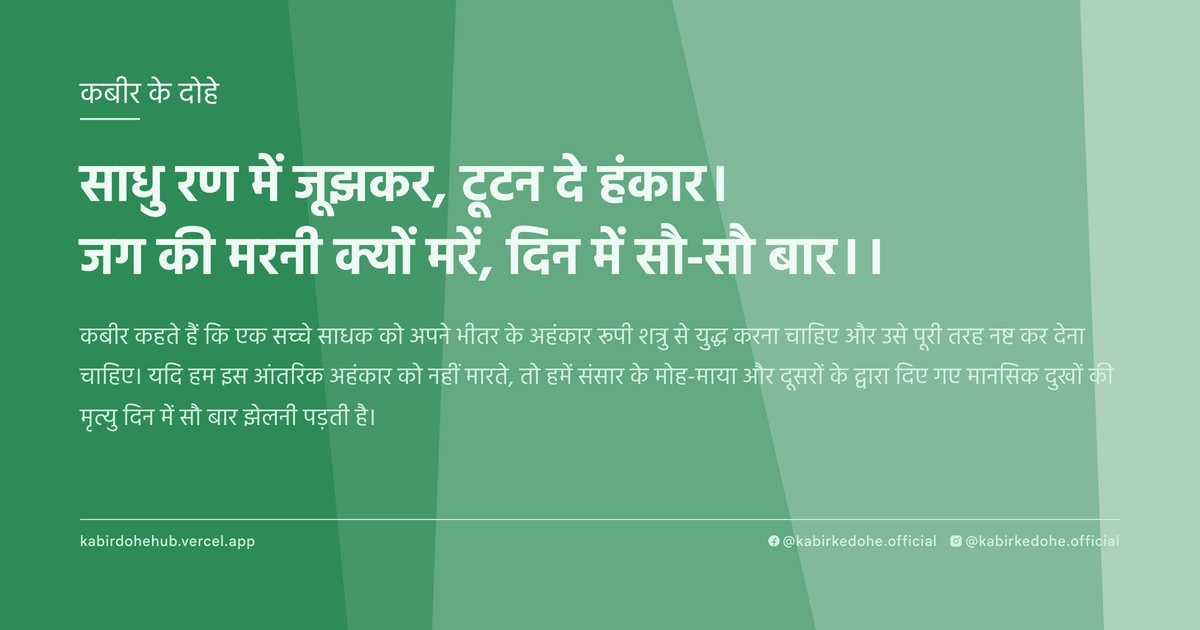
साधु रण में जूझकर, टूटन दे हंकार।
जग की मरनी क्यों मरें, दिन में सौ-सौ बार।।
Sadhu ran mein joojhkar, tootan de hankaar. Jag ki marni kyon marein, din mein sau-sau baar.
इस पृष्ठ पर इस कबीर दोहे का अर्थ (meaning), हिंदी व्याख्या और अंग्रेज़ी अनुवाद, दार्शनिक विश्लेषण और व्यावहारिक जीवन सीख दी गई है। यह दोहा अहंकार (The Ego) विषय से जुड़ा है — Kabir doha meaning and explanation in Hindi and English.
अर्थ (Meaning):
कबीर कहते हैं कि एक सच्चे साधक को अपने भीतर के अहंकार रूपी शत्रु से युद्ध करना चाहिए और उसे पूरी तरह नष्ट कर देना चाहिए। यदि हम इस आंतरिक अहंकार को नहीं मारते, तो हमें संसार के मोह-माया और दूसरों के द्वारा दिए गए मानसिक दुखों की मृत्यु दिन में सौ बार झेलनी पड़ती है।
Kabir asserts that a true seeker must engage in a spiritual battle within themselves to annihilate the ego. If one does not slay this internal pride, they are condemned to suffer the 'death' of worldly disappointments and mental anguish a hundred times a day, trapped in a cycle of perpetual emotional instability.
व्याख्या (Interpretation):
इस दोहे का शाब्दिक अर्थ है कि साधु को युद्ध के मैदान में उतरकर अपने अहंकार को तोड़ना चाहिए। यहाँ 'रण' बाहरी युद्ध नहीं, बल्कि अंतर्मन का संघर्ष है जहाँ आत्मा और अहंकार के बीच द्वंद्व चलता है। निरगुण भक्ति के अनुसार, अहंकार ही वह पर्दा है जो आत्मा को परमात्मा से अलग करता है। जब तक 'मैं' जीवित है, तब तक 'वह' (ईश्वर) प्रकट नहीं हो सकता। माया हमें यह विश्वास दिलाती है कि हमारी पहचान हमारे पद, प्रतिष्ठा और शरीर से है, जो कि एक भ्रम है। अद्वैत वेदांत के परिप्रेक्ष्य में, यह अहंकार ही द्वैत का कारण है। जब साधक इस मिथ्या अहंकार को नष्ट करता है, तो वह उस अवस्था में पहुँचता है जहाँ वह स्वयं को ब्रह्म के साथ एकाकार पाता है। इस प्रकार, अहंकार की एक बार की मृत्यु हमें संसार की अनंत मानसिक मृत्युओं से मुक्त कर देती है।
Literally, the verse urges the seeker to enter the battlefield of the mind to shatter the ego. The 'battle' described is not a physical conflict but the internal struggle between the transient ego and the eternal soul. In the tradition of Nirgun Bhakti, the ego is the primary veil obscuring the realization of the Formless Divine. As long as the 'I' persists, the 'Thou' remains hidden. Maya creates the illusion that our identity is tied to social status, possessions, or the physical body, which are all ephemeral. From the lens of Advaita Vedanta, this ego is the root of duality, creating a false separation between the Atman and Brahman. By consciously annihilating this false identity, the seeker transcends the cycle of suffering. Thus, a single, decisive spiritual death of the ego liberates the soul from the hundred daily deaths caused by worldly attachment and social validation.
दार्शनिक विश्लेषण (Philosophical Analysis):
कबीर का यह दोहा उस समय की सामाजिक और धार्मिक जड़ता पर प्रहार करता है जहाँ लोग बाहरी कर्मकांडों और जातिगत श्रेष्ठता में विश्वास करते थे। कबीर ने स्पष्ट किया कि मोक्ष किसी मंदिर, मस्जिद या तीर्थयात्रा से नहीं, बल्कि आंतरिक शुद्धिकरण से मिलता है। उनका दृष्टिकोण सूफी मत के 'फना' (अहंकार का विनाश) और अद्वैत वेदांत के 'अहं ब्रह्मास्मि' के करीब है। वे तर्क देते हैं कि मनुष्य की अधिकांश पीड़ा बाहरी परिस्थितियों से नहीं, बल्कि उसकी अपनी अपेक्षाओं और अहंकार से उपजती है।
ऐतिहासिक रूप से, कबीर ने उस युग में यह बात कही जब धर्म का उपयोग सत्ता और वर्चस्व के लिए किया जा रहा था। उन्होंने 'साधु' शब्द का प्रयोग किसी विशेष वस्त्र पहनने वाले के लिए नहीं, बल्कि उस व्यक्ति के लिए किया जो सत्य की खोज में समर्पित है। उनके लिए, वास्तविक तपस्या जंगल जाना नहीं, बल्कि समाज के बीच रहकर अपने भीतर के क्रोध, लोभ और अहंकार को जीतना है।
मनोवैज्ञानिक स्तर पर, 'दिन में सौ बार मरना' उस मानसिक तनाव और अवसाद को दर्शाता है जो हम तब महसूस करते हैं जब हमारी इच्छाएँ पूरी नहीं होतीं या जब कोई हमारी प्रशंसा नहीं करता। यह आधुनिक समय के 'डिजिटल ईगो' जैसा ही है, जहाँ व्यक्ति अपनी पहचान दूसरों की प्रतिक्रियाओं (likes/comments) पर टिका देता है।
कबीर का दर्शन यह है कि जब तक हम अपनी पहचान को बाहरी दुनिया से जोड़ते रहेंगे, हम असुरक्षित रहेंगे। वास्तविक स्वतंत्रता तब आती है जब हम यह जान लेते हैं कि हम शरीर या मन नहीं, बल्कि वह शुद्ध चेतना हैं जो इन सबसे परे है। यह बोध ही अहंकार का अंत है।
अंततः, यह दोहा हमें सिखाता है कि आध्यात्मिक मार्ग कठिन है और इसमें साहस की आवश्यकता है। यह कोई शांत ध्यान मात्र नहीं है, बल्कि एक सक्रिय युद्ध है। यह युद्ध स्वयं के विरुद्ध है, ताकि वह 'स्व' मिट सके और केवल 'सत्य' शेष रहे।
Kabir's verse strikes at the heart of the social and religious rigidity of his era, where spirituality was often reduced to external rituals and caste-based superiority. He posits that liberation is not found in temples, mosques, or pilgrimages, but through rigorous internal purification. His philosophy converges with the Sufi concept of 'Fana' (the annihilation of the self) and the Advaita Vedanta realization of 'Aham Brahmasmi' (I am Brahman).
Historically, Kabir spoke during a period when religion was frequently weaponized for power and social stratification. He redefined the 'Sadhu' not as someone wearing saffron robes, but as an individual committed to the pursuit of Truth. For Kabir, true asceticism is not fleeing to the forests, but remaining within society while conquering the internal enemies of greed, anger, and pride.
Psychologically, the phrase 'dying a hundred times a day' describes the acute mental distress and emotional volatility that arise from unmet expectations and the craving for external validation. This mirrors the modern struggle with the 'digital ego,' where self-worth is precariously tied to social media metrics and public perception.
Kabir argues that as long as we anchor our identity in the external world, we remain vulnerable to suffering. True freedom emerges when we realize that we are not the body or the fluctuating mind, but the pure, unchanging consciousness that transcends both. This realization is the only way to permanently dismantle the ego.
Ultimately, this doha teaches that the spiritual path is not a passive retreat but an active, courageous struggle. It is a war against the false self. Only when the 'I' is completely erased can the 'Truth' manifest, transforming the seeker from a fragmented being into a unified expression of the Divine.
मूल संदेश (Core Message):
- आंतरिक युद्ध ही वास्तविक आध्यात्मिक संघर्ष है।
- अहंकार का त्याग ही मानसिक शांति का एकमात्र मार्ग है।
- बाहरी पहचान एक भ्रम है जो केवल पीड़ा उत्पन्न करती है।
- स्वयं को मिटाकर ही परमात्मा का अनुभव संभव है।
- मानसिक स्थिरता केवल 'मैं' के विसर्जन से आती है।
- The internal battle is the only true spiritual struggle.
- Surrendering the ego is the sole path to lasting peace.
- External identity is an illusion that generates only suffering.
- The experience of the Divine is possible only after the 'I' vanishes.
- Mental stability arises only from the dissolution of the ego.
व्यावहारिक उदाहरण (Practical Example):
एक समय की बात है, वाराणसी के घाटों पर रामदीन नाम का एक वृद्ध बुनकर रहता था। रामदीन अपने काम में निपुण था और पूरे शहर में उसकी बनाई साड़ियों की चर्चा थी। इस प्रसिद्धि ने उसके भीतर एक सूक्ष्म अहंकार पैदा कर दिया था। वह अब अन्य बुनकरों को तुच्छ समझने लगा था और खुद को 'सर्वश्रेष्ठ' मानने लगा था।
रामदीन का जीवन अब तनावपूर्ण हो गया था। यदि कोई ग्राहक उसकी साड़ी में एक छोटा सा दोष निकालता, तो वह घंटों तक दुखी रहता। यदि कोई दूसरा बुनकर उससे अधिक दाम पर कपड़ा बेचता, तो उसे जलन होती। वह वास्तव में दिन में सौ बार मरता था—कभी अपमान से, कभी ईर्ष्या से, तो कभी अपनी श्रेष्ठता खोने के डर से।
एक दिन उसकी मुलाकात एक घुमंतू फकीर से हुई। फकीर ने रामदीन की बेचैनी को देखा और उससे पूछा, "तुम इतने कुशल कलाकार हो, फिर भी तुम्हारी आँखों में शांति क्यों नहीं है?"
रामदीन ने अपनी व्यथा सुनाई कि कैसे लोग उसकी कला की कद्र नहीं करते या कैसे दूसरे उससे आगे निकल रहे हैं। फकीर मुस्कुराया और उसने रामदीन को एक पुरानी, फटी हुई चादर दिखाई और कहा, "इस चादर को देखो। इसमें कोई डिजाइन नहीं है, कोई चमक नहीं है, फिर भी यह मुझे ठंड से बचाती है। इसकी उपयोगिता इसकी सादगी में है, इसकी प्रसिद्धि में नहीं।"
फकीर ने आगे कहा, "तुम अपनी कला को अपनी पहचान बना चुके हो। जब कला की प्रशंसा होती है, तो तुम फूलते हो; जब आलोचना होती है, तो तुम टूट जाते हो। तुम अपनी साड़ियों के धागों में नहीं, बल्कि अपने अहंकार के धागों में उलझ गए हो।"
रामदीन को यह बात गहराई से चुभी। उसने महसूस किया कि उसकी सारी पीड़ा उसकी 'श्रेष्ठता' की चाहत से पैदा हो रही थी। उसने तय किया कि वह अब अपनी कला को 'मेरा' नहीं, बल्कि 'ईश्वर का उपहार' मानेगा।
अगले कुछ महीनों में, रामदीन का व्यवहार बदल गया। अब जब कोई उसकी साड़ी की आलोचना करता, तो वह उसे सुधारने का अवसर मानता, न कि अपने सम्मान पर चोट। उसने अन्य बुनकरों की मदद करना शुरू कर दिया, जिससे उसकी ईर्ष्या समाप्त हो गई।
उसने पाया कि जैसे ही उसने 'सबसे महान बुनकर' होने के दावे को त्याग दिया, उसका मानसिक बोझ हल्का हो गया। वह अब वास्तव में शांति से सो पाता था।
रामदीन ने सीखा कि अहंकार का युद्ध जीतना ही वास्तविक जीत है। उसने अपनी पहचान को अपनी उपलब्धियों से अलग कर लिया, और इस प्रकार वह उन सौ छोटी-मोटी मानसिक मृत्युओं से मुक्त हो गया जो उसे हर दिन तोड़ती थीं।
Once, in the vibrant alleys of Varanasi, lived an elderly weaver named Ramdeen. Ramdeen was a master of his craft, and his exquisite sarees were renowned throughout the city. However, this fame sowed a seed of subtle pride within him. He began to view other weavers as inferior and started believing he was the 'supreme artist' of the guild.
Consequently, Ramdeen's life became a storm of anxiety. If a customer pointed out a tiny flaw in his weave, he would spend hours in deep sorrow. If another weaver sold a piece for a higher price, he was consumed by jealousy. He was literally 'dying a hundred times a day'—sometimes from perceived insult, sometimes from envy, and often from the fear of losing his status.
One afternoon, he encountered a wandering Sufi mystic. The mystic noticed the tension in Ramdeen's shoulders and asked, "You are a master of art, yet why is there no peace in your eyes?"
Ramdeen poured out his frustrations, complaining about the lack of appreciation and the competition. The mystic smiled and showed him an old, tattered cotton sheet. "Look at this cloth," he said. "It has no intricate design, no golden threads, yet it protects me from the cold. Its value lies in its utility, not in its fame."
The mystic continued, "You have made your art your identity. When the art is praised, you inflate; when it is criticized, you collapse. You are not entangled in the threads of your loom, but in the threads of your own ego."
These words pierced Ramdeen's heart. He realized that his suffering was not caused by the customers or the other weavers, but by his own desperate need to be seen as the best. He decided to stop claiming the art as 'his' and instead view it as a divine gift flowing through him.
Over the following months, a profound shift occurred. When someone criticized his work, he no longer felt attacked; instead, he saw it as an opportunity to refine his skill. He began teaching younger weavers, replacing his jealousy with mentorship.
He discovered that the moment he surrendered the title of 'The Greatest Weaver,' his mental burden vanished. He finally experienced a sleep that was deep and undisturbed.
Ramdeen learned that the only war worth fighting is the one against the ego. By detaching his identity from his achievements, he liberated himself from the hundred daily deaths of emotional turmoil.
अभ्यास मार्गदर्शन (Practice Guidance):
- प्रतिदिन 20 मिनट मौन ध्यान करें, जहाँ आप अपने विचारों को केवल एक साक्षी (Observer) की तरह देखें, बिना उनमें शामिल हुए।
- एक 'अहंकार डायरी' बनाएँ: जब भी आपको किसी बात पर बुरा लगे या आप खुद को दूसरों से श्रेष्ठ महसूस करें, तो उस भावना को लिखें और विश्लेषण करें कि कौन सा 'मैं' घायल हुआ है।
- सेवा का अभ्यास: सप्ताह में एक बार ऐसा कार्य करें जिसमें आपकी कोई पहचान न हो और जिसका श्रेय आपको न मिले (गुमनाम सेवा)।
- निदान चेकलिस्ट: क्या मैं दूसरों की सफलता से विचलित होता हूँ? क्या मैं अपनी प्रशंसा की उम्मीद करता हूँ? क्या मैं आलोचना सुनकर क्रोधित होता हूँ? यदि हाँ, तो अहंकार अभी जीवित है।
- Practice 20 minutes of silent mindfulness daily, observing your thoughts as a detached witness without identifying with them.
- Maintain an 'Ego Journal': Whenever you feel offended or superior, record the emotion and analyze which specific part of your 'false identity' was triggered.
- Practice Anonymous Service: Once a week, perform a helpful act where your identity remains hidden and you receive no credit or recognition.
- Diagnostic Checklist: Do I feel unsettled by others' success? Do I crave validation? Do I react with anger to criticism? If yes, the ego is still dominant.
चिंतन प्रश्न (Reflection Questions):
- मेरी वह कौन सी छवि है जिसे मैं दुनिया के सामने बनाए रखने के लिए सबसे अधिक संघर्ष करता हूँ?
- यदि मेरी सारी उपलब्धियाँ और पद आज छीन लिए जाएँ, तो मेरे पास क्या बचेगा?
- क्या मेरा 'आध्यात्मिक' होना भी मेरे अहंकार का एक हिस्सा बन गया है?
- मैं किन लोगों को खुद से छोटा समझता हूँ और यह मेरी किस धारणा से प्रेरित है?
- मेरे जीवन के वे कौन से क्षण थे जब मैंने वास्तव में 'मैं' को भुला दिया था?
- Which public image of myself do I struggle the most to maintain and protect?
- If all my achievements and titles were stripped away today, what would remain of me?
- Has my 'spirituality' or 'righteousness' itself become a tool for my ego?
- Who are the people I subconsciously consider inferior, and what bias fuels this?
- In which moments of my life did I truly forget the 'I' and merge with the experience?