
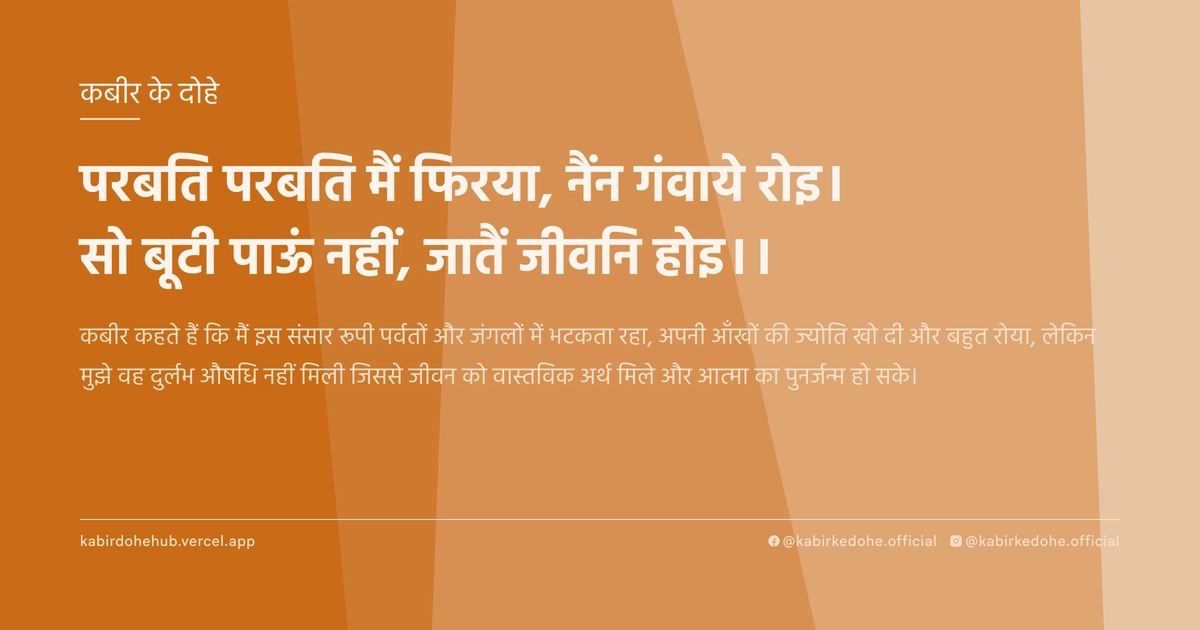
परबति परबति मैं फिरया, नैंन गंवाये रोइ।
सो बूटी पाऊं नहीं, जातैं जीवनि होइ।।
Parbati parbati main phirya, nain ganvaye roi. So booti paaun nahi, jaatain jeevani hoi.
इस पृष्ठ पर इस कबीर दोहे का अर्थ (meaning), हिंदी व्याख्या और अंग्रेज़ी अनुवाद, दार्शनिक विश्लेषण और व्यावहारिक जीवन सीख दी गई है। यह दोहा वैराग्य (Detachment) विषय से जुड़ा है — Kabir doha meaning and explanation in Hindi and English.
अर्थ (Meaning):
कबीर कहते हैं कि मैं इस संसार रूपी पर्वतों और जंगलों में भटकता रहा, अपनी आँखों की ज्योति खो दी और बहुत रोया, लेकिन मुझे वह दुर्लभ औषधि नहीं मिली जिससे जीवन को वास्तविक अर्थ मिले और आत्मा का पुनर्जन्म हो सके।
Kabir laments that he wandered through the mountains and forests of this material world, weeping and exhausting his sight in the search. He expresses the profound grief of failing to find that rare, spiritual herb—the divine knowledge—which alone can grant true life and liberation to the soul.
व्याख्या (Interpretation):
यहाँ 'पर्वत' सांसारिक मोह-माया और बाहरी कर्मकांडों के प्रतीक हैं। कबीर का विलाप उस साधक का है जो सत्य को बाहर खोजता है, जबकि वह भीतर स्थित है। यह दोहा निर्गुण भक्ति की उस अवस्था को दर्शाता है जहाँ साधक को यह बोध होता है कि बाहरी तीर्थयात्राएँ और शास्त्र-ज्ञान व्यर्थ हैं यदि आत्म-साक्षात्कार न हो। 'बूटी' यहाँ उस ज्ञान का रूपक है जो अज्ञानता के अंधकार को मिटाकर आत्मा और ब्रह्म की एकता (अद्वैत) को प्रकट करता है। यह मानव स्थिति के उस विरोधाभास को उजागर करता है जहाँ हम जिसे खोज रहे हैं, वही खोजकर्ता है।
The 'mountains' serve as metaphors for the towering distractions of worldly attachments and the rigid structures of external ritualism. Kabir's weeping represents the existential crisis of the seeker who searches for Truth in the external landscape, unaware that the destination is the seeker themselves. This reflects the essence of Nirgun Bhakti, where the formless Divine is not found in idols or geography but in the silence of the heart. The 'herb' symbolizes the rare gnosis (Jnana) that dissolves the illusion of Maya and reveals the non-duality of Atman and Brahman. It highlights the central paradox: the soul wanders the earth seeking the very essence that it already is.
दार्शनिक विश्लेषण (Philosophical Analysis):
कबीर का यह दोहा उनके युग के धार्मिक पाखंड और बाहरी आडंबरों पर एक तीखा प्रहार है। उस समय समाज जातिवाद और कठिन तपस्याओं में उलझा था, जहाँ मोक्ष को बाहरी यात्राओं या कठोर शारीरिक कष्टों से जोड़ा जाता था। कबीर ने इस धारणा को चुनौती देते हुए बताया कि वास्तविक आध्यात्मिक प्रगति 'अहं' के विसर्जन से आती है, न कि पर्वतों पर भटकने से।
दार्शनिक स्तर पर, यह अद्वैत वेदांत के करीब है, जहाँ माया को एक पर्दे के रूप में देखा जाता है जो सत्य को ढकता है। कबीर कहते हैं कि जब तक हम द्वैत (मैं और ईश्वर अलग हैं) में विश्वास करते हैं, हम उस 'बूटी' को नहीं पा सकते। यह खोज वास्तव में एक मनोवैज्ञानिक यात्रा है—बाहरी दुनिया से आंतरिक शून्यता की ओर।
सूफी मत के 'फना' (अहंकार का विनाश) के सिद्धांत के साथ इसका गहरा संबंध है। जैसे सूफी संत खुदा को पाने के लिए स्वयं को मिटाने की बात करते हैं, कबीर भी यहाँ अपनी 'आँखों के खोने' की बात कर रहे हैं, जिसका अर्थ है कि सांसारिक दृष्टि का अंत होना आवश्यक है ताकि दिव्य दृष्टि जागृत हो सके।
यह दोहा यह भी स्पष्ट करता है कि आध्यात्मिक ज्ञान कोई वस्तु नहीं है जिसे बाजार या जंगल में पाया जा सके। यह एक आंतरिक रूपांतरण है। जो लोग केवल शास्त्रों को रटते हैं या केवल कर्मकांड करते हैं, वे उसी तरह भटकते रहते हैं जैसे कोई व्यक्ति बिना नक्शे के घने जंगलों में खो गया हो।
अंततः, कबीर यह संदेश देते हैं कि जीवन की सार्थकता केवल सांसारिक अस्तित्व में नहीं, बल्कि उस चेतना के जागरण में है जो जन्म और मृत्यु के चक्र से परे है। यह 'जीवनि' (जीवन) शारीरिक आयु का विस्तार नहीं, बल्कि शाश्वत सत्य का अनुभव है।
This couplet is a searing critique of the religious hypocrisy and external ostentation prevalent during Kabir's era. Society was entrenched in caste hierarchies and rigorous asceticism, believing that liberation was achieved through external pilgrimages or physical hardship. Kabir dismantles this notion, asserting that true spiritual progress stems from the dissolution of the 'I' (ego), not from wandering physical mountains.
Philosophically, this aligns with Advaita Vedanta, where Maya is viewed as a veil obscuring the ultimate reality. Kabir suggests that as long as we operate within the framework of duality—perceiving a separation between the self and the Divine—the 'herb' of enlightenment remains elusive. The search is not a geographical journey but a psychological shift from the periphery of existence to the center of being.
There is a profound resonance here with the Sufi concept of 'Fana' (annihilation of the self). Just as Sufi mystics speak of dying before death to meet the Beloved, Kabir's mention of 'losing his eyes' symbolizes the necessary death of the worldly perception to awaken the spiritual vision. The physical eyes see the illusion; the inner eye sees the Truth.
Furthermore, Kabir clarifies that spiritual knowledge is not a commodity to be acquired or a destination to be reached. It is an internal alchemy. Those who cling solely to scriptural rote learning or ritualistic performance are like travelers lost in a dense forest without a compass, mistaking the map for the territory.
Ultimately, Kabir posits that the meaning of life is not found in the mere extension of biological existence, but in the awakening of a consciousness that transcends the cycle of birth and death. This 'life-giving herb' is not a cure for mortality, but the realization of immortality through the union of the individual soul with the Universal Spirit.
मूल संदेश (Core Message):
- बाहरी खोज अक्सर आंतरिक सत्य से दूर ले जाती है।
- अहंकार का विसर्जन ही वास्तविक ज्ञान की औषधि है।
- सत्य किसी भूगोल में नहीं, बल्कि चेतना में बसता है।
- कर्मकांड केवल शरीर को थकाते हैं, आत्मा को नहीं जगाते।
- प्रेम और करुणा ही वह दुर्लभ बूटी है जो जीवन को सार्थक करती है।
- External searching often acts as a diversion from internal truth.
- The dissolution of the ego is the only true medicine for the soul.
- Truth resides not in geography, but in the depths of consciousness.
- Rituals may exhaust the body, but they rarely awaken the spirit.
- Compassion and love are the rare herbs that grant genuine life.
व्यावहारिक उदाहरण (Practical Example):
वाराणसी के एक पुराने घाट पर रहने वाली एक वृद्ध विधवा, जानकी, का जीवन केवल पूजा-पाठ और कठोर उपवासों में बीता। उसने अपना पूरा जीवन इस विश्वास में बिता दिया कि यदि वह हर साल कठिन तीर्थयात्राएं करेगी और घंटों मंत्रोच्चार करेगी, तो उसे मोक्ष मिलेगा।
वह हर साल काशी के मंदिरों और दूरदराज के आश्रमों में जाती, अपनी सीमित जमापूंजी खर्च करती और शरीर को कष्ट देती। उसे लगता था कि ईश्वर किसी विशेष स्थान पर या किसी विशेष विधि से प्रसन्न होते हैं।
वर्षों बाद, जब वह शारीरिक रूप से इतनी कमजोर हो गई कि वह चल भी नहीं सकती थी, वह एक छोटे से कमरे में अकेली रह गई। उसकी आँखों की रोशनी धुंधली हो गई थी, और वह अपनी पिछली यात्राओं की यादों में रोती थी कि उसे अभी तक वह 'शांति' नहीं मिली जिसके लिए उसने इतना संघर्ष किया।
एक दिन, उसके घर के पास एक साधारण सा व्यक्ति आया जो केवल प्रेम और सेवा की बात करता था। उसने जानकी से कहा, "माँ, आप जिस ईश्वर को पहाड़ों और मंदिरों में खोज रही थीं, वह तो आपकी अपनी करुणा में छिपा है।"
जानकी ने पहले तो इसे नकारा, लेकिन फिर उसने गौर किया कि जब वह दूसरों की मदद करती थी, तब उसे जो सुख मिलता था, वह किसी मंदिर की घंटी से अधिक मधुर था।
उसने महसूस किया कि उसने अपना पूरा जीवन 'बाहर' खोजने में बर्बाद कर दिया, जबकि वह 'बूटी' उसके अपने हृदय की निस्वार्थ सेवा और प्रेम में थी।
उसने अपनी शेष आयु पूजा-पाठ के दिखावे के बजाय, सड़क पर रहने वाले अनाथ बच्चों को खिलाने और उन्हें सहारा देने में बिताई।
उसकी आँखों में अब आंसू थे, लेकिन वे दुख के नहीं, बल्कि उस बोध के थे कि सत्य कहीं बाहर नहीं, बल्कि स्वयं के भीतर की करुणा में है।
उसने पाया कि जिस मोक्ष को वह तीर्थों में खोज रही थी, वह वास्तव में अहंकार के विसर्जन और प्रेम के विस्तार में था।
यह जानकी का 'कबीर ट्विस्ट' था—बाहरी खोज का अंत और आंतरिक उपस्थिति का आरंभ।
In the ancient ghats of Varanasi lived an elderly widow named Janaki, whose entire existence was defined by rigid rituals and severe fasting. She spent her life believing that liberation was a reward for enduring physical hardship and visiting distant shrines.
Every year, she exhausted her meager savings to travel to remote ashrams and temples, convinced that the Divine resided in specific geographical coordinates or was pleased by the precision of her mantras.
As the decades passed, Janaki became physically frail, eventually confined to a small, dim room. Her eyesight began to fail, and she often wept, feeling that despite her lifelong devotion, the ultimate 'peace' remained elusive.
One day, a simple wanderer visited her. He didn't carry scriptures or wear saffron robes; he spoke only of love and service. He told her, "Mother, the God you seek in the mountains is hiding in your own capacity for compassion."
Initially, Janaki dismissed him, but she began to notice a strange phenomenon: the fleeting joy she felt while helping a neighbor or feeding a stray dog was more profound than any blessing she had received at a temple.
She realized with a shock that she had spent her entire life searching 'outside,' treating spirituality like a treasure hunt in a foreign land, while the 'herb' of enlightenment was the very love she had suppressed in favor of ritual.
For the remainder of her days, Janaki abandoned the performance of piety. Instead, she dedicated her time to caring for orphaned children on the streets, providing them with warmth and food.
Her eyes still watered, but the tears were no longer of grief; they were the tears of recognition. She had finally found the medicine for her soul.
She discovered that the liberation she sought through pilgrimage was actually found in the dissolution of her ego and the expansion of her heart.
This was Janaki's 'Kabir Twist'—the shift from the exhaustion of searching to the stillness of being.
अभ्यास मार्गदर्शन (Practice Guidance):
- दैनिक आत्म-निरीक्षण: प्रतिदिन 20 मिनट मौन बैठें और विचार करें कि आप अपनी खुशी के लिए किन बाहरी चीजों (पद, प्रशंसा, वस्तुओं) पर निर्भर हैं।
- जर्नलिंग प्रॉम्प्ट: "यदि मैं आज अपनी सभी बाहरी पहचान (नाम, धर्म, पेशा) खो दूँ, तो मेरे भीतर क्या बचेगा?"
- व्यवहार परिवर्तन: किसी ऐसे व्यक्ति की निस्वार्थ सेवा करें जिससे आपका कोई व्यक्तिगत लाभ न हो, और देखें कि क्या यह आपको आंतरिक शांति देता है।
- डायग्नोस्टिक चेकलिस्ट: क्या मैं अभी भी यह मानता हूँ कि शांति किसी विशेष स्थान, व्यक्ति या भविष्य की घटना से आएगी? (यदि हाँ, तो आप अभी भी 'पर्वतों' में भटक रहे हैं)।
- Daily Self-Inquiry: Spend 20 minutes in absolute silence, observing the mental habit of seeking validation or happiness in external sources (status, praise, possessions).
- Journaling Prompt: "If I were to strip away all my external identities—my name, religion, and profession—what remains at the core of my existence?"
- Behavioral Shift: Perform an act of selfless service for someone from whom you can gain nothing, observing if this act brings a deeper sense of presence than ritualistic prayer.
- Diagnostic Checklist: Do I still believe that peace is a destination to be reached or a reward for a specific ritual? (If yes, you are still wandering the 'mountains' of illusion).
चिंतन प्रश्न (Reflection Questions):
- मैं अपनी आध्यात्मिक यात्रा में किन 'पर्वतों' (दिखावे या उम्मीदों) पर चढ़ने की कोशिश कर रहा हूँ?
- क्या मेरी धार्मिकता वास्तव में मुझे विनम्र बना रही है, या यह मेरे अहंकार को एक नया मुखौटा दे रही है?
- वह कौन सा डर है जो मुझे अपने भीतर झाँकने से रोकता है और मुझे बाहर भटकने पर मजबूर करता है?
- क्या मैं सत्य को खोज रहा हूँ, या मैं केवल उस छवि को खोज रहा हूँ जो दुनिया को 'आध्यात्मिक' लगे?
- मेरे जीवन की वह कौन सी 'बूटी' है जिसे मैंने अनदेखा किया है क्योंकि वह बहुत साधारण थी?
- Which 'mountains' of social expectation or spiritual vanity am I currently attempting to climb?
- Is my adherence to faith making me truly humble, or is it providing a sophisticated mask for my ego?
- What is the specific fear that prevents me from looking inward, forcing me to seek answers in the external world?
- Am I genuinely seeking the Truth, or am I merely seeking the identity of someone who 'looks' spiritual?
- What simple, internal 'herb' of grace have I ignored because it lacked the glamour of a grand quest?